Satellite-to-Phone Connectivity Explained: How Direct-to-Device Networks Work
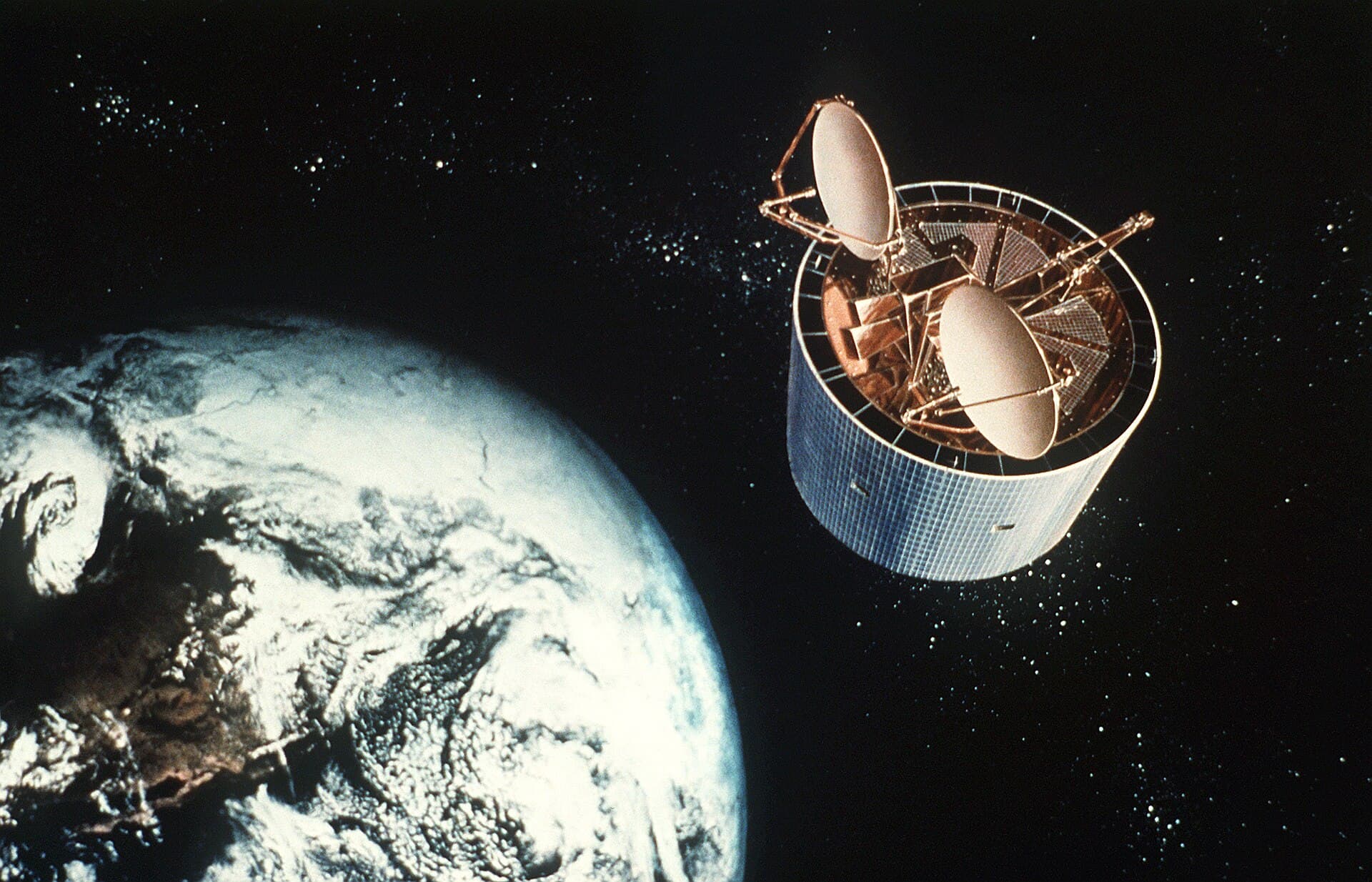
Photo: Unknown author (Public domain) / Wikimedia Commons / Public domain
A phone normally reaches the internet through a base station a few kilometers away. The radio path is short, the antenna is tuned for cellular bands, and the network reuses spectrum across thousands of small cells. Beyond the last tower, the same phone may have no practical connection even though a satellite is passing overhead.
Satellite-to-phone connectivity, also called direct-to-device or direct-to-cell, tries to close that gap by letting a compatible handset talk to a satellite directly. It does not turn a satellite into a tower in space. The link has to overcome distance, handset power, antenna gain, satellite motion, spectrum rules, and shared capacity. This article walks through those constraints with real numbers, explains the standards behind them, and describes what the first services deliver as of October 2026.
Direct answer: Direct-to-device satellite service connects compatible phones to satellites using mobile-network procedures and licensed spectrum. Low-Earth-orbit motion, long distances, a handset's roughly 0.2-watt transmitter, Doppler shift, shared beam capacity, and national regulation all shape what is possible. Messaging and emergency traffic are much easier than continuous broadband, so claims should always be checked for a specific phone, place, network partner, and date.
From a cell tower to a satellite
What a terrestrial cell does
A cellular base station serves a defined area with antennas, power, a link to the network core, and a scheduler that hands out radio resources to every phone in range. The phone and tower coordinate timing, frequency, authentication, and handover as you move. The whole system assumes a particular range of signal strengths and propagation delays, which are set by distances of hundreds of meters to a few kilometers.
A satellite can cover a far larger footprint, but wide coverage creates trade-offs. The satellite is hundreds of kilometers away, the signal at the handset is much weaker, many users share the same resources, and the satellite moves relative to the ground at kilometers per second. The network must handle those differences directly rather than copying a tower design into orbit.
Direct-to-device versus a satellite terminal
A conventional satellite terminal has a dish or flat-panel antenna, higher transmit power, and often a modem built for the satellite network. A phone is small, battery-powered, and held at changing angles. Direct-to-device systems therefore operate under a much stricter link budget, and they push most of the difficulty onto the satellite.
The phone may also need a clear view of the sky. Buildings, trees, terrain, vehicles, and even the user's body can block or weaken the signal. The handset's supported radio bands, modem firmware, and carrier configuration decide whether it can use the service at all.
Think of two people trying to talk across a valley. A conventional terminal is like someone with a megaphone aiming at a listener with a large ear trumpet. A phone is like someone with no megaphone, and the only way the conversation works is if the listener builds a very large ear. That is why current direct-to-device satellites carry big antenna arrays: the satellite does the work the phone cannot.
Why low-Earth orbit matters
Satellites are placed at different altitudes, and each altitude trades coverage against signal strength and delay. The 3GPP overview of non-terrestrial networks gives typical ranges: low Earth orbit (LEO) at about 500 to 2,000 kilometers, medium Earth orbit (MEO) at about 8,000 to 20,000 kilometers, and geostationary orbit (GEO) at 35,786 kilometers, where a satellite stays fixed over one spot on the equator. For a broader introduction to orbits, see How Satellites Orbit Earth.
The table compares a LEO satellite at 550 kilometers, a representative altitude for large constellations, with a GEO satellite. The values are computed from distance and the speed of light for a satellite directly overhead, using 1.9 GHz as an example mid-band cellular frequency.
| Quantity | LEO at 550 km | GEO at 35,786 km |
|---|---|---|
| Distance to a phone directly below | 550 km | 35,786 km |
| Free-space path loss at 1.9 GHz | about 153 dB | about 189 dB |
| One-way delay, phone to satellite to ground station | about 3.7 ms | about 239 ms |
| Orbital speed | about 7.6 km/s | about 3.1 km/s |
| Time a satellite stays above the horizon on an overhead pass | at most about 12 minutes | continuous |
| Satellites needed for continuous coverage | Many | A few, but not near the poles |
Decibels (dB) are a logarithmic scale: every 10 dB is a factor of 10 in power. A 36 dB gap between LEO and GEO means the GEO signal is about 4,000 times weaker at the receiver. That is why LEO is the natural choice for a handset that can only transmit a fraction of a watt, and why delay-sensitive services such as voice benefit from short paths. GEO has its own strengths. One satellite covers a huge region without handovers, and a fixed position simplifies tracking. The comparison is not a universal winner, and the best choice depends on the service, antenna, spectrum, and economics. The delay side of the story is covered in How Satellite Internet Reduces Latency.
Handover and tracking
A LEO satellite crosses the sky in minutes, so a phone connected to it must hand the session over to the next satellite, or to a terrestrial tower, within moments. The network may hand a session from one satellite to another, from satellite coverage to a tower, or the other way around. A handover can fail if the next satellite is not yet visible, the spectrum is unavailable, or the device cannot stay synchronized.
Picture a relay race where the baton has to pass between runners moving at 7.6 kilometers per second. The handover logic is the choreography that keeps the baton from being dropped. This is why a constellation needs many spacecraft: each point on the ground must always have another satellite rising as the previous one sets. The sheer number of objects also raises orbital traffic concerns, which are covered in AI and Space Debris Tracking.
The link budget in plain numbers
A link budget adds up every gain and loss between a transmitter and a receiver: transmit power, antenna gain, path loss, receiver sensitivity, atmospheric effects, interference, and a safety margin. The most useful way to understand direct-to-device is to run the numbers for one example.
Free-space path loss, in decibels, is 20 times the base-10 logarithm of distance in kilometers, plus 20 times the logarithm of frequency in megahertz, plus a constant of 32.45. At 1.9 GHz, a tower 5 kilometers away gives a path loss of about 112 dB. A LEO satellite 550 kilometers straight overhead gives about 153 dB. The satellite link is therefore about 41 dB worse than the tower link, which is a factor of roughly 12,000 in power, before any extra losses from tilted geometry, atmosphere, foliage, or the user's hand.
Where the missing 41 dB comes from
Nothing in the phone can change that distance, so the system makes up the difference elsewhere:
- A large satellite antenna. AST SpaceMobile's prototype BlueWalker 3, launched on September 10, 2022, unfolded an array of about 64 square meters (693 square feet). Its production Block 2 satellites carry arrays of about 223 square meters (2,400 square feet), according to the company's summary on Wikipedia. A large collecting area works like a bigger ear.
- Narrow beams. The satellite focuses its transmit power into a small patch on the ground, boosting signal strength inside the patch and reducing interference with neighbors.
- Low data rates. Narrower channels and robust coding let a receiver decode a signal that is very weak, at the cost of speed.
- Time. Short messages can be retried until they get through, which is why texting works long before video does.
The phone's limits
The standard power class for handsets, power class 3 in 3GPP terms, allows about 23 dBm, or roughly 0.2 watts, of transmit power. The 3GPP overview confirms that Release 17 supports power class 3 handheld devices, which are required to have a GNSS receiver (a satellite positioning chip, such as GPS). Handset antennas are also small and designed for many bands, with little gain. Holding the phone vertically, putting it in a pocket, or using it inside a building changes the path, and indoors the extra loss can erase the margin entirely.
The uplink, phone to satellite, is therefore the hard direction. The satellite can shout loudly toward the ground, but the phone can only whisper back. Much of the engineering in direct-to-device systems is about making sure that whisper can still be decoded.
Signal strength is not capacity
A strong signal does not guarantee a fast connection. Information theory sets a ceiling: capacity grows with channel bandwidth and with the ratio of signal power to noise. When the signal is weak compared with noise, as it is in these links, the ceiling rises roughly in proportion to the received power, so every halving of power roughly halves the achievable speed. A clean weak link can support a short message while failing a high-rate session. Coding, retransmission, scheduling, and narrow bandwidth can improve reliability, but each choice costs speed, energy, or capacity.
Doppler shift and timing
Relative motion changes the apparent frequency of a signal. A siren sounds higher as an ambulance approaches and lower as it recedes, and the same effect shifts a satellite's radio signal. At an orbital speed near 7.6 kilometers per second, the line-of-sight speed relative to a ground user can reach several kilometers per second near the horizon. At 1.9 GHz that corresponds to a frequency shift on the order of tens of kilohertz, many times wider than a narrow channel in the same band.
Terrestrial cellular standards assume timing and frequency errors far smaller than this. For satellite service, 3GPP added mechanisms for the phone to compensate. In the standard's Release 17, handsets must be GNSS-capable, and they pre-compensate for Doppler and delay using their own position fix and the satellite's published orbit data (ephemeris). The network adds common timing offsets so that signals from users at very different distances still arrive in the right time slots. Delay also stalls some retransmission schemes, which the standard addresses by changing how feedback is handled.
The standards: 3GPP non-terrestrial networks
3GPP is the partnership that writes the specifications behind mobile telecommunications. Its non-terrestrial network (NTN) work adapts cellular technology to satellites and high-altitude platforms. The goal is interoperability, so that a standard phone and a satellite from different companies can understand each other. A specification, however, does not mean every phone, carrier, or satellite supports every feature. According to the 3GPP overview, the work has proceeded in stages.
| Release | NTN content (per the 3GPP overview) |
|---|---|
| Rel-15 and Rel-16 | Studies of use cases, channel models, and needed changes; no normative satellite specification completed |
| Rel-17 | First normative NTN. NR-NTN with transparent payload only, for LEO and GEO in FR1 bands; new bands n255 (L-band) and n256 (S-band); handheld power class 3 supported with GNSS; Earth-fixed tracking areas. Also IoT-NTN for NB-IoT and eMTC |
| Rel-18 | 30 MHz channel bandwidth for n255 and n256; band n254 added; network-verified location; coverage enhancements and improved mobility between satellite and terrestrial networks; Ka-band support; on-board user-plane functions |
| Rel-19 | Work on regenerative payloads, store-and-forward operation, UE-to-satellite-to-UE communication, GNSS-independent operation, and support for reduced-capability devices |
Two terms in that table matter. A transparent payload (bent pipe) means the satellite acts like a radio repeater and the base-station intelligence sits at a ground gateway. A regenerative payload puts base-station functions on the satellite itself, which enables links between satellites. Releases are cumulative, and implementations lag them. A headline claiming "5G from space" or "3GPP-compatible" should identify the release and the features actually deployed.
Who is building what, as of October 2026
The state of the market changes quickly, so every item below is dated and sourced to the Wikipedia articles listed at the end. Treat it as a snapshot, not a ranking or a recommendation.
| Service | What is documented | Status noted |
|---|---|---|
| Starlink Direct to Cell, with T-Mobile and other carriers | SpaceX reported successful text-message testing with T-Mobile on January 8, 2024; initial service was text, with voice and limited data planned; partners include Rogers, One NZ, Optus, and Kyivstar | Rebranded Starlink Mobile in March 2026; about 650 of roughly 9,800 Starlink satellites used for the service as of February 2026 |
| AST SpaceMobile | Aims to link standard smartphones to a 3GPP-compliant space network; first space-based two-way call with unmodified smartphones on April 25, 2023 via BlueWalker 3 | Five Block 1 satellites launched September 12, 2024; BlueBird 6 launched in December 2025; BlueBird 7 was lost after an April 2026 launch problem; plans up to 60 Block 2 satellites |
| Apple, emergency messaging | Satellite emergency messaging added with the iPhone 14 in 2022 via Globalstar | Mainly text-based |
| Google Pixel 9, emergency | "SOS Satellite" feature introduced in 2024 | Emergency use |
| Iridium Project Stardust | Announced in 2024 as a planned 5G non-terrestrial service for messaging and IoT | Planned |
Notice the range of ambitions. Some services are designed as emergency or messaging features that use dedicated satellite spectrum and phone software. Others aim to reuse terrestrial carrier spectrum so that an unmodified handset connects like it would to a tower. These are different engineering problems with different limits.
Messaging, voice, and broadband are different services
Low-bandwidth messages
Short messages require little data and tolerate delay. The system can schedule transmissions, retry failures, and wait for a better satellite geometry. In practice the user may need to step outside, point the phone toward open sky, and wait for a satellite pass. Text and location updates are the first realistic services, which matches what operators have launched first.
Voice
Voice requires a more continuous link and a latency low enough for conversation. Handover, fading, interference, and capacity all affect quality. LEO delays of a few milliseconds are small next to the processing and network delays in the rest of the path, so the main challenges are keeping the link up and sharing capacity. Support for messaging does not prove voice is available everywhere.
Broadband
Broadband needs much higher capacity per user and tighter scheduling. Even if one handset reaches a high rate in a test, a shared constellation must serve many devices across a region. For example, AST SpaceMobile says its larger Block 2 satellites support up to 120 megabits per second, but that is the capacity of a satellite, which many phones share, not a per-phone rate. Practical performance depends on spectrum, beam size, backhaul, satellite density, and demand.
| Service type | Typical data need | Tolerance for delay | Main constraint |
|---|---|---|---|
| Text message | Bytes to kilobytes | High; retries acceptable | Finding a visible satellite |
| Location update | Tiny | High | Sky view and battery |
| Voice call | Continuous, low rate | Low | Sustained link, handover, capacity |
| Video or large downloads | High and steady | Moderate | Shared beam capacity and spectrum |
Capacity: a beam is a shared medium
A satellite beam is a shared resource. The number of users, their data demand, the scheduling rules, the spectrum, and how often the beams can be reused determine total capacity. A link that works for one demonstration handset may behave differently when thousands of devices attempt to connect.
Operators can prioritize emergency traffic, cap bandwidth, limit service windows, or restrict applications. These are network-policy choices rather than evidence of a technical failure. Capacity planning must account for geographic demand, satellite elevation, spectrum, and backhaul.
Coverage maps are conditional
A coverage map describes an intended service area. It may leave out the device model, whether you must be outdoors, topography, network load, message size, and activation status. Read the legend and the terms. A map is not proof that a phone will connect at every point inside a shaded region, and a service that works in one country may be unavailable in another.
Spectrum and regulation
Satellite and terrestrial networks share a regulated radio environment, and both need frequency rights, interference protection, and licenses. Direct-to-device systems add a twist: to reach unmodified phones, the satellite must transmit in bands that phones already support, which are usually licensed to terrestrial carriers. That is why many services pair a satellite operator with a mobile carrier, and why spectrum deals are a major part of the story. For example, SpaceX announced in September 2025 that it would acquire EchoStar's AWS-4 and AWS-H spectrum, according to the Starlink article on Wikipedia. AST SpaceMobile's record shows how the process works in the United States: it received temporary FCC authority to test using AT&T and Verizon spectrum in January 2025 and further authorizations during 2025.
A service may work in one country and be unavailable in another because of spectrum, licensing, emergency-service requirements, device approval, or network partnerships. "Global coverage" should therefore be treated as a dated, service-specific claim rather than a physical guarantee. Satellite beams cross borders, so international coordination through the International Telecommunication Union (ITU) and national regulators decides which frequencies can be used and under what conditions. Regulatory and product details change quickly; consult current regulator and operator information.
Emergency connectivity and its limits
Satellite-to-phone services are often discussed in emergencies because disasters can damage towers, power, or backhaul. A satellite link may offer a useful alternative, but the user still needs a compatible device, a view of the sky, battery power, network availability, and an emergency service path.
An emergency message may not reach a local responder immediately. Location accuracy, message delivery, language, congestion, and the user's ability to hold the device all matter. Users should not assume that a satellite feature replaces local emergency services, official alerts, a dedicated satellite messenger, or a conventional phone connection. For urgent danger, contact local emergency services by the fastest available method and follow official guidance. This article is a technical explainer, not emergency communications advice.
Satellite-to-phone and ordinary mobile networks
Direct-to-device connectivity is most likely to complement terrestrial networks, not replace them in dense urban areas. Towers provide high capacity where people and fiber are concentrated. Satellites can extend reach across oceans, deserts, mountains, and disaster zones, but shared space resources and line-of-sight constraints remain. The terrestrial side is explained in What Is 5G and How Is It Different From 4G? and How Wi-Fi and 5G Actually Work.
A hybrid network can hand traffic between terrestrial and non-terrestrial access. The user may see one app while the network manages different radio paths underneath. That requires authentication, billing, policy, routing, handover, and support to work across both. For comparison, global positioning relies on a similar mix of satellites and ground infrastructure, as described in How GPS Works, and satellites are only one layer of connectivity; most intercontinental traffic still runs through cables, as Why Undersea Cables Carry Most Internet Traffic explains.
Privacy, security, and resilience
A satellite link does not remove ordinary mobile-network privacy issues. The system still handles identifiers, location, device information, messages, and network metadata. Providers should document retention, access, lawful requests, and security practices. Rel-18 also adds network-verified location for satellite access, which shows how central location is to these services.
Satellite infrastructure also introduces space and ground risks: interference, jamming, cyber compromise, ground-station outages, debris, and launch failures. The loss of AST SpaceMobile's BlueBird 7 after its April 2026 launch is a reminder that deployment depends on rockets as well as radios. A resilient architecture uses redundancy and fallback but cannot guarantee service during every disaster. The radio path should be authenticated and encrypted according to the applicable mobile-network architecture, but users should not assume a signal is private merely because it comes from space. Launch costs and cadence, which drive how fast constellations can grow, are covered in Why Rocket Launches Cost So Much, and the broader commercial picture in SpaceX and the New Space Race: 2026 Status. For the count of spacecraft already aloft, see Countries With the Most Satellites in Orbit.
A practical service-comparison framework
| Question | Why it matters | Evidence to check |
|---|---|---|
| Which phone models work? | Modem and firmware support vary | Manufacturer and carrier documentation |
| What service is offered? | Messaging is not broadband | Product specification and terms |
| Is sky view required? | Buildings and terrain can block signals | Field conditions and coverage notes |
| Which country and spectrum? | Permissions differ by jurisdiction | Regulator and carrier information |
| What happens under load? | Capacity is shared | Network policy and service limits |
| How is emergency traffic handled? | Delivery and response are separate | Official emergency documentation |
| Is terrestrial handover supported? | Users may move between paths | Network architecture and tests |
| What data is retained? | Satellite systems process location and identity | Privacy policy and retention terms |
| Which 3GPP release and features? | "Compatible" can mean very different things | Operator technical documentation |
This is a decision framework, not a ranking of providers.
What the technology may enable
Direct-to-device networks may extend basic connectivity to places where towers are uneconomic or difficult to build. They could support environmental monitoring, maritime communication, disaster recovery, logistics, and rural messaging. The value depends on reliability, affordability, local regulation, and whether the application can tolerate intermittent service.
The technology may also encourage new architectures in which terrestrial, aerial, and space links cooperate. That does not remove the need for fiber, towers, local maintenance, or community connectivity. A satellite link can fill a gap without solving every digital-divide problem, because a gap in coverage is often a gap in income, power, and devices too.
Limitations
Satellite-to-phone service is highly conditional. Capability depends on the device, carrier, satellite constellation, spectrum, country, sky visibility, weather, capacity, software, network state, and service plan. A technical demonstration or operator announcement is not a universal performance guarantee. Satellite links do not provide unlimited broadband, eliminate latency, replace terrestrial infrastructure, or guarantee emergency response.
Product details in this article were checked against the sources below on October 21, 2026 and may change. This article is a conceptual explainer, not a coverage promise, procurement recommendation, or emergency-communications plan.
Frequently asked questions
Q: What is satellite-to-phone connectivity? A: It is a service that lets a compatible mobile phone exchange data with a satellite, or through a satellite-assisted network, beyond ordinary tower coverage. It is also called direct-to-device or direct-to-cell. Supported services range from emergency text messaging to carrier-integrated coverage using unmodified handsets.
Q: Is satellite-to-phone the same as satellite internet? A: Not exactly. Traditional satellite internet uses a dedicated terminal with a dish or flat-panel antenna and a higher-power transmitter. Direct-to-device services target ordinary or specially supported phones, which have a transmit power of about 0.2 watts and small antennas, so they currently deliver far lower speeds.
Q: Does every phone work with direct-to-device services? A: No. Compatibility depends on the modem, radio bands, firmware, carrier, satellite system, and local authorization. 3GPP Release 17 supports power class 3 handheld devices, but they must be able to use GNSS for Doppler and timing correction, and operators decide which models they enable.
Q: Can satellite-to-phone provide broadband? A: Not at tower-like speeds today. Messaging was the first service for the Starlink and T-Mobile partnership, with voice and limited data planned. AST SpaceMobile cites up to 120 megabits per second for its larger satellites, but that capacity is shared among all users in a beam.
Q: Does the phone need a clear view of the sky? A: Usually yes. Buildings, terrain, trees, and vehicles can block or weaken the signal, and the link has little margin to spare. A path loss about 41 dB worse than a nearby tower leaves little room for obstruction.
Q: Can satellite-to-phone service guarantee emergency communication? A: No. Delivery depends on the device, sky view, battery, network availability, message handling, and local emergency integration. Use official emergency channels and follow local guidance.
The takeaway
The physics of satellite-to-phone service is unforgiving. A phone that can transmit only about 0.2 watts has to reach a satellite hundreds of kilometers away across a path that is roughly 12,000 times weaker than the path to a nearby tower, while that satellite sweeps across the sky at 7.6 kilometers per second. Every design choice in the field answers one of those facts: big satellite antennas to listen to a whisper, Doppler compensation to follow a moving target, low data rates to survive a weak signal, and carrier partnerships to reach unmodified phones. Those answers work, which is why text and emergency messaging arrived first, and why continuous broadband will be a harder step. The most useful way to read any future announcement is to ask which of those constraints it actually removed.
Sources
- 3GPP: Non-terrestrial networks overview
- Wikipedia: Direct-to-cell
- Wikipedia: AST SpaceMobile
- Wikipedia: Starlink
Free-space path loss, orbital speed, delay, and pass-length figures in this article are calculated from standard physical constants and the altitudes stated in the text.
This article is educational and does not guarantee coverage or emergency connectivity.
Read next:
Follow new articles
Add SciHub101 to your feed reader to see new science and technology stories.
About the Author
SciHub101 is an independent science and technology publication founded and edited by Buğra Sözeri, a software engineer and app developer based in Türkiye. AI tools assist with drafting and research. Source documentation in the existing archive is uneven, and articles are being reviewed and corrected. The Editorial Team byline identifies editorial responsibility; it does not certify specialist or independent human review. Where we compare products, anything built by our own team is labelled as such — see the editorial guidelines and About page for how corrections and disclosures work.
Related Articles

Why Is the Night Sky Dark? Olbers' Paradox Explained
The night sky is dark because the universe has a finite age, not because stars are few. How Olbers' paradox works, who solved it, and what it reveals.
Countries with the Fastest Internet Speeds (Fixed Broadband Ranked)
The United Arab Emirates leads the world with a median fixed broadband download speed of 413.2 Mbps — more than four times the global average of roughly 90 Mbps. High urbanization rates, state-backed fiber rollout programs, and competitive telecoms markets are the common threads running through every country at the top of the Ookla Speedtest Global Index 2024.

Countries with the Most Internet Users (2026 Ranked)
China has 1.09 billion internet users — the largest national online population on Earth. India is close behind at 920 million, with the fastest growth. The US (315M), Indonesia (220M), and Brazil (190M) round out the top 5. By 2026, 5.5 billion people — 67% of humanity — are online. Here's the full ranking and what it means.
Countries with the Highest Internet Penetration (2025 Ranked)
The Gulf states report about 100% internet use, and Denmark, Luxembourg, and Norway are above 99%. At the other end, several countries are below 20%. Here is the ranking, how it is measured, and what keeps 2.2 billion people offline.
Kepler's Three Laws: Why Planets Speed Up Near the Sun
Kepler's three laws explained with NASA data: why orbits are ellipses, why planets speed up near the Sun, and how P² = a³ weighs planets and finds exoplanets.