How Do Wind Turbines Work — and Can They Power the World?
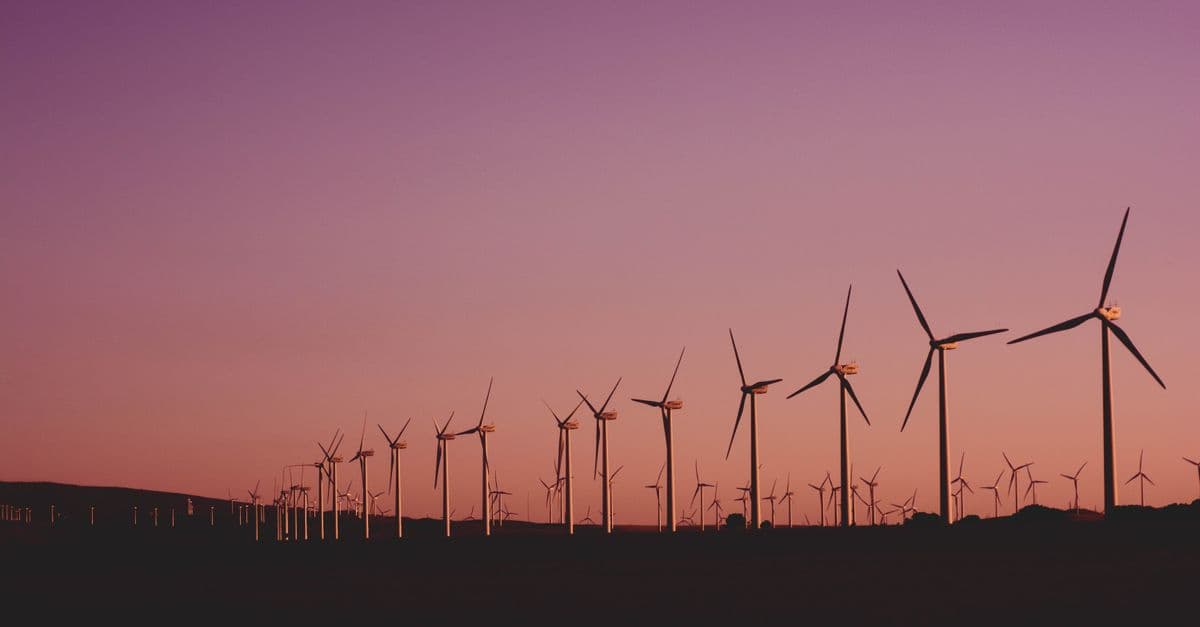
Photo: Narcisa Aciko / Pexels
A modern wind turbine is one of the largest moving machines humans have ever built. The biggest now reach over 250 metres in height — taller than the Eiffel Tower — with blades longer than a 747's wingspan. They convert the kinetic energy of moving air into electricity at extraordinary efficiency. Here's how they actually work, and how realistic it is to power civilisation with wind.
Key takeaways
- Wind turbines convert kinetic energy of wind into electricity via aerodynamic blades and a generator.
- Modern turbines achieve 40-50% efficiency — close to the theoretical maximum (Betz's limit, 59.3%).
- Wind power is now among the cheapest sources of new electricity globally.
- Wind is intermittent — it must be combined with storage and other sources for full grid coverage.
- Offshore wind is dramatically scaling up, with turbines exceeding 15 MW each.
The basic principle
Wind has kinetic energy because air molecules are moving. A turbine extracts some of that energy by slowing the air down. The slowed air then carries less kinetic energy; the difference becomes electricity.
The maximum theoretical efficiency is Betz's limit: 59.3% of incoming wind energy can be extracted. Above this, you'd have to stop the wind completely, but stopped air can't keep moving through the rotor.
How a wind turbine works
The blades
Modern blades are aerodynamic airfoils — like aircraft wings. As wind passes them, lift is generated, pushing the blade. This converts straight-line wind motion into rotation around the hub.
Blade design is finely tuned: too aggressive and they stall in high wind; too gentle and they don't capture enough energy in low wind. The shape varies along the length to handle different relative wind speeds.
The hub and rotor
The blades attach to a hub. The hub rotates a shaft connected to the gearbox.
The gearbox
Wind turbines rotate slowly — 10-20 revolutions per minute. Generators need much faster rotation. The gearbox steps up the rotation speed to ~1,500 RPM.
Some newer "direct-drive" turbines skip the gearbox using specialised generators that work at low RPM. Trade-off: simpler mechanically but heavier generator.
The generator
Converts the rotation into electricity using the same principles as any electric generator: rotating magnets create a changing magnetic field that induces current in coils.
The nacelle
The horizontal "body" of the turbine houses the gearbox, generator, control systems, and yaw mechanism that turns the turbine into the wind.
The tower
Provides height. Higher = stronger and steadier wind. Modern towers are 100+ metres for onshore turbines, 150+ metres for offshore.
The control system
Monitors wind speed, blade pitch, rotor speed, and grid conditions. Adjusts blade angle continuously to optimise power output. Shuts down in dangerous winds.
Capacity factors
A turbine rated at "5 MW" doesn't produce 5 MW continuously — that's just its peak. The capacity factor is the fraction of rated capacity actually delivered:
- Land-based wind: 30-45%.
- Offshore wind: 40-55%.
- Best sites: can exceed 60%.
For comparison: solar panels typically have 15-25% capacity factor; nuclear plants ~90%.
Onshore vs offshore wind
Onshore
- Cheaper to build and maintain.
- Easier to connect to the grid.
- Land conflicts and visual impact concerns.
- Lower capacity factors than offshore.
Offshore
- Stronger, steadier winds.
- Bigger turbines possible (no transport size limit).
- More expensive infrastructure (subsea foundations, cables).
- Less visual impact on populated areas.
- Faster scaling — minimal community opposition.
The biggest current offshore turbines are 15-18 MW each (single turbine = enough power for ~15,000 homes). 20+ MW turbines are in development.
Wind power growth
Global wind capacity has grown from ~17 GW in 2000 to over 1,000 GW today. Roughly:
- China leads with ~40% of global wind capacity.
- US, Germany, India, UK follow.
- Offshore wind is fastest-growing — over 70 GW deployed and accelerating.
Wind now supplies ~10% of global electricity, and ~20%+ in some countries (Denmark exceeds 50% in some periods).
The intermittency problem
Wind doesn't blow continuously. Some days are calm; some are stormy.
Geographic averaging
Wind farms spread across regions partially compensate — when one area is calm, another isn't. National-grid statistics show that wind output is much more stable than any single farm.
Storage
Batteries, pumped hydro, and emerging technologies (compressed air, flow batteries, hydrogen) can shift wind power to times of low generation.
Grid management
Demand response, smart grids, and interconnection across regions help match supply to demand.
Backup generation
Some natural gas, nuclear, or hydro is still typically needed for periods of extended low wind. The fraction needed decreases as storage and grid integration improve.
Cost evolution
Wind power costs have dropped dramatically:
- 2010: ~$110/MWh average.
- 2025: ~$30-40/MWh for new onshore wind in good locations.
Wind is now among the cheapest sources of new electricity in most markets. Existing nuclear and hydro plants are still cheaper to operate, but new build wind beats new build fossil fuels.
Environmental impact
Carbon footprint
Manufacturing a wind turbine produces emissions, mostly from steel and concrete. The carbon payback is 3-9 months — after that, the turbine is producing essentially carbon-free power for 25-30 years.
Wildlife
Bird and bat deaths are real concerns. Modern siting and design (lower rotation speeds, painted blades, improved layout) significantly reduce impact. Domestic cats kill orders of magnitude more birds than wind turbines do.
Land use
Onshore wind takes land but typically allows farming or grazing under the turbines. Effective footprint per MW is small.
End-of-life
Blade disposal has been a concern — blades use composite materials that are hard to recycle. New blade designs and recycling technologies are addressing this.
Common misconceptions
"Wind power isn't reliable"
Aggregated across regions, wind is highly predictable hours to days ahead. Day-to-day variability is real but manageable with grid integration.
"Wind turbines kill millions of birds"
Most studies find ~100,000-500,000 birds killed annually in the US — significant, but far less than building collisions (~600 million) or domestic cats (~2.4 billion).
"Turbines are eyesores"
Subjective. Some find them beautiful, others ugly. Polling shows local populations near working turbines often have more favourable opinions than those who only know wind power abstractly.
"Wind isn't really clean"
Lifecycle analysis consistently shows wind power has dramatically lower emissions per MWh than fossil fuels — typically 1-2% of coal's carbon intensity.
"Wind isn't reliable enough to power the grid"
Some grids run >50% wind for extended periods. Combined with storage and transmission, much higher fractions are achievable.
History and Evolution of Wind Turbine Technology
Modern wind turbines descend from simple pumps and mills, then electrical generation experiments in the late 1800s. Charles F. Brush built the first electricity-generating windmill in 1888 in Cleveland, Ohio — a crude 12 kW machine with a 17-meter diameter rotor. It powered his home and charged batteries.
Throughout the 20th century, wind power was largely ignored in regions with abundant fossil fuels. Interest revived after the 1973 oil crisis. Early research turbines in the 1980s–1990s were problematic: unreliable, expensive, and prone to mechanical failure. The kilowatt-scale machines had failure rates exceeding 50% annually.
The turning point came with megawatt-scale machines in the 2000s. Improved materials, computer-aided design, and manufacturing precision made turbines much more reliable. The learning curve is steep: each doubling of cumulative capacity reduces costs by ~15-20%. With over 1,000 GW deployed globally, the cost per megawatt has collapsed.
Offshore wind, commercially unviable in 1990, now drives the growth. The first offshore wind farm (Horns Rev, Denmark, 2000) had 80 MW; current projects exceed 1,000 MW single facilities.
Source: International Energy Agency (2024). Global Wind Report 2024 — Annual Market Update. Historical deployment and cost trends.
Advanced Aerodynamics: Why Blade Design Matters
Turbine blades are far more sophisticated than they appear. Modern blades combine:
Aerodynamic twist — the blade isn't straight but twisted along its length. The tip experiences higher relative wind speed than the root, so twist optimizes angle of attack (AoA) at each section for maximum lift-to-drag ratio.
Adaptive trailing-edge flaps — inspired by bird wings. Flaps adjust during operation to optimize power capture and reduce loads (fatigue).
Tubercles — bumps on the leading edge (mimicking whale fins). Small tubercles reduce drag and improve stall behavior at high wind speeds.
Serrated trailing edges — reduce noise by disrupting turbulent flow at the trailing edge.
Vortex generators — small fins that trip the airflow into turbulence, preventing flow separation at low wind speeds.
Each refinement adds ~1-3% efficiency. Over a 25-year lifespan producing billions of dollars in electricity, that's millions in value.
Research is ongoing into morphing blades (self-adjusting shapes using smart materials) and swept blades (curved tips inspired by eagles). Swept designs reduce fatigue and allow larger turbines on the same towers.
Grid Integration Challenges at Scale
As wind penetration increases (>50% in some regions), grid operators face new challenges:
Frequency stability: Traditional power plants (coal, gas, nuclear) provide inertia — they're heavy machines that resist sudden frequency changes. Wind turbines have no inertia; they're controlled by software. Grid operators now implement "synthetic inertia" — software that makes turbines respond like traditional plants during frequency events. This requires fast communication and precise control, adding complexity.
Voltage support: Wind plants must actively stabilize voltage (preventing brownouts). Modern turbines use power electronics (convertors and inverters) capable of this, but older designs didn't. Retrofitting is expensive.
Ramp rates: Wind can increase or decrease rapidly (e.g., squall line hits a wind farm, output drops 50% in seconds). Grids need fast-response resources (batteries, gas turbines) to balance. Current grid technology handles this but with cost.
Transmission congestion: Wind farms often locate in remote, windy areas far from population centers. Building transmission to move power creates bottlenecks. In Texas, high-capacity wind is occasionally curtailed (shut down) due to transmission limits despite strong wind.
Demand patterns: Electricity demand peaks in evening/morning; wind often peaks at night. Misalignment requires storage or load shifting.
Source: Milligan, M., et al. (2023). Integration of High-Penetration Wind and Solar into the Power Grid: Lessons and Opportunities. NREL Technical Report.
Energy Storage: The Missing Piece
Wind's intermittency is solvable with sufficient storage. The required capacity depends on wind penetration and regional demand patterns.
Battery storage (lithium-ion) is scaling rapidly — cost fell from $1,000/kWh (2010) to ~$150/kWh (2024). A wind farm with 6-hour battery backup costs ~$200/MWh additional (including battery + converter). At $30-40 base wind cost, batteries add 20-50% cost but enable 80%+ wind electricity systems.
Pumped hydro stores energy by pumping water uphill during low-demand periods, then releasing it downhill through generators during high demand. It's the largest energy storage technology globally (~160 GW), but requires specific geography (hills + water) and has limited future expansion potential.
Hydrogen production: Excess wind during low-demand periods can electrolyze water, producing hydrogen. Hydrogen is storable long-term and can be burned in gas turbines (hydrogen-ready power plants are under development) or fuel cells. Round-trip efficiency is only ~40-50%, but enables long-duration (weeks/months) storage for seasonal variation.
Emerging technologies — compressed air energy storage (CAES), flow batteries (vanadium redox), thermal storage (molten salt) — each has niches but are less mature than batteries or pumped hydro.
Realistic scenarios for 100% wind power require a mix: 70-80% wind + solar, 10-15% hydro/geothermal, 5-10% storage, plus limited gas backup for extreme events.
Scaling Limits: How Big Can Turbines Get?
Turbines grow every decade, but physical limits approach.
Current largest: 14-15 MW onshore (GE Haliade-X), 20 MW offshore (prototype). Designs for 30+ MW are in development but face challenges:
Tower stress — A 30 MW turbine on a 200 m tower experiences enormous bending moments. Taller towers need thicker walls (more material, weight, cost). Offshore allows taller towers (no transport limits) but marine corrosion adds cost.
Blade logistics — 100 m+ blades are nearly impossible to transport. Future factories will need to be near deployment (e.g., adjacent to ports for offshore turbines). This increases cost/complexity.
Foundation costs — A 30 MW offshore turbine needs a massive foundation (monopile, floating platform). Foundation costs are dominated by structure, not by a few extra megawatts. Economies of scale slow above ~20 MW.
Gearbox losses — Larger turbines create larger forces. Gearboxes have efficiency losses (~2-3%) that scale with torque. Direct-drive systems avoid gearboxes but need massive low-speed generators, adding weight and cost.
Most industry analyses suggest the optimal onshore size is 12-15 MW and offshore is 18-25 MW. Larger machines have diminishing returns: the cost per megawatt stops falling.
Rather than giant turbines, the future might emphasize distributed smaller turbines (5-10 MW each) with better capacity factors, or floating offshore platforms enabling deployment in deeper waters (lower cost per MWh in some regions).
The Global Wind Resource Atlas
Wind potential varies dramatically by geography. The Global Wind Atlas (World Bank, 2024) maps wind speeds globally. Key regions:
Exceptional resources (12+ m/s mean wind speed):
- Patagonia (Chile/Argentina)
- North Sea (offshore)
- Coastal China/Vietnam
- East African highlands
- Australian deserts
- US Great Plains
Very good (9-12 m/s):
- Most of Northern Europe
- US coasts and Midwest
- India (monsoon regions)
- Parts of Brazil
Moderate (7-9 m/s):
- Southern Europe, Mediterranean
- Southern US
- Parts of Asia
Poor (<7 m/s):
- Tropical regions, doldrums
- Dense forests, mountains
A single 5 MW turbine in an exceptional site (12+ m/s) produces ~30 GWh/year (60%+ capacity factor). The same turbine in a poor site (6 m/s) produces ~8 GWh/year (18% capacity factor) — 4× less revenue for the same capital cost.
Site selection is critical. This is why China and Denmark dominate global wind: they combined massive inland wind resources with political will and capital.
Wind in Hybrid Systems
Wind doesn't power grids alone. Realistic decarbonized grids mix sources:
Wind + Solar: Complementary — solar peaks midday, wind often stronger at night/dawn/dusk. Combined, they smooth out variability compared to either alone.
Wind + Hydro: Hydro provides storage and dispatchability. Canadian, Norwegian, and Brazilian grids already blend these successfully.
Wind + Nuclear: Nuclear provides baseload (always-on), wind provides marginal capacity. Denmark/Germany show that high wind + existing nuclear works; new build nuclear could go higher.
Wind + Geothermal: Geothermal is constant, wind is variable. Grids with geothermal (Iceland, Kenya, parts of US) have natural stability.
Wind + Interconnected Grids: Super-grids connecting regions allow load-balancing (if Europe is calm, divert power from a windy Africa; vice versa). Requires massive investment in inter-country transmission.
Most modelling studies (e.g., Stanford 2024, BloombergNEF) suggest 50-70% wind + solar, 20-30% nuclear/hydro/geothermal, 10% storage and demand response is the optimal 2050 grid mix.
Economic Reality: Wind vs Fossil
Levelized Cost of Electricity (LCOE) — the all-in cost per MWh over the turbine lifetime:
- Wind (onshore, good site): $30-50/MWh
- Wind (onshore, mediocre site): $60-90/MWh
- Wind (offshore): $70-120/MWh
- Solar (utility-scale): $25-60/MWh
- Nuclear (new build): $100-200/MWh
- Gas (CCGT): $60-100/MWh (volatile with fuel price)
- Coal: $80-150/MWh (declining, less being built)
Wind beats fossil fuels on cost in most locations. Existing coal plants (with no capital cost remaining) can undercut new wind, but new fossil plants can't compete.
Add carbon pricing (which many regions now have), and wind's advantage grows. A $50/tonne CO₂ price makes wind ~$20-30 cheaper than fossil alternatives.
The remaining debate isn't "can wind work economically?" (it can) but "how fast can we build enough wind + storage to replace fossil fuels?" The answer is politically and supply-chain constrained, not economically constrained.
Frequently Asked Questions
Q: How much electricity does one turbine produce?
A: A modern 5 MW onshore turbine produces about 14–22 GWh/year — enough for 4,000–6,000 homes. A 15 MW offshore turbine roughly 60 GWh — 18,000 homes. Exact output depends heavily on local wind resources and turbine design.
Q: Why do turbines stop turning even when it's windy?
A: Possible reasons include maintenance, low grid demand, extremely high winds (turbines shut down above ~25 m/s for safety), or coordinated grid operations preventing overgeneration.
Q: Are turbines noisy?
A: At 300+ metres distance (typical residential setbacks), turbines produce around 35–45 dB — quieter than a refrigerator. Closer distances (within 100m) can be louder, which is why setback regulations exist.
Q: Can wind turbines work in cold weather?
A: Yes — cold air is denser, so wind power is actually higher per MW for a given wind speed. Icing on blades is the main concern; modern turbines have de-icing or anti-icing systems.
Q: What about hurricanes?
A: Modern offshore turbines are designed for Category 5 conditions. Specific hurricane-resilient designs are being deployed for Atlantic regions. Actual failure rates during hurricanes are low.
Q: Can 100% renewable energy (all wind) power civilization?
A: Unlikely with wind alone. Technical studies show 50–70% wind + solar + hydro/nuclear + storage is more realistic and resilient. Geographic constraints, seasonal variation, and storage costs make 100% wind impractical. But wind can reliably provide 60–80% of electricity in most regions.
Read next:
- How Do Solar Panels Work — and Are They Worth It?
- What Is Green Hydrogen — and Could It Replace Fossil Fuels?
- Is Nuclear Power Safe? The Real Risks and Benefits
Related Reading
A modern 5 MW onshore turbine produces about 14-22 GWh/year — enough for 4,000-6,000 homes. A 15 MW offshore turbine roughly 60 GWh — 18,000 homes.
Why do turbines stop turning even when it's windy?
Possible reasons: maintenance, grid demand low, very high winds (turbines stop above ~25 m/s for safety), or coordinated grid operations.
Are turbines noisy?
At 300+ metres distance (typical residential setbacks), turbines produce around 35-45 dB — quieter than a refrigerator.
Can wind turbines work in cold weather?
Yes — cold air is denser, so wind power is actually higher per MW for a given wind speed. Icing on blades is the main concern; modern turbines have de-icing systems.
What about hurricanes?
Modern offshore turbines are designed for category 5 conditions. Specific hurricane-resilient designs are being deployed for Atlantic regions.
The bottom line
Wind power converts moving air into electricity at remarkable efficiency. Modern turbines are massive engineering marvels, getting cheaper and bigger each year. Combined with solar, storage, and grid integration, wind can power a substantial portion of global electricity. It's not the only solution — geography, weather variability, and infrastructure matter — but it's a major one. The transition from fossil fuels to wind isn't theoretical anymore. It's happening, accelerating, and increasingly cost-effective. The remaining questions are about pace and equity, not technical feasibility.
Related Reading
Follow new articles
Add SciHub101 to your feed reader to see new science and technology stories.
About the Author
SciHub101 is an independent science and technology publication founded and edited by Buğra Sözeri, a software engineer and app developer based in Türkiye. AI tools assist with drafting and research. Source documentation in the existing archive is uneven, and articles are being reviewed and corrected. The Editorial Team byline identifies editorial responsibility; it does not certify specialist or independent human review. Where we compare products, anything built by our own team is labelled as such — see the editorial guidelines and About page for how corrections and disclosures work.
Related Articles
Best Free Hydroponic Calculators and References 2026
Best free hydroponic calculators and references in 2026: Rootless Farm for crop profiles and 18 tools, plus five university and open tools, with limits.
Grid-Scale Battery Storage: The Missing Piece of the Energy Transition
Solar and wind are cheap but not dispatchable. Grid-scale battery storage fills the gap for hours, not weeks. This article covers how the systems work, how fast costs fell, what Hornsdale and California showed, and where batteries still fall short.
How Do Solar Panels Work — and Are They Worth It?
Solar panels turn sunlight directly into electricity using the photoelectric effect. They're now the cheapest form of new power generation in most of the world. Here's how they work and whether they pay off.
What Is Green Hydrogen — and Could It Replace Fossil Fuels?
Green hydrogen is made by splitting water with renewable electricity, so burning it releases only water. It is promising for industries that cannot easily electrify, but it is costly and wasteful elsewhere.
Complete Sustainability Guide 2026 — Climate, Energy, and Conservation
The complete guide to sustainability in 2026: renewable energy, climate science, circular economy, conservation strategies, and actionable steps to reduce your impact.
How to Reduce Your Electricity Bill: 15 Proven Tips Ranked by Real Savings
The average U.S. household spends $1,600–$2,400 annually on electricity, with heating and cooling accounting for 40–50% of consumption. Water heating, appliances, and standby phantom load account for most of the remaining consumption. Reducing electricity consumption requires prioritizing actions by impact: upgrading HVAC efficiency (15–25% savings), improving home insulation (15–20% savings), installing a heat pump water heater (40–50% water heating savings), replacing old refrigerators and washing machines (20–30% appliance savings), eliminating phantom load (5–10% savings), and optimizing lighting. A typical homeowner implementing these 15 actions saves $300–$600 annually (20–25% reduction in bills), with payback periods of 3–8 years through lower energy bills and modest maintenance cost reductions.