Why Do We Have Fingerprints? The Science
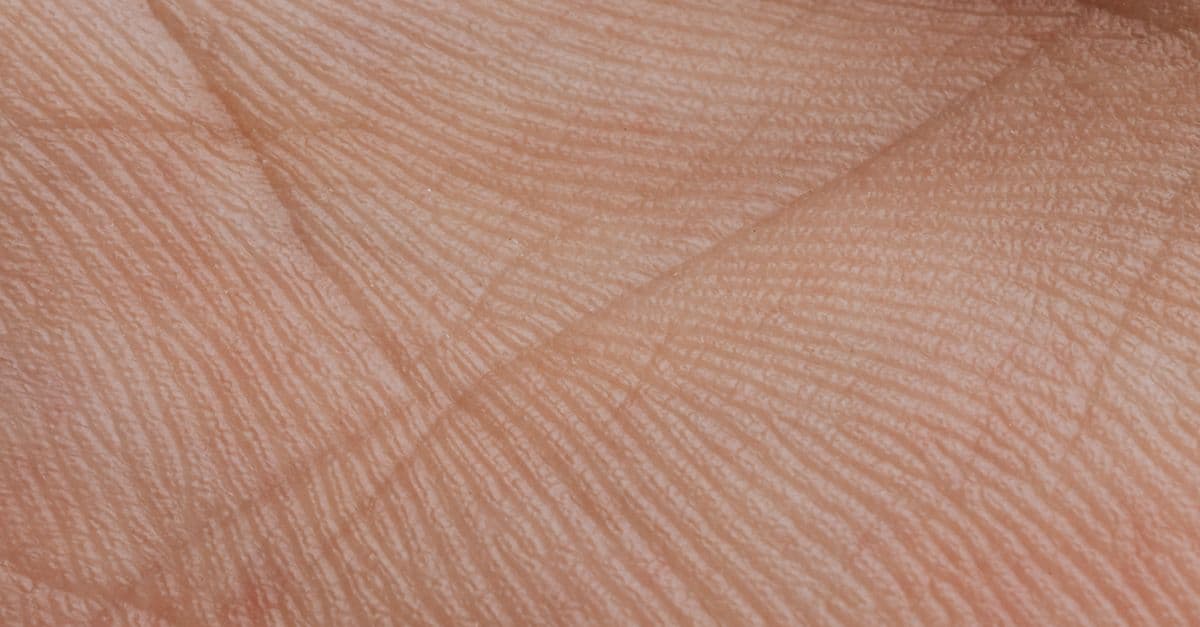
Photo: KoolShooters / Pexels
Fingerprints exist to help you grip a coffee cup and feel the grain of wood. Those parallel ridges on your fingertips are not decorative — they are a mechanical and sensory tool refined over roughly 65 million years of primate evolution. Understanding why we have them means following the story from evolutionary function down to the molecular mathematics that carves each ridge into place before you are born.
The Evolutionary Mystery of the Friction Ridge
The technical name for fingerprint ridges is friction ridges, and they appear on the palms, fingertips, and soles of all primates, as well as on koalas (a striking case of convergent evolution). The pattern of ridges specific to the hand and foot is called the dermatoglyphic pattern, from the Greek for "skin carving."
For most of the 20th century, biologists assumed ridges served one purpose: improving grip. The logic is intuitive — a smooth fingertip slides off a wet surface; a ridged one does not. But direct experimental tests have complicated that story. A 2009 study by researchers at the University of Manchester found that friction ridges actually reduce contact area compared with a completely smooth pad, which in theory could reduce static friction on very smooth surfaces. What ridges do instead is channel deformation forces — when a ridge presses against a surface, it buckles slightly, creating a signal that propagates efficiently to underlying nerve receptors.
The evolutionary picture, then, is not "ridges = better grip" in a simple sense. Ridges are a sensory amplification system that happened to also aid grip, particularly on rough or wet textures where the ridges act like tire treads, redirecting water away from the contact zone.
Grip and Moisture Control: The Mechanical Function
Friction ridges do improve traction, but the mechanism is selective. On rough surfaces, ridges lock into surface irregularities the way a key fits a lock — the alternating peaks and valleys increase the number of mechanical interlocking points. On wet surfaces, the channels between ridges act as drainage grooves, preventing the hydroplaning effect that would occur on a smooth fingertip pressed against a wet glass.
Your skin is a layered mechanical structure in which the outer epidermis is anchored to the dermis below by interlocking columns called dermal papillae. Friction ridges sit directly over rows of these papillae, which means the ridges are also structurally reinforced from below — they are not just surface texture but a full-thickness architectural feature of the skin.
How Fingerprints Amplify Touch
The sensory benefit of fingerprints is arguably more significant than the mechanical one. Embedded in the skin beneath the ridges are Meissner's corpuscles — small encapsulated nerve endings that specialize in detecting light touch and low-frequency vibrations, roughly in the 5–50 Hz range. These receptors are densely packed at the fingertips: about 140 per square centimeter, far higher than anywhere else on the body.
When a ridge slides across a textured surface, it generates vibrations at a frequency determined by the ridge spacing and movement speed. Those vibrations are funneled directly down toward the Meissner's corpuscles below. The effect is similar to how a guitar's body amplifies string vibrations: the ridge architecture converts surface texture into a structured mechanical signal that the nervous system can read with high resolution.
This is why fingertip sensitivity allows you to feel features as fine as 13 nanometers in height — roughly 10,000 times smaller than a human hair. The sense of touch depends on this ridge-to-receptor chain at every step.
A fingerprint ridge can amplify surface texture vibrations well enough for the nervous system to detect features 13 nanometers tall — smaller than most viruses.
How Fingerprints Form in the Womb
Friction ridges appear between weeks 10 and 24 of gestation. The process begins at the fingertip pads — small mounds of cells that swell during early fetal development and then flatten as the fingers grow longer. The relative size and timing of this pad regression, combined with the curvature of the fingertip at the moment ridges initiate, determines whether the final pattern becomes an arch, a loop, or a whorl.
The ridges do not grow from a single point outward. Instead, multiple initiation sites appear across the fingertip simultaneously and propagate outward as wave fronts. Where two wave fronts meet at an angle, they form the characteristic Y-shaped junction (called a triradius) that forensic scientists use to classify prints. The mechanical stress in the underlying tissue — which changes as the fetal hand grows, flexes, and presses against the uterine wall — influences where each initiation site starts and how fast each wave travels.
This sensitivity to mechanical context is why the nervous system's development and fetal movement both play a role in the final pattern. Two fetuses sharing the same womb, and the same DNA, encounter subtly different mechanical environments — and that difference is encoded in their ridges.
The Turing Pattern: Mathematics Behind the Ridges
The molecular engine driving ridge formation is a reaction-diffusion system, a concept first described mathematically by Alan Turing in 1952. Turing showed that two interacting chemicals — one that activates a process and one that inhibits it — could spontaneously generate stable, repeating spatial patterns from an initially uniform distribution, simply through differences in their diffusion speeds. The activator spreads slowly and reinforces itself; the inhibitor spreads faster and suppresses the activator in surrounding tissue. The result is a self-organizing wave of alternating high and low activity — stripes, spots, or spirals, depending on the geometry and the ratio of diffusion rates.
A landmark 2023 paper published in Cell confirmed that exactly this kind of Turing system drives human fingerprint ridge formation. The three key molecular players are WNT (a signaling protein that promotes ridge formation and stimulates its own amplifier EDAR), EDAR (which boosts WNT activity, creating a positive feedback loop), and BMP (a pathway that diffuses farther and faster, suppressing WNT activity in neighboring zones). WNT and EDAR act together as the activator; BMP acts as the inhibitor. Their interplay, constrained by the geometry of the fingertip and the local signaling environment at each initiation site, generates the parallel ridges with consistent spacing — typically around 400–500 micrometers apart — that characterize volar skin across all humans.
What makes this mechanism remarkable is that it is not a blueprint. No gene directly instructs "ridge goes here, gap goes there." The pattern is an emergent property of chemistry and geometry, which is precisely why it cannot be perfectly replicated — even by copying the genome.
Why Even Identical Twins Differ
Identical twins share essentially the same DNA, which is why they share the same general fingerprint pattern type — both might have loops on most fingers, for instance. But they do not share the same fingerprints. The Turing system described above is sensitive to initial conditions: the exact position of the first cells that trigger WNT signaling, the local curvature of the fingertip at initiation, the precise mechanical stresses from fetal movement and the position of the hand against the uterine wall.
These conditions differ between twins even in the same womb, because two fetuses occupy different positions, move independently, and press against different surfaces. Small differences in those initial conditions cascade through the reaction-diffusion process into permanently different ridge patterns. It is the same reason that two identical snowflakes are theoretically possible but never actually observed — the same physics, different histories.
Are Fingerprints Unique Forever?
Under normal circumstances, yes. The ridge pattern set during fetal development is permanent because it reflects the deep architecture of the skin — the alignment of the dermal papillae below the surface. Superficial wounds heal by regenerating the same pattern. Only deep injuries that destroy the dermal papillae (severe burns, certain skin diseases, or the deliberate scarring occasionally attempted by criminals) can alter or obliterate ridges permanently.
Aging does thin and flatten ridges slightly, which is why fingerprint scanners sometimes struggle with elderly users. But the underlying pattern topology — the arrangement of loops, whorls, arches, and their junction points — remains the same from birth to death.
What fingerprints are made of, practically speaking, is sweat and skin oils transferred to a surface when a ridge makes contact. The residue left behind mirrors the ridge pattern with enough detail that modern forensic methods can identify individuals from partial prints containing as few as 12 comparison points.
Frequently Asked Questions
Q: Why do humans have fingerprints? A: Fingerprints serve two main functions: improving grip (especially on wet or rough surfaces by channeling water and interlocking with texture) and amplifying fine touch by funneling surface vibrations to Meissner's corpuscles, the nerve endings beneath the ridges that detect light touch and texture.
Q: Why are fingerprints unique to each person? A: The ridge pattern forms through a Turing reaction-diffusion process during fetal development that is highly sensitive to initial conditions — the exact geometry of the fingertip, local molecular concentrations, and mechanical forces from fetal movement. These conditions are never identical between individuals, so the emergent ridge pattern is never identical either, even when the DNA is the same.
Q: Do identical twins have the same fingerprints? A: No. Identical twins share the same general pattern type (both may have loops on most fingers), but their specific ridge details differ because they occupy different positions in the womb and experience different mechanical forces during the weeks when ridges form. The Turing system that generates ridges is too sensitive to those physical differences to produce an exact copy.
Q: What are fingerprints made of? A: The ridges themselves are made of skin — the same layered epidermis and dermis as the rest of the hand, reinforced structurally by underlying columns of dermal tissue. The latent prints left on surfaces are residues of sweat (mostly water, salts, and amino acids) and skin oils deposited when the ridges contact a surface.
Q: Can fingerprints be lost or changed? A: Superficial wounds heal leaving the original pattern intact, because the dermal papillae that anchor the ridge architecture are preserved. Deep injuries — severe burns, major scarring, or certain skin conditions like adermatoglyphia (a rare genetic disorder causing ridge-free fingertips from birth) — can permanently alter or erase ridges. Aging also flattens ridges gradually, but does not change the fundamental pattern.
Read next:
Follow new articles
Add SciHub101 to your feed reader to see new science and technology stories.
About the Author
SciHub101 is an independent science and technology publication founded and edited by Buğra Sözeri, a software engineer and app developer based in Türkiye. AI tools assist with drafting and research. Source documentation in the existing archive is uneven, and articles are being reviewed and corrected. The Editorial Team byline identifies editorial responsibility; it does not certify specialist or independent human review. Where we compare products, anything built by our own team is labelled as such — see the editorial guidelines and About page for how corrections and disclosures work.
Related Articles
How Do Teeth Work? The Science of Dental Anatomy
Teeth are the only part of the skeleton exposed to the environment, and enamel—the hardest substance in the human body—must withstand decades of grinding, biting, and acid attacks. Unlike bone, enamel cannot regenerate once damaged, making it a one-shot investment in mouth function. Understanding the structure of teeth (enamel, dentin, pulp, cementum), why they fail, and how they differ from bone reveals why dental health requires prevention, not just treatment.
Yawning Science: Contagion, Sleep, and the Brain
Yawning is linked to arousal, brain temperature, social contagion, and state switching. This guide explains what scientists know and what remains uncertain.
How Skin Works — Your Largest Organ
Skin's three layers, how it protects you, why it ages, and the biology of pigment, sweat, and sensation in your body's largest organ.
Finger Wrinkling in Water: The Science of Wet Grip
Wrinkled fingers are an active nervous-system response, not simple swelling. This guide explains grip, blood vessels, and evolution.
Goosebumps Science: Cold, Fear, and Music
Goosebumps come from a 300-million-year-old reflex: tiny muscles pull hair follicles upright when cold, fear, or music trigger the sympathetic nervous system.
How Do Wounds Heal? The Science of Tissue Repair
Wound healing is a four-stage biological process triggered immediately after injury and lasting weeks to years. Within seconds, platelets plug the wound; within hours, immune cells flood the area and initiate inflammation; over days to weeks, fibroblasts synthesize collagen and new blood vessels form; over months to years, tissue remodels and scars form. Despite apparent simplicity, the process involves coordinated signaling across dozens of cell types, growth factors, and immune mechanisms. Understanding wound healing is critical for treating chronic wounds (affecting 2 percent of the global population) and improving outcomes after surgery, trauma, and burn injuries.