How Electricity Works — Electrons and Current
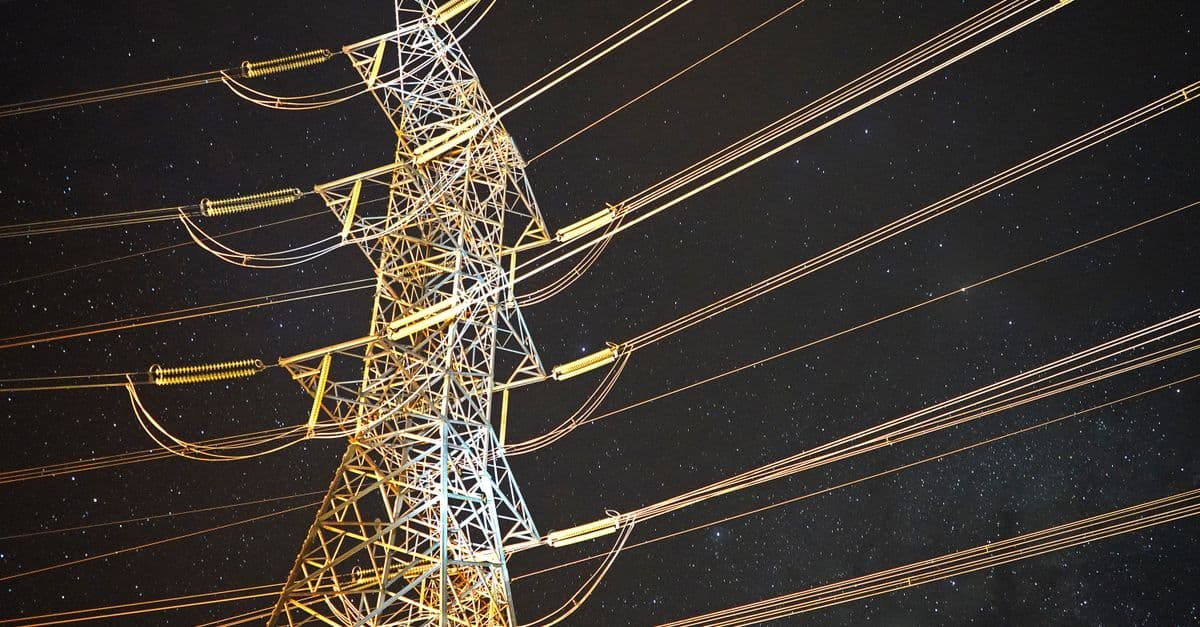
Photo: Christopher Borges / Pexels
Electricity is the flow of electrons through a conductive material, or in some cases — batteries, nerve cells, electrolysis — the flow of charged ions instead. Everything from the light over your desk to the data center training a large language model comes down to the same underlying trick: pushing electrons through a conductor in a controlled way, at scale, and turning that flow into work.
What Electricity Actually Is
Every atom has a nucleus of protons and neutrons surrounded by electrons. In most materials those electrons are locked to their atoms. In conductors — copper, aluminum, gold, silver — the outermost electrons are only loosely bound. They form what physicists call a "sea" of free electrons that can drift from atom to atom under the slightest push. Everyday devices such as touchscreens rely on these electrical principles.
That "push" is an electric field, created by a difference in electric potential between two points. Connect a wire between those two points and free electrons drift toward the higher-potential end. That drift is current. It sounds almost too simple to power modern civilization, but the entire electrical grid, every microchip, and every nerve impulse in your body reduce to variations on this one mechanism.
It's worth being precise about direction here, because it trips people up. Conventional current — the arrows in every circuit diagram, defined in the 18th century before anyone knew electrons existed — flows from positive to negative. Actual electrons, which carry negative charge, drift the opposite way, from negative to positive. Engineers still use conventional current for circuit analysis because the math works out the same either way; it's a historical accident that stuck.
The Four Core Concepts
Four quantities describe almost all electrical phenomena, and once you have an intuition for each, the rest of electrical engineering is mostly bookkeeping.
- Voltage (V, volts) — electrical "pressure" pushing electrons through a circuit. Think of it as water pressure in a pipe: the higher the pressure, the harder water gets pushed even before any water is flowing.
- Current (I, amperes) — the rate of electron flow, measured in coulombs of charge per second. This is the water flow rate itself, in liters per second.
- Resistance (R, ohms, symbol Ω) — opposition to that flow, caused by electrons colliding with atoms in the conductor and losing energy as heat. This is a narrow, kinked pipe restricting water flow.
- Power (P, watts, W) — energy delivered or consumed per second. P = V × I.
These are tied together by Ohm's law, described by German physicist Georg Ohm in his 1827 book Die galvanische Kette, mathematisch bearbeitet (source: Britannica, Georg Ohm):
V = I × R
Know any two variables and you can solve for the third. A 60-watt bulb on a 120-volt US household circuit draws 0.5 amperes (60 ÷ 120 = 0.5). A 1,500-watt hair dryer on the same 120-volt circuit draws 12.5 amperes — close to tripping a standard 15-amp breaker on its own. That single equation is the foundation nearly every downstream calculation in this article builds on.
AC vs DC: The War of Currents
There are two fundamentally different ways to deliver electrical power, and the choice between them shaped an entire era of industrial history.
Direct current (DC) flows in one direction only. Batteries, USB ports, solar panels, and the internal circuitry of virtually every electronic device run on DC, because transistors and logic chips need a stable, one-directional voltage to switch reliably.
Alternating current (AC) reverses direction periodically — 60 times per second (60 Hz) in North America and parts of South America and Asia, 50 times per second (50 Hz) in most of Europe, Africa, and the rest of Asia. Grid power, from the outlet in your wall to the transformer on your street, is AC.
In the 1880s, Thomas Edison championed DC distribution through his Pearl Street Station in Manhattan, the first commercial power plant in the United States. Nikola Tesla and industrialist George Westinghouse pushed AC instead, and the ensuing rivalry, later nicknamed the "War of Currents," included public demonstrations, smear campaigns, and dueling patents (source: Library of Congress, Edison vs. Westinghouse).
AC won for one decisive engineering reason: transformers. A transformer uses electromagnetic induction to step AC voltage up or down with very little energy loss, and that capability turned out to be the difference between a power system that could serve a single neighborhood and one that could serve an entire continent. DC of that era had no equivalent, cheap way to change voltage, which capped how far it could travel efficiently.
For a deeper look at the electromagnetic principle transformers rely on, see our explainer on how magnetism works.
Why did AC beat DC in the War of Currents?
AC won because transformers could step its voltage up for efficient long-distance transmission and back down for safe household use, something 1880s DC technology could not do economically. Higher voltage means lower current for the same power, and lower current means far less energy wasted as heat over long transmission distances.
Why High Voltage for Transmission
Power lost as heat in a wire follows a specific formula: P_loss = I² × R. The exponent on current is the whole story. If you double the voltage while delivering the same total power, you cut the current in half — and because loss scales with current squared, halving the current cuts transmission losses by a factor of four, not two.
This is the entire reason transmission lines run at extraordinarily high voltages: 100 kilovolts (kV) to over 1,100 kV on the most extreme ultra-high-voltage lines. China's Changji–Guquan line, which moves power roughly 3,293 kilometers (2,046 miles) from coal- and wind-rich Xinjiang province to Anhui in eastern China, operates at 1,100 kV DC and is the longest and highest-capacity transmission line in the world (source: Power-Technology, world's longest power transmission lines).
The practical path looks like this: a power station generates electricity at a moderate voltage (typically 10–25 kV at the generator terminals), a step-up transformer raises it for the long haul, and step-down transformers lower it in stages until it reaches the safe levels used inside buildings — 120/240 V in the US, 230 V across most of Europe and Asia.
How Power Is Generated
Roughly 60% of the world's electricity still comes from one fundamental trick: spinning a magnet inside a coil of wire, exploiting a principle English scientist Michael Faraday discovered in 1831 — that a changing magnetic field induces an electric current in a nearby conductor (source: U.S. EIA, electricity in the United States). This is electromagnetic induction, and it's the mechanical-to-electrical conversion step at the heart of nearly every large power plant on Earth.
What spins the magnet — the "prime mover" in engineering terms — varies by fuel source:
| Generation method | What spins the turbine | Typical scale |
|---|---|---|
| Natural gas / coal steam | Burning fuel boils water into high-pressure steam | Hundreds of MW to a few GW |
| Nuclear | Fission heat boils water into steam | ~1 GW per reactor |
| Hydroelectric | Falling or flowing water | 10 MW to over 22 GW (Three Gorges Dam) |
| Wind | Moving air | 2–15 MW per turbine |
| Geothermal | Earth's internal heat flashes water to steam | 10–100 MW per plant |
A few generation methods skip the spinning turbine entirely and convert energy to electricity directly:
- Photovoltaic (solar) — photons knock electrons free inside a semiconductor, with no moving parts at all. See our how solar panels work explainer for the physics of the p-n junction that makes this possible.
- Electrochemical — batteries and fuel cells generate current through chemical reactions rather than mechanical motion. Lithium-ion cells, the dominant chemistry in phones and EVs, lose a measurable fraction of their capacity every charge cycle through a set of degradation mechanisms we cover in why lithium-ion batteries age.
The Grid: Power Plant to Your Wall
Electricity's path from generation to the outlet behind your couch passes through several distinct voltage stages, each engineered for a different job.
- Generation — power plant produces electricity, typically at 10–25 kV.
- Step-up transformer — boosts voltage to hundreds of kilovolts for efficient long-distance travel.
- Transmission lines — carried on tall steel towers across hundreds of kilometers.
- Substations — step voltage back down to 4–35 kV for regional distribution.
- Distribution lines — the poles and wires running down your street.
- Pole or pad-mounted transformer — the gray cylinder near your house drops voltage to 120/240 V.
- Service drop — the final wire into your home's electrical panel.
North American homes receive split-phase 240 V service: two 120 V "hot" legs and a neutral wire, derived from a single transformer winding tapped at its center. Standard wall outlets and lighting circuits use one 120 V leg; large appliances like electric dryers, ranges, and water heaters draw on both legs simultaneously for the full 240 V, because heating elements and large motors need more power than a single 120 V leg can efficiently deliver. Most of Europe, Africa, and Asia instead use 230 V single-phase service throughout the home, which is one reason US and European appliance plugs and voltages aren't interchangeable.
Industrial and commercial facilities typically run on three-phase power: three AC waveforms offset from each other by 120 degrees, arriving on three separate conductors. Because the three phases never dip to zero at the same instant, the combined power delivery is far smoother than single-phase AC, which is exactly what large motors, elevators, and factory equipment need to avoid vibration and torque pulsing.
What is HVDC and why do some long lines use DC instead of AC?
High-voltage direct current (HVDC) transmission converts AC to DC at one end of a line and back to AC at the other, using large solid-state converter stations. For very long distances — typically beyond 600–800 km overhead, or any underwater cable — HVDC loses less energy than AC, because AC lines suffer extra losses from the changing electromagnetic field the alternating current creates in the cable itself. Brazil's Rio Madeira link, at 2,385 km with a 7.1-gigawatt capacity, is one of the highest-capacity HVDC lines in the world, moving hydroelectric power from the Amazon basin to São Paulo (source: NS Energy Business, world's longest transmission lines).
Circuits: Series, Parallel, and What "Short" Actually Means
A circuit needs an unbroken path for current to flow — a source, a load, and a return path back to the source. Break that loop anywhere and current stops instantly everywhere in it, which is why a single burned-out bulb in an old-style series-wired string of Christmas lights could darken the whole strand.
Series circuits connect components one after another along a single path, so the same current flows through every component, but voltage divides across them according to each component's resistance. Parallel circuits connect components across the same two points, so each branch sees the full source voltage, but the current divides — each branch draws current in proportion to how much resistance it presents. Household wiring is parallel: unplugging your toaster doesn't dim your refrigerator, because each outlet is a separate branch off the same voltage source.
A short circuit happens when current finds an unintended low-resistance path — say, a frayed hot wire touching bare metal or a neutral wire. Because Ohm's law says current rises as resistance falls, a short can pull enormous current almost instantly, generating heat fast enough to melt insulation or start a fire. That is precisely the failure mode circuit breakers and fuses exist to catch.
How does a circuit breaker actually stop a short circuit?
A circuit breaker contains a bimetallic strip or an electromagnet that responds to current above a rated threshold. When current spikes — from a short circuit or an overloaded circuit — the strip heats and bends, or the electromagnet's pull becomes strong enough to mechanically trip a spring-loaded switch, physically separating the contacts and breaking the circuit within milliseconds, well before wiring insulation reaches its ignition temperature.
Why Birds Don't Get Electrocuted
A bird perched on a single power line has both feet at essentially the same electric potential — there's no voltage difference across its body, so by Ohm's law, no meaningful current flows through it even though the wire itself might carry thousands of amperes. Current requires a path, and a path requires a difference in potential between two points on that path.
The moment that bird's wing brushes a second wire at a different voltage, or touches a grounded transformer housing, it creates that potential difference — and completes a circuit through its own body. This is also the underlying reason line workers use insulated bucket trucks and "barehand" technique with full-body conductive suits when working on live high-voltage lines: by bonding themselves electrically to the line and staying isolated from ground, they, like the bird, sit at one potential with no path for current to flow through them.
Safety: Plugs, Grounding, and GFCIs
The third, round prong on a US power plug is the ground (or "earth") connection, wired directly to a metal stake driven into the earth near your home's electrical panel. In a fault condition — a frayed wire touching a metal appliance case, for instance — the ground wire offers current a low-resistance path away from the user and back toward the source, which trips the circuit breaker before a person touching that case becomes the path instead.
GFCI and RCD breakers (Ground Fault Circuit Interrupter in the US, Residual Current Device in the UK and much of Europe) work on a different principle than a standard breaker: they continuously compare the current flowing out on the hot wire against the current returning on the neutral wire. Under normal operation those two currents are identical. If even a small fraction — as little as 4–6 milliamperes under US code — goes missing, it means current is leaking somewhere it shouldn't be, such as through a person standing in a wet bathroom. The device trips in a fraction of a second, well under the fibrillation threshold discussed earlier. US National Electrical Code has required GFCI protection in bathrooms, kitchens, garages, and outdoor outlets since the 1970s, with the requirement steadily expanded in subsequent code cycles (source: NFPA, National Electrical Code).
Surge protectors use components called metal-oxide varistors (MOVs), which behave like an open circuit — essentially invisible — at normal household voltage, but become highly conductive the instant voltage spikes above a threshold, typically from a lightning strike nearby or a large motor switching off elsewhere on the grid. That sudden conductivity shunts the spike's energy to ground instead of letting it reach a computer or television's sensitive internal circuitry.
What Happens When the Grid Fails: Two Real Case Studies
Understanding grid failures is one of the clearest ways to see why the mechanisms above matter at scale.
The Northeast Blackout of August 14, 2003 left an estimated 55 million people without power across eight US states and the Canadian province of Ontario. The root cause was almost anticlimactic: a transmission line in Ohio sagged into an overgrown tree and tripped offline, and a software bug in the control room alarm system at the utility FirstEnergy meant operators never got the alert telling them to redistribute load. Without human intervention, overloaded neighboring lines began tripping in a cascade, and within about an hour the failure had rippled across the entire interconnected regional grid. At least 11 deaths were attributed to the blackout, and total economic damage was estimated at roughly six billion US dollars (source: Wikipedia, Northeast blackout of 2003, corroborated by Scientific American, five years later).
The event illustrates a property specific to interconnected AC grids: because every generator on a synchronous grid must stay locked to the same frequency (60 Hz in this case), a local imbalance between supply and demand doesn't stay local. It propagates as a frequency deviation across the whole interconnected system, and protective relays — devices designed to prevent equipment damage — start disconnecting overloaded lines automatically, sometimes faster than operators can respond.
Texas's February 2021 winter storm outage offers a different failure mode. Extreme cold froze natural gas wellheads, pipelines, and instrumentation, along with some wind turbines, cutting generation capacity at the same time heating demand spiked to record levels. Because the Texas grid (operated by ERCOT) is largely isolated from the two other major US interconnections, it had far less ability to import emergency power from neighboring regions. Millions lost power for days, and the event was linked to hundreds of deaths (source: U.S. Energy Information Administration, February 2021 cold weather event).
Both cases share a lesson: the grid's efficiency — the very AC infrastructure that lets power move cheaply across vast distances — also means failures at one point can cascade far beyond it, unless redundancy, interconnection, and fast automated protection are engineered in deliberately.
AC vs DC at a Glance
Table 1. Practical differences between AC and DC power, from generation to your devices.
| Property | AC | DC |
|---|---|---|
| Direction | Reverses 50–60 times per second | Constant, one direction |
| Long-distance transmission | Excellent — transformers step voltage up/down cheaply | Historically difficult; modern HVDC now used for extreme distances and undersea cables |
| Inside electronics | Converted to DC by a power supply first | Used directly by chips and transistors |
| Common sources | Power grid, generators, alternators | Batteries, solar panels, fuel cells |
| Common uses | Home wiring, motors, grid distribution | Electronics, EV batteries, USB devices |
| Voltage step conversion | Easy (transformer) | Harder, requires a DC-DC converter |
| Relative shock danger at same voltage | Somewhat more dangerous — AC's frequency near 50-60 Hz overlaps with the heart's own electrical rhythm | Slightly less dangerous at equivalent voltage, though still hazardous at high levels |
Electric vehicles sit at an interesting intersection of both systems: they store energy as DC in their battery pack, but most EV traction motors run on AC, produced from the battery's DC by an onboard inverter, because AC induction and permanent-magnet motors are more efficient and durable at the power levels EVs need. Charging itself flips the direction again — see our explainer on how EV charging works for how Level 1, Level 2, and DC fast charging each handle that AC/DC conversion differently.
What People Get Wrong About Electricity
A few misconceptions come up often enough to be worth addressing directly.
"Electrons move at nearly the speed of light through a wire." They don't. The electrons themselves drift remarkably slowly — often just millimeters per second in a typical household wire under normal load. What moves near the speed of light is the electric field itself, which is why a light switch across the room seems to respond instantly: the field propagates through the wire and nudges electrons everywhere along it almost simultaneously, even though any single electron barely moves.
"Voltage is what kills you." Current is what does the physiological damage — voltage just determines how much current a given resistance (including a person's body) will pass. That's why a 20,000-volt static shock from touching a doorknob after walking on carpet is startling but harmless (extremely low current, brief duration), while 120 V household current, under the wrong conditions, has killed people.
"Unplugging a device stops all power draw." Many modern devices in "standby" mode still draw a small trickle of current, sometimes called phantom or vampire load, to keep an internal clock, remote-control sensor, or network connection alive. It's a small effect per device, but the US Department of Energy has estimated that standby power collectively accounts for a meaningful share of residential electricity use nationwide.
"Resistance is always bad." Resistance is exactly what an incandescent filament, a toaster's heating coil, or an electric stove burner relies on — deliberately high resistance converts electrical energy efficiently into heat. It's only "loss" when it happens somewhere you didn't want heat generated, like inside a transmission cable.
Frequently Asked Questions
Q: What's the difference between voltage and current? A: Voltage is the "pressure" or potential difference pushing electrons through a circuit; current is the actual rate of electron flow that results. A high voltage with no closed circuit produces zero current, while even a modest voltage across a low-resistance path can drive dangerously high current.
Q: Why does grid electricity use AC instead of DC? A: Transformers can cheaply step AC voltage up for efficient long-distance transmission and back down for safe household use, something 1880s DC technology couldn't do. Modern HVDC links now handle a handful of specialized ultra-long or undersea routes, but AC remains the backbone of nearly every national grid.
Q: Why don't birds get electrocuted on power lines? A: Both of a bird's feet sit on the same wire at the same electric potential, so no voltage difference exists across its body and no current flows. Electrocution requires a difference in potential, such as touching two different wires or a wire and a grounded object simultaneously.
Q: What does the third prong on a plug do? A: It's the ground, or earth, connection — a dedicated safety path that gives fault current somewhere to go besides through a person, tripping the circuit breaker before the appliance's metal case can deliver a dangerous shock.
Q: How does a surge protector work? A: It contains metal-oxide varistors that act like an open circuit at normal household voltage but become highly conductive once voltage exceeds a threshold, shunting sudden spikes — from lightning or large equipment switching off nearby — safely to ground before they reach your devices.
Q: How is electricity generated from sunlight? A: Photovoltaic cells use semiconductors, usually silicon, where incoming photons knock electrons loose into a conduction band, creating a voltage and current directly, with no moving parts and no combustion involved.
Q: How much current does it take to kill a person? A: Current in the range of roughly 60–100 milliamperes through the chest at household AC frequency can trigger ventricular fibrillation, a chaotic heart rhythm that is often fatal without immediate defibrillation. That is why GFCI breakers are calibrated to trip at just a few milliamperes of leakage, far below that threshold.
Q: What is the difference between a fuse and a circuit breaker? A: A fuse contains a metal strip that physically melts and permanently breaks the circuit once current exceeds its rating, so it must be replaced after tripping. A circuit breaker uses a mechanical or electromagnetic switch that trips under excess current but can simply be reset and reused.
Q: Why do power lines use high voltage instead of just thicker wires? A: Because transmission loss scales with the square of current (P_loss = I² × R), doubling voltage at constant power halves the current and cuts losses fourfold — far more effective than adding copper, which raises cost and weight without addressing the exponential relationship between current and heat loss.
Q: Can electricity travel through the human body without leaving a mark? A: Yes. Internal damage, including cardiac arrhythmia and nerve or muscle injury, can occur with little or no visible skin burn, particularly with AC at lower voltages, which is one reason electrical injuries are evaluated with an ECG even when the skin looks largely unaffected.
The takeaway
Electricity is, underneath all the infrastructure, a remarkably simple physical relationship: push electrons with voltage, let resistance and geometry decide how much current flows, and P = V × I tells you the rest. Every design choice downstream — AC over DC, extreme transmission voltages, three-phase industrial power, GFCI thresholds calibrated in milliamperes — traces back to that relationship and to the hard limits it imposes, particularly the I²R heat loss that makes long-distance transmission a solved problem only because of transformers. The 2003 and 2021 blackouts are reminders that the same interconnection efficiency that makes cheap, reliable power possible across a continent is also what lets a localized failure cascade if the automated protections and redundancy aren't engineered in from the start.
Sources
- Ohm, Georg. Die galvanische Kette, mathematisch bearbeitet. 1827. Summarized: Britannica, Georg Ohm
- U.S. Energy Information Administration — Electricity in the United States
- U.S. Energy Information Administration — February 2021 cold weather event
- OSHA — Electrocution Hazards Training
- NFPA — National Electrical Code (NFPA 70)
- Library of Congress — Edison vs. Westinghouse: A Shocking Rivalry
- Wikipedia (cross-checked against primary reporting) — Northeast blackout of 2003
- Scientific American — The 2003 Blackout, Five Years Later
- Power-Technology — Unveiling the World's Longest Power Transmission Lines
- NS Energy Business — Profiling Five of the World's Longest Power Transmission Lines
- Halliday, Resnick, Walker. Fundamentals of Physics. Wiley, 11th ed.
Read next:
Follow new articles
Add SciHub101 to your feed reader to see new science and technology stories.
About the Author
SciHub101 is an independent science and technology publication founded and edited by Buğra Sözeri, a software engineer and app developer based in Türkiye. AI tools assist with drafting and research. Source documentation in the existing archive is uneven, and articles are being reviewed and corrected. The Editorial Team byline identifies editorial responsibility; it does not certify specialist or independent human review. Where we compare products, anything built by our own team is labelled as such — see the editorial guidelines and About page for how corrections and disclosures work.
Related Articles
How 3D Printing Works — Additive Manufacturing
How 3D printing works explained: FDM, SLA, SLS, metal printing, materials, software workflow, real applications, and what additive manufacturing is good for.

Top 5 Productivity Tools for Remote Work
Notion, Linear, Slack, Loom, Calendly — the five tools remote teams actually use in 2026, with open-source alternatives and evidence-based picks.
History of Electricity: Faraday, Tesla, Edison, and the Force That Powers the World
Electricity was a scientific curiosity in 1800. Within 100 years it was lighting cities and running factories.

How AI Data Centers Use Electricity
AI data centers use electricity for GPU compute, cooling, and grid conversion losses, not just chips. See real training vs. inference power figures.

How Airplanes Fly — Physics of Flight
The real physics behind lift, thrust, and drag — what every textbook gets wrong and what actually keeps 400-ton jets in the sky.
How Satellites Orbit Earth: The Physics and Engineering Behind Eyes in the Sky
There are over 8,000 active satellites orbiting Earth right now. Here's how they stay up and what they do.