Countries with the Most High-Speed Rail (2025 Ranked)
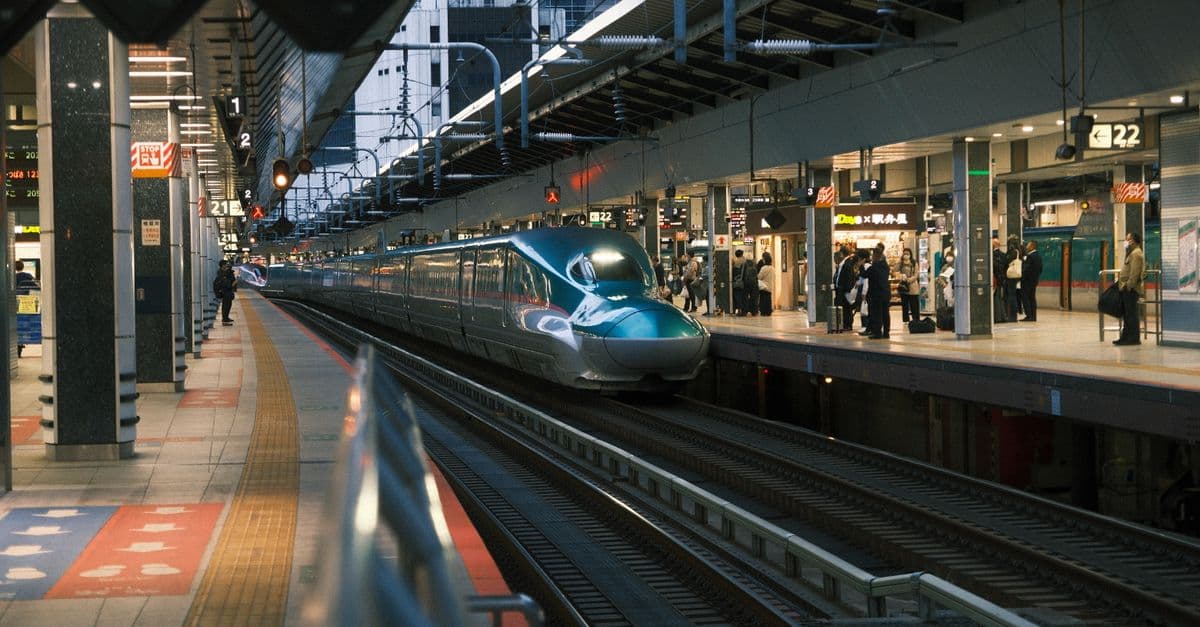
Photo: Zain Abba / Pexels
High-speed rail — typically defined as services operating at 250 km/h (155 mph) or above — has transformed intercity travel across Asia and Europe. China has invested more in this infrastructure than the rest of the world combined, while Japan's Shinkansen network remains the operational benchmark for reliability. Here are the countries leading in high-speed rail.
Key takeaways
- China has over 45,000 km of high-speed rail — more than the rest of the world combined — built almost entirely since 2008.
- Japan's Shinkansen (bullet train), launched in 1964, has carried over 10 billion passengers with zero passenger fatalities from derailments or collisions.
- Spain has the most high-speed rail per capita in Europe and the second-longest network in the world.
- The United States has no true high-speed rail by international definition — Amtrak's Acela reaches 240 km/h only briefly and averages 110 km/h.
- High-speed rail is consistently safer than flying per passenger-kilometre on comparable routes — and lower carbon than aviation.
Countries with the most high-speed rail (2025)
| Rank | Country | HSR network (km) | Lines | Top speed |
|---|---|---|---|---|
| 1 | China | 45,000+ | 40+ | 350 km/h |
| 2 | Spain | 4,000+ | 20+ | 350 km/h |
| 3 | Japan | 3,600+ | 9 | 320 km/h |
| 4 | France | 2,800+ | 8 | 320 km/h |
| 5 | Germany | 1,600+ | 10 | 300 km/h |
| 6 | Italy | 1,400+ | 6 | 300 km/h |
| 7 | South Korea | 1,200+ | 5 | 305 km/h |
| 8 | Turkey | 1,100+ | 7 | 250 km/h |
| 9 | Sweden | 700+ | 3 | 200 km/h* |
| 10 | United Kingdom | 113 km | 1 (HS1) | 300 km/h |
| — | United States | 0 (by definition) | — | — |
| — | India | Under construction | — | 350 km/h (planned) |
| — | Australia | Proposed | — | — |
Sweden's X2000 services operate at lower speeds on upgraded track; full HSR construction ongoing.
Source: International Railway Organization (IRO), national railway authorities, UIC (International Union of Railways) (2024–2025 data).
Where this data comes from
High-speed rail network lengths and line counts derive from the International Union of Railways (UIC) database, cross-checked with national railway operators and the International Railway Organization. Definition: services operating at 250 km/h or higher, purpose-built or heavily upgraded track. Some countries (Spain, Germany) count services at slightly lower speeds; the figures reflect the most commonly cited figures from official sources. Data reflects 2024–2025 operational networks and under-construction projects. Operating passenger numbers (Shinkansen 10 billion passengers) come from operator annual reports. Cost estimates for new construction (California, US Northeast Corridor) are from published feasibility studies and government sources.
Network length concentration tells a story about political priorities and financing: China's 45,000 km was built with explicit state investment targeting economic development and urban connectivity; Japan's 3,600 km was built incrementally over 60 years starting in 1964; Spain's 4,000 km reflects European Union cohesion policy funding and national political choices. The US absence of HSR (despite being wealthier than Japan, Spain, or Korea) reflects decades of political and financing decisions favouring road and aviation infrastructure. Australia's non-existent HSR despite viable corridors suggests that wealth alone does not determine HSR adoption — political commitment to long-term infrastructure investment is necessary but not sufficient; the US Northeast Corridor would be commercially viable HSR but has never achieved the political consensus to fund $100+ billion construction.
China — the world's high-speed rail superpower
China's high-speed rail achievement is one of the most remarkable infrastructure feats in history:
The scale: In 2008, China had zero high-speed rail. By 2025, it has 45,000+ km — more than the rest of the world combined. This was built in approximately 15 years at a cost exceeding $800 billion. The network connects virtually every major Chinese city.
The technology transfer: China's HSR began through technology transfer agreements with Siemens (Germany), Alstom (France), Bombardier (Canada), and Kawasaki (Japan). Chinese engineers then developed domestic variants — the CRH380 and later the Fuxing series — incorporating Chinese modifications. The Fuxing CR400AF runs at 350 km/h commercially, and a prototype exceeded 600 km/h in testing.
The economics: China's HSR is operated by China State Railway Group (CR), which carries substantial debt. Many routes, particularly to smaller cities, operate below the passenger volumes required for financial sustainability. The network is justified partly on economic development grounds — HSR access has been shown to increase real estate values, tourism, and regional GDP in areas served.
The Beijing-Shanghai corridor: China's busiest HSR route — 1,318 km in under 4.5 hours — carries over 100 million passengers annually. At this density, it generates sufficient revenue to cover operating costs.
Global export: China is now aggressively exporting HSR technology and construction — building or bidding for projects in Indonesia (Jakarta-Bandung line opened 2023), Thailand, Malaysia, Laos, Ethiopia, and numerous other countries. The Jakarta-Bandung line (142 km, operational 2023) was China's first HSR export success.
Japan — the original and the safest
Japan's Shinkansen network predates all others by decades:
1964 launch: The Tōkaidō Shinkansen between Tokyo and Osaka opened in time for the 1964 Tokyo Olympics — the world's first purpose-built high-speed railway. The original operating speed was 210 km/h; the same route now operates at 285 km/h.
Zero fatalities: In 60+ years of operation, over 10 billion passengers, the Shinkansen has had zero passenger fatalities from train accidents — no derailments causing deaths, no collisions. This record includes surviving the 2011 Tōhoku earthquake and tsunami with no passenger deaths despite trains in operation at the time. The safety system (ATC — Automatic Train Control) and earthquake detection (UrEDAS) are benchmarks for global rail safety.
Punctuality: The average Shinkansen delay is less than 1 minute. When a Shinkansen is cancelled, passengers receive a written apology. The operational discipline required to run hundreds of trains per day at 320 km/h with this precision is considered a world-class logistical achievement.
The Maglev future: Japan's Linear Chuo Shinkansen — a magnetic levitation (maglev) line between Tokyo and Osaka — has been under construction since 2014. The planned operating speed is 500 km/h. The Yamanashi test track has achieved 603 km/h in testing — the world speed record for rail transport. Opening has been delayed due to environmental concerns and construction challenges; current estimates suggest 2034 for the Tokyo-Nagoya segment.
Spain — Europe's most extensive network
Spain has invested heavily in HSR since the first line (Madrid-Seville) opened in 1992:
4,000+ km: Spain's AVE (Alta Velocidad Española) network is Europe's most extensive by route length — reflecting a political decision to build a nationally integrated network connecting all major cities.
Low ridership challenge: Spain's HSR network was criticised for low passenger utilisation on many routes — particularly Madrid-Valladolid and some regional connections — where construction costs were not justified by demand. Spanish HSR debt has been a fiscal concern.
The liberalisation: Spain became the first country in Europe to allow private competition on HSR routes — Ouigo (French low-cost operator) and Iryo (Spanish private operator) now compete with national operator Renfe on the main Madrid-Barcelona corridor, significantly reducing fares.
United States — the conspicuous absence
The absence of true high-speed rail in the United States is notable given its wealth:
Why it doesn't exist: The US favoured car and aviation infrastructure investment from the 1950s onwards. The Interstate Highway System and domestic aviation network were built with federal investment that railways never received. Passenger rail (Amtrak) is privately structured with limited public subsidy — unlike European and Asian HSR which is largely state-funded.
The Acela: Amtrak's Acela on the Washington-New York-Boston Northeast Corridor reaches 240 km/h briefly — below the 250 km/h international HSR definition. Average speed is approximately 110 km/h due to shared track, curves, and stops. A true HSR upgrade of the Northeast Corridor is estimated to cost $100+ billion and faces political, funding, and right-of-way obstacles.
California HSR: California's HSR project (Los Angeles-San Francisco) has been under development since 2008 at an estimated cost that has risen from $33 billion to $130+ billion — with a projected completion date that has repeatedly slipped to beyond 2033 for a partial segment.
Frequently asked questions
Is high-speed rail better than flying?
For distances under 600 km (approximately 400 miles), HSR typically wins on total journey time when city-centre-to-city-centre travel is counted (no airport check-in, security, or transit). Above 600 km, aviation becomes competitive on time. Carbon-per-passenger-kilometre: HSR is typically 6–10 times lower than aviation. Cost: competitive with economy aviation when infrastructure is publicly subsidised; HSR can be more expensive than low-cost airlines on competitive routes.
What is the fastest train in the world?
In commercial operation: the Shanghai Maglev (transrapid) operates at 430 km/h — the fastest commercial rail service globally, connecting Shanghai Pudong Airport to the city. In conventional wheeled HSR: China's Fuxing trains and French TGV commercial services reach 350 km/h. In testing: Japan's Linear Chuo Shinkansen prototype achieved 603 km/h — the absolute rail speed record.
Why doesn't Australia have high-speed rail?
Australia's population is concentrated in coastal cities (Sydney, Melbourne, Brisbane, Perth) that are separated by long distances. The Sydney-Melbourne corridor (~900 km) would be the natural first HSR route — studies suggest it would be commercially viable. However, construction costs ($100+ billion estimated) and the political difficulty of securing long-term infrastructure funding have repeatedly delayed progress. Private proposals have not attracted sufficient investment; federal government proposals have not been funded.
The bottom line
High-speed rail represents one of the clearest examples of how infrastructure investment shapes economic geography. China's extraordinary HSR expansion has connected its interior to coastal economic centres, raised regional land values, and established a global export industry. Japan's network has sustained urban-regional economic integration for 60 years with an unmatched safety record. Europe's networks provide environmental alternatives to aviation that carry measurable carbon benefits. The United States' absence from this technology — despite its wealth — reflects decades of political choices about transportation investment that are extremely difficult to reverse given the scale of sunk costs in road and aviation infrastructure.
Related Reading
Follow new articles
Add SciHub101 to your feed reader to see new science and technology stories.
About the Author
SciHub101 is an independent science and technology publication founded and edited by Buğra Sözeri, a software engineer and app developer based in Türkiye. AI tools assist with drafting and research. Source documentation in the existing archive is uneven, and articles are being reviewed and corrected. The Editorial Team byline identifies editorial responsibility; it does not certify specialist or independent human review. Where we compare products, anything built by our own team is labelled as such — see the editorial guidelines and About page for how corrections and disclosures work.
Related Articles

Countries With the Most Social Media Users (2026 Data)
China reports about 1.28 billion social media user identities, India 500 million, and the United States 254 million. Here is how the ranking works, why some countries top 100% of their population, and what the numbers cannot tell you.

Countries with the Most Internet Censorship (2025 Ranked)
North Korea's internet is accessible to fewer than 1,000 people — everyone else uses a sealed domestic intranet. China's Great Firewall blocks 10,000+ websites. Iran blocks 50% of the world's top websites. Here are the countries with the most internet censorship.

Countries with the Fastest Internet Speeds (Fixed Broadband Ranked)
The United Arab Emirates leads the world with a median fixed broadband download speed of 413.2 Mbps — more than four times the global average of roughly 90 Mbps. High urbanization rates, state-backed fiber rollout programs, and competitive telecoms markets are the common threads running through every country at the top of the Ookla Speedtest Global Index 2024.

Countries with the Most Data Centers (2025 Ranked)
The United States hosts more data centers than any other country by every count, but the totals vary from about 3,800 to 5,400 depending on the database. Here is the ranking, why facility counts and megawatts tell different stories, and what the IEA says about data centre electricity.

How Bridges Are Engineered to Not Fall Down
Bridges carry millions of people safely every day. Here's the remarkable engineering behind why they hold.

How the Internet Actually Works
Undersea cables, packets, IP addresses, routers, DNS and encryption: the engineering that moves every click from your device to a server and back in a fraction of a second.