What If a Gamma-Ray Burst Hit Earth?
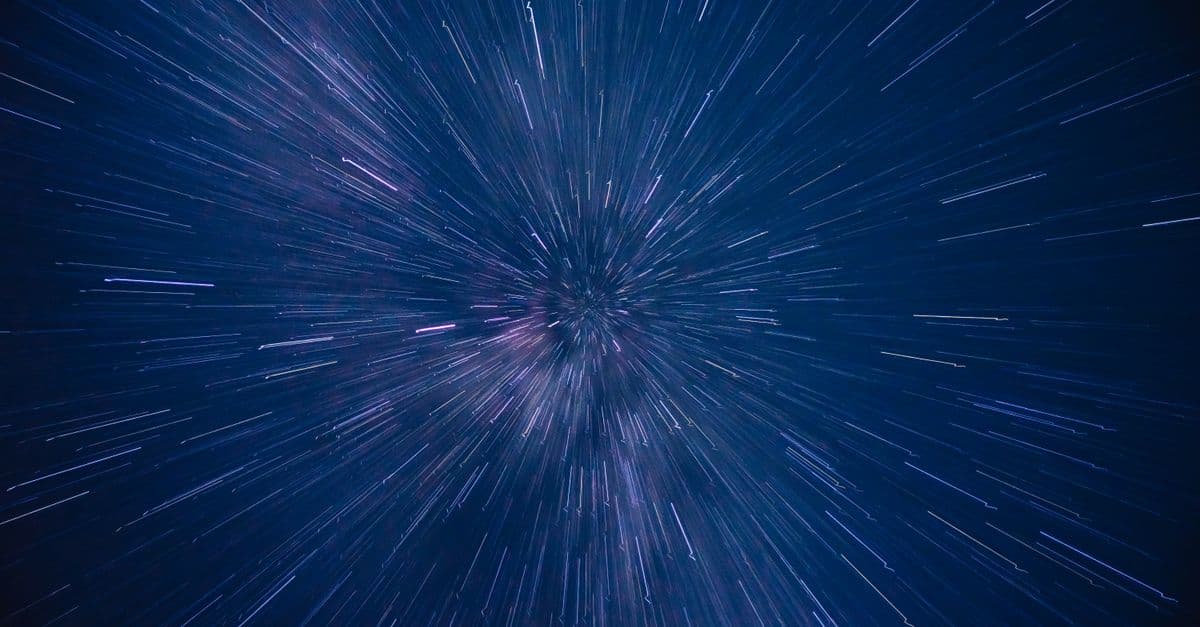
Photo: Daria Rohova / Pexels
A gamma-ray burst (GRB) is the most energetic explosion in the universe — the death cry of a massive star collapsing into a black hole, or the violent merger of two neutron stars — releasing more energy in ten seconds than the Sun will emit across its entire ten-billion-year lifetime. We see distant GRBs constantly; NASA's Swift satellite detects roughly 90 to 100 of them a year, close to one every four days. They are spectacular curiosities from a safe distance, right up until you imagine one of those beams aimed at us, from much closer to home.
Thought experiment. This article explores a hypothetical scenario for educational and speculative purposes. The events described are not predictions and should not be interpreted as warnings, advocacy, or instructions.
Key takeaways
- A GRB releases roughly 10⁴⁴ joules of energy in collimated jets typically only a few degrees wide — a cosmic flashlight beam, not a light bulb.
- A GRB within about 6,000 light-years, aimed directly at Earth, could measurably damage the ozone layer.
- Inside roughly 3,000 light-years, the same event could destroy up to half the ozone layer within seconds, a scenario detailed in NASA-funded modeling by Brian Thomas and colleagues (Thomas et al., 2005, The Astrophysical Journal).
- The Ordovician–Silurian mass extinction (445 million years ago), which killed roughly 60 to 70 percent of marine species, has been hypothesized to be GRB-triggered by Adrian Melott's team, though the evidence remains circumstantial.
- No known star within a few thousand light-years is currently aimed at Earth in a way that poses a credible threat — including WR 104, once considered the leading candidate.
- The brightest GRB ever recorded, GRB 221009A in October 2022, was roughly 7 billion light-years away — far too distant to matter, but a reminder that these events are real, current, and observable.
What is a gamma-ray burst?
Gamma-ray bursts come in two physically distinct flavors, separated by how long the initial flash of gamma radiation lasts.
Long GRBs, lasting more than two seconds and sometimes several minutes, come from the collapse of massive, rapidly rotating stars into black holes — the so-called "collapsar" model. As the star's core implodes, the surrounding material doesn't fall in cleanly. Some of it forms a swirling accretion disk around the newborn black hole, and that disk launches two narrow jets of matter and radiation moving at more than 99.99 percent the speed of light. The jets punch through the collapsing star's outer envelope and erupt into space as a beamed flash of gamma rays.
Short GRBs, lasting less than two seconds, come from a different catastrophe entirely: the merger of two neutron stars, or possibly a supernova. About 20 km wide but containing more mass than the Sun.">neutron star and a black hole. On August 17, 2017, astronomers watched this happen for the first time in real time. The LIGO and Virgo gravitational-wave detectors picked up the telltale chirp of two neutron stars spiraling into each other 130 million light-years away (event GW170817), and 1.7 seconds later, NASA's Fermi satellite detected a short gamma-ray burst from the same patch of sky (GRB 170817A). The odds of that coincidence happening by chance were about 1 in 20 million, according to the joint LIGO-Virgo-Fermi analysis published in The Astrophysical Journal Letters in 2017. It was the first direct proof that neutron star mergers produce short GRBs, and it opened the era of "multi-messenger astronomy" — reading the same cosmic event in both gravitational waves and light.
Both flavors release similar total energies, on the order of 10⁴⁴ joules — comparable to converting a significant fraction of a small planet's mass directly into energy via E=mc². Critically, that energy doesn't radiate outward in every direction like a star does. It's concentrated into two narrow, oppositely pointed jets with an opening angle of just a few degrees, similar to a lighthouse beam rather than a light bulb's glow. Because of that focusing, the apparent brightness of a GRB, if you happen to be standing in the beam, can exceed 10⁵⁰ erg per second in isotropic-equivalent luminosity — a number so large it only makes sense as a ratio: for the few seconds it lasts, a GRB can outshine the combined light of every other star in the observable universe.
How close is dangerous?
Radiation intensity falls off with the square of distance — the inverse-square law, the same rule that makes a flashlight blinding up close and useless across a football field. A GRB's fluence (energy delivered per square meter) drops fast enough that at cosmological distances — billions of light-years, where most GRBs we observe actually occur — Earth's atmosphere absorbs the incoming photons with no measurable surface effect.
The danger zone inside our own galaxy depends on which damage threshold you're using. Based on the atmospheric chemistry modeling in Thomas et al. (2005) published in The Astrophysical Journal, and the biological threshold work of Melott et al. (2004) in International Journal of Astrobiology, researchers have sketched out rough bands:
| Distance from Earth | Estimated effect |
|---|---|
| ~6,000 light-years | Detectable atmospheric chemistry changes; ozone layer measurably affected but recoverable within years |
| ~3,000 light-years | Roughly 35–50% ozone depletion; UV-B at the surface rises several-fold for years; plausible mass extinction trigger |
| ~1,000 light-years | Severe, near-global ozone destruction; years of intense UV exposure; oceanic photic zones heavily disrupted |
| ~300 light-years | Most surface life on land dies back; ocean ecosystems significantly damaged |
| ~100 light-years | Catastrophic: atmospheric heating, secondary muon shower at ground level, direct biological damage; few species survive |
Table: Estimated GRB damage bands by distance, based on Thomas et al. (2005) and Melott et al. (2004) modeling. These are order-of-magnitude estimates, not precise thresholds — actual damage depends on the GRB's total energy, duration, and exact alignment.
A GRB beam originating from within roughly 3,000 light-years and pointed at Earth would plausibly constitute a mass extinction event. The reassuring part is the math on frequency: estimates in the literature put the galactic GRB rate at only a handful per million years across the entire Milky Way, and only a small fraction of those would happen to be both close enough and aimed precisely enough to matter. Being in the blast radius requires two independent strokes of bad luck — proximity and alignment — happening at once.
What the radiation actually does to Earth
Here's a detail that surprises most people: the gamma-rays themselves never reach the ground. They're absorbed almost entirely in the upper atmosphere, tens of kilometers up. Nobody would be "irradiated" directly by the burst. The damage arrives secondhand, through atmospheric chemistry, and it unfolds over years rather than seconds.
How does a GRB destroy the ozone layer?
Gamma photons slamming into the upper atmosphere ionize nitrogen and oxygen molecules, producing nitrogen oxides (NOₓ). These molecules are catalytic ozone destroyers — a single NO molecule can break apart thousands of ozone (O₃) molecules through a repeating reaction cycle before it's finally removed from the stratosphere:
$$NO + O_3 \rightarrow NO_2 + O_2$$ $$NO_2 + O \rightarrow NO + O_2$$
Because each nitrogen oxide molecule acts as a reusable catalyst rather than being consumed in a single reaction, a comparatively small amount of NOₓ can cause outsized ozone loss. Thomas et al. (2005) modeled a GRB at a distance that would produce this kind of NOₓ pulse and found ozone column depletion in the 35 to 50 percent range for a burst within a few thousand light-years, concentrated most heavily over the hemisphere facing the burst.
Why does ozone loss matter for life on the surface?
Ozone is Earth's UV-B filter. Strip half of it away and ultraviolet-B radiation (wavelengths of 280 to 315 nanometers, energetic enough to break chemical bonds in DNA) floods the surface in far larger doses than anything organisms have adapted to. The consequences cascade fast: DNA damage driving skin cancer in animals and mutation rates in general, die-off of phytoplankton in the ocean's sunlit surface layer (the base of the marine food web), reduced photosynthesis and crop failure on land, and cataracts and eye damage across the animal kingdom. Melott's team noted that even ozone depletions in the 10 to 30 percent range are enough to meaningfully raise UV-driven mortality in sensitive species; a 50 percent loss is a different order of magnitude entirely.
Climate effects layer on top of the UV problem. Some of the same NOₓ chemistry that destroys stratospheric ozone also generates nitrogen dioxide (NO₂), a brown gas that absorbs visible sunlight. In sufficient quantity, that absorption can produce measurable atmospheric cooling — researchers have speculated about a multi-year "post-GRB winter," though the magnitude is genuinely debated in the literature and is likely far milder than the cooling produced by a major volcanic eruption like Tambora in 1815.
Acid rain follows separately. NO₂ reacts with atmospheric moisture to form nitric acid (HNO₃), which falls as acid precipitation. Combined with UV-driven photic-zone die-off, freshwater and coastal ecosystems would face a second, slower wave of chemical stress on top of the radiation damage.
None of these mechanisms are speculative science fiction. Each one — NOₓ-catalyzed ozone destruction, UV-B biological damage, NO₂ radiative cooling, and nitric acid deposition — is standard atmospheric chemistry, the same reaction pathways studied in the context of nuclear winter and volcanic climate forcing. What's genuinely uncertain is not whether a nearby GRB would trigger these effects, but exactly how severe and how long-lasting they'd be at a given distance.
The Ordovician extinction hypothesis
The Ordovician–Silurian extinction, roughly 445 million years ago, wiped out an estimated 60 to 70 percent of marine species — at the time, essentially all complex life lived in the ocean. The conventional explanation involves a glaciation event and associated sea-level drop, and that remains the mainstream view. But in 2004, physicist Adrian Melott and colleagues proposed, in a paper published in International Journal of Astrobiology, that a nearby GRB could explain specific features of the extinction record that a purely climate-driven story struggles with.
Their case rested on a few observations from the fossil record: trilobite species living in shallow water — exactly where UV-B exposure would hit hardest if the ozone layer collapsed — went extinct at disproportionately higher rates than deeper-water relatives. The extinction's onset also appears to have been comparatively abrupt for a purely glacial mechanism, and the pattern of loss looked more consistent with a sudden radiation-driven UV pulse layered on top of the glaciation than with cooling alone.
The hypothesis remains plausible but unproven. Researchers have proposed that a genuine GRB event millions of years in the past might leave a detectable isotopic fingerprint — certain isotopes like iron-60 that are produced in massive stellar explosions and could, in principle, be found in ancient rock layers — but no such signature has been conclusively identified for the Ordovician event specifically. It's worth being precise about what that means: the absence of confirmed evidence isn't confirmation that a GRB didn't happen, it just means the Ordovician extinction currently has an incomplete causal story, and a GRB is one candidate piece among several.
What the hypothesis does demonstrate, regardless of whether it turns out to be correct for the Ordovician specifically, is that the physics is sound: a sufficiently close and well-aimed GRB absolutely can cause the kind of ozone collapse, UV spike, and ecological cascade that shows up as a mass extinction in the fossil record. Over Earth's 4.5-billion-year history, with statistically dozens of opportunities for a close GRB to have occurred, it would be more surprising if none ever hit us than if one or two did.
Could a GRB hit Earth soon?
The honest answer is: statistically, almost certainly not on any timescale that matters to us personally. Estimates for the rate of sufficiently close, sufficiently well-aimed GRBs striking Earth put the interval at roughly once every 300 million to several billion years — a threat class comparable to, or rarer than, a dinosaur-killing asteroid impact.
Astronomers have looked hard for specific nearby candidates that might beat the odds, and the list has actually gotten shorter and less alarming over time as observations improved:
- WR 104, a Wolf-Rayet star (a massive, late-stage star shedding its outer layers rapidly) roughly 8,000 light-years away, spent years as the most-cited "death star" candidate because its rotation axis appeared to point roughly toward Earth. New observations from the Keck Observatory in Hawaii, published in 2025 and using three separate instruments to re-measure the binary system's orbital geometry, found the rotation axis is actually offset by 30 to 40 degrees from our line of sight — a large enough angle that a future GRB from this star would almost certainly miss Earth entirely. This is a genuine case of better data resolving a scary headline.
- Eta Carinae, about 7,500 light-years away, is a massive, unstable binary star system famous for a 19th-century "supernova impostor" eruption. It's a candidate for a future supernova, but it's not the type of progenitor expected to produce a GRB, and even a full supernova at that distance poses no serious threat to Earth.
- Betelgeuse, the red supergiant in Orion's shoulder just 550 light-years away, will go supernova sometime in the next roughly 100,000 years. It will not produce a GRB under any known model — red supergiants lack the rapid rotation and specific core collapse dynamics thought necessary — and even its eventual supernova, this close, is expected to be a dramatic sky event rather than a biological threat.
No known star within about 5,000 light-years is currently oriented to produce a GRB jet aimed at Earth. Combined with the low base rate of GRBs in general, that means Earth is, as far as current astronomy can tell, safe from this particular threat for the foreseeable future.
Could anything on Earth survive one?
Survival prospects split sharply by habitat, which is itself informative about how the damage mechanism actually works.
Deep marine life would be largely fine. UV-B does not penetrate seawater beyond roughly the top 10 to 30 meters, so anything below the photic zone — the vast majority of ocean volume by depth — would be shielded from the radiation entirely, even as surface plankton populations collapsed.
Subterranean and deep-sea ecosystems would barely notice. Cave-dwelling species, organisms in deep aquifers, and hydrothermal vent communities draw energy from chemical processes rather than sunlight and sit below any UV penetration depth. These ecosystems are already adapted to permanent darkness, so a surface catastrophe changes nothing for them.
Surface land life would take the worst of it. Exposed animals, plants, and especially anything reliant on direct sunlight for reproduction or photosynthesis would face years of UV-B intensity far beyond anything in the evolutionary record. Mass die-offs and localized extinctions among sensitive species would be expected, though generalist species with UV-avoidance behaviors (nocturnal activity, burrowing, thick pigmentation) would fare comparatively better. Over subsequent centuries, as the NOₓ pulse washes out of the stratosphere and normal oxygen photolysis rebuilds ozone, the atmosphere would gradually recover.
Human civilization would face a severe but survivable challenge, assuming the GRB happened today rather than fictionally targeting some future scenario. Extended time outdoors during peak UV years would carry serious skin cancer and cataract risk, comparable to but far exceeding current worst-case ozone-hole exposure in places like southern Chile or Australia. Surface agriculture would be badly disrupted, likely requiring UV-shielded greenhouse cultivation to maintain food security during the worst years. Modern civilization has tools no Ordovician trilobite had — synthetic sunscreen, UV-blocking glass and greenhouse film, vitamin D supplementation to offset reduced safe sun exposure, and the capacity to shift agriculture and outdoor labor to indoor or shielded settings. None of that makes the scenario pleasant, but it moves the outcome from "extinction-level" to "severe multi-year public health and agricultural crisis," assuming the burst falls toward the milder end of the danger-zone table above.
What people get wrong about gamma-ray bursts
Myth: GRB radiation directly irradiates the ground, like a blast wave. In reality, the gamma-ray photons themselves are absorbed high in the atmosphere within moments. The actual damage to the surface is delivered indirectly and gradually, through the ozone-depletion and UV-B chemistry described above, unfolding over months to years rather than as an instantaneous flash of lethal radiation reaching the ground.
Myth: any nearby supernova will produce a GRB. Most supernovae, including the eventual explosion of Betelgeuse, do not produce gamma-ray bursts at all. GRBs require specific progenitor conditions — rapid core rotation feeding an accretion disk around a forming black hole, for long GRBs, or a compact-object merger, for short GRBs. The vast majority of stellar deaths in the galaxy are ordinary supernovae with no beamed gamma-ray jet whatsoever.
Myth: because we detect roughly one GRB a day with Swift, Earth is under constant bombardment. Nearly every GRB we detect originates billions of light-years away, in other galaxies, where the inverse-square law has reduced the fluence to something Earth's atmosphere absorbs without any measurable biological effect. GRB 221009A, the brightest burst ever recorded, in October 2022, originated roughly 7 billion light-years away and was still safely observable rather than dangerous — that distance is the entire reason it was safe to watch rather than catastrophic to experience.
Myth: if a dangerous GRB were coming, we'd see it in advance and could prepare. This is largely false, and it's one of the genuinely unsettling parts of the physics. A GRB's gamma-ray jet travels at essentially the speed of light, meaning the light announcing the event and the damaging radiation itself arrive at almost exactly the same time. There would be no meaningful early-warning period, unlike an asteroid on a tracked orbit that can be spotted years or decades out. The only real mitigation is the astronomy done in advance, identifying which nearby stars could plausibly produce a beamed GRB and whether their rotation axes point our way — exactly the kind of survey work that ruled out WR 104.
What it tells us
The GRB scenario is a reminder that the universe contains energy releases far beyond anything in our own solar system, and that distance — measured in thousands of light-years, not kilometers — is the only real safety margin between Earth and a class of event that can strip away the ozone layer in seconds. The same violent stellar processes that forge the heavy elements making up planets, oceans, and living cells are, by their nature, capable of unmaking a biosphere if pointed the wrong way. Understanding exactly how a GRB would damage Earth's atmosphere is also what let astronomers rule out WR 104 as a real threat: precise measurement, not vague worry, is what actually keeps this in the category of a fascinating thought experiment rather than a live concern. Another large-scale cosmic thought experiment is what if we built a Dyson sphere around the Sun.
Frequently asked questions
Q: How often does Earth detect a gamma-ray burst? A: NASA's Swift satellite detects roughly 90 to 100 gamma-ray bursts per year, close to one every four days, but nearly all of them originate billions of light-years away in distant galaxies and pose no threat whatsoever to Earth.
Q: What is the closest known star that could produce a dangerous GRB? A: WR 104, a Wolf-Rayet star roughly 8,000 light-years away, was long considered the leading candidate, but 2025 Keck Observatory measurements found its rotation axis is offset 30 to 40 degrees from Earth's line of sight, meaning a future GRB from that star would likely miss us.
Q: Would a gamma-ray burst destroy Earth entirely? A: No. Even a close, well-aimed GRB would not physically destroy the planet or its atmosphere. It would cause severe, years-long ozone depletion and a spike in surface UV-B radiation, a serious biological and ecological crisis, but not planetary destruction.
Q: Can a supernova produce a gamma-ray burst? A: Only certain types can. Long GRBs come from the collapse of specific rapidly rotating massive stars into black holes, not from ordinary supernovae. Most supernovae, including Betelgeuse's expected future explosion, are not expected to produce a GRB.
Q: How do scientists know a nearby GRB caused an ancient mass extinction? A: They don't know for certain. Adrian Melott's 2004 hypothesis for the Ordovician–Silurian extinction rests on circumstantial evidence, like the disproportionate die-off of shallow-water trilobites, rather than a confirmed isotopic signature. It remains a plausible but unproven explanation.
Q: How much warning would we get before a dangerous GRB hit Earth? A: Essentially none. A GRB's gamma-ray jet travels at the speed of light, so the burst is detected at almost exactly the moment its radiation arrives. Unlike an asteroid on a trackable orbit, there is no meaningful advance-warning window for a GRB itself.
Q: What was the brightest gamma-ray burst ever recorded? A: GRB 221009A, detected in October 2022 and nicknamed the "BOAT" (Brightest Of All Time), was roughly 70 times brighter than the previous record holder. It originated about 7 billion light-years away, in Earth's terms, essentially harmless despite its extraordinary intrinsic power.
Q: Would deep-ocean or underground life survive a nearby GRB? A: Yes, in large part. UV-B radiation, the main damage mechanism, does not penetrate seawater beyond roughly 10 to 30 meters, so deep marine ecosystems and subterranean or deep-sea communities that don't depend on sunlight would be largely unaffected by the radiation itself.
Q: What's the difference between a long and a short gamma-ray burst? A: Long GRBs last more than two seconds and come from the collapse of massive rotating stars into black holes. Short GRBs last less than two seconds and come from mergers of neutron stars, confirmed directly in 2017 when gravitational waves from event GW170817 coincided with the short burst GRB 170817A.
Q: Could a gamma-ray burst end human civilization? A: A GRB within roughly 3,000 light-years, precisely aimed at Earth, would be a severe global crisis, damaging agriculture, ecosystems, and public health for years. It's more accurately described as a catastrophic disruption than a guaranteed extinction event, and no known nearby star is currently aimed to produce one.
Read next:
Follow new articles
Add SciHub101 to your feed reader to see new science and technology stories.
About the Author
SciHub101 is an independent science and technology publication founded and edited by Buğra Sözeri, a software engineer and app developer based in Türkiye. AI tools assist with drafting and research. Source documentation in the existing archive is uneven, and articles are being reviewed and corrected. The Editorial Team byline identifies editorial responsibility; it does not certify specialist or independent human review. Where we compare products, anything built by our own team is labelled as such — see the editorial guidelines and About page for how corrections and disclosures work.
Related Articles
What If Earth's Magnetic Field Flipped?
Earth's magnetic field has reversed polarity hundreds of times in the past 200 million years — and it could happen again. During the transition, the field weakens, more cosmic radiation reaches the surface, and compasses spin uselessly. But it isn't the apocalypse some claim.

What If Earth's Oxygen Levels Doubled?
If atmospheric oxygen rose from 21% to 42%, paper would catch fire from a single spark, lightning storms would ignite vast wildfires, and giant insects might become possible — but the world would be a tinderbox.
What If the Sun Disappeared for One Week?
Eight minutes after the Sun vanishes, Earth goes dark. What happens to life, physics, and civilization in the days that follow?
What If a Rogue Planet Entered Our Solar System?
There may be more rogue planets — wandering worlds without stars — than there are stars in the galaxy. If one drifted into our solar system, even a brief passage could destabilize planetary orbits and reshape Earth's climate for millennia.
What If the Sun Became a Black Hole?
If the Sun were swapped for a black hole of the same mass, Earth's orbit would not change at all. The danger is the lost sunlight, which would turn the surface into a frozen, lightless world.
What If Earth Had Two Moons? The Science of a Twin-Moon World
A second moon would change tides, eclipses, calendars, and possibly life itself. Here's exactly what would happen — based on real orbital physics — if we suddenly had two moons.