What If the Sun Became a Black Hole?
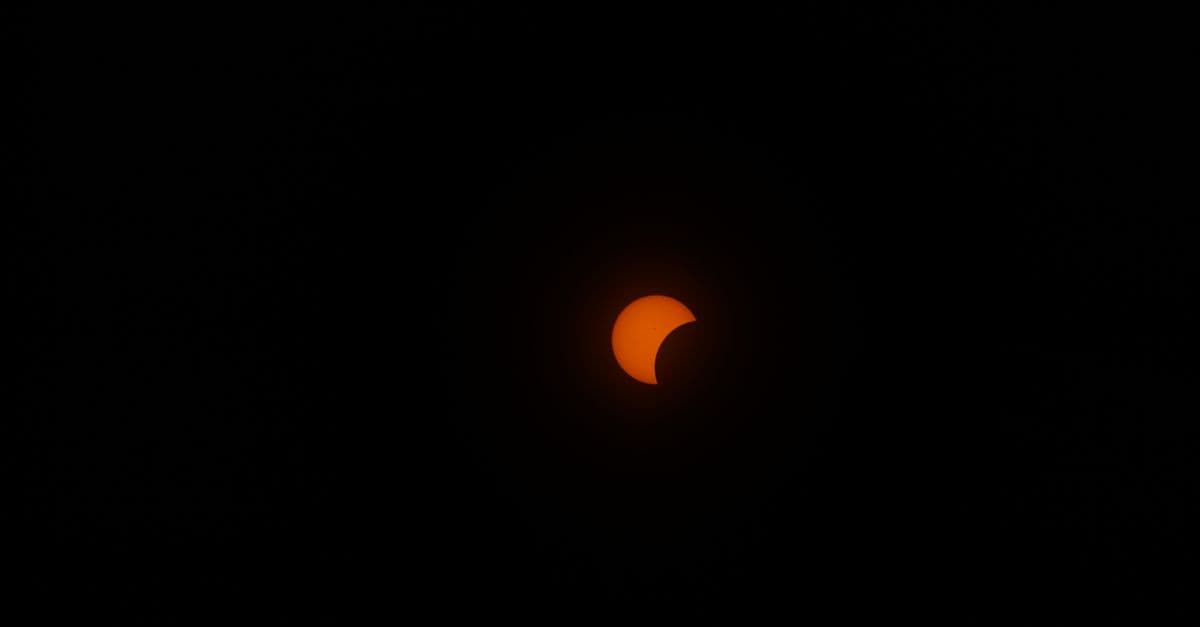
Photo: Adriel Arevalo / Pexels
Swap the Sun for a black hole with exactly the same mass and Earth's orbit would not budge. The planet would keep moving at about 29.78 kilometers per second on the same 365-day loop, because gravity responds to how much mass there is, not to how tightly it is packed. What would change is the light. This article works through that thought experiment: how small the black hole would be, what we would and would not see, how long the freeze would really take, and why "black holes suck things in" is the wrong lesson.
Thought experiment. This article explores a hypothetical scenario for educational and speculative purposes. The events described are not predictions and should not be interpreted as warnings, advocacy, or instructions.
Key takeaways
- A black hole with the Sun's mass would have a Schwarzschild radius (the size of its event horizon) of about 2.95 km, so the whole object would be less than 6 km across.
- Earth's orbit would not change. At 1 AU, gravity depends only on the enclosed mass, and the mass is the same.
- Sunlight delivers roughly 3,700 times more power to Earth than the planet's own interior does. Losing it is the real catastrophe.
- The oceans hold about 1,000 times the heat of the atmosphere. Air and land would chill within weeks, but freezing the oceans would take at least a century and probably far longer.
- The real Sun cannot become a black hole. It will end as a white dwarf in about five billion years.
Could the Sun ever become a black hole?
No, and the reasons are worth knowing, because they show what the thought experiment is really asking. A star becomes a black hole when its core runs out of usable fuel and gravity beats every pressure that could hold the core up. The Sun's core will never get there. NASA expects the Sun to swell into a red giant and then become a white dwarf in roughly five billion years (NASA). You can read the full timeline in our piece on what happens when the Sun dies.
A white dwarf is the exposed core of a dead star. Most hold between 0.5 and 0.7 solar masses in a ball about as wide as Earth, and they are propped up by electron degeneracy pressure, a quantum effect that stops electrons from being squeezed into the same states. That support fails only above about 1.44 solar masses, the Chandrasekhar limit, and the Sun sheds so much of its outer material on the way to becoming a white dwarf that it ends up far below that line. Our guide to white dwarfs covers the details.
Even stars that do collapse leave a floor on the remnant's mass. Neutron stars, held up by a similar quantum pressure among neutrons, top out somewhere around 2 to 3 solar masses in theoretical estimates (the Tolman-Oppenheimer-Volkoff limit; see Wikipedia for the published range). A collapsing core heavier than that has nothing left to stop it, so the lightest black holes made by dying stars weigh a few Suns, not one. The difficulty of finding objects in that gap is a live research topic, covered in our article on stellar versus supermassive black holes.
Only a hypothetical class of objects called primordial black holes, which would have formed in the early universe rather than from stars, could weigh as little as the Sun. They remain unconfirmed (Wikipedia). For scale, the nearest black hole known, Gaia BH1, sits about 1,560 light-years away and weighs roughly 9.6 solar masses (El-Badry et al., 2022). Nothing remotely like a one-solar-mass black hole is anywhere near us.
So the scenario is a stipulation, not a forecast. We declare that every kilogram of the Sun is replaced by a black hole of equal mass, silently, with no explosion and no burst of energy. That is not something physics allows, but it is a clean way to isolate one question: what depends on the Sun's mass, and what depends on its light?
| Object | Mass | Radius | Light output | Status |
|---|---|---|---|---|
| The Sun today | 1.9884 × 10³⁰ kg | 695,700 km | 3.828 × 10²⁶ W | Real (NASA fact sheet) |
| White dwarf the Sun will become | Typically 0.5 to 0.7 solar masses | Comparable to Earth's radius | Faint glow from stored heat | Expected in about 5 billion years |
| Solar-mass black hole | 1.9884 × 10³⁰ kg | 2.95 km (Schwarzschild radius) | None; Hawking radiation of about 6 × 10⁻⁸ K | Thought experiment only |
How small is a solar-mass black hole?
Every mass has a Schwarzschild radius: the size to which you would have to squeeze it before nothing, not even light, could escape. The formula is r = 2GM/c², where G is the gravitational constant (6.674 × 10⁻¹¹ m³ kg⁻¹ s⁻²), M is the mass, and c is the speed of light. Put in the Sun's mass of 1.9884 × 10³⁰ kg and you get 2,953 meters. The event horizon, the one-way boundary around the hole, would be a sphere about 5.9 kilometers across, shorter than Mount Everest is tall.
That is a compression of roughly 236,000 times in radius. The Sun's average density today is about 1,410 kilograms per cubic meter, a little more than water. Inside a 2.95-kilometer sphere the same mass averages about 1.8 × 10¹⁹ kilograms per cubic meter, roughly 13 quadrillion times denser. We worked both numbers out from the NASA fact sheet's mass and radius, so treat the last digit as approximate.
An analogy helps. Earth, by the same formula, has a Schwarzschild radius of just under 9 millimeters, so squeezing the planet into a ball about 1.8 centimeters wide, roughly a marble, would make it a black hole. The Sun is about 333,000 Earths, which is why its Schwarzschild radius is measured in kilometers rather than millimeters. Any object becomes a black hole if you crush it small enough. The Sun's problem is that nothing in its life cycle can do the crushing.
A second analogy covers what the horizon is. Picture a river flowing toward a waterfall, with the current getting faster the nearer you get. Far upstream, a swimmer can paddle against it. At some point the water moves faster than the fastest swimmer could ever paddle, and from there on, no strategy works. Physicists sometimes describe space near a black hole in just these terms, as a flow carrying everything inward. The horizon is the place where the flow exceeds the speed of light. Outside it, you can still leave. Our explainer on what happens inside a black hole takes the story past that edge.
Why Earth's orbit would not change
Here is the part that surprises most people. Far outside a spherically symmetric object, gravity depends only on the total mass inside, not on how that mass is arranged. Isaac Newton proved this for his theory of gravity (the shell theorem), and in general relativity the equivalent result is Birkhoff's theorem: the spacetime outside any spherical, non-rotating mass is the Schwarzschild solution, whatever is happening inside. If you want the background on how gravity works in both pictures, see how gravity works from Newton to Einstein.
A useful way to hold this: gravity reads the mass on the label, not the packaging. A dense lead ball and a much larger, fluffier ball with the same total mass pull on a distant satellite identically. Earth, at 1 AU (149,597,870.7 km, the definition of the astronomical unit), cannot tell whether the 1.9884 × 10³⁰ kilograms at the center are a glowing plasma ball or a 5.9-kilometer black one.
The numbers come out the same either way. The Sun's gravitational parameter, GM, is about 1.327 × 10²⁰ m³/s². Dividing by the square of Earth's distance gives an acceleration of about 5.93 millimeters per second squared, and the circular-orbit speed works out to about 29.8 kilometers per second, matching NASA's mean orbital velocity for Earth of 29.78 km/s and sidereal period of 365.256 days (NASA Earth fact sheet). The Moon would keep orbiting Earth, the other planets would keep orbiting the hole, and solar tides on Earth's oceans would continue, since they come from the gradient of the Sun's gravity, which is also set by mass and distance.
There is one honest asterisk. The real Sun spins and is very slightly flattened, which gives its gravity a tiny departure from the perfect-sphere ideal. A nonrotating black hole has no such flattening. The effect is small, and it matters far more for fast, close-in orbits than for ours.
| Quantity at Earth's location | The Sun today | Solar-mass black hole |
|---|---|---|
| Gravitational acceleration | 5.93 × 10⁻³ m/s² | 5.93 × 10⁻³ m/s² |
| Mean orbital speed | 29.78 km/s | 29.78 km/s |
| Orbital period | 365.256 days | 365.256 days |
| Sunlight at the top of the atmosphere | About 1,361 W/m² | 0 W/m² |
| Solar wind | Typically 400 km/s or faster | None |
| Tidal acceleration across a 2 m object | About 1.6 × 10⁻¹³ m/s² | About 1.6 × 10⁻¹³ m/s² |
The solar-constant figure is the nominal value adopted by the International Astronomical Union in 2015 (1,361 W/m²), consistent with Kopp and Lean's 2011 measurement of 1.3608 kW/m² (summary on Wikipedia). The solar-wind speed is NOAA's figure for slow wind, with fast streams running 500 to 800 km/s (NOAA Space Weather Prediction Center).
The first ten minutes: what Earth would notice
Nothing, for 499 seconds. Light takes 499.0 seconds to cross one astronomical unit (Wikipedia), which is about 8 minutes and 19 seconds. Sunlight that left the Sun's surface before the swap is still in flight, and Earth would enjoy a perfectly normal afternoon until the last of it arrived.
The changes in gravity would not arrive any sooner. When the LIGO and Virgo detectors caught two neutron stars merging in 2017, the gamma-ray burst reached us 1.74 seconds after the gravitational waves, after both had traveled for a very long time. That delay limits any difference between the speed of gravity and the speed of light to a few parts in 10¹⁵ (Abbott et al., 2017). Gravity news and light news travel together, so there would be no warning, and Earth's orbit would not get a lurch of any kind.
After the 499 seconds, the dayside sky would go black within seconds. The Moon would follow almost immediately: it sits about 1.3 light-seconds from us, so its last reflected sunlight would reach us a couple of seconds after the Sun's. The other planets would fade on their own schedules, because each one's reflected glow also has to cross the gap. Jupiter averages 5.2 AU from the Sun, and sunlight takes about 43 minutes to reach it (NASA). Add the trip from Jupiter to Earth, which ranges from roughly 4.2 AU to 6.2 AU depending on where each planet is in its orbit, and Jupiter would keep shining for somewhere between about 78 and 95 minutes after the Sun disappeared. That figure comes from our own arithmetic with the light-travel time, not from a published study.
Charged particles would take longer. The solar wind already streaming toward Earth would keep arriving for days: at a typical 400 km/s, a parcel needs about 4.3 days to cross 1 AU, and a fast 800 km/s stream needs about 2.2. Auroras would dim as the supply thinned, and the northern lights would eventually stop. Earth's magnetic field, generated in the liquid core rather than by the Sun, would carry on unchanged.
One more signal would end at the 499-second mark. Fusion in the Sun's core produces neutrinos, ghostly particles that stream out almost unimpeded, and underground detectors measure them. The same arrival delay applies, so the solar neutrino flux would drop to zero at nearly the same moment the light failed. That would be the first clear sign that the cause was in the Sun's core rather than in some cloud between us and it. Our article on the solar neutrino problem explains how those detectors work.
Outside the inner solar system, a quieter change would unfold. Comet tails point away from the Sun because radiation and the solar wind push on the gas and dust they shed. With both gone, a comet falling inward would travel as a dark, tailless lump. The physics of comet tails is a reminder of how much of the solar system the Sun's output quietly shapes.
Why the freeze takes longer than the movies say
The popular version of this story has Earth turning to ice within days. The physics is slower, and the reason is the ocean. To see why, start with the energy budget.
Above the atmosphere, sunlight arrives at about 1,361 watts per square meter. Earth presents a disc of radius 6,371 kilometers, so it intercepts roughly 1.7 × 10¹⁷ watts. Averaged over the whole sphere, that is about 340 W/m², of which about 29 percent is reflected and about 240 W/m² is absorbed (NASA Earth Observatory). In steady state Earth radiates roughly the same 240 W/m² back to space as infrared. Turn the Sun off and the input drops to nearly zero while the output continues.
What remains is the planet's internal heat. Davies and Davies (2010) estimate that Earth loses 47 ± 2 terawatts through its surface, which averages about 92 milliwatts per square meter (Solid Earth, 2010). Divide the 340 W/m² the Sun supplies on average by 0.092 W/m² and you get a ratio near 3,700. The Sun delivers about 3,700 times more energy than the entire planet's interior can offer, which is why geothermal heat can keep vents warm but cannot keep the surface habitable.
How fast the planet cools depends on how much heat is stored and how fast it can escape. The table sets out the three reservoirs that matter. The figures are our own order-of-magnitude arithmetic from NOAA's ocean volume (1,335,000,000 cubic kilometers, per NOAA), the atmosphere's mass (about 5.15 × 10¹⁸ kg), and standard values for specific heat and for the latent heat of fusion of ice (333.55 kJ/kg).
| Reservoir | Mass | Heat released per 1 K of cooling | Notes |
|---|---|---|---|
| Atmosphere | About 5.15 × 10¹⁸ kg | About 5 × 10²¹ J | Loses its heat within days to weeks |
| Oceans | About 1.4 × 10²¹ kg | About 5.5 × 10²⁴ J | Roughly 1,000 times the atmosphere |
| Freezing the oceans solid | About 1.4 × 10²¹ kg | About 4.6 × 10²⁶ J in total | Latent heat released as water becomes ice |
The atmosphere and the land surface have little thermal inertia, so they would cool quickly. For the first weeks, continental interiors would fall toward temperatures normally seen only in polar winter, which is the part of the story that is broadly correct. Our scenario article on a Sun that goes dark for a year gives a month-by-month account of the air and land, and the shorter one-week version covers the first days. Published models of the exact temperature curve differ, so we leave the specific figures to those articles.
The oceans are a different matter. They hold about a thousand times more heat per degree than the air, and the ocean would have to shed about 4.6 × 10²⁶ joules just to turn to ice. Suppose, generously, that the ocean could radiate at Earth's entire present outgoing rate of about 1.2 × 10¹⁷ watts (240 W/m² over the planet's 5.1 × 10¹⁴ square meters). Freezing it would still take about 3.7 × 10⁹ seconds, or roughly 120 years. In reality the loss rate would collapse as the planet cooled, because thermal radiation falls with the fourth power of temperature, and ice on top would insulate the water beneath. This is bounding arithmetic, not a forecast, and we could not find a published ocean-freezing timeline to cite. But the floor is a century, not months.
One feedback speeds the early stages. Water vapor is the strongest greenhouse gas in the atmosphere, and it holds in much of the surface heat. As air cools it can hold less, vapor condenses and rains or snows out, and the greenhouse blanket thins just when the planet needs it most. That is why the early cooling would be steeper than the ocean's slow inertia might suggest.
Photosynthesis would stop as the light failed, and with it the base of almost every food web on land and in the sunlit ocean. The deep ocean and rock-hosted life are a different story, which we return to below.
Where the temperature finally settles
Given enough time, a dark Earth would cool until the heat leaking out of the interior balances the heat the surface radiates to space. The Stefan-Boltzmann law says a surface at temperature T radiates σT⁴ per square meter, where σ is 5.67 × 10⁻⁸ W m⁻² K⁻⁴. Set that equal to the 0.0916 W/m² of geothermal flux and solve for T:
T = (0.0916 / 5.67 × 10⁻⁸)^(1/4), which is about 36 K, or roughly −237 °C.
This is an idealization. It treats the surface as a perfect radiator, ignores any insulating layers, and assumes the geothermal flux stays constant. The flux will not stay constant, because roughly half of Earth's internal heat output is estimated to come from radioactive decay, though published estimates of that share span a wide range (Wikipedia, Earth's internal heat budget), and that source slowly fades. Still, the order of magnitude is secure: tens of kelvins, not hundreds.
For comparison, Pluto averages about −232 °C (around 41 K) at roughly 39 AU from the Sun (NASA). At that distance sunlight still delivers about 0.9 W/m² (1,361 W/m² divided by 39 squared), roughly ten times more than the geothermal flux in our dark-Earth case. A fully dark Earth would, in the very long run, end up colder than Pluto's average surface.
At 36 K, Earth's air would not survive as a gas. The gases that make up most of it change phase at these temperatures:
| Gas | Share of dry air (by mole) | Boils at (1 atm) | Freezes at (1 atm) |
|---|---|---|---|
| Nitrogen | About 78.08% | 77.355 K | 63.23 K |
| Oxygen | About 20.95% | 90.188 K | 54.36 K |
At 36 K both would sit well below their freezing points. Earth's atmosphere, about 5.15 × 10¹⁸ kilograms, spread over 5.1 × 10¹⁴ square meters, comes to roughly 10,000 kilograms for every square meter of surface. Condensed to liquid air, which has a density of roughly 0.8 to 1.1 grams per cubic centimeter (liquid nitrogen is 0.808 and liquid oxygen 1.141), that is a layer roughly 9 to 12 meters deep, a little thinner if it freezes solid. The atmosphere would rain out and settle as a coating on the ice and bare rock. It would not happen in months. It would happen as the oceans' heat finally ran out, over a span that is likely to be centuries to millennia.
The very last fate of the oceans depends on how well the ice insulates them. Thick ice conducts heat poorly, and several bodies in our own solar system are thought to hold liquid water under ice shells. Jupiter's moon Ganymede is the largest example, and our article on Ganymede explains the evidence. Whether a dark Earth could do the same, with geothermal heat feeding a hidden ocean beneath kilometers of ice, is an open question that depends on how much heat the planet retains.
What the black hole itself would look like
From Earth, you would not see it at all. The horizon would be a sphere 5.9 kilometers across, 1 AU away, which works out to an angular diameter of about 8 milliarcseconds (3.95 × 10⁻⁸ radians). That is far too small for any backyard telescope to resolve, and it would be black on a black sky anyway.
It would, however, bend light. A massive object acts as a gravitational lens: light from a star passing near it is deflected, and a star directly behind it would be smeared into a ring. The ring's angular radius for a distant source is sqrt(4GM/(c²D)), where D is the distance to the lens (Einstein radius). For our hole at 1 AU, that is sqrt(2 × 2,953 m / 1.496 × 10¹¹ m), about 2 × 10⁻⁴ radians, or about 41 arcseconds. The Sun's disc spans about half a degree, so this ring would be a tiny feature, but astronomers routinely detect effects of that size, and it is the technique behind our piece on gravitational lensing. Background stars in a patch of sky a few tens of arcseconds wide around the hole would appear displaced and magnified.
Could it glow? Matter falling into black holes heats up and shines, but there is almost no matter near this one. Without the Sun's output, there would be no solar wind to feed it, and the leftover dust and gas in interplanetary space would be too sparse to make a visible accretion disc. A black hole that is not eating is dark.
What about Hawking radiation, the faint thermal glow that quantum theory predicts for black holes? The Hawking temperature of a solar-mass hole works out to about 6 × 10⁻⁸ K (from T = ħc³/8πGMk_B). The cosmic microwave background is 2.7 K, far hotter, so the hole would absorb more energy than it radiates and slowly gain mass. A one-solar-mass black hole would take more than 10⁶⁷ years to evaporate even if the universe were empty (Wikipedia). For the full picture, see our article on Hawking radiation.
How would astronomers detect it? The same way they found Gaia BH1: by watching something else move. In that case, a Sun-like star in a wide orbit was tugged in a way only an unseen heavy companion could cause (El-Badry et al.). In our scenario, the hole is the thing everything orbits, so its presence would be obvious from the orbits of the planets, which would look unchanged, and from the absence of anything shining at the center.
Why black holes do not "suck"
The picture of a black hole as a cosmic vacuum cleaner is the most durable myth in popular astronomy, and this scenario takes it apart. A black hole does not pull harder than a star of the same mass. It just lets you get closer.
Consider the pull at different distances. At the Sun's old surface, 695,700 kilometers from the center, the escape velocity is about 618 kilometers per second, found from sqrt(2GM/r). At the horizon, 2.95 kilometers from the center, the escape velocity is the speed of light. Between those two radii, the black hole's gravity grows enormously compared with the Sun's, but you can only get there by flying inside the volume the Sun used to fill. Outside it, the two objects are indistinguishable.
Tidal forces, the difference in pull between your head and your feet, show the same thing. A rough Newtonian estimate across a 2-meter object is 2GM × 2 m / r³. At the Sun's former surface it is about 1.6 × 10⁻⁶ m/s², utterly harmless. At the horizon of the black hole it is about 2 × 10¹⁰ m/s², roughly two billion times Earth's surface gravity. At Earth's distance it is about 10⁻¹³ m/s², far too small to notice. Danger arrives only when you are close enough to the hole to be in territory the Sun's bulk would have covered. For that experience, read about what would happen if you fell into a black hole or what a hole would do if one appeared next to Earth.
A better analogy than a vacuum cleaner is a well. A well does not suck water toward itself from the surrounding ground. It is just a place where you can go deeper than the surface allows. The ground around it is unaffected, and so are the people walking past. A black hole is a well in spacetime, and the Sun, by being a ball of gas, was a well with a floor.
Could anything survive the dark?
Some life would, for a while, and some for far longer. Photosynthesis would stop as the light failed, and that is the base of nearly all surface food webs. Plants and algae would not be able to make sugars, and animals that eat them would follow within weeks to months, with the timing depending on how much each species can store.
Beyond that, it gets more interesting. Deep-sea hydrothermal vents, where hot, mineral-rich water emerges from the seafloor, support communities built on chemosynthesis, in which microbes get energy from chemical reactions instead of sunlight. Our articles on the deepest sea creatures and on deep-sea creatures and bioluminescence cover that world. There is a catch that popular accounts skip: many vent animals rely on microbes that burn sulfide with oxygen, and that oxygen originally comes from photosynthesis. Once the surface froze and stopped exchanging gas with the water below, those communities would be living on a finite stock of dissolved oxygen. Microbes that use hydrogen or methane without oxygen could carry on longer, as long as geology kept supplying the chemicals.
Microbial communities in rock and sediment, sometimes kilometers below the surface, run on slow chemistry and geothermal heat. They are not tied to the Sun in any direct way, and they are the best candidates for life that outlasts the freeze. The honest summary is that the biosphere would not vanish, but it would shrink to a tiny fraction of its present size, living in places humans rarely see.
Humans could survive only with help from technology. Nuclear reactors or geothermal plants could in principle power heated shelters and artificial lighting for crops, and a small population could endure that way. Feeding eight billion people from such systems is a different matter, since the infrastructure does not exist and could not be built in the time available. Our piece on the Sun going dark for a year walks through what that would mean for food and power in more detail.
What this means
The thought experiment pulls apart two ideas that most people treat as one. The first is gravity, which belongs to mass and is blind to how that mass is arranged. By that measure the Sun and a solar-mass black hole are twins, and Earth would circle either one on the same path. The second is light, which belongs to nuclear fusion, and the loss of it ends everything that depends on sunlight, which is nearly everything we can see.
The lesson about black holes is the same one in disguise. They are not monsters with extra gravity. They are very small things whose danger is concentrated in a very small region. Stay outside that region and a black hole is just a heavy, invisible object, which is exactly how it would behave at the center of our solar system.
There is also a quieter lesson in the timeline. Air and land would give up their heat in days to weeks, but the oceans would take at least a century to freeze and plausibly far longer. The planet would lose its light and its warmth on very different clocks, and the gap between them is where the last refuges of life would be found.
Frequently Asked Questions
Q: Would Earth fall into a black hole that replaced the Sun?
A: No. At 1 AU, a solar-mass black hole exerts exactly the same gravitational pull as the Sun, so Earth would keep its 29.78 km/s orbit and 365.256-day period. Orbits only change if the central mass changes, and here it does not. Danger from a black hole comes from getting very close to it, not from its gravity at a distance.
Q: How long would it take Earth to notice the Sun had become a black hole?
A: About 8 minutes and 19 seconds. Light needs 499 seconds to cross 1 AU, and gravitational changes travel at the same speed, so Earth would receive no warning. Sunlight already in transit would keep arriving until the 499-second mark, then the sky would go dark.
Q: Could the Sun really become a black hole?
A: No. The Sun is expected to end as a white dwarf in roughly five billion years. Black holes formed by dying stars weigh at least a few Suns, because a collapsing core must exceed the neutron-star limit of roughly 2 to 3 solar masses. A one-solar-mass black hole could only be a hypothetical primordial one.
Q: How cold would Earth get without the Sun?
A: Eventually, about 36 K (around −237 °C) if only geothermal heat of about 0.092 W/m² warmed the surface, a rough Stefan-Boltzmann estimate. Reaching that would take far longer than a year, because the oceans hold about 1,000 times the heat of the atmosphere. Freezing them solid would take at least about a century, even under generous assumptions.
Q: Would we be able to see the black hole?
A: Not directly. Its event horizon would span about 8 milliarcseconds, and it would emit almost no light. It would show up through gravitational lensing, which would distort background stars within roughly 41 arcseconds of it, and through its gravitational influence on the orbits of the planets.
Q: Would the Moon still orbit Earth?
A: Yes. The Earth-Moon system would be unaffected, because the Sun's gravity on it would be unchanged. The Moon would go dark within a couple of seconds of the Sun's light failing, since its brightness is reflected sunlight, but it would remain in orbit and keep raising tides.
Q: Would the oceans freeze solid?
A: Eventually, probably, but not quickly. Even if the ocean radiated heat at Earth's entire present outgoing rate, shedding the latent heat of freezing would take about 120 years. In practice it would take longer, because the radiating surface would cool and ice would insulate the water beneath. Whether any liquid water persisted under thick ice depends on how much geothermal heat remained.
Sources
- NASA, Sun facts and NASA Sun fact sheet (mass, radius, luminosity, end-of-life fate)
- NASA Earth fact sheet (orbital velocity and period, Earth mass)
- NASA Earth Observatory, Climate and Earth's Energy Budget (incoming, reflected, and absorbed sunlight)
- Davies and Davies (2010), Earth's surface heat flux, Solid Earth (47 ± 2 TW)
- Abbott et al. (2017), Gravitational waves and gamma rays from a binary neutron star merger (1.74-second delay, speed of gravity)
- El-Badry et al. (2022), Gaia BH1, a Sun-like star orbiting a dormant black hole
- NOAA, How much water is in the ocean? and NOAA Space Weather Prediction Center, Solar wind
- NASA, Pluto facts and NASA, Jupiter facts
Read next:
Follow new articles
Add SciHub101 to your feed reader to see new science and technology stories.
About the Author
SciHub101 is an independent science and technology publication founded and edited by Buğra Sözeri, a software engineer and app developer based in Türkiye. AI tools assist with drafting and research. Source documentation in the existing archive is uneven, and articles are being reviewed and corrected. The Editorial Team byline identifies editorial responsibility; it does not certify specialist or independent human review. Where we compare products, anything built by our own team is labelled as such — see the editorial guidelines and About page for how corrections and disclosures work.
Related Articles
What If the Earth Stopped Spinning?
Earth spins at 1,674 km/h at the equator. If it suddenly stopped, supersonic winds would devastate the surface. If it slowed gradually, the consequences are still severe — a 6-month day, ocean redistribution, and a collapsing magnetic field.
What If Jupiter Became a Star?
Jupiter is sometimes called a 'failed star' — but it would need to be 80 times more massive to ignite hydrogen fusion. If we somehow gave it enough mass, our solar system would gain a faint red dwarf companion, and Earth would barely notice.
What If Gravity Disappeared for One Second?
What if gravity vanished for one second? The math shows orbits shift by millimeters to meters, and the ground may carry you along. A thought experiment.
What If the Sun Disappeared for One Week?
Eight minutes after the Sun vanishes, Earth goes dark. What happens to life, physics, and civilization in the days that follow?
What If a Rogue Planet Entered Our Solar System?
There may be more rogue planets — wandering worlds without stars — than there are stars in the galaxy. If one drifted into our solar system, even a brief passage could destabilize planetary orbits and reshape Earth's climate for millennia.
What If You Fell Into a Black Hole?
Two perspectives, one terrifying destination. From spaghettification to the firewall paradox — the real physics of falling into a black hole.