What If Earth Had Rings Like Saturn?
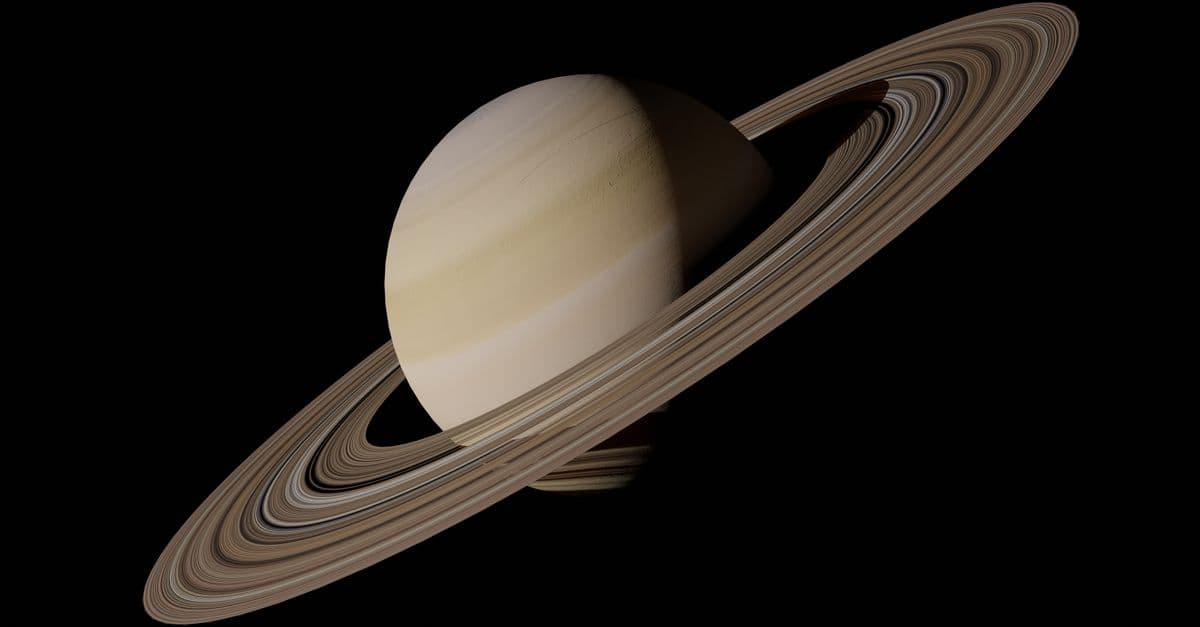
Photo: Zelch Csaba / Pexels
Saturn's rings span 280,000 kilometers (174,000 miles) tip to tip but are barely 10 meters (30 feet) thick in most places — a disc of water ice so thin it would be invisible edge-on from a few hundred kilometers away. Earth has no rings today. But geological evidence published in 2024 suggests we did have them once, roughly 466 million years ago, and the fallout may have triggered an ice age. This piece asks a straightforward physics-and-biology question: what would daily life on Earth actually look like with a permanent Saturn-style ring system overhead?
Thought experiment. This article explores a hypothetical scenario for educational and speculative purposes. The events described are not predictions and should not be interpreted as warnings, advocacy, or instructions.
Key takeaways
- Earth's Roche limit for icy particles sits at roughly 9,500 km from the planet's center, about 3,100 km altitude — deep inside the zone where GPS and communications satellites operate.
- Rings would appear as a bright arc crossing the sky, edge-on and dazzling at the equator, elliptical and dramatic at mid-latitudes, and entirely invisible from the poles.
- Tropical regions would experience periodic daytime shading, and one real-world case study — the Ordovician ring hypothesis — links a similar event to an 8°C (14.4°F) global cooling episode.
- Nearly every satellite orbit humans rely on today (LEO, GPS, geostationary) would sit inside or adjacent to the debris field, making modern space infrastructure far harder to build.
- Earth likely did wear rings twice in its history: briefly after the Moon-forming giant impact 4.5 billion years ago, and again — according to a 2024 Monash University study — around 466 million years ago.
Where rings can exist: the physics of the Roche limit
Planetary rings aren't arbitrary. They form and survive only within the Roche limit — the distance from a planet inside which tidal forces stretch and eventually shred any object that gets close enough, rather than letting it clump into a moon. Outside that limit, gravity wins and debris accretes into satellites. Inside it, tides win and satellites stay shredded into rings.
The relationship is a simple ratio of densities:
$$d \approx 2.44,R_p\left(\frac{\rho_p}{\rho_m}\right)^{1/3}$$
Plug in Earth's radius (6,378 km) and mean density (about 5,515 kg/m³) against icy debris (about 920 kg/m³), and the Roche limit for ice comes out to roughly 9,500 km from Earth's center, or about 3,100 km altitude. For rockier debris (around 3,000 kg/m³), the limit tightens to roughly 7,800 km from the center, or about 1,400 km altitude — already deep inside low Earth orbit (LEO).
That means a realistic Earth ring system would stretch from somewhere above the upper atmosphere out to roughly 30,000 km, the rough outer boundary where dynamical effects (solar radiation pressure, the Moon's gravity, atmospheric drag on stray particles) tend to disperse loose material before it can settle into a stable disc. This band swallows the ISS orbit (400 km), most Earth-observation satellites (400–800 km), the entire GPS constellation (about 20,200 km), and reaches to within a few thousand kilometers of geostationary orbit (35,786 km).
For comparison, Saturn's own Roche limit for ice sits much farther out — its rings extend from about 7,000 km above its cloud tops to roughly 80,000 km, according to NASA's Cassini mission overview. Saturn is roughly 9.4 times Earth's radius and considerably less dense (its bulk density is lower than water), so its Roche geometry is proportionally larger even though the underlying physics is identical. The takeaway: any planet can, in principle, wear rings — what differs is exactly where they'd sit relative to the planet's own useful orbital space, and for Earth, that "useful space" happens to be exactly where our satellites live.
What Earth's rings would actually look like from the ground
The rings would orbit in Earth's equatorial plane, tilted 23.4° relative to Earth's orbit around the Sun (Earth's axial tilt). That tilt determines almost everything about how the rings would appear from any given latitude.
From the equator, the rings would be edge-on — a razor-thin, brilliant white line running exactly east to west, passing directly overhead at noon and, when illuminated by reflected sunlight, visible again at night as a glowing seam bisecting the sky. Because the observer is looking along the ring plane rather than down onto it, the apparent width would be only a few arcminutes, similar to how Saturn's own rings vanish into a thin line during ring-plane crossings as seen from Earth.
From mid-latitudes, roughly 30° to 40° north or south, the geometry opens up dramatically. The rings would appear as a sweeping arc rising from the eastern horizon, curving to an altitude of around 60° in the southern sky (for northern-hemisphere observers) before descending in the west. Because the observer is now looking at an angle across the ring plane rather than along it, the rings would present a wide, elliptical band — something closer to the postcard image of Saturn's rings, except wrapped around an entire sky rather than confined to a small disc.
From the poles, the rings would drop below the horizon entirely. Polar observers would never see them, day or night — a strange asymmetry where the most spectacular astronomical feature in human history would be permanently invisible to Arctic and Antarctic populations.
How bright would the rings actually be at night?
Saturn's rings have a Bond albedo (a measure of total reflected sunlight) around 0.5, roughly comparable to fresh snow, and from Saturn's cloud tops they shine about as bright as a half Moon. Scaled to Earth's much closer ring distance and assuming similar ice composition, Earth's rings would plausibly appear somewhere between a quarter Moon and a full Moon in brightness, depending on particle density and the sun angle. That's enough to end true darkness across most of the inhabited world.
Tropical shading and its climate consequences
Because the rings orbit directly over Earth's equator, their shadow sweeps across tropical and subtropical latitudes in a predictable seasonal pattern. At equinoxes, the shadow is a thin line hugging the equator. At solstices, the shadow shifts toward whichever hemisphere is tilted away from the Sun, projecting a broad dark band across a swath of the tropics for part of each day.
This isn't a purely theoretical effect. It's the mechanism behind the strongest real-world evidence that Earth once had rings.
An 8°C global cooling is enormous by the standards of climate history — for comparison, the difference between today's climate and the depths of the last Ice Age was roughly 5–6°C globally. If a temporary, decaying ring can plausibly account for a swing of that size, a permanent, stable ring system would likely produce sustained cooling of a similar order in tropical latitudes, with knock-on effects worldwide:
- Weakened Hadley circulation. The Hadley cell is the atmospheric conveyor belt that rises at the equator and sinks around 30° latitude, driving trade winds and defining the location of major deserts. Less solar heating at the equator means a weaker, possibly narrower Hadley cell.
- Shifted rainfall belts. Tropical rainforests depend on the Intertropical Convergence Zone, a band of rising, moisture-laden air that tracks the sun's most direct point. A shaded equator could push or fragment that zone, shrinking rainforest range and expanding semi-arid savannah.
- Altered monsoon timing. Monsoon systems in South Asia, West Africa, and northern Australia are driven by land-ocean temperature contrasts that themselves depend on consistent solar heating. Periodic ring shadows would introduce a wobble into that cycle that doesn't exist today.
- Complicated seasonal forecasting. Meteorologists would need to model not just axial tilt and orbital eccentricity but ring particle density, ring plane precession, and shadow geometry — a genuinely harder prediction problem than the one we have now.
None of this is catastrophic in the way a sudden asteroid strike is. It's closer to a permanent, geographically uneven version of the aerosol-driven cooling that follows a major volcanic eruption — the kind seen after Mount Pinatubo's 1991 eruption, which cooled global temperatures by about 0.5°C for roughly a year, according to long-standing volcanology literature, except a ring's effect would be concentrated at low latitudes and would never go away.
The satellite catastrophe: why modern spaceflight and rings don't mix
This is where a ringed Earth stops being merely beautiful and starts being a serious constraint on technology. Modern civilization depends on a stack of orbital infrastructure that happens to sit almost entirely inside the zone where ring debris would live.
| Orbit / Asset | Typical Altitude | Ring Zone Overlap |
|---|---|---|
| International Space Station | ~400 km | Inside rocky Roche limit — direct exposure |
| Earth observation satellites | 400–800 km | Inside rocky Roche limit — direct exposure |
| Starlink-type mega-constellations | 340–1,200 km | Inside or bordering rocky Roche limit |
| GPS constellation | ~20,200 km | Inside the full ring band (icy Roche limit to ~30,000 km) |
| Galileo (EU navigation) | ~23,222 km | Inside the full ring band |
| Geostationary comms satellites | 35,786 km | Just outside outer ring edge, but reached by crossing through it |
Table: Major categories of modern satellite infrastructure and how they would overlap with a hypothetical Earth ring system extending from roughly 1,400–3,100 km (rocky/icy Roche limits) to about 30,000 km.
The physical danger comes down to relative velocity. Orbital debris and micrometeoroids in low Earth orbit already travel at roughly 7–8 km/s relative to satellites, fast enough that even millimeter-sized fragments can puncture spacecraft hulls — this is well documented by NASA's Orbital Debris Program Office, which tracks collision risk for the ISS today from a far sparser debris population than a genuine planetary ring would contain. A continuous ring of ice and rock particles at similar relative speeds would sandblast anything orbiting inside it. Practical consequences:
- Low Earth orbit becomes unusable for long-duration missions. Satellites and crewed stations inside the rocky Roche limit would face continuous erosion, closer to what the Cassini spacecraft experienced skimming Saturn's rings during its final "Grand Finale" orbits in 2017, when engineers oriented Cassini's dish as a shield against ring-plane particles even during brief, carefully targeted passes.
- Mid-altitude navigation constellations would need redesigning. GPS and Galileo sit squarely inside the ring band under this scenario; either satellite navigation would need to move to much higher or much lower orbits, or accept a shortened operational lifespan and constant replacement.
- Reaching geostationary orbit requires crossing the ring plane. Launch trajectories would need to time transits through gaps in ring density, similar to how the Cassini and Juno missions carefully planned ring-plane crossings around Saturn and Jupiter respectively to minimize particle impact risk.
- A permanent, planet-scale Kessler syndrome. The Kessler syndrome describes a runaway cascade of orbital collisions that generates more debris than it destroys. A stable natural ring is essentially a permanent, low-density version of that cascade — not runaway, because the system reaches equilibrium, but permanently present rather than a rare catastrophic failure mode.
Given all this, a technological civilization that evolved on a ringed Earth would likely have developed spaceflight along a very different path — probably favoring high-altitude balloon and aircraft-based observation much longer, delaying satellite communications, and possibly discovering orbital mechanics through the rings' own dynamics before ever launching a rocket through them.
Would rocket launches even be possible?
Yes, but launch windows and trajectories would matter far more than they do today. Rockets could launch through gaps in ring density or during low-density seasonal phases, much as Cassini timed its ring-plane crossings around Saturn. Sustained operations above the rocky Roche limit (roughly 1,400 km) would remain difficult without shielding, favoring orbits either well below or well above the debris band.
Could life evolve differently under a permanent ring?
Biology responds to light cycles in ways that are easy to overlook until you change them. A permanent ring bright enough to rival the Moon, combined with periodic tropical daytime shading, would plausibly reshape several evolutionary pressures over deep time.
Circadian and lunar-cycle disruption. Many marine species — most famously coral, which times mass spawning events to lunar cycles — use moonlight intensity as a synchronizing cue. A ring brighter and more constant than the Moon (rather than waxing and waning over 29.5 days) could blur or eliminate that signal, forcing organisms to rely on other cues like water temperature or day length instead.
Nocturnal predator-prey dynamics. Brighter nights generally favor visual predators over the prey that depend on darkness for cover — a pattern already observed on Earth around bright moonlit nights, when many small mammals reduce foraging activity to avoid predation, a behavior documented in field ecology as "predation risk allocation." A permanently brighter night sky could shift this balance semi-permanently rather than just during the full Moon.
Photoperiodism in plants. Many plants use day length and light quality to time flowering and dormancy. Periodic ring shadowing over the tropics would introduce a new, non-seasonal light variable into that signal, one with no clean analog in current plant physiology — it's genuinely unclear whether tropical flora would adapt to treat it as noise or evolve to use it as a cue.
Animal navigation. Many migratory species, from dung beetles to nocturnal birds, use the Moon, stars, or the Milky Way's polarization pattern for orientation. Research on dung beetles published in Current Biology has shown they can navigate using the Milky Way itself. A dominant ring arc across the sky would likely become the brightest, most stable navigational reference available at night, and it's plausible some species would evolve to orient by it much as some birds already orient by star patterns.
The Theia hypothesis: the first time Earth (probably) had rings
The Ordovician ring event described above wasn't Earth's only brush with rings — and it likely wasn't even the first. The dominant scientific explanation for the Moon's origin, the giant impact hypothesis, holds that a Mars-sized protoplanet informally named Theia struck the young Earth in a glancing blow roughly 4.5 billion years ago.
The immediate aftermath, according to decades of impact-simulation research going back to foundational studies archived at NASA's Technical Reports Server, would have vaporized a large fraction of both bodies and thrown an enormous mass of molten and vaporized rock into orbit around Earth. That material didn't instantly become the Moon. Within hours to days it would have flattened into a glowing, high-temperature debris disc — functionally a ring system, just one made of rock vapor and molten droplets rather than water ice.
Material outside Earth's Roche limit began accreting almost immediately; simulation studies suggest the bulk of the proto-Moon may have assembled within a period as short as a decade to a few centuries, though full consolidation into the Moon we see today likely took longer. Material inside the Roche limit either fell back to Earth or gradually spiraled out past the limit and joined the growing Moon. Within roughly 100,000 years, the debris disc was gone and Earth had a single, large moon in a fairly close orbit — one that has since drifted outward at roughly 3.8 cm per year, a rate directly measured by laser reflectors left on the lunar surface during the Apollo missions.
So in a real sense, Earth's very first "rings" are the reason we have a Moon at all rather than no natural satellite. The ring phase was a byproduct of catastrophe, not a stable end state — but it demonstrates that the physics discussed throughout this article isn't speculative fiction. It happened, twice, in Earth's actual history.
Common misconceptions about a hypothetical Earth ring system
"Rings would look like a distant, small band, similar to how Saturn appears through a telescope." This confuses the view from outside a ring system with the view from underneath one. Saturn's rings look modest from Earth because we're 1.2 billion kilometers away. From Earth's own surface, with rings just a few thousand kilometers up, the arc would dominate a large fraction of the visible sky — closer in scale to the Milky Way's band, but far brighter and more sharply defined.
"The rings would block out the Sun." Except during specific shadow-crossing windows near the equator, this is false. Rings are extremely thin relative to their diameter — Saturn's are roughly 10 meters thick across 280,000 km of width, a ratio thinner than a sheet of paper relative to a football field, according to NASA's Cassini findings. They cast a narrow shadow line, not a broad eclipse.
"A ring system is basically the same thing as a debris field or 'space junk,' just bigger." Not quite. Human-made orbital debris is a scattered, chaotic hazard concentrated in specific altitude bands, largely a byproduct of decades of launches and a handful of anti-satellite tests and collisions. A planetary ring is a dynamically stable, orbitally organized structure shaped by gravity and collisional damping over geological time — Saturn's rings have likely persisted, in some form, for a substantial fraction of the solar system's history, per ongoing Cassini-era research into ring age described on NASA's science pages. They're a natural, quasi-permanent feature, not accumulated litter.
"If Earth had rings, the seasons would work the same as now, just with a nicer sky." Also false, per the Ordovician case study above — the shading effect on tropical solar input is a real climate variable, not a cosmetic detail. Rings would measurably change global temperature distribution, not just the view.
"Rings only exist around gas giants." Saturn, Jupiter, Uranus, and Neptune all have rings, which does create that impression. But the physics of the Roche limit applies to any planet with enough mass to tidally disrupt a nearby object — smaller, rocky worlds like Earth or Mars can host rings too, given the right debris supply. Mars's moon Phobos, in fact, is expected to be torn apart by tidal forces within roughly 30–50 million years and may form a ring of its own, based on stress modeling published by planetary scientists studying the moon's orbital decay.
Frequently asked questions
Q: How close would an object need to get to Earth to form a ring? A: It would need to cross Earth's Roche limit — about 9,500 km from Earth's center (roughly 3,100 km altitude) for icy material, or about 7,800 km from the center (roughly 1,400 km altitude) for rocky material. Inside that boundary, Earth's tidal forces exceed the object's self-gravity and it gets pulled apart into a debris ring rather than staying intact as a moon.
Q: Did Earth actually have rings in the past? A: Likely yes, twice. A 2024 Monash University study in Earth and Planetary Science Letters proposes an equatorial ring formed around 466 million years ago after an asteroid crossed the Roche limit, based on 21 equator-clustered impact craters from that period. Earth also plausibly wore a short-lived debris ring roughly 4.5 billion years ago, immediately after the Theia impact that formed the Moon.
Q: Would rings make Earth colder or warmer overall? A: The clearest real-world evidence points to cooling, at least regionally. The Ordovician ring hypothesis links equatorial shading to an 8°C (14.4°F) global temperature drop associated with the Hirnantian Icehouse glaciation. The effect is concentrated in the tropics rather than spread evenly worldwide.
Q: Could satellites and the ISS coexist with a ring system? A: Not easily. The ISS orbits at about 400 km, GPS satellites at about 20,200 km, and geostationary satellites at 35,786 km — nearly the entire range humans currently use for orbital infrastructure overlaps the roughly 1,400–30,000 km band where ring debris would persist. Long-duration missions inside that band would face continuous particle erosion.
Q: Would the rings be visible during the day? A: Partially. Rings bright enough to rival a quarter or half Moon at night would likely be visible as a faint pale band against a blue daytime sky, similar to how the Moon itself is often visible during the day, though contrast would be weaker near the horizon and stronger higher in the sky.
Q: Do any other rocky planets or moons have rings today? A: Not currently among rocky planets, but the dwarf planet Haumea and the centaur objects Chariklo and Chiron have confirmed ring systems, showing that rings aren't exclusive to gas giants. Mars's moon Phobos is expected to eventually be torn apart by tidal forces and could form a temporary ring of its own within tens of millions of years.
Q: Would a ring system affect eclipses? A: Yes, indirectly. Lunar and solar eclipses depend on precise alignment between Earth, the Moon, and the Sun. A dense ring system wouldn't block those alignments directly, but it would add a new recurring shadow-and-light event of its own — the ring's own transit shadow — that has no equivalent in Earth's current sky.
Q: How thick would Earth's rings be compared to their width? A: If Earth's rings resembled Saturn's proportionally, they would be roughly 10 meters (30 feet) thick across a system tens of thousands of kilometers wide — an almost unimaginably thin disc, comparable in ratio to a sheet of paper spread across a football field.
Q: Could humans eventually mine a ring system for resources? A: In principle, yes — a ring made largely of water ice, as Saturn's is (over 95% water ice by composition, per Cassini data), would represent an enormous, relatively accessible reservoir of water and volatile compounds close to Earth, though extracting material from a zone this hazardous to spacecraft would require very different engineering than asteroid mining in open space.
The takeaway
A ringed Earth would be the most visually dramatic version of our planet imaginable — and also a considerably more complicated one to live on. The rings would rewrite the night sky, cool the tropics, quietly reshape ecosystems that depend on stable light cycles, and turn the orbital space we currently use for GPS, communications, and crewed spaceflight into a hazard zone. None of this is pure speculation: the same physics that would govern a permanent Earth ring already produced two real, if temporary, ring systems in our planet's actual history — one that gave us the Moon, and one that may have helped trigger an ice age 466 million years ago. The absence of rings today isn't a cosmic accident to be taken for granted; it's the reason satellite navigation, uninterrupted sunlight at the equator, and dark night skies at every latitude were ever possible in the first place.
Read next:
Follow new articles
Add SciHub101 to your feed reader to see new science and technology stories.
About the Author
SciHub101 is an independent science and technology publication founded and edited by Buğra Sözeri, a software engineer and app developer based in Türkiye. AI tools assist with drafting and research. Source documentation in the existing archive is uneven, and articles are being reviewed and corrected. The Editorial Team byline identifies editorial responsibility; it does not certify specialist or independent human review. Where we compare products, anything built by our own team is labelled as such — see the editorial guidelines and About page for how corrections and disclosures work.
Related Articles
What If Earth Lost Its Axial Tilt?
Earth's 23.5° tilt creates seasons and stabilizes climate. What would happen if it vanished — or flipped to 90°?. Learn the science, key examples, and...
What If the Sun Disappeared for One Week?
Eight minutes after the Sun vanishes, Earth goes dark. What happens to life, physics, and civilization in the days that follow?
What If Earth Had Two Moons? The Science of a Twin-Moon World
A second moon would change tides, eclipses, calendars, and possibly life itself. Here's exactly what would happen — based on real orbital physics — if we suddenly had two moons.
Why Do We Have Seasons? The Science of Earth's Tilt
Earth's 23.5-degree axial tilt, not its elliptical orbit, is why we have seasons. The tilt means each hemisphere receives more direct sunlight and longer daylight hours for part of the year (summer), then less direct light and shorter days for another part (winter). The two hemispheres always experience opposite seasons simultaneously. Solstices and equinoxes mark the extremes and midpoints of this tilt cycle.

What If All Water on Earth Disappeared?
What would happen if every drop of water on Earth vanished? Explore the catastrophic consequences for life, atmosphere, and planet.
What If Earth Had No Moon?
The Moon is more than a nightlight. It holds Earth's tilt steady, drives our tides, and may have made complex life possible.