What Are Cataclysmic Variables, Novae, and Dwarf Novae?
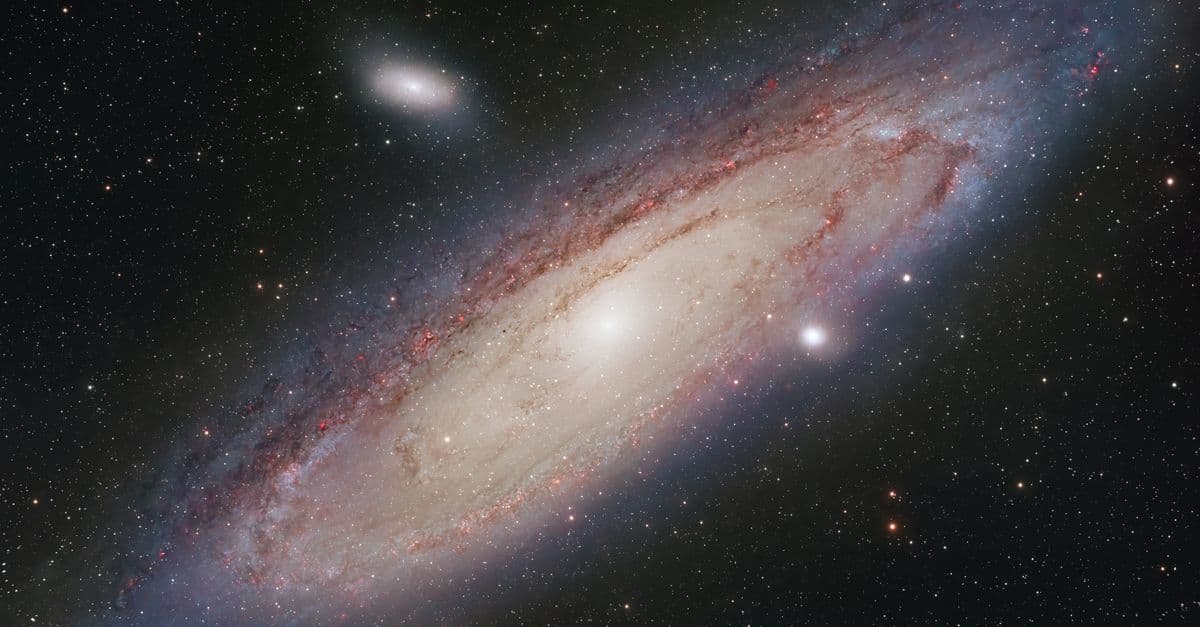
Photo: Luis Felipe Alburquerque Briganti / Pexels
A cataclysmic variable is a pair of stars close enough that one is slowly being eaten by the other. The eater is a white dwarf, the Earth-sized, extremely dense remnant of a dead star. The victim is usually a small red star that has swollen to the edge of its gravitational territory. Gas spills across, swirls into a disk, and sometimes either the disk or the white dwarf's surface erupts. Those eruptions are dwarf novae and classical novae, and they are among the most reliable explosions in the sky.
What a cataclysmic variable actually is
NASA's HEASARC archive describes cataclysmic variables (CVs) as binary systems made of a normal star and a white dwarf, with orbital periods typically between one and 10 hours. A typical system would fit inside the Earth-Moon distance. That is the first surprise: the two stars orbit each other far closer than Mercury orbits the Sun, and the whole arrangement is dwarfed by the star that would be at its center if it were alone.
The name comes from the behavior, not the shape. "Cataclysmic" is an old astronomers' label for stars that brighten suddenly and unpredictably. "Variable" simply means the brightness changes. More than a thousand CVs have been catalogued, and surveys keep adding to the list. Most are faint, which is why they were discovered mostly by surveys that watch the sky for changes.
Four ingredients appear in almost every system:
- The white dwarf (the accretor). A compact object with a mass often near that of the Sun but a radius comparable to Earth's. It no longer fuses hydrogen in its core. Electron degeneracy pressure, a quantum effect that stops electrons from being squeezed into the same states, holds it up. The white dwarf article covers how these remnants form.
- The donor star. Usually a low-mass red dwarf, sometimes a slightly evolved star. It fills its Roche lobe, the teardrop-shaped region around a star inside which its own gravity wins against the tidal pull of its partner.
- A stream of gas. Gas leaves the donor at the inner Lagrange point (L1), the saddle between the two stars where gravitational pulls and the rotating frame balance.
- An accretion disk or magnetic funnel. The gas carries too much angular momentum to drop straight down. In weakly magnetic systems it forms a disk; in strongly magnetic ones the white dwarf's field steers it.
Think of the Roche lobe as the rim of a bathtub in orbit. As long as the water stays below the rim, nothing spills. Once the donor swells or the orbit shrinks so the star reaches the rim, gas pours through the overflow point and falls toward the other star.
How much energy does accretion release?
Accretion is an efficient engine. A gram of gas falling onto a white dwarf releases roughly the gravitational binding energy at its surface, and that energy comes out as light. HEASARC notes that accretion onto a white dwarf converts about 0.03 percent of the infalling mass energy into X-rays, while hydrogen fusion into helium converts about 0.7 percent. Fusion is more efficient per gram, but the gravitational release is steady and does not need a trigger.
A worked example shows the scale. Take a white dwarf of 0.8 solar masses and a radius of 7,000 kilometers, accreting at 10⁻⁹ solar masses per year, which is a typical order of magnitude for a long-period system. The energy per kilogram, GM/R, is about 1.5 × 10¹³ joules. The mass flow is about 6 × 10¹³ kilograms per second. Multiply them and the luminosity is roughly 10²⁷ watts, or about 10³⁴ erg/s, which is a couple of times the Sun's output. A tiny stream of gas produces a power source as bright as a star, in a volume smaller than a planet.
The same numbers give the infall speed. Gas falling from far away onto that surface reaches about 5,500 kilometers per second, nearly 2 percent of the speed of light, before it hits.
Why some CVs have a period gap
Orbital periods are the most important fingerprint of a CV. They tell you how large the orbit is and, because the donor must fit inside its Roche lobe, how large the donor is. Plot the number of CVs against period and you see a deficit, now called the period gap, between about 2 and 3 hours.
Christian Knigge's 2006 analysis of donor stars, published in Monthly Notices of the Royal Astronomical Society, measured the edges of the gap at 2.15 ± 0.03 hours and 3.18 ± 0.04 hours. The same work put the minimum period for ordinary hydrogen-rich CVs at 76.2 ± 1.0 minutes. Both numbers come from fitting the observed masses and radii of donor stars, not from a single clean cutoff, which is why the gap is a dip rather than an empty zone.
Magnetic braking above the gap
CVs lose orbital angular momentum, and as they do the orbit tightens. Above the gap, the leading explanation is magnetic braking. The donor has a magnetic field, a wind of charged particles streams out along it, and tidal forces keep the donor rotating in step with the orbit. The wind carries angular momentum away, a bit like a spinning figure skater whose arms are being pulled outward by an invisible hand that robs the spin and not just the speed. Because the star is locked to the orbit, the loss comes out of the orbit itself.
As the orbit shrinks, the donor is forced to give up mass faster. Systems above the gap tend to have higher mass-transfer rates and brighter disks.
The gap and gravitational waves below it
The classic story says that when the donor has lost enough mass, around 0.2 solar masses, it becomes fully convective (energy is carried by churning gas all the way to the center), the magnetic braking mechanism weakens sharply, and the donor relaxes back inside its Roche lobe. Mass transfer stops. The system becomes a detached binary that is faint and hard to spot. It keeps shrinking through other angular momentum losses until the donor touches its lobe again at about 2 hours, and transfer resumes.
Below the gap, the main drain is gravitational radiation: the binary ripples spacetime and loses orbital energy as it does. This is the same process behind the gravitational waves that ground-based detectors hear from merging compact objects, only here it is far gentler. Transfer rates drop to a trickle.
A 2011 study by Knigge, Isabelle Baraffe, and Joseph Patterson in the Astrophysical Journal Supplement Series tested this picture by fitting evolutionary tracks to observed donor stars. They found that standard recipes need small rescalings. Gravitational radiation had to be scaled up by a factor of 2.47 ± 0.22 below the gap, and the magnetic braking recipe scaled down to 0.66 ± 0.05 above it. In other words, the broad story holds, but nobody has the braking rates exactly right.
The period minimum and a record-setter
As mass drains away, the donor shrinks until it can no longer contract to stay inside its lobe. Quantum pressure begins to resist, and the star's density stops climbing as fast as its mass falls. The orbit stops tightening and starts to widen again. That turnaround is the period minimum, about 76 minutes for hydrogen-rich systems. The best-observed example of a system near the minimum is WZ Sagittae, whose orbital period is about 82 minutes.
Not every CV follows the standard script. ZTF J1813+4251, found by Kevin Burdge and colleagues in a 2022 Nature paper, has an orbital period of only 51 minutes. Its donor is a star of about 0.1 solar masses with a temperature comparable to the Sun's and a density about 100 times higher because it is helium-rich. Evolutionary models in the paper indicate it will become a helium CV with a period under 20 minutes. That makes it a bridge between hydrogen-fed and helium-fed CVs.
Dwarf novae: when only the disk erupts
A dwarf nova is the gentle cousin of a nova. Nothing explodes on the white dwarf. Instead the accretion disk switches between a dim state and a bright one, and the brightness rises by a factor of 6 to 250 over a day or two, then fades over days. That corresponds to roughly 2 to 6 magnitudes.
HEASARC says dwarf novae recur as often as every few weeks and typically last a few days. Their peak absolute brightness is at least 100 times weaker than a classical nova. Brian Warner showed that the brightening comes from the disk's luminosity, not from the stars themselves.
The disk instability model
The standard explanation is the disk instability model (DIM). It starts from a simple observation: the donor delivers gas at a roughly constant rate, but the disk cannot always pass it inward at that rate. Gas piles up in the disk while it is cool and neutral. Neutral gas is a poor conductor of angular momentum, so viscosity is low, and the disk holds the extra gas like a reservoir behind a dam.
At some radius the gas gets hot enough that hydrogen begins to ionize. Ionization sharply raises the opacity (how well the gas traps heat), which heats the gas further, which ionizes more. A heating front sweeps through the disk. Viscosity jumps, the gas drains inward quickly, and the disk brightens. When the reservoir runs low, a cooling front sweeps back, and the disk returns to its quiet state.
Think of a bucket filling from a tap and tipping over once it holds enough water. The tap is the donor, constant and slow. The bucket tips when full, empties much faster than it filled, and then starts filling again. Physicists call this a thermal-viscous limit cycle.
SS Cygni and the distance that saved the theory
SS Cygni, in the constellation Cygnus, is a textbook dwarf nova, but for years it was a problem. Hubble Space Telescope measurements placed it at 159 ± 12 parsecs. At that distance it would be too luminous for its disk to be unstable. In 2013 a team led by James Miller-Jones used very long baseline interferometry (radio telescopes spread across continents acting as one) and published a geometric distance of 114 ± 2 parsecs in Science. At the shorter distance the system is intrinsically fainter and fits the instability picture neatly. The paper's title says the result "vindicates accretion disc theory."
That episode is a good reminder of how much of CV physics depends on getting distances right. Gaia, the European Space Agency's astrometry mission, has since made such measurements routine for nearby systems.
The dwarf nova subtypes
| Subtype | Prototype | Typical behavior | What sets it apart |
|---|---|---|---|
| U Geminorum | U Gem | Outbursts roughly every 3 to 4 months, about a hundredfold brightening | The classic case; U Gem averages about 105 days between outbursts but ranges from 62 to 257 days |
| Z Camelopardalis | Z Cam | Outbursts, then "standstills" a bit below peak | Sits between dwarf novae and nova-like variables |
| SU Ursae Majoris | SU UMa | Frequent normal outbursts plus longer, brighter superoutbursts | Superhumps in the light curve during superoutbursts |
| WZ Sagittae | WZ Sge | Rare superoutbursts, decades apart | Very short orbital period, near the minimum |
U Geminorum itself was found by J. R. Hind in 1855, and its orbit takes 4 hours and 11 minutes. It normally sits between magnitude 14.0 and 15.1 and can climb above 9. Gaia DR2 places it 93.4 parsecs away, with a white dwarf of about 1.2 solar masses and a red dwarf of about 0.42 solar masses.
Superoutbursts and superhumps
SU UMa stars add a twist. Every so often they produce a superoutburst that is brighter and lasts longer, and in the light curve a periodic wobble called a superhump appears with a period a few percent longer than the orbit. The standard interpretation is that the disk grows until its outer edge reaches a resonance with the donor's orbit. The disk becomes lopsided and precesses slowly, and the beat between the precession and the orbit produces the superhump period.
The useful part is what superhumps reveal. The size of the period excess is linked to the ratio of the two stars' masses, which is hard to measure by other means in such faint systems.
WZ Sagittae and a prediction that failed
WZ Sge is the extreme case. Superoutbursts were recorded in 1913, 1946, and 1978, which suggested a clock ticking every 32 to 33 years. The next one arrived early. The 2001 superoutburst came only 23 years after the previous one. After sitting near magnitude 15.5, the star rose to a peak visual magnitude of about 8.2, and the superoutburst lasted a few weeks.
The lesson is useful for anyone tempted to predict astrophysical events from a few examples. The recurrence looked periodic across three eruptions and then broke the pattern on the fourth.
Classical novae: thermonuclear explosions on the surface
A classical nova is a different animal. HEASARC lists them as fusion-dominated systems, in contrast to the accretion-dominated dwarf novae. Gas from the companion accumulates on the white dwarf's surface, and the layer grows hotter and denser underneath. Because a white dwarf is degenerate, heating does not make it expand and cool, as it would in an ordinary star. The thermostat is broken.
Eventually the base of the hydrogen layer reaches about 20 million kelvin and hydrogen begins to fuse through the CNO cycle (carbon, nitrogen, and oxygen act as catalysts, speeding the conversion of hydrogen to helium). The fusion heats the layer, which speeds the fusion, and so on. The outcome is a thermonuclear runaway, which blows most of the accumulated shell off the star.
What a nova looks like
- Brightening. HEASARC gives 10 to 15 magnitudes for classical novae, which means a factor of 10,000 to 1,000,000.- Peak brightness. Nova peak absolute magnitudes cluster around -8.8, with a secondary group near -7.5. That is more than a hundred thousand times the Sun's luminosity.
- Ejected mass. About one ten-thousandth of a solar mass, and only about 5 percent of the accreted gas actually fuses during the outburst.
- Nearby examples. Nova Cygni 1975 (V1500 Cygni) reached magnitude 2.0, nearly as bright as Deneb, and Nova Centauri 2013 reached magnitude 3.3, the brightest nova of the millennium up to that point.
A nova is not a star dying. The white dwarf survives, resumes accreting, and eventually erupts again. HEASARC says classical novae are hypothesized to recur every 10,000 years or so, though recurrent novae, covered below, do it much faster.
How often do they happen?
Astronomers estimate that roughly 25 to 75 novae erupt in the Milky Way each year. Only about 10 are discovered annually. Dust hides most of the Galaxy's disk from optical telescopes, and amateur coverage is thin in the southern sky. As of 2019, 407 probable Galactic novae had been recorded. Roughly one nova every 12 to 18 months reaches naked-eye visibility.
Speed classes
Novae are sorted by how fast they fade. Fast novae drop two magnitudes in fewer than 25 days, and slow ones take more than 80 days. The speed tracks the physics of the underlying white dwarf. Massive white dwarfs have stronger surface gravity, so they need less accreted gas to ignite and eject it faster. That correlation is the basis of the maximum magnitude-rate of decline (MMRD) relation, which at one point made novae look like candidate standard candles. In practice scatter and dust limited its use, and astronomers now treat it with caution.
Nova spectra and the work of spectroscopy
Classical novae are a showcase for spectroscopy, the study of how light splits into its component colors. Early in the outburst the spectrum shows broad absorption lines from the expanding, cooling fireball. Later the ejecta thin out and emission lines of hydrogen, nitrogen, oxygen, and neon dominate. Doppler shifts in these lines give expansion speeds that are often over a thousand kilometers per second, and the line ratios give abundances. Many novae show unusually high abundances of the CNO elements, a hint that some of the white dwarf's material is mixed into the burning layer.
Recurrent novae: the ones that repeat
Wikipedia defines a recurrent nova as a nova with two or more recorded eruptions separated by 80 years or less. Astronomers suspect most or all novae recur on very long timescales, from roughly 1,000 to 100,000 years, so the recurrent ones are those whose clocks are fast enough to catch.
| System | Recorded eruption years (selection) | Typical interval |
|---|---|---|
| RS Ophiuchi | 1898, 1933, 1958, 1985, 2006, 2021 | 9 to 26 years |
| T Pyxidis | 1890, 1902, 1920, 1944, 1967, 2011 | 12 to 44 years |
| U Scorpii | 1863, 1906, 1917, 1936, 1979, 1987, 1999, 2010, 2022 | 8 to 43 years |
| T Coronae Borealis | 1866, 1946 | 79 to 82 years |
| M31N 2008-12a (in Andromeda) | Roughly yearly | About 12 months |
The intervals depend on two things: how massive the white dwarf is and how fast it is fed. A heavy white dwarf and a high accretion rate shorten the cycle.
RS Ophiuchi and the first gamma rays from a nova
RS Oph has a red giant donor, so the white dwarf's ejecta slam into the giant's thick wind. The 2021 outburst made history. In August 2021, the Fermi-LAT space telescope and the ground-based H.E.S.S. and MAGIC observatories detected gamma rays at GeV and TeV energies, the first very high energy detection from a nova. The shock wave between ejecta and wind accelerates particles to extraordinary energies. A 2023 analysis by Rebecca Diesing and colleagues in the Astrophysical Journal argued that one shock cannot explain both the GeV and TeV emission and that multiple shocks are needed.
T Coronae Borealis: the waiting game
T CrB, the "Blaze Star," is a recurrent nova in Corona Borealis with a red giant companion. Eruptions were recorded in 1866 and 1946, an interval of about 80 years. Starting in February 2015 the star brightened from magnitude 10.5 to about 9.2, and in 2023 it faded by roughly a third of a magnitude, its lowest level since 2016. Some observers read that fading as a possible pre-eruption dip, though no eruption has followed.
Predictions that the eruption would arrive in 2024 and later in 2025 did not pan out. As of October 21, 2026, it had still not erupted. NASA has said the star is normally near magnitude 10, too faint for the naked eye, and should reach about magnitude 2 at maximum. The honest forecast is that it will erupt when it erupts.
U Scorpii and the Type Ia question
U Sco is a favorite for people studying whether white dwarfs can grow until they explode. Its eruptions are quick, dropping three magnitudes from peak in about 2.6 days. Because its white dwarf is heavy, it was long considered a candidate to reach the Chandrasekhar limit, the maximum mass a white dwarf can have, about 1.4 solar masses (the limit that Subrahmanyan Chandrasekhar worked out as a young physicist).
A 2025 paper by Bradley Schaefer and Gordon Myers in the Astrophysical Journal timed 218 eclipses from 1945 to 2025 and measured how the orbit changed across the 1999, 2010, 2016, and 2022 eruptions. Their conclusion: the four eruptions ejected a total of (103 ± 14) × 10⁻⁶ solar masses, while the white dwarf accreted only about 4 × 10⁻⁶ solar masses between them. Ejected mass was about 26 times accreted mass. If that holds, the white dwarf is shrinking, not growing, and U Sco cannot become a Type Ia supernova.
Magnetic CVs: polars and intermediate polars
Not every CV forms a disk. When the white dwarf has a strong magnetic field, the field takes over the flow.
Polars (AM Herculis stars). Field strengths typically run from 10 to 80 million gauss, and the strongest known among CVs belongs to AN Ursae Majoris at 230 million gauss. The field is strong enough to force the white dwarf to spin in step with the orbit, so the same face always points at the companion. The gas stream is captured before it can form a disk and slides along field lines onto the white dwarf near its magnetic poles. This region can produce half the system's optical light and also emits X-rays. The name comes from the polarized light the system emits.
Intermediate polars (DQ Herculis stars). Their fields are weaker, and the white dwarf is not synchronized with the orbit. A disk forms but is truncated near the white dwarf, where the field channels gas to the poles. These systems show X-ray pulsations at the white dwarf's spin period.
Asynchronous polars. Four systems, V1500 Cyg, BY Cam, V1432 Aql, and CD Ind, have spin and orbital periods that differ by about 1 percent or less. The leading idea is that a nova eruption knocked the white dwarf out of lockstep and some are slowly resynchronizing. V1500 Cyg is the same star as Nova Cygni 1975.
How a magnetic field changes the light
Because there is no disk, the dominant light source in a polar is a shock above the pole. The infalling gas moves at a large fraction of the free-fall speed and decelerates abruptly in a shock, heating to temperatures high enough to radiate hard X-rays. The hot gas also radiates optical light, and electrons spiraling in the field emit cyclotron radiation. Because the shock region rotates in and out of view as the system orbits, polars vary strongly over each orbit.
Related cases: symbiotic stars and supersoft sources
A symbiotic star is a white dwarf (or another compact object) paired with a red giant, and the white dwarf captures gas from the giant's wind instead of from Roche-lobe overflow. RS Ophiuchi is both a recurrent nova and a symbiotic system. The long period and giant companion make the environment around the white dwarf messy.
A supersoft X-ray source (SSS) is a white dwarf where hydrogen fuses steadily on the surface rather than building up for an explosion. HEASARC lists temperatures of 200,000 to 800,000 K and luminosities near 10³⁸ erg/s for these sources, with more than 90 percent of the X-rays below 0.5 keV. Steady burning requires accretion of about 10⁻⁷ solar masses per year, and the Eddington limit for a one-solar-mass white dwarf is about 10³⁸ erg/s, so the sources shine right at the ceiling. These are the systems most likely to let a white dwarf grow.
Why cataclysmic variables matter
CVs are a laboratory. They are close, bright, and variable, and their disks can be studied on timescales of days instead of millennia.
Accretion physics. The physics of the disk instability applies to X-ray binaries containing neutron stars or black holes, which show similar outbursts. The shared mechanism is thermal-viscous switching. CVs make the test cleaner because their disks are cooler and the physics is simpler. The neutron star case is more extreme but follows the same logic.
Stellar evolution. The period distribution encodes how binaries lose angular momentum, which affects everything from white dwarf masses to binary star lifetimes. A donor that survives a giant phase and a common-envelope episode, which is how many CVs get their tight orbits, ends up in a system that CV studies can measure.
Type Ia supernovae. The "single degenerate" channel needs a white dwarf to gather mass from a normal companion. The alternative, "double degenerate," merges two white dwarfs. CVs and recurrent novae are the closest test of the first channel. The U Sco result is a data point against the idea that recurrent novae simply grow their white dwarfs. The broader picture of what happens when supernovae explode is where that question leads.
Chemical enrichment. In 2015 Akito Tajitsu and colleagues reported in Nature the detection of beryllium-7 in the spectra of the classical nova V339 Delphini, taken 38 to 48 days after the explosion. Beryllium-7 decays into lithium-7 with a half-life of about 53 days, and the authors argued it formed in the eruption through the reaction ³He(α,γ)⁷Be. The result is direct evidence that novae can produce lithium, an element that stellar nucleosynthesis otherwise struggles to make in large quantities.
Variability and distance. Cataclysmic variables sit in the same broader family as Cepheids and other variable stars, though the cause of the changes is different. Pulsating stars change because they swell and shrink. CVs change because gas flows or explodes.
Common misconceptions
"A nova is a new star." The name comes from the Latin for "new," because observers saw a star appear where none had been visible. The star was there all along, too faint to see. The white dwarf was a faint companion that brightened by a factor of up to a million.
"A nova and a supernova are the same thing at different sizes." They are different physics. A classical nova burns a thin surface layer and leaves the white dwarf intact. A supernova destroys the star or collapses its core.
"Dwarf novae are small novae." They share a name, and little else. Dwarf novae involve no nuclear fusion, only a change in how the disk transports gas.
"Recurrent novae are all heading for explosion." Some may be. The U Sco measurement suggests that at least one of the best candidates loses more mass than it gains, so growth to the Chandrasekhar limit is not guaranteed.
Frequently asked questions
Q: What is a cataclysmic variable? A: A cataclysmic variable is a close binary in which a white dwarf pulls gas from a low-mass companion. NASA's HEASARC describes them as a normal star and a white dwarf with orbital periods of about one to 10 hours. The gas forms a disk or magnetic stream and produces outbursts of different kinds.
Q: What is the difference between a nova and a dwarf nova? A: A classical nova is a thermonuclear runaway on the white dwarf's surface that brightens the system by 10 to 15 magnitudes. A dwarf nova is a disk instability with no fusion, brightening by roughly 2 to 6 magnitudes, with peak brightness at least 100 times weaker than a classical nova.
Q: What is the period gap? A: The period gap is a shortage of CVs with orbital periods between about 2.15 and 3.18 hours, as measured by Knigge in 2006. The usual explanation is that magnetic braking weakens when the donor becomes fully convective, so mass transfer stops until gravitational radiation brings the stars back into contact.
Q: How often do novae happen in the Milky Way? A: Astronomers estimate 25 to 75 per year in the Galaxy, but only about 10 are discovered each year because dust and limited sky coverage hide the rest. Roughly one every 12 to 18 months becomes bright enough to see without a telescope.
Q: Will T Coronae Borealis erupt soon? A: Astronomers expect it to, based on its 79 to 82 year recurrence and a pre-eruption dip in 2023, but forecasts for 2024 and 2025 were wrong. As of October 21, 2026, it had not erupted. When it does, it should briefly reach about magnitude 2.
Q: Can a cataclysmic variable become a Type Ia supernova? A: It is still debated. A white dwarf that gains mass up to about 1.4 solar masses could explode, but Schaefer and Myers found in 2025 that U Scorpii ejects about 26 times the mass it accretes, so that system should not get there. Other systems, including supersoft sources with steady burning, remain candidates.
Q: Do novae make new elements? A: Yes, in small amounts. In 2015 Tajitsu and colleagues detected beryllium-7, which decays into lithium-7, in nova V339 Delphini, showing novae can manufacture lithium. How much they contribute to the Galaxy's total lithium is a separate question the detection did not settle.
The takeaway
A cataclysmic variable turns a slow, quiet transfer of gas into some of the sky's most regular fireworks. The disk can flicker every few months with no fusion at all, or the surface can ignite once in thousands of years and shine like a hundred thousand Suns. The same few ingredients, a white dwarf, a donor star, and a stream of gas, produce all of it, and the details of how that stream behaves decide which kind of eruption you get.
What makes these systems valuable is that the physics is measurable. Distances now come from radio parallax and Gaia, orbital periods come from eclipses, and gamma-ray telescopes can catch shock waves from an erupting nova. Every refinement has corrected an older assumption, from SS Cygni's distance to U Sco's mass balance, which is how a field stays honest.
Sources
- NASA HEASARC, Cataclysmic Variables
- Knigge (2006), The Donor Stars of Cataclysmic Variables, MNRAS 373, 484
- Knigge, Baraffe, and Patterson (2011), The Evolution of Cataclysmic Variables as Revealed by their Donor Stars, ApJS
- Miller-Jones et al. (2013), An accurate geometric distance to the compact binary SS Cygni, Science 340, 950
- Tajitsu et al. (2015), Explosive lithium production in the classical nova V339 Del, Nature 518, 381
- Burdge et al. (2022), A dense 0.1 solar-mass star in a 51-minute orbital period eclipsing binary, Nature 610, 467
- Diesing et al. (2023), Evidence for multiple shocks from the gamma-ray emission of RS Ophiuchi, ApJ
- Schaefer and Myers (2025), Orbital Period Changes of Recurrent Nova U Scorpii, ApJ 991, 110
- Wikipedia, Recurrent nova, Nova, Dwarf nova, AM Herculis star, and U Geminorum, used for event dates and summary figures
Related Reading
Follow new articles
Add SciHub101 to your feed reader to see new science and technology stories.
About the Author
SciHub101 is an independent science and technology publication founded and edited by Buğra Sözeri, a software engineer and app developer based in Türkiye. AI tools assist with drafting and research. Source documentation in the existing archive is uneven, and articles are being reviewed and corrected. The Editorial Team byline identifies editorial responsibility; it does not certify specialist or independent human review. Where we compare products, anything built by our own team is labelled as such — see the editorial guidelines and About page for how corrections and disclosures work.
Related Articles
What Are Cosmic Rays? High-Energy Particles Raining Down from Space
Cosmic rays are atomic nuclei and subatomic particles accelerated to extraordinary energies by the most violent events in the universe. Some arrive with energies exceeding anything a particle accelerator can produce, yet their sources remain one of astrophysics' great unsolved mysteries.
How Do We Measure Cosmic Distances? The Distance Ladder Explained
From parallax to supernovae, astronomers chain overlapping methods together to measure distances from the nearest stars to galaxies billions of light-years away. Here is how each rung of the cosmic distance ladder works, and why its top rung is now in dispute.
White Dwarfs: The Fate of 97% of All Stars
When the Sun dies, it will leave behind a white dwarf — a city-sized object containing half the Sun's mass, supported not by nuclear fusion but by quantum mechanics. White dwarfs are already the most common stellar remnants in the galaxy, and every star you see in the night sky under 8 solar masses will eventually become one. Some will detonate as the universe's most reliable distance markers. Others will crystallize into diamond-like spheres and cool for trillions of years.
What Is Spectroscopy? How Light Reveals Everything About the Universe
Spectroscopy, the analysis of light spread out by wavelength, is the most productive tool in astronomy. From a single beam of starlight it can reveal temperature, composition, speed, rotation, and magnetic field strength. Doppler shifts of spectral lines exposed the expansion of the universe, and the fingerprints of atoms identify every element the light has passed through.
What Is the Chandrasekhar Limit? The Number That Determines a Star's Fate
The Chandrasekhar limit, about 1.44 solar masses, is the heaviest a white dwarf can be before electron degeneracy pressure fails. It shapes Type Ia supernovae, cosmic distance measurements, and which stellar remnants become white dwarfs, neutron stars, or black holes.
What Are Wolf-Rayet Stars? The Universe's Most Extreme Suns
Wolf-Rayet stars are massive, extremely hot stars that have blown away their outer layers in winds of thousands of kilometers per second. They show us the inside of a star, they seed space with dust and heavy elements, and many will end as supernovae or black holes.