What Are Active Galactic Nuclei? Quasars, Blazars, Seyferts
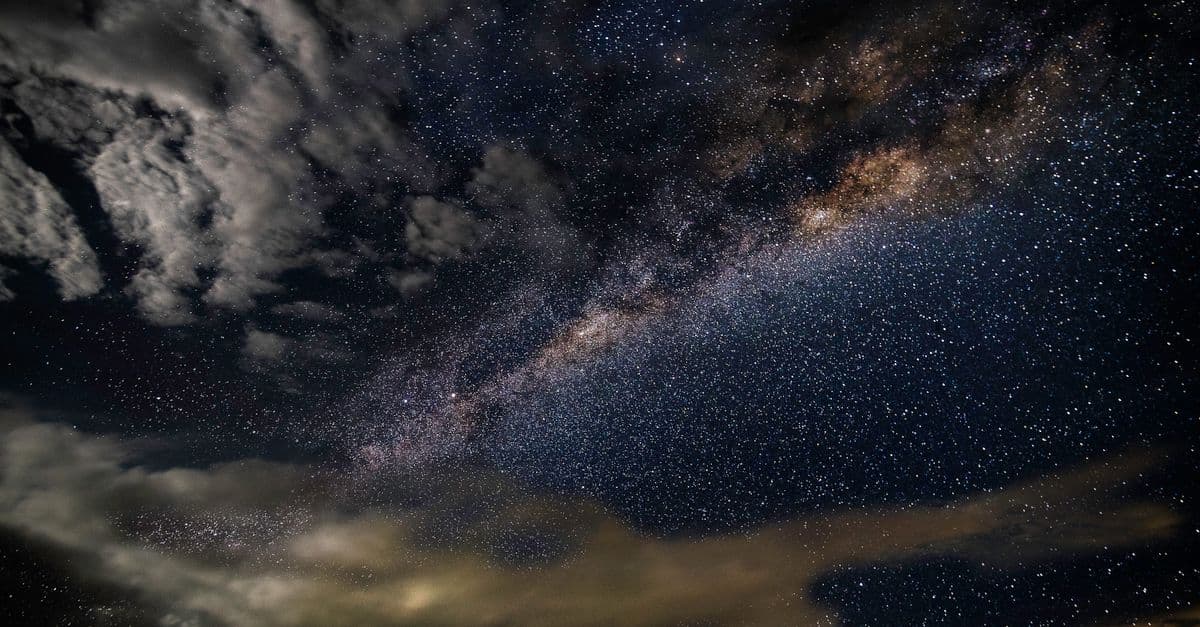
Photo: Arnie Chou / Pexels
In 1963 the astronomer Maarten Schmidt studied the spectrum of 3C 273, a star-like radio source, and found hydrogen lines shifted toward the red by about 15.8%. That placed it roughly 2.4 billion light-years away and made it about four trillion times as luminous as the Sun. Objects like it are now understood as active galactic nuclei (AGN): galaxy cores where a supermassive black hole is feeding on gas. This article explains how AGN shine, why quasars, Seyferts, and blazars are so closely related, and how they shape the galaxies around them.
Key takeaways
- An AGN is a galaxy nucleus powered by gas falling onto a supermassive black hole, not by stars. Accretion can release roughly 6% to about 32% of the infalling mass as energy, compared with 0.7% for hydrogen fusion.
- Seyfert galaxies, quasars, radio galaxies, and blazars differ mainly in luminosity, in how much the dusty torus blocks our view, and in whether a powerful jet is pointed at us.
- Blazars are AGN whose jets point nearly along our line of sight. Relativistic beaming makes them look far brighter and more variable than the same jet seen from the side.
- Jets and winds from AGN heat and expel gas. This feedback is one reason black hole mass tracks the properties of the host galaxy's bulge.
- Black holes of 10⁹ solar masses already existed within about 670 million years of the Big Bang, which is difficult to explain with slow growth from small seeds.
What an active galactic nucleus is, and what it is not
Most large galaxies are believed to contain a supermassive black hole at their center. Few of them are active. The black hole at the center of the Milky Way, Sagittarius A*, has a mass of about 4.30 million Suns according to the GRAVITY collaboration's 2022 measurement, and it is faint. The black hole in the giant elliptical galaxy M87 weighs about 6.5 billion Suns, as measured by the Event Horizon Telescope (EHT) in its first image, and it drives a bright jet. The difference is not mainly the size of the black hole. It is whether gas is falling in, and how fast.
An AGN, then, is a black hole with a steady supply of fuel. The black hole itself emits nothing, since light cannot escape its event horizon. The glow comes from the gas on its way in, which heats up as it falls. This is the key to the extreme luminosity: the central region of an AGN can outshine every star in its host galaxy combined, from a region that is tiny by galactic standards.
The idea took decades to assemble, as the milestones below show.
| Year | Milestone |
|---|---|
| 1909 | Edward Fath records emission lines in the spectra of NGC 1068 and M81 |
| 1943 | Carl Seyfert describes galaxies with bright nuclei and broad emission lines |
| 1954 | Walter Baade and Rudolph Minkowski identify Cygnus A, a radio source, with a distant galaxy |
| 1963 | Maarten Schmidt measures the redshift of 3C 273 (z = 0.158) |
| 1964 | Edwin Salpeter and Yakov Zel'dovich propose accretion onto massive black holes as the power source |
| 1969 | Donald Lynden-Bell proposes that nearby galaxies host dormant "dead quasars" |
Source for the timeline: Wikipedia's overview of active galactic nuclei, which cites the original papers.
How a black hole shines: accretion and the Eddington limit
Gas does not fall straight into a black hole. Like water circling a drain, it keeps most of its sideways motion, so it settles into a flat, rotating accretion disk. Friction and magnetic turbulence in the disk let gas shed angular momentum (the quantity that keeps it in orbit) and slowly spiral inward. Gravitational energy becomes heat, and the inner disk glows brightly, mostly in ultraviolet light.
The efficiency of this process is what makes AGN extreme. Fusion in a Sun-like star releases about 0.7% of the fuel's rest-mass energy. Accretion onto a black hole releases roughly 6% for a non-rotating hole and up to about 32% for a rapidly spinning one, according to the overview of quasars on Wikipedia. Astronomers usually adopt a round value of 10% (an efficiency written as η = 0.1) for estimates.
That allows a simple calculation. The luminosity is L = η × Ṁ × c², where Ṁ is the rate of mass accretion and c is the speed of light. For a luminous quasar with L = 10³⁹ watts (10⁴⁶ erg per second) and η = 0.1:
- Ṁ = L / (η c²) = 10³⁹ W / (0.1 × 9 × 10¹⁶ m²/s²) ≈ 1.1 × 10²³ kg per second.
- Over a year, that is about 3.5 × 10³⁰ kg, or roughly 1.8 solar masses.
So a quasar that outshines a galaxy consumes only a couple of solar masses of gas per year. The most luminous known quasar, J0529-4351, is reported by ESO to shine more than 500 trillion times brighter than the Sun and to grow by just over one solar mass per day, with a black hole of about 17 billion solar masses (ESO press release). Our dedicated article on quasars tells that story.
There is also a ceiling. Radiation pushes outward on the gas and gravity pulls it inward, and at some luminosity the two forces balance. This is the Eddington luminosity, which scales with the black hole's mass: about 1.3 × 10³¹ watts (1.3 × 10³⁸ erg per second) per solar mass. A black hole of 10⁸ solar masses has an Eddington luminosity of roughly 1.3 × 10³⁹ watts, so the quasar in the example above would be running at about 80% of its limit. Super-Eddington accretion is possible when the flow is dense enough to trap photons, but the emerging luminosity saturates at only a few times the limit.
The anatomy of an AGN, from the disk to the jet
An AGN is not a single glowing blob. It has layers, each studied through a different kind of observation.
| Component | Rough scale | What it does | How we learn about it |
|---|---|---|---|
| Accretion disk | Sub-parsec | Radiates ultraviolet and optical light | Continuum shape, variability |
| Corona | Close to the disk | Hot gas above the disk that produces X-rays | X-ray spectra |
| Broad-line region (BLR) | Light-days to light-months | Gas clouds moving at 1,000 to over 10,000 km/s, producing broad emission lines | Reverberation mapping |
| Dusty torus | Parsecs to tens of parsecs | Doughnut-shaped ring of gas and dust that blocks some lines of sight | Infrared emission, obscuration |
| Narrow-line region | Hundreds of parsecs to kiloparsecs | Slower gas (hundreds of km/s) producing narrow emission lines | Direct imaging in nearby AGN |
| Jet | Sub-parsec to megaparsecs | Collimated plasma outflow at nearly the speed of light | Radio, X-ray, optical imaging |
(A parsec is about 3.26 light-years.)
The broad-line region is too small to image in most cases, so astronomers use light echoes. When the disk brightens, the broad-line gas responds after a delay equal to the light travel time across the region. Measuring that delay gives the region's size, and combined with the line widths, the mass of the black hole. A 2013 compilation by Misty Bentz and colleagues of 41 AGN found that the size of the hydrogen-beta emitting region grows with luminosity with a slope of 0.533 and a scatter of 0.19 dex, which turns a single spectrum into a mass estimate. Reverberation mapping of 3C 273 gives a black hole of about 886 million solar masses.
This works much like judging the size of a canyon from the delay of an echo. You cannot see the walls, but the time lag between your shout and its return tells you how far away they are.
The unified model: one engine, many labels
Early astronomers cataloged AGN by what they saw: Seyferts with and without broad lines, quasars, radio galaxies, and flickering objects now called blazars. By the 1980s it was clear that these were not all fundamentally different. The unified model proposes that most of the variety comes from two factors: the direction from which we view the system, and whether the AGN has a strong jet. A third factor, the luminosity, separates mild Seyferts from quasars.
The key observation came from NGC 1068, a Seyfert galaxy that shows only narrow lines in ordinary light. In 1985 Robert Antonucci and Joseph Miller measured its polarized light, which had been scattered around the obscuring material, and found broad lines hiding in it. A hidden broad-line region was there all along, blocked from direct view. In 1995 C. Megan Urry and Paolo Padovani reviewed the evidence in a paper in the Publications of the Astronomical Society of the Pacific and concluded that many AGN properties depend mainly on viewing angle, through obscuration by the dusty torus and relativistic beaming of jets.
A good analogy is a lit window viewed through a thick curtain. Straight on, you see the bright source clearly. Through the curtain's edge, you see only a dim glow. Different angles give different observations of the same light.
| Class | Typical host | Radio output | Spectrum | Main reason it looks this way |
|---|---|---|---|---|
| Seyfert 1 | Spiral | Radio-quiet | Broad and narrow lines | Torus viewed near face-on |
| Seyfert 2 | Spiral | Radio-quiet | Narrow lines only | Torus blocks the broad-line region |
| Radio-quiet quasar | Often merging or bright host | Weak | Broad lines, very luminous | High-luminosity version of Seyfert 1 |
| Radio-loud quasar | Elliptical | Strong jets | Broad lines | Powerful jet, moderate angle |
| FR I radio galaxy | Giant elliptical | Strong, fading lobes | Weak lines | Lower-power jet |
| FR II radio galaxy | Giant elliptical | Strong, edge-bright lobes | Narrow or weak lines | Higher-power jet |
| Blazar | Elliptical | Strong, variable | Featureless or broad lines | Jet pointed nearly at us |
Unification is a framework, not a finished theory. The same sources note that the strict version works partly, and that other factors matter: the accretion rate, the strength of the jet, obscuration within the host galaxy, and where the object is in its life cycle. Some AGN do not fit the simple torus picture neatly.
Seyfert galaxies: the mild end
Carl Seyfert described the class in 1943. Seyfert galaxies are AGN of modest power, with nuclei of roughly 10⁸ to 10¹¹ solar luminosities, in spiral host galaxies that remain easy to see around the glare. Estimates of how common they are vary: Wikipedia's summary gives about 10% of all galaxies in one place and 16% plus or minus 5% in recent surveys, while earlier estimates based on the brightest examples were nearer 1% of spirals.
Type 1 Seyferts show both broad and narrow emission lines. NGC 4151 is a classic example. Type 2 Seyferts show only narrow lines, as in NGC 1068, the Circinus galaxy, and NGC 4945. Intermediate types (1.2, 1.5, 1.8, and 1.9) describe partly obscured broad-line regions, which is what you expect if obscuration varies by degrees.
Seyferts are important because they are close. Their nearness lets astronomers resolve the narrow-line region, map winds, and test the unified model in detail. They also give the clearest view of how a modest AGN affects star formation in its host.
Quasars: the luminous end
A quasar is, at heart, a Seyfert 1 nucleus with so much power that the host galaxy is hard to detect against it. Radio-quiet quasars have little radio emission relative to their optical light. About 10% of quasars are radio-loud, meaning they have powerful jets, and the other roughly 90% are radio-quiet. More than 900,000 quasars had been confirmed as of July 2023, according to the Wikipedia article on quasars.
Quasars were far more common in the past. Activity peaked about 10 billion years ago, at a redshift near 2, which roughly matches the era of the greatest star formation. Nearby quasars are rare because most large galaxies have used up or lost the gas needed to keep the black hole fed. The record-holder for distance among quasars is J0313-1806, at a redshift of 7.642, which means the light left it only about 670 million years after the Big Bang (Wang and colleagues, 2021). It hosts a black hole of about 1.6 billion solar masses and shows high-speed winds with velocities near 20% of the speed of light.
For the history of how quasars were found, how they behave over cosmic time, and how astronomers use them as backlights, see our explainer on quasars. This article focuses on how they fit with the rest of the AGN family.
Radio galaxies: jets that outgrow their hosts
In radio galaxies, a jet dominates the picture. The jets can extend far beyond the visible galaxy and end in huge lobes of radio-emitting plasma. Bernard Fanaroff and Julia Riley split them into two classes in 1974. In FR I sources, the jets are brightest near the galaxy and fade outward. In FR II sources, the jets stay bright to the end and finish in compact hot spots where they strike the surrounding gas.
Cygnus A is the standard example of a powerful radio galaxy. It lies at a redshift of 0.056, about 232 megaparsecs (760 million light-years) away, and has a black hole of roughly 2.5 billion solar masses. Grote Reber found a concentrated radio source in Cygnus in 1939, and in 1951 it became one of the first radio sources matched to an optical object.
Centaurus A is the nearest large example. It lies roughly 11 to 13 million light-years away, hosts a black hole of about 55 million solar masses, and has a radio-emitting region about 1.8 million light-years across. In 2021 the Event Horizon Telescope released an image showing a jet emerging from its core.
M87 shows what a jet looks like up close. The jet extends at least 5,000 light-years from the core. In 1999, Hubble images measured knots in it appearing to move at four to six times the speed of light. This is an illusion of geometry. A source approaching us at close to light speed can nearly keep pace with the light it emits, so the transverse motion we see over time is exaggerated. No object moves faster than light.
Blazars: looking straight down the jet
A blazar is an AGN whose jet points close to our line of sight. The result is spectacular. Material in the jet moves at nearly the speed of light, and that motion compresses and brightens the radiation beamed toward us, an effect called Doppler boosting. A helpful comparison is a train horn: the pitch jumps as the train approaches, and a jet aimed at you is similarly shifted to higher energy and amplified in brightness.
Boosting depends on the Doppler factor, δ = 1 / [Γ(1 − β cos θ)], where Γ is the jet's Lorentz factor, β is its speed as a fraction of light speed, and θ is the angle to the line of sight. For a jet with Γ = 10 seen at θ = 5°, β is 0.995 and δ comes out near 11. Observed brightness rises steeply with the Doppler factor, roughly as its third or fourth power, so a modest-seeming angle can boost the brightness by a factor of thousands. This is why a blazar can look dramatically more powerful than a similar jet seen from the side.
Blazars have several recognizable properties:
- Rapid variability. Their brightness can change significantly over hours or days. Markarian 421, a blazar at a distance of about 400 million light-years, had a gamma-ray outburst in 1996 with a rise time of about 15 minutes, measured at the Whipple Observatory.
- Strong polarization. Synchrotron radiation (light from fast electrons spiraling in a magnetic field) is intrinsically polarized.
- Broad energy coverage. Emission runs from radio waves through gamma rays, in two humps: one from synchrotron radiation and one from higher-energy photons produced by inverse Compton scattering, where fast electrons boost lower-energy light.
There are two main subtypes. BL Lacertae objects have weak or no emission lines. Flat-spectrum radio quasars (FSRQs) show broad emission lines and tend to be more luminous. Brightness and the position of the synchrotron peak are loosely related, an observation called the blazar sequence, though how much of it is real and how much a result of sample selection remains debated.
Blazars also connect to particle astrophysics. On September 22, 2017, the IceCube observatory detected a high-energy neutrino of about 290 teraelectronvolts. Its direction matched TXS 0506+056, a blazar that was flaring at the time, and the team concluded that blazars may be sources of such neutrinos (IceCube Collaboration and partners, 2018). Separately, IceCube reported 79 excess neutrinos from the Seyfert galaxy NGC 1068 at 4.2 sigma, pointing to TeV neutrino production in a nearby AGN (IceCube Collaboration, 2022). Both results are suggestive and have prompted follow-up, but they are not yet a complete picture of how AGN make neutrinos. The space-based Fermi telescope maps the gamma-ray side of this story.
How jets are launched
Two mechanisms, proposed decades ago, dominate the discussion. In the Blandford-Znajek process (1977), magnetic fields threading a spinning black hole extract some of its rotational energy and drive a jet. In the Blandford-Payne process (1982), magnetic fields anchored in the accretion disk fling disk gas outward like beads on a rotating wire. Simulations suggest both can operate, and the Blandford-Znajek process is often favored for the most powerful jets, though this is not settled.
The question of why only about a tenth of AGN have strong jets is also open. Black hole spin, magnetic field strength, and the state of the accretion flow are all candidates. The EHT's images of the shadow of M87's black hole, and the study of its jet base, are aimed in part at answering this directly. Our overview of how black holes form provides background on what lies at the center.
AGN feedback: how a black hole regulates its galaxy
The most important thing AGN do may be to affect the galaxies around them. Black holes are tiny compared with their hosts, yet their masses correlate with properties of the surrounding bulge. The relation between black hole mass and the velocity spread of stars in the bulge (the M-sigma relation) is tight. A 2013 review by John Kormendy and Luis Ho shows it is not a simple story: black holes correlate with classical bulges and elliptical galaxies, not with galaxy disks, and black holes exist in pure-disk galaxies. They describe four regimes of feedback and argue that averaging over successive mergers can also produce tight correlations without any feedback at all.
Two modes of feedback are commonly distinguished.
- Quasar mode (radiative). When a black hole feeds rapidly, radiation and winds can drive gas out of the central region. J0313-1806 is an example, with winds near 20% of light speed. Removing gas starves star formation.
- Radio mode (kinetic). In massive galaxies at the centers of clusters, jets inflate bubbles in the hot gas. These bubbles stir and heat the gas and slow its cooling.
The Perseus cluster provides the most famous example of the second mode. Chandra X-ray images of the galaxy at its center show two bubble-shaped cavities, each about 50,000 light-years wide, pushing aside the hot gas. They also reveal ripples that behave like sound waves, which translate to a B-flat 57 octaves below middle C. According to the Chandra release, the waves may explain why the cluster's gas has not cooled over the past 10 billion years to form trillions of stars. The waves lose energy to the gas as they travel, which heats it.
Computer models of galaxy formation generally include AGN feedback to reproduce the observed split between blue star-forming galaxies and red quiescent ones, and the shortage of very massive galaxies that are still forming stars. Without it, simulated massive galaxies tend to be too big and too blue.
Observations of the early universe test these ideas. In a 2023 study of the James Webb Space Telescope, Adam Carnall and colleagues examined 10 massive quiescent galaxies at redshifts above 3. They found these galaxies formed most of their mass around a redshift of 10, and that two of them had already built more than 10¹⁰ solar masses by a redshift of 8. That means star formation shut down within the first billion years of cosmic history. The authors argue earlier work undercounted such galaxies by a factor of 3 to 5, which deepens tension with theoretical models. What stopped the star formation is not settled; AGN feedback is one candidate. Our overview of what James Webb has found covers the broader results.
Why early supermassive black holes are hard to explain
If a black hole grows by accreting at the Eddington limit with an efficiency of 10%, its mass grows by a factor of e (about 2.7) roughly every 50 million years. That follows from the balance of the Eddington luminosity against the accretion efficiency. Starting from a 100-solar-mass black hole left behind by a massive star, reaching one billion solar masses requires about 16 such growth steps, or roughly 800 million years of uninterrupted, maximum-rate feeding.
That is uncomfortably close to the available time. J0313-1806 already had about 1.6 billion solar masses 670 million years after the Big Bang. At the extreme, a team led by Akos Bogdán reported a heavily obscured, X-ray-luminous black hole in a galaxy at a redshift of about 10.3, seen roughly 500 million years after the Big Bang, using the James Webb telescope and the Chandra X-ray Observatory. Its mass of roughly 10⁷ to 10⁸ solar masses (assuming Eddington-limited growth) is comparable to the stellar mass of its host galaxy. In a paper on the source, the authors argue this is consistent with heavy seeds: black holes of 10,000 to 100,000 solar masses formed by direct collapse of gas clouds, instead of light seeds left by the first stars.
The result is a hint rather than a verdict. It is a single object, the mass depends on an assumption about accretion rate, and rival explanations such as short bursts of super-Eddington growth are still on the table. For the broader context of galaxy mergers and black hole growth, see galactic cannibalism and our comparison of stellar and supermassive black holes.
Common misunderstandings
"Quasars are stars." The name means "quasi-stellar" because they looked like stars in photographs. They are galaxy nuclei billions of light-years away.
"A bright AGN means a huge black hole." Not necessarily. Luminosity depends on both the mass and the accretion rate. A modest black hole feeding quickly can outshine a bigger one that is starved of gas. See our ranking of the biggest black holes ever found for how mass is measured.
"AGN are all in the distant past." Quasars peaked long ago, but milder AGN such as Seyferts are common nearby, and even the Milky Way has shown signs of past activity. The Fermi bubbles, two huge gamma-ray lobes above and below our galaxy, are one candidate relic, as described in our article on them.
"Superluminal jets break relativity." They do not. The apparent speed is a projection effect.
"Black holes pull everything in." A black hole only attracts gas by gravity, as any equal mass would from far away. The glow of an AGN comes from a small amount of gas that spirals in. Most of the surrounding galaxy never falls in.
Frequently asked questions
Q: What is the difference between an AGN and a quasar? A: "AGN" is the general term for any galaxy nucleus powered by accretion onto a supermassive black hole. A quasar is the most luminous kind of AGN, so bright that the host galaxy is hard to see. Seyfert galaxies are lower-luminosity AGN, and blazars are AGN with jets pointed toward us.
Q: Does the Milky Way have an active galactic nucleus? A: No. Sagittarius A* has a mass of about 4.30 million Suns and is currently faint, so the Milky Way is not an AGN today. There is evidence of more activity in the past, such as the Fermi bubbles, but the central black hole is mostly dormant.
Q: What is the unified model of AGN? A: It is the idea that many types of AGN are the same object seen from different angles. A dusty torus hides the broad-line region from some directions, and a jet is seen most directly from one direction. It explains much of the variety but not all of it, since accretion rate and environment also matter.
Q: Why do blazars flicker so fast? A: Their jets point nearly at us, and relativistic beaming shrinks the apparent timescale and boosts the brightness. A change that takes days in the jet's own frame can look like hours to us. Markarian 421 once rose in gamma rays over about 15 minutes.
Q: How do astronomers weigh a black hole in an AGN? A: A common method is reverberation mapping. When the disk brightens, the broad-line gas brightens after a delay equal to the light-travel time across the region. That delay gives the region's size, and the width of the emission lines gives the gas speed, from which the black hole's mass follows.
Q: Can an AGN affect star formation across a whole galaxy? A: Yes, in some cases. Winds can sweep gas out of a galaxy, and jets can heat the gas around it so it cannot cool and form stars. How much this matters across the population of galaxies is still debated.
The takeaway
Active galactic nuclei are a single idea, a black hole fed by gas, expressed in many forms. The differences between a Seyfert, a quasar, a radio galaxy, and a blazar come largely from three things: how much gas is falling in, which way we are looking, and whether a jet is present. What makes AGN more than a catalog of exotic objects is that they link scales that seem unrelated, from an accretion disk smaller than the solar system to a cluster of galaxies millions of light-years wide. The black hole's growth and the galaxy's growth appear to be coupled, though how tightly is still under study. The next test comes from the earliest black holes, which will show whether they began as heavy seeds or grew faster than the standard picture allows.
Sources
- Urry and Padovani, Unified Schemes for Radio-Loud Active Galactic Nuclei, 1995
- Kormendy and Ho, Coevolution (or not) of supermassive black holes and host galaxies, 2013
- Bentz and colleagues, The radius-luminosity relationship for active galactic nuclei, 2013
- Wang and colleagues, A luminous quasar at redshift 7.642, 2021
- Bogdán and colleagues, X-ray luminous black hole in a gravitationally lensed galaxy at a redshift of about 10.3
- Carnall and colleagues, Massive quiescent galaxies at redshifts above 3 in the first JWST CEERS field
- GRAVITY Collaboration, Mass of the central black hole of the Milky Way from stellar orbits, 2022
- IceCube Collaboration and partners, Multi-messenger observations of a flaring blazar coincident with IceCube-170922A, Science, 2018
- IceCube Collaboration, Evidence for neutrino emission from the nearby active galaxy NGC 1068, 2022
- ESO, Brightest quasar press release
- Chandra X-ray Observatory, Perseus cluster sound waves
Related Reading
Follow new articles
Add SciHub101 to your feed reader to see new science and technology stories.
About the Author
SciHub101 is an independent science and technology publication founded and edited by Buğra Sözeri, a software engineer and app developer based in Türkiye. AI tools assist with drafting and research. Source documentation in the existing archive is uneven, and articles are being reviewed and corrected. The Editorial Team byline identifies editorial responsibility; it does not certify specialist or independent human review. Where we compare products, anything built by our own team is labelled as such — see the editorial guidelines and About page for how corrections and disclosures work.
Related Articles
What Is a Gamma-Ray Burst? The Brightest Explosions in the Universe
Gamma-ray bursts are flashes of gamma rays from collapsing massive stars and merging neutron stars. Learn how they work, how astronomers catch them, and why the brightest one on record, GRB 221009A, still puzzles researchers.
How Do Telescopes Work? From Galileo to the 39-Meter ELT
A telescope gathers more light than the eye and resolves finer detail. Galileo's 1609 refractor showed him moons around Jupiter. ESO's 39.3-meter Extremely Large Telescope collects nearly a million times more light than Galileo's lens, once adaptive optics cancels the blur of Earth's atmosphere.
What Are Quasars — The Brightest Objects in the Universe?
Quasars outshine entire galaxies from a region smaller than the solar system. They powered the early universe, shaped galaxy formation, and are now our most powerful probes of cosmic history. Here's what they actually are.
Biggest Black Holes Ever Found
The most massive black holes challenge galaxy formation models. This article explains ultramassive black holes, how mass is measured, and why records change.
How Do Black Holes Form? Every Pathway, From Stars to Seeds
Black holes form through several distinct pathways: massive stars collapsing after fusion ends, neutron star mergers that exceed the mass limit, direct collapse of gas clouds in the early universe, and possibly primordial black holes from density fluctuations just after the Big Bang. Supermassive black holes remain partly mysterious in origin, but likely grew through a mix of heavy seeds, mergers, and accretion.
What Is Galaxy Evolution? How Galaxies Change Over Cosmic Time
Galaxies are not static objects. They grow, merge, transform, and eventually fall quiet. Over 13.8 billion years the universe has gone from small, chaotic protogalaxies to the spirals and giant ellipticals we see today, and tracing that transformation is one of astronomy's deepest challenges.