What Is Galaxy Evolution? How Galaxies Change Over Cosmic Time
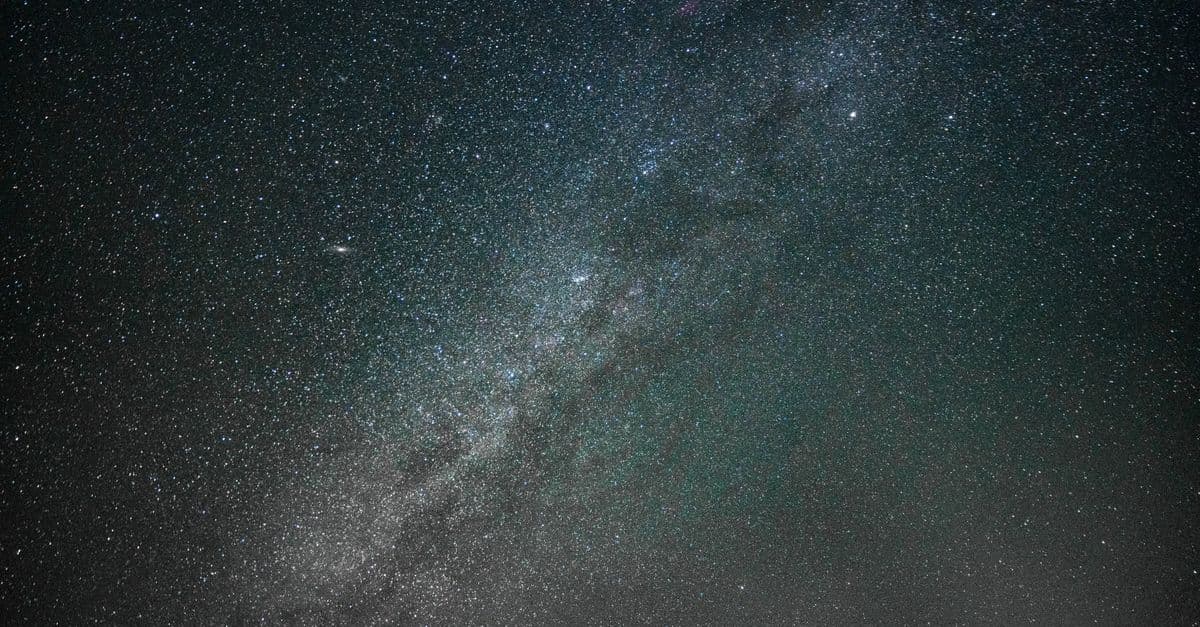
Photo: Aarin Husain / Pexels
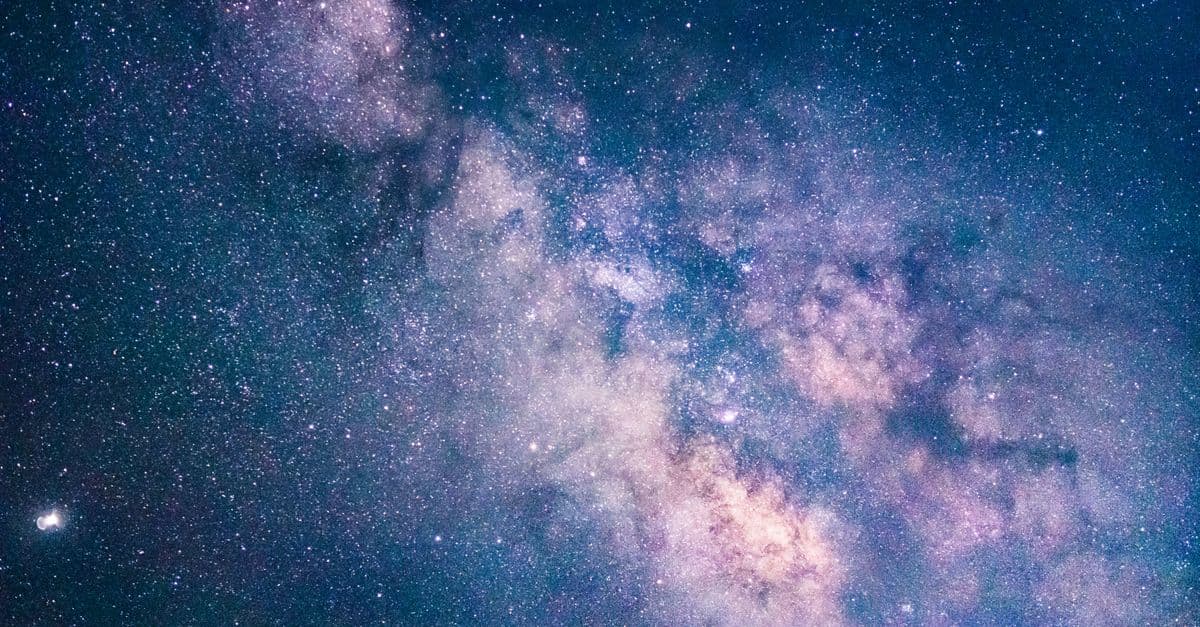
The Milky Way looks like a settled, orderly spiral: a thin disk of young blue stars, a bulge of older red ones, and hundreds of billions of stars in all. It was not always this tidy. Roughly 10 billion years ago it swallowed a smaller galaxy that left a permanent mark on its structure, and it is still eating its neighbors today. Galaxy evolution is the study of how galaxies change their shapes, sizes, colors, star formation rates, and chemical makeup over cosmic time, and why some stay blue and busy while others turn red and quiet.
Why galaxies change at all
A galaxy is a bookkeeping problem. Gas flows in from the surrounding cosmic web, some of it turns into stars, some is blown back out by exploding stars and black holes, and smaller galaxies fall in and get absorbed. Whether a galaxy ends up as a blue spiral or a red elliptical depends on how those four accounts balance over billions of years.
The stage for all of this is set by dark matter. In the standard cosmological model, small clumps of dark matter collapsed first, and larger ones assembled later by merging smaller ones, a bottom-up process called hierarchical structure formation. Ordinary gas falls into these dark matter halos and cools, and that is where galaxies form. Imagine a stream of creeks feeding bigger rivers, which feed a lake: each galaxy is a lake whose level depends on the inflow, the stars it makes, and how much water gets pumped back out. Astronomers can estimate how much mass a galaxy contains using methods explained in how astronomers weigh galaxies, and the gravitational scaffolding comes from the dark component described in dark matter and dark energy explained.
Because light takes time to travel, telescopes are time machines. A galaxy 10 billion light-years away is seen as it was 10 billion years ago. Astronomers therefore do not watch any single galaxy evolve. They line up snapshots of many galaxies at different distances, like photographs of different people at different ages, and infer the life story of the whole population. For how we count those snapshots, see how many galaxies are in the universe.
The bimodal galaxy population
The most striking fact about galaxies in the nearby universe is that they sort themselves into two groups instead of spreading smoothly across all colors and shapes. Astronomers call this bimodality.
- The blue cloud: Spiral and irregular galaxies, including the Milky Way, that are actively forming stars. Their blue color comes from short-lived, hot young stars. They are rich in gas and dust.
- The red sequence: Elliptical and lenticular galaxies that form few or no new stars. Their light is dominated by old, cool, red stars, and they contain little cold gas. The most massive galaxies in the universe, such as the giants at the centers of galaxy clusters, belong here.
- The green valley: A thinly populated zone between the two. Galaxies caught here appear to be in transition from star-forming to quiet, and there are fewer of them than in either group, which suggests that the crossing can be fast.
| Property | Blue cloud | Green valley | Red sequence |
|---|---|---|---|
| Typical shape | Spiral, irregular, dwarf | Mixed | Elliptical, lenticular |
| Star formation | Active | Declining | Little or none |
| Dominant stars | Young, hot, blue | Mixed ages | Old, cool, red |
| Cold gas | Abundant | Depleted | Scarce |
| Population | Many | Few | Many |
Among star-forming galaxies, the rate of star formation tracks stellar mass tightly: more massive galaxies form stars faster. This relation is called the star-forming main sequence, and it has a scatter of only a factor of about two. Galaxies that fall far below it are the ones in the process of shutting down.
Gravity alone does not predict the split. Something must switch star formation off in some galaxies and keep it off. That something is called quenching, and it is the central puzzle of the field.
The cosmic star formation history
Astronomers can add up all the star formation in a volume of space at each epoch to produce a curve of the universe's stellar baby boom. In a widely cited review, Piero Madau and Mark Dickinson, writing in the Annual Review of Astronomy and Astrophysics, summarized the shape of that curve in their 2014 paper.
- The star formation rate density peaked at a redshift of about 1.9 (redshift, abbreviated z, measures how much the universe has stretched since the light left; higher z means farther back in time). That moment was about 3.5 billion years after the Big Bang. Astronomers nickname this period cosmic noon.
- After the peak, the rate declined exponentially with an e-folding time of 3.9 billion years, which works out to a drop of an order of magnitude or more by today.
- Half of the stellar mass in the universe today formed before z = 1.3. About 25 percent formed before the peak, and another 25 percent formed after z = 0.7.
- Less than about 1 percent of today's stars formed during the era of reionization, the time when the first stars and galaxies lit up and transformed the intergalactic gas. That era is covered in what reionization is.
In other words, the universe made most of its stars when it was between roughly 2 and 6 billion years old. We live in the long, quiet afterglow of the baby boom. The fall since cosmic noon reflects several things at once: gas supplies drying up as the universe expanded, the shutdown of massive galaxies, and feedback keeping remaining gas from cooling.
| Epoch | Time after Big Bang | What was happening |
|---|---|---|
| Cosmic dawn | Under about 0.5 billion years | First galaxies assembling; very few stars in total |
| Cosmic noon (z about 1.9) | About 3.5 billion years | Peak of star formation across the universe |
| Mid-life (z about 1.3) | Roughly 4.5 to 5 billion years | Half of today's stellar mass already in place |
| Today | 13.8 billion years | Star formation concentrated in disk galaxies; massive ellipticals quiet |
How galaxies grow: gas streams and hot halos
Cold streams feed young galaxies
Gas does not just sit around waiting to be turned into stars. In the early universe, much of it arrived along filaments of the cosmic web, which you can read about in the cosmic web. In halos below a critical mass, this gas reaches the galaxy as relatively cool streams, never heated to the halo's virial temperature (the temperature gas reaches when it falls into the halo and is thermalized). Cold streams feed star formation efficiently, and they explain how young galaxies could form stars so fast.
Why a hot halo shuts the tap
In 2006, Avishai Dekel and Yuval Birnboim published a model that explained part of the bimodality in terms of this gas behavior. Their paper, Galaxy Bimodality due to Cold Flows and Shock Heating, put the critical threshold at a halo mass of about 10¹² solar masses, and the bimodality itself at a stellar mass around 3 × 10¹⁰ solar masses. Below the threshold, cold streams build disks. Above it, at redshifts below 2, a stable shock heats the infalling gas and leaves it dilute and hot, which makes it far more vulnerable to being heated further by black hole feedback. The result, in their picture, is the passively evolving red-and-dead spheroid, starting around z of about 1.
Think of a garden hose and a pot on a stove. A small galaxy gets a steady trickle of cool water straight into the pot. A big galaxy sits inside a halo of steaming gas that never reaches the pot, and a hot, thin atmosphere does not collapse into stars.
Mergers: collisions that rebuild galaxies
Galaxies also grow by eating each other. When two galaxies pass close enough for gravity to overcome their relative motion, they lose orbital energy through a process called dynamical friction and spiral together. The stars rarely collide, because the spaces between them are enormous, but the gas clouds do, and the shared gravity rearranges everything.
Astronomers sort mergers by the mass ratio of the two partners:
- Major mergers between galaxies of comparable mass tend to destroy disks and build elliptical shapes, and they can trigger intense bursts of star formation and feed central black holes.
- Minor mergers, in which a small galaxy falls into a big one, are more frequent and gentler. They thicken disks, add to bulges, and leave streams of stars across the halo.
The Antennae Galaxies (NGC 4038 and NGC 4039) are a textbook ongoing major merger. A 2008 Hubble study placed them at about 45 million light-years, closer than the earlier estimate of 65 million, by measuring the brightness of their red giant stars. The two galaxies began interacting a few hundred million years ago, and they are used as a standard laboratory for testing galaxy evolution theory.
The Milky Way's own history
Our galaxy shows how this works. Using data from the Gaia satellite, a team led by Amina Helmi of the University of Groningen identified a merger that happened about 10 billion years ago. The galaxy that fell in, named Gaia-Enceladus (it is sometimes called the Gaia Sausage), was slightly larger than the Small Magellanic Cloud, according to the Groningen release on the work. Most stars in the Milky Way's halo came from that single event, and the merger stirred up and inflated the thick disk. The wider story of our galaxy's growth is told in galactic cannibalism: the Milky Way's history of mergers.
The popular claim that the Milky Way and Andromeda will certainly collide in about 4.5 billion years has also been revised. A 2025 study in Nature Astronomy led by Till Sawala of the University of Helsinki, summarized in a University of Western Australia release, reanalyzed Hubble and Gaia data and found about a 50 percent chance of a merger within 10 billion years. The Large Magellanic Cloud, a satellite now falling into the Milky Way, pulls our galaxy's motion away from Andromeda and lowers the odds, while the Triangulum Galaxy nudges Andromeda toward us. The collision is possible, but it is no longer a certainty, and any merger would be at least several billion years away.
Merger trees and the hierarchy
Simulations of dark matter record the assembly history of every halo as a merger tree: each large halo today is the end product of many smaller progenitors fusing together. Observations support the picture through the structure of stellar halos, which are built from dissolved satellites, and through the way galaxy populations change with distance. Merger rates were higher in the past, when the universe was denser, and have declined as expansion has pulled things apart.
Quenching: why galaxies stop forming stars
Quenching is the shutdown of star formation, and it is among the most debated topics in astrophysics. No single mechanism does the job everywhere. Different processes dominate at different galaxy masses and in different environments.
Black hole feedback
Most large galaxies host a supermassive black hole at the center, as described in stellar versus supermassive black holes. When gas falls onto it, the black hole shines as an active galactic nucleus, a topic covered in what active galactic nuclei are. That energy can heat or expel gas from the host galaxy. Astronomers distinguish two broad modes:
- Radiative (quasar) mode: At high accretion rates, the nucleus drives powerful winds that can sweep gas out of the galaxy over short timescales. These outflows are seen directly in the spectra of quasars, the brightest of which are described in what quasars are.
- Kinetic (jet) mode: At low accretion rates, as in massive ellipticals today, jets of radio-emitting plasma heat the surrounding hot gas so that it cannot cool and fall in. In the Perseus galaxy cluster, Chandra X-ray images show cavities in the hot gas blown by the jets of the central galaxy NGC 1275. The energy deposited by these jets counters the radiative cooling that would otherwise feed new stars.
The existence of a tight relationship between black hole mass and the velocity spread of stars in the host galaxy's bulge suggests that galaxies and their black holes grew together, with the black hole acting as a regulator.
Environmental quenching
Galaxies in dense clusters get quenched by their surroundings, and this has nothing to do with their own mass.
- Ram pressure stripping: A galaxy plowing through the hot gas of a cluster at roughly 1,000 km/s feels a headwind with pressure proportional to the gas density times the speed squared. If that pressure exceeds the pull of the galaxy's own gravity, the gas is stripped away, sometimes leaving long tails of ionized gas that give "jellyfish galaxies" their name. A 2017 Nature study by Bianca Poggianti and colleagues reported active nuclei in most of the jellyfish galaxies with the longest tails in their sample, hinting that stripping may also feed black holes.
- Strangulation: The hot cluster gas removes the galaxy's outer gas reservoir, cutting off the supply of fresh fuel. The remaining gas is slowly used up, and star formation fades over billions of years.
- Harassment: Repeated close, fast encounters in a crowded cluster stir up disks and can convert spirals into lenticular galaxies.
These processes produce the morphology-density relation. In 1980, Alan Dressler measured about 6,000 galaxies in 55 nearby rich clusters and found that the fraction of ellipticals and lenticulars rises, and the fraction of spirals falls, as the local galaxy density increases. Spirals dominate the sparsest regions and are a small minority in the densest clumps.
Mass quenching
Even isolated massive galaxies quench, which means the process cannot depend on environment alone. The hot halo described above is one explanation, since a stable shock keeps gas from reaching the galaxy. Black hole feedback then keeps the hot gas from cooling. In practice, these two mechanisms work together: a hot halo stops the supply, and the jets prevent it from restarting.
| Mechanism | Where it acts | What it removes | Evidence |
|---|---|---|---|
| Quasar-mode feedback | Massive galaxies, often at high redshift | Cold gas, via outflows | Outflows in quasar spectra |
| Jet-mode feedback | Massive ellipticals, cluster centers | Prevents hot gas from cooling | X-ray cavities in Perseus and other clusters |
| Hot halo (shock heating) | Halos above about 10¹² solar masses | Gas supply | Simulations and bimodality in galaxy properties |
| Ram pressure stripping | Galaxies in clusters | Existing gas | Jellyfish galaxies, long gas tails |
| Strangulation | Cluster and group satellites | Gas reservoir | Slow fading of star formation in satellites |
| Mergers | All masses | Gas, via starbursts and shape change | Antennae and other merging pairs |
How galaxies change shape
As galaxies turn from star-forming to quiet, their shapes change too. Galaxies at cosmic noon were typically clumpier and more irregular than nearby spirals, held a much larger share of their mass as gas, and had more turbulent gas motions. Reviews of the cold gas in galaxies across cosmic time, such as the 2020 review by Linda Tacconi, Reinhard Genzel, and Amiel Sternberg, show that gas fractions in typical star-forming galaxies have fallen strongly since the peak of cosmic star formation.
One of the long-running puzzles is the compactness of early quiet galaxies. Observations at redshift of about 2 found massive, quiescent galaxies, nicknamed red nuggets, that were several times smaller than nearby ellipticals of the same stellar mass. How do you grow a galaxy's size without adding much mass? The leading explanation is minor mergers: the galaxy keeps swallowing small satellites whose stars settle in the outskirts, puffing up the system without adding much total mass. The details remain debated.
For the spiral shapes that survive, see why galaxies have spiral arms, and for the Milky Way's present structure, see what the Milky Way is.
What JWST is revealing
The James Webb Space Telescope observes in the infrared, which lets it see the rest-frame visible and ultraviolet light of very distant galaxies after cosmic expansion has stretched it. The overview in what JWST has found covers the telescope in general. For galaxy evolution, a few results stand out.
Galaxies appear very early. The Nature paper by Stefano Carniani and colleagues confirmed JADES-GS-z14-0 with spectroscopy at a redshift of about 14.3, roughly 300 million years after the Big Bang. Galaxies exist that early, and some are luminous.
Quiet galaxies appear very early too. A team led by Adam Carnall used JWST to confirm a massive quiescent galaxy, GS-9209, at z = 4.658, about 1.25 billion years after the Big Bang. It holds about 3.8 × 10¹⁰ solar masses of stars, formed over roughly 200 million years before star formation shut down when the universe was about 800 million years old. Later JWST studies have reported massive quiescent galaxies at even higher redshifts, in numbers that some models struggle to reproduce, though these counts rest on very few objects and will be tested by larger surveys.
Disks show up earlier than expected. Analyses of JWST survey fields such as CEERS have found disk-like galaxies to be common even at redshifts of 3 and beyond. Classification at these distances is difficult, and other analyses suggest some compact, elongated galaxies may be mistaken for disks, so the exact fractions are uncertain.
The "too massive, too early" debate
Early JWST results suggested a handful of galaxies at z of 7 to 9 with stellar masses above 10¹⁰ solar masses, which seemed to strain the standard cosmological model. Subsequent work has softened the tension. Analyses that include strong nebular emission give stellar masses up to roughly a factor of 10 lower, and some of the reddest compact sources, called little red dots, have turned out to contain active black holes whose light had been counted as starlight. Later analyses of the stellar mass function found no galaxy clearly exceeding the maximum mass allowed by the standard model, though some do require that an unusually high fraction of gas turned into stars.
The better description is that early galaxies formed stars more efficiently than many simulations assumed, not that cosmology is broken. Which mechanisms allow this, such as bursty star formation or reduced feedback at low metal content, is an active research question.
Galactic archaeology: reading history from nearby stars
Distant snapshots are one tool. The other is to dissect a nearby galaxy star by star, an approach called galactic archaeology.
- Ages and abundances. Stars preserve the chemistry of the gas they formed from. Stars in the Milky Way's thick disk are enriched in alpha elements (oxygen, magnesium, and similar), a pattern that indicates they formed quickly, before Type Ia supernovae had time to add iron. The thin disk formed more slowly. These patterns are used to reconstruct star formation histories.
- Orbits. Gaia has measured the positions and motions of more than a billion stars. Groups of stars with shared unusual orbits are fossils of ancient mergers, and Gaia-Enceladus was identified this way.
- Streams. Satellite galaxies that fall into larger ones are stretched into long streams. The Andromeda Galaxy has a prominent stream tracing a past infall event.
The Milky Way is a useful benchmark because it is the one galaxy we can study at this level of detail, though it may not be typical. A glimpse of the oldest stellar systems around it appears in what globular clusters are.
What people get wrong about galaxy evolution
"Galaxies evolve along a single track from spiral to elliptical." There are many routes. Some spirals become lenticulars through gas stripping, some ellipticals form in mergers, and some small galaxies stay blue for their entire lives. Not every elliptical was once a spiral.
"Quenching means a galaxy has died." A quenched galaxy has stopped forming stars at a significant rate, but it still holds billions of stars that continue to shine for billions of years. Some quenched galaxies later receive fresh gas through mergers and resume forming stars.
"JWST has broken the Big Bang." The telescope has found galaxies that are brighter or more mature than some models expected, but later analyses have reduced the claimed stellar masses in several cases. The result is a revision of how efficient early star formation was, not a rejection of cosmology. For the standard picture, see the Big Bang explained.
"We watch galaxies change in real time." Galaxy evolution takes hundreds of millions to billions of years, so astronomers cannot watch a galaxy evolve. They compare populations at different distances, and use simulations to connect the dots. Edwin Hubble's 1929 observations of galaxy motions, discussed in Edwin Hubble's profile, started the practice of reading cosmic history from galaxies.
The takeaway
Galaxies are the result of a long competition between fuel, stars, and feedback. In the first few billion years, plentiful gas and frequent mergers drove the universe to its peak of star formation. Since then, cold gas supplies have thinned, hot halos have stopped fresh gas from reaching massive galaxies, black hole jets have kept that gas hot, and clusters have stripped the gas from their members. JWST has pushed the story back to within a few hundred million years of the Big Bang and shown that galaxies, including quiet ones, grew up faster than expected. The open question is not whether this story is right in outline, but which processes dominate at each mass and epoch.
Sources
- Madau and Dickinson, Cosmic Star Formation History, Annual Review of Astronomy and Astrophysics 52 (2014)
- Dekel and Birnboim, Galaxy Bimodality due to Cold Flows and Shock Heating, MNRAS 368 (2006)
- Carnall et al., A massive quiescent galaxy at redshift 4.658, Nature (2023)
- ESA/Hubble, The Antennae moves closer
- University of Groningen, Astronomers discover the giant that shaped the early days of our Milky Way
- University of Western Australia, Astronomers thought the Milky Way was doomed to crash into Andromeda
Q: What is galaxy evolution? A: Galaxy evolution is the study of how galaxies change over cosmic time, including their shapes, sizes, colors, star formation rates, and chemical composition. Astronomers study it by comparing galaxies at different distances (and therefore different ages), by dissecting nearby galaxies star by star, and by running simulations of galaxies growing inside dark matter halos.
Q: When did the universe form the most stars? A: Star formation across the universe peaked at a redshift of about 1.9, roughly 3.5 billion years after the Big Bang, according to a widely cited 2014 review by Madau and Dickinson. It has declined since then. Half of today's stellar mass had already formed before a redshift of 1.3.
Q: What is quenching? A: Quenching is the shutdown of star formation in a galaxy. It happens through several mechanisms, including heating by supermassive black hole jets and winds, hot gas halos that stop fresh gas from arriving in massive galaxies, and stripping of gas by the hot medium in galaxy clusters. Which mechanism dominates depends on a galaxy's mass and environment.
Q: Will the Milky Way collide with Andromeda? A: Possibly, but not certainly. A 2025 study in Nature Astronomy led by Till Sawala estimated about a 50 percent chance of a merger within 10 billion years, once the Large Magellanic Cloud and other nearby galaxies were included. Earlier predictions of a collision in about 4.5 billion years are no longer considered safe.
Q: Has JWST found galaxies that break the standard model of cosmology? A: Not so far. Early reports of overly massive galaxies were revised downward in several cases because of nebular emission and black hole contamination, and later analyses found no galaxy clearly above the maximum mass the standard model allows. JWST has shown that early galaxies, including some quiet ones, formed stars more efficiently than many simulations assumed.
Q: What is the difference between a blue cloud and a red sequence galaxy? A: Blue cloud galaxies are mostly spirals and irregulars that are actively forming stars, and their light is dominated by young blue stars. Red sequence galaxies are mostly ellipticals and lenticulars that have stopped forming stars, so their light is dominated by old, cool stars. Galaxies in the sparse region between them are thought to be in transition.
Related reading:
Follow new articles
Add SciHub101 to your feed reader to see new science and technology stories.
About the Author
SciHub101 is an independent science and technology publication founded and edited by Buğra Sözeri, a software engineer and app developer based in Türkiye. AI tools assist with drafting and research. Source documentation in the existing archive is uneven, and articles are being reviewed and corrected. The Editorial Team byline identifies editorial responsibility; it does not certify specialist or independent human review. Where we compare products, anything built by our own team is labelled as such — see the editorial guidelines and About page for how corrections and disclosures work.
Related Articles
What Is Helioseismology? Listening to the Sun's Heartbeat
The Sun rings like an enormous bell. Convection keeps striking it, and the resulting sound waves bounce around inside, shifting the visible surface by tiny amounts. Measuring those shifts lets astronomers map the Sun's interior, rotation, and composition.
How Do We Search for Dark Matter? Detection Experiments and Methods
Dark matter makes up 27% of the universe's energy content, yet its nature remains one of science's deepest mysteries. Physicists are searching for it underground, in space, at particle accelerators, and with gravitational telescopes — using every tool available to trap something that refuses to interact.