What Is Stellar Feedback? How Stars Reshape the Galaxies They're Born In
Photo: Felix Mittermeier / Pexels
Stellar feedback is the energy, momentum, and mass that stars pump back into the gas they formed from. Ultraviolet light from young massive stars ionizes and pushes away their birth clouds, stellar winds blow bubbles, and supernovae drive shocks that sweep through galaxies. Without feedback, gravity would turn gas into stars far faster than we observe. With it, star formation stays slow and heavy elements spread far from where they were made.
Why star formation is so slow
The puzzle that feedback solves is one of efficiency. Gravity should be able to turn a cold molecular cloud into stars quickly, but it does not.
The benchmark is the free-fall time, the time a cloud would take to collapse under its own gravity if nothing resisted. It depends only on density:
$$t_{ff} = \sqrt{\frac{3\pi}{32G\rho}}$$
For a giant molecular cloud with about 100 hydrogen atoms per cubic centimeter, a typical value, I get a free-fall time of roughly 4 to 5 million years from this formula, depending on the assumed mean mass per particle. Denser clumps collapse faster, scaling as the inverse square root of density. If a cloud converted all its gas to stars on that timescale, the galaxy's star formation rate would be enormously higher than what astronomers measure.
It is not. Krumholz and Tan (2007) reviewed observations across clouds, infrared dark clouds, and dense clumps and found that only about 1 percent of the gas forms stars per free-fall time, with no jump to rapid star formation even at much higher densities. Star formation, in their words, is slow, which argues against models in which clusters form in a single free-fall collapse.
Two ingredients slow it down. Turbulence (chaotic gas motions that provide pressure support) keeps most of a cloud from collapsing, so only dense subregions form stars. Stellar feedback then clears away what remains. The ratio is easiest to see in the lifecycle of whole clouds.
Chevance and colleagues (2020) applied a statistical method to nine nearby disk galaxies from the PHANGS-ALMA survey and found that giant molecular clouds live only 10 to 30 million years. Clouds spend 75 to 90 percent of that time without massive stars, and once massive stars emerge, the clouds disperse within 1 to 5 million years. The authors concluded that early feedback drives the dispersal and leaves each cloud with an integrated star formation efficiency of about 4 to 10 percent.
| Quantity | Value | Source |
|---|---|---|
| Star formation efficiency per free-fall time | About 1% | Krumholz and Tan (2007) |
| Cloud lifetime | 10 to 30 million years | Chevance et al. (2020) |
| Fraction of cloud life without massive stars | 75 to 90% | Chevance et al. (2020) |
| Cloud dispersal after massive stars appear | 1 to 5 million years | Chevance et al. (2020) |
| Integrated efficiency over a cloud's life | About 4 to 10% | Chevance et al. (2020) |
| Gas forming stars before the H II region blows the rest away | Under 10% | Summary of H II region studies (Wikipedia) |
How slowly and inefficiently molecular clouds convert gas to stars.
Feedback acts like a thermostat. When star formation heats and pushes the surrounding gas, it reduces the supply of cold dense gas that star formation needs, so the system regulates itself. Stars are both the product and the brake. For the objects this regulation produces, see Stellar Nurseries: How Stars Are Born in the Dark.
Radiation feedback: H II regions
The first feedback arrives long before the first supernova. Massive O and B stars emit enough ultraviolet radiation to strip electrons from hydrogen atoms, and the surrounding gas becomes an H II region (a bubble of ionized hydrogen).
H II region — a region of gas ionized by the ultraviolet light of hot young stars, typically at about 10,000 K, compared with 10 to 20 K for the cold molecular cloud it came from.
The size of the bubble is set by a balance. Ionizing photons make new ions, and ions recombine with electrons to form neutral atoms again. The Strömgren radius is where the two rates are equal:
$$r_S = \left(\frac{3Q_{H}}{4\pi \alpha_B n^2}\right)^{1/3} \approx 7,\text{pc} \left(\frac{Q_H}{10^{50},\text{s}^{-1}}\right)^{1/3} \left(\frac{n}{100,\text{cm}^{-3}}\right)^{-2/3}$$
Here Q is the number of ionizing photons emitted per second, n is the gas density, and αB is the recombination coefficient, about 2 to 3 × 10⁻¹³ cm³ per second at 10⁴ K. The 10⁵⁰ photons per second is an illustrative round number for a cluster of massive stars. Plugging it in, I get about 7 parsecs (about 23 light-years). The size shrinks quickly as the gas gets denser, so a compact cluster in dense gas makes a small bright region and the same stars in thin gas make a large one.
Ionized gas is hot, and hot gas has high pressure. The H II region therefore expands into the colder neutral gas around it, sweeping that gas into a dense shell. Where the cloud has an edge, the ionized gas streams out into the thinner surroundings. H II regions last of the order of a few million years, and radiation pressure from the hot young stars drives much of the gas away. Reference summaries put the share of gas that becomes stars at under 10 percent before the rest is blown off.
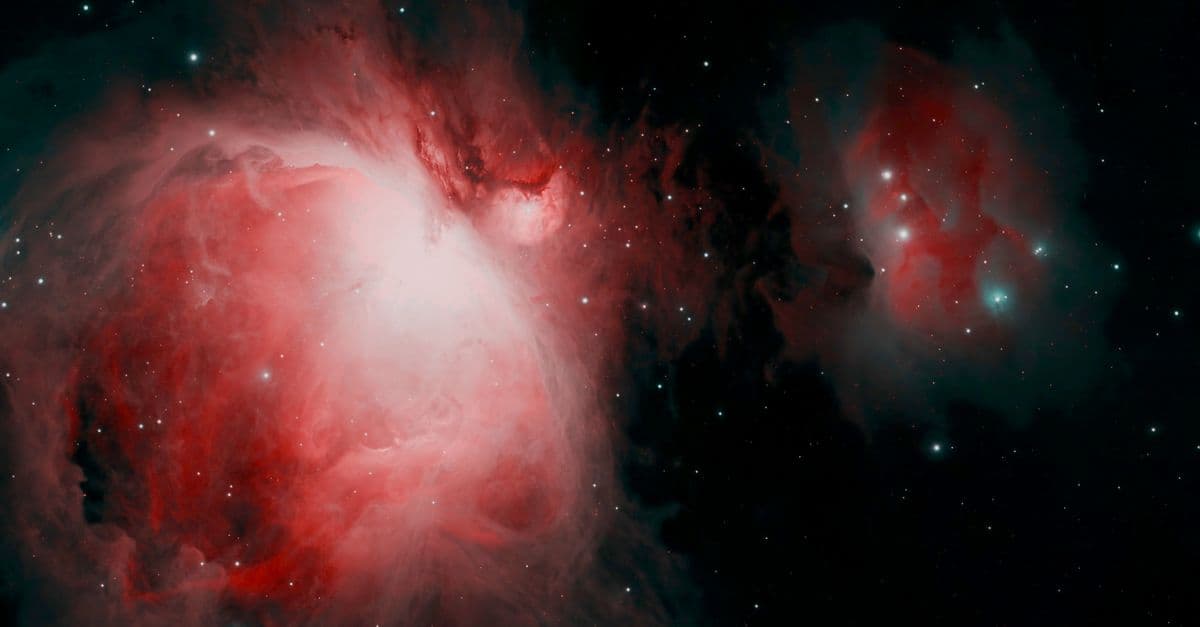
The nearest example is the Orion Nebula, about 500 parsecs (1,500 light-years) away. It is a thin layer of ionized gas on the face of the molecular cloud OMC-1, lit mainly by the Trapezium cluster and especially the star θ¹ Orionis. See The Orion Molecular Cloud for the larger structure.
Radiation pressure and photodissociation
Photons push as well as heat. Ultraviolet and infrared light is absorbed by dust grains that are coupled to the gas, so the force on a column of gas and dust is approximately
$$F_{rad} = \frac{(1+\tau_{IR})L}{c}$$
where L is the luminosity of the cluster, c is the speed of light, and τIR is the optical depth to infrared light. When the dusty gas is thick enough that infrared photons are absorbed and re-emitted several times, the force is multiplied. In the densest, dustiest starbursts, radiation pressure can rival other feedback processes, and how much it matters in a given system is still debated.
Photons with energies between about 6 and 13.6 eV cannot ionize hydrogen but can break apart molecules such as H₂ and CO. They create photodissociation regions, the transition zone between ionized gas and cold molecular gas. Telescopes such as ALMA and Herschel trace these zones through the [C II] line at 158 micrometers and the [O I] line at 63 micrometers, and the heating in this layer helps set the temperature of the neutral interstellar medium.
Stellar winds: the quiet bulldozers
Massive stars also lose mass in fast winds. O and B stars shed material relatively slowly, at rates of order 10⁻⁷ to 10⁻⁶ solar masses per year, but at very high speeds, and radiation pressure on absorption lines of heavy elements such as carbon and nitrogen drives the outflow. Over a lifetime, a very massive star can lose up to half its mass.
The energy is substantial. Take a mass-loss rate of 10⁻⁶ solar masses per year and a speed of 2,000 kilometers per second. The wind's kinetic power, ½ × mass-loss rate × speed², works out to about 10³⁶ erg per second by my arithmetic. Over 3 million years that is about 10⁵⁰ erg, roughly 10 percent of the 10⁵¹ erg of a single supernova, delivered by one star. A cluster with many such stars multiplies the total, and Wolf-Rayet stars, which are evolved stars shedding their outer layers at high rates, contribute heavily.
Winds blow wind-blown bubbles: hot, low-density interiors surrounded by a shell of swept-up gas, a structure described in the classic model of Weaver and colleagues (1977). Their importance is that they pre-condition the surroundings. By the time the first supernova explodes, the neighborhood has already been partly cleared, which changes how efficiently the explosion couples to the gas.
Winds do not only come from massive stars. Asymptotic giant branch stars, the late stages of stars of intermediate mass, lose mass in dust-driven winds and return carbon, dust, and slow-neutron-capture elements to the interstellar medium. In old stellar populations, where massive stars have long since died, these winds are a main source of recycled gas, though their feedback is gentle compared with supernovae.
Supernovae: the largest single injection
A core-collapse supernova, the death of a star of more than about eight solar masses, releases roughly 10⁵¹ erg of kinetic energy, a unit astronomers call 1 foe. Ejecta can move at speeds of up to about 10 percent of the speed of light, though the bulk is slower. The Milky Way's rate is estimated at about 1.6 to 4.6 supernovae per century. At two per century, the average power is about 6 × 10⁴¹ erg per second by my arithmetic, enough to stir the entire galactic disk. For the explosion types, see Supernova Explained.
A supernova remnant evolves through stages, and the stage matters for feedback.
| Phase | What happens | Approximate duration |
|---|---|---|
| Free expansion | Ejecta coast until they sweep up about their own mass | Tens to a few hundred years |
| Sedov-Taylor | Hot shocked gas drives the shell; strong X-ray emission | Until radiative losses become important |
| Snowplow (radiative) | Shell cools into a dense layer, under about 1 parsec thick | Until the remnant slows to the local gas speed |
| Merger with the interstellar medium | Remnant slows to the local gas speed and feeds turbulence | After about 30,000 years |
The stages of a supernova remnant. Durations depend on gas density, so only the endpoints are well defined.
During the Sedov-Taylor stage the shock radius grows as R ∝ (E/ρ)1/5 t2/5, where E is the explosion energy, ρ is the gas density, and t is time. The remnant's interior is filled with million-degree plasma that glows in X-rays. In the snowplow phase the shell radiates away its thermal energy, but it keeps moving on its momentum, like a bulldozer rolling after the engine is cut.
For feedback, the number that matters is the momentum a supernova gives the surrounding gas. Observations of seven Milky Way radiative remnants with measurable atomic shells put the shell momentum between about 0.5 and 4.5 × 10⁵ solar masses times kilometers per second, consistent with an explosion of about 10⁵¹ erg (Koo and colleagues, "Radiative Supernova Remnants and Supernova Feedback"). That agreement matters, because galaxy simulations have to inject the right momentum to reproduce real galaxies.
Superbubbles and the Local Bubble
Stars are born in clusters, so their supernovae overlap in space and time. Together they carve a superbubble, a hot, low-density cavity hundreds of parsecs across. Superbubbles are efficient because the hot interior keeps its pressure while the explosions continue, which lets the gas push out of the disk.
The Sun lives inside one. The Local Bubble is a region of low-density gas at least 1,000 light-years across, and its gas is far thinner than the typical interstellar medium (about 0.05 atoms per cubic centimeter in commonly quoted estimates). Studies attribute it to 14 to 20 supernovae from stellar groups in the Scorpius-Centaurus association, over the past 10 to 20 million years. Estimates put the Sun's entry into the bubble at roughly 5 million years ago.
The twist is that supernovae can also trigger star formation. Zucker and colleagues (2022, Nature) used Gaia data to map gas and young stars within 200 parsecs of the Sun and found that most nearby star-forming complexes lie on the Local Bubble's surface, with young stars moving outward. Their traceback points to a burst of star formation about 14 million years ago, followed by supernovae that expanded the bubble, swept up a shell of gas, and let that shell fragment and collapse into the nearby molecular clouds. Feedback does not only stop star formation. In a swept-up shell, it can start it. The Milky Way's structure is described in The Milky Way: Structure, Spiral Arms, and the Galactic Center.
Galactic winds: when feedback leaves the galaxy
If star formation is intense enough, the combined power of many supernovae and winds can push gas out of the galaxy entirely. These flows are called galactic winds or superwinds, and they are seen mainly in starburst galaxies, those forming stars at many times the normal rate.
M82: the textbook case
Messier 82, the Cigar Galaxy, is about 3.5 to 3.8 megaparsecs (12 million light-years) away and has had a starburst running at roughly 10 solar masses per year, about ten times the rate of a normal galaxy, for up to 50 million years. A tidal interaction with its neighbor M81 funneled gas into its core; the most recent close encounter is thought to have happened 200 to 500 million years ago. The active starburst region is about 500 parsecs across, and Hubble found 197 young massive clusters there in 2005, averaging about 200,000 solar masses each.
The result is a bipolar superwind powered by supernovae, which go off at roughly one every ten years in the starburst clumps. Leroy and colleagues (2015) mapped molecular gas around M82 and found it extends about 3 kiloparsecs from the midplane. Both the carbon monoxide and the atomic hydrogen show the kinematic signature of a hot outflow surrounded by a cone of cooler gas. The cool outflow changes from mostly molecular near the disk to mostly atomic beyond about 1 kiloparsec, and its mass flux falls off with a scale length of 1 to 2 kiloparsecs.
The multiphase structure, hot wind inside and cool gas on the walls, is typical. The hot gas carries most of the energy, and the cool gas carries much of the mass.
Mass loading
Astronomers describe how strongly a wind affects its host with the mass-loading factor η, the ratio of the mass outflow rate to the star formation rate. If η is 1, the galaxy ejects as much gas as it turns into stars. If η is 10, it expels ten times more.
Simulations show that η changes enormously with time and mass. In the FIRE cosmological simulations, Muratov and colleagues (2015) found that for progenitors of Milky Way-like galaxies, η is about 10 at high redshift and drops well below 1 at low redshift, and that circumgalactic outflow speeds are typically one to three times the halo's circular velocity. Early, low-mass galaxies sit in shallow gravitational wells, so feedback can expel a large share of their gas. Later, deeper wells hold gas that the winds cannot overcome.
This is the main reason dwarf galaxies are so faint compared with the dark matter halos that surround them. A dwarf galaxy turns a small fraction of its available gas into stars, because feedback keeps blowing the gas out.
Where the metals go
Astronomers use the word metals for every element heavier than helium. Stars make them: nucleosynthesis in cores and supernova explosions builds carbon, oxygen, iron, and more. Feedback decides where they end up.
Peeples and colleagues (2014) tallied the metals produced by star-forming galaxies and found that only 20 to 25 percent remain in the galaxies' stars, interstellar gas, and dust, a fraction that is surprisingly constant across stellar mass. For galaxies of about 10¹⁰ solar masses, roughly 40 percent of the produced metals can be accounted for in the circumgalactic medium within 150 kiloparsecs. The rest are in places that are harder to measure. Most metals, in other words, are outside the galaxies that made them, which is where galactic winds carried them.
The circumgalactic medium (CGM) is the diffuse gas around a galaxy, outside the disk and inside the virial radius, where the halo's gravity dominates. It is both a reservoir that galaxies can draw on to form stars and a dumping ground for what feedback expels. A 2017 review described it as a source of a galaxy's star-forming fuel and a regulator of its gas supply.
The metallicity pattern across galaxies follows the same logic. The mass-metallicity relation, in which more massive galaxies are richer in heavy elements, is widely attributed to feedback: low-mass galaxies lose a larger share of their enriched gas to winds, while massive galaxies hold on to theirs.
Feedback in galaxy formation
Modern simulations, including FIRE, IllustrisTNG, EAGLE, and SIMBA, need feedback to produce galaxies that look like real ones. Without it, they make too many stars, particularly in small halos.
The efficiency of turning baryons into stars depends strongly on halo mass. Behroozi and colleagues (2013) found that halos near 10¹² solar masses are the most efficient at forming stars at all redshifts, which means smaller and larger halos convert their baryons into stars less efficiently. At the low-mass end, stellar feedback is the leading explanation. At the high-mass end, it is not enough.
| Galaxy mass regime | Dominant brake on star formation | Typical outcome |
|---|---|---|
| Dwarf (shallow potential) | Stellar feedback and winds | Low star formation efficiency; high mass loading |
| Milky Way-mass (halos near 10¹² solar masses) | Balance of stellar feedback and gas accretion | Most efficient star formation |
| Massive ellipticals and cluster centers | Active galactic nucleus feedback | Quenched, "red and dead" galaxies |
Which process regulates star formation changes with galaxy mass.
Madau and Dickinson (2014) summarized the history that feedback has shaped. The cosmic star formation rate density peaked about 3.5 billion years after the Big Bang (redshift near 1.9), then declined exponentially with an e-folding time of 3.9 billion years. Half of the stellar mass observed today formed before redshift 1.3, and about 25 percent formed after redshift 0.7. The causes of that decline are debated, but a dwindling supply of cold gas and the feedback that governs how efficiently it is used are both part of the picture.
In the most massive galaxies, stellar feedback is thought to be insufficient. Their gravitational wells are deep enough that supernova-driven winds struggle to escape. Feedback from active galactic nuclei, jets and radiation from accreting supermassive black holes, is invoked to keep these galaxies and the gas around them from cooling and forming stars. How stellar and black hole feedback interact across scales is one of the central unsolved problems of galaxy formation.
What is measured and what is modeled
| Statement | Status |
|---|---|
| Star formation efficiency per free-fall time is about 1% | Observed in many clouds |
| Clouds disperse 1 to 5 million years after massive stars appear | Measured statistically in nine nearby galaxies |
| A supernova remnant shell carries about 0.5 to 4.5 × 10⁵ solar masses km/s | Measured in seven Milky Way remnants |
| Starbursts like M82 drive multiphase outflows | Directly observed |
| Only about 20 to 25% of produced metals stay in galaxies | Inferred from a budget of observed components |
| Mass-loading factor of about 10 for early Milky Way progenitors | Simulation result (FIRE) |
| Feedback explains dwarf galaxy faintness | Leading interpretation, tested through simulations |
Open questions
Several things are unsettled.
- Which feedback dominates, and when? Radiation, winds, and supernovae act at different times and scales, and simulations disagree on the relative weight of early (pre-supernova) feedback.
- How does the momentum couple to the gas? The supernova momentum depends on the density of the surrounding gas. In clustered, pre-cleared environments, it differs from the isolated case, and simulations must resolve scales of a few parsecs to capture this.
- How much gas actually leaves? Mass-loading factors are hard to measure because the outflowing gas is spread over several phases, each requiring a different telescope.
- Where do the metals go? The CGM accounting remains incomplete, and measurements of the missing fraction depend on assumptions about gas that is hard to detect.
Answering these requires resolving cloud-scale physics inside galaxy-scale simulations, and observing the multiphase outflows in all their phases. Space telescopes such as JWST contribute dust and infrared line observations, and radio arrays map cold gas.
FAQs
Q: What is stellar feedback in simple terms? A: Stellar feedback is everything stars do to the gas that formed them: ionizing it with ultraviolet light, pushing it with radiation and winds, and blasting it with supernovae. These processes disperse molecular clouds, stop star formation locally, drive gas out of galaxies, and spread heavy elements into the surrounding medium.
Q: Why is star formation so inefficient? A: Turbulence and feedback both limit it. Observations find that only about 1 percent of a cloud's gas forms stars per free-fall time. Once massive stars appear, their radiation and winds disperse the cloud within 1 to 5 million years, leaving an integrated efficiency of about 4 to 10 percent, according to Chevance and colleagues (2020).
Q: How big is an H II region? A: It depends on the star's output and the gas density. For 10⁵⁰ ionizing photons per second in gas of 100 atoms per cubic centimeter, the Strömgren radius is about 7 parsecs. The radius scales with the cube root of the photon rate and falls steeply as density rises.
Q: What is a galactic wind? A: A galactic wind is a large-scale outflow of gas driven by the combined energy of many supernovae and stellar winds, seen mostly in starburst galaxies. In M82, molecular gas extends about 3 kiloparsecs from the galaxy's midplane, and the outflow has a hot component surrounded by cooler gas.
Q: What is the mass-loading factor? A: It is the ratio of the mass outflow rate to the star formation rate. A value of 10 means a galaxy expels ten times more gas than it converts to stars. In FIRE simulations, Milky Way progenitors had values near 10 at high redshift and well below 1 at low redshift.
Q: Does stellar feedback ever trigger star formation? A: Yes. Zucker and colleagues (2022) found that star formation near the Sun lies on the surface of the Local Bubble, a cavity blown by supernovae. The expanding shell swept up gas, which fragmented and collapsed into the nearby molecular clouds.
Q: Where do most of a galaxy's metals end up? A: Mostly outside the galaxy. A 2014 budget found that only 20 to 25 percent of the metals produced by star-forming galaxies remain in their stars, gas, and dust, with a large share, about 40 percent for galaxies near 10¹⁰ solar masses, in the circumgalactic medium within 150 kiloparsecs.
The takeaway
The universe's slow pace of star formation is not an accident of gravity but the signature of regulation. Stars heat and push the gas that feeds them, so a region that starts forming stars quickly reduces its own supply. At the scale of clouds this takes a few million years, at the scale of galaxies it sets how many stars dwarfs can hold, and at the scale of the cosmos it distributes the elements that later generations of stars and planets are made from. The Sun itself sits in a cavity carved by earlier explosions, near clouds that those explosions helped build.
Sources
- Chevance et al. (2020), "The lifecycle of molecular clouds in nearby star-forming disc galaxies": cloud lifetimes, dispersal times, and efficiencies.
- Krumholz and Tan (2007), "Slow Star Formation in Dense Gas: Evidence and Implications": about 1 percent efficiency per free-fall time.
- Madau and Dickinson (2014), "Cosmic Star Formation History": the cosmic star formation peak and decline.
- Peeples et al. (2014), "A Budget and Accounting of Metals at z~0: Results from the COS-Halos Survey": how much of the metals produced stay in galaxies.
- Tumlinson, Peeples and Werk (2017), "The Circumgalactic Medium": the CGM as fuel source and regulator.
- Muratov et al. (2015), "Gusty, gaseous flows of FIRE": mass-loading factors in simulations.
- Behroozi, Wechsler and Conroy (2013), "The Average Star Formation Histories of Galaxies in Dark Matter Halos from z=0-8": star formation efficiency versus halo mass.
- Zucker et al. (2022), "Star formation near the Sun is driven by expansion of the Local Bubble": supernova-triggered star formation.
- Leroy et al. (2015), "The Multi-Phase Cold Fountain in M82": the M82 outflow.
- Koo et al. (2020), "Radiative Supernova Remnants and Supernova Feedback": observed remnant shell momentum.
- Wikipedia, H II region, Supernova remnant, Local Bubble, and Messier 82: background figures.
Related reading:
Follow new articles
Add SciHub101 to your feed reader to see new science and technology stories.
About the Author
SciHub101 is an independent science and technology publication founded and edited by Buğra Sözeri, a software engineer and app developer based in Türkiye. AI tools assist with drafting and research. Source documentation in the existing archive is uneven, and articles are being reviewed and corrected. The Editorial Team byline identifies editorial responsibility; it does not certify specialist or independent human review. Where we compare products, anything built by our own team is labelled as such — see the editorial guidelines and About page for how corrections and disclosures work.
Related Articles
What Is the Circumgalactic Medium? The Invisible Halo Around Every Galaxy
Every galaxy is wrapped in a huge, diffuse halo of gas that reaches hundreds of thousands of light-years past the visible disk. This circumgalactic medium feeds star formation, receives supernova debris, and holds a large share of a galaxy's baryons and metals.
What Is Space Colonization? The Physics and Challenges of Living Off Earth
Establishing a permanent human presence on the Moon, on Mars, or in free-space habitats means solving problems in radiation, partial gravity, closed-loop life support, local resources, and population size. Here is what the measurements and the physics actually demand.
What Is the Interstellar Medium? The Space Between Stars
The interstellar medium (ISM), the gas and dust filling the space between stars, is not empty. It is a multiphase medium ranging from 10 K molecular clouds where stars form to million-kelvin plasma heated by supernovae. Dust hides the centre of our galaxy from visible light, and the ISM is both the raw material for new stars and the place where dying stars deposit their products.
What Is a Nebula? The Gas Clouds That Build and Destroy Stars
Nebulae are vast clouds of gas and dust between stars. Some are stellar nurseries where new stars form, some are shells shed by dying stars, and some are the debris of supernova explosions. The Orion Nebula is a nursery visible to the naked eye; the Crab Nebula is the expanding wreckage of a star that exploded in 1054.
Stellar Nurseries: How Stars Are Born in the Dark
The Pillars of Creation are not killing stars — they are building them. Inside those towering columns of cold gas, dense knots called Bok globules are collapsing under their own weight, heating up toward nuclear ignition. The James Webb Space Telescope, in 2022, showed us the newborn stars Hubble never could.