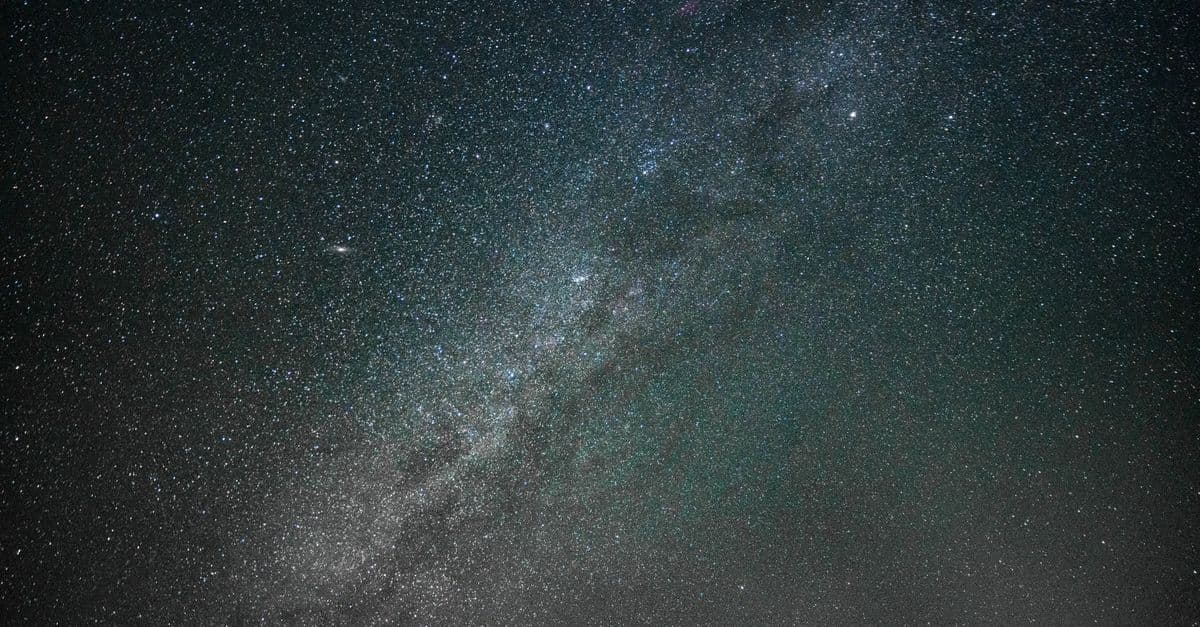
What Is a Nebula? The Gas Clouds That Build and Destroy Stars
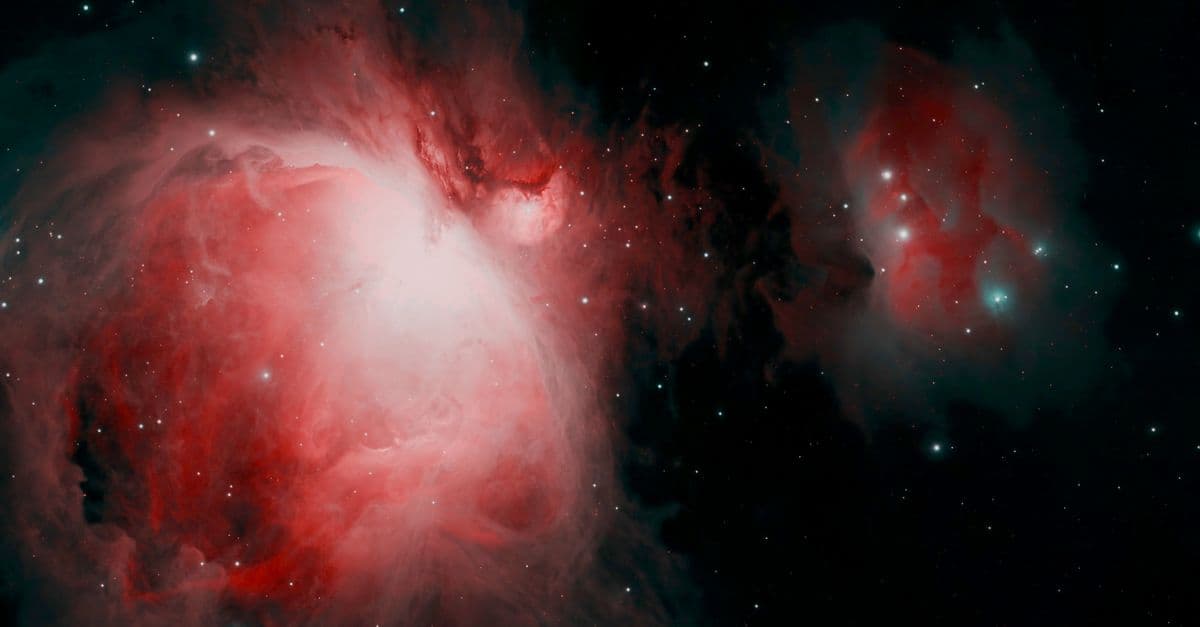
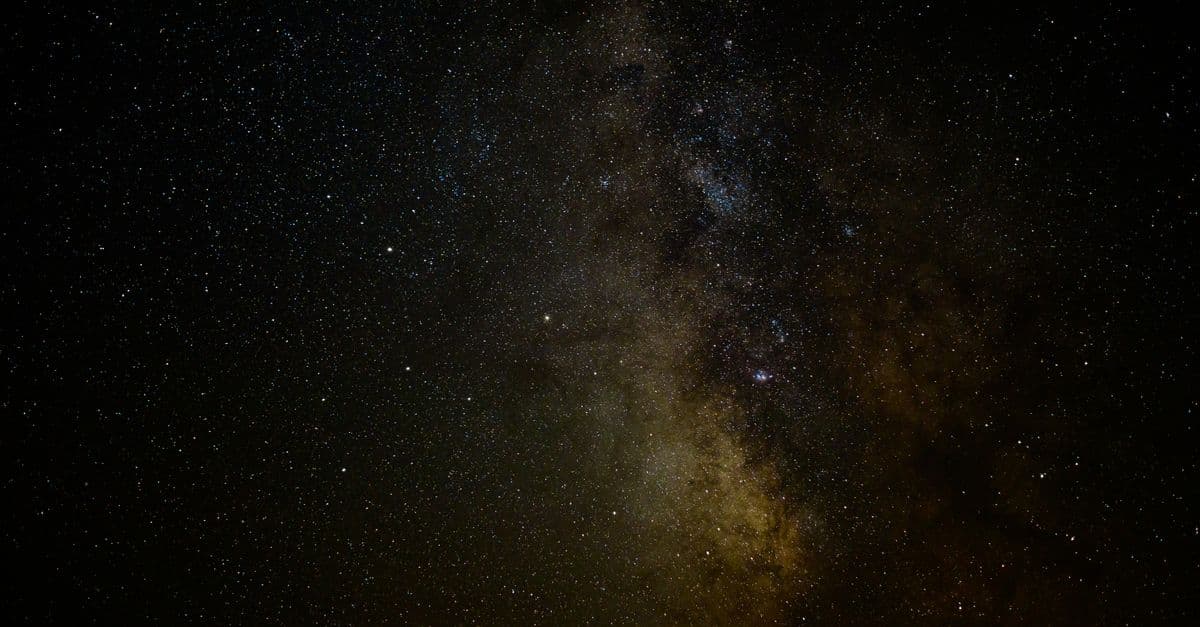
Photo: Daniel Cid / Pexels
A nebula is a cloud of gas and dust in space, and the word covers four very different objects: nurseries where stars are forming, dark clouds that block the light behind them, shells blown off by dying stars, and the debris of exploded ones. The Orion Nebula, about 1,350 light-years away, is a nursery you can see with the naked eye. The Crab Nebula is the expanding wreckage of a star that Chinese astronomers saw explode in 1054. Each type has its own physics, and together they trace the life cycle of stars.
What a nebula is, and why the word once meant "galaxy"
"Nebula" is Latin for "cloud," and for most of astronomical history it meant any fuzzy patch that stayed fuzzy in a telescope. That bucket held two very different things: real clouds of gas inside our own galaxy, and distant star systems too far away to resolve. Astronomers called the second group "spiral nebulae," and nobody could say whether they sat inside the Milky Way or far outside it.
The argument came to a head on April 26, 1920, when Harlow Shapley and Heber Curtis debated the question at the National Academy of Sciences. Shapley argued the spirals were small and local; Curtis argued they were separate "island universes." The debate ended without a winner. The answer arrived in the 1920s, when Edwin Hubble found Cepheid variable stars (stars whose pulsation period reveals their true brightness, and therefore their distance) in the Andromeda "nebula." His first distance, about 900,000 light-years, was too small by a factor of nearly three, since the modern figure is about 2.5 million light-years. Even the underestimate was far too large to fit inside the Milky Way (University of Arizona, JSTOR Daily).
After that, "nebula" shrank to its modern meaning: a cloud of gas and dust inside a galaxy. The cloud itself is nothing exotic. It is hydrogen and helium with a sprinkling of heavier elements and a little dust, spread so thinly that a cubic centimeter of air in a room holds about 10¹⁹ molecules while even the dense molecular clouds described below hold at most a million. What makes a nebula visible, or conspicuously invisible, is what happens when starlight meets that thin material.
Scale is the other thing to keep in mind. Nebulae are tiny in density and enormous in size, with the Crab Nebula about 11 light-years across and a single Hubble mosaic of the Orion Nebula covering about as much sky as the full Moon. A thin cloud that large can still hold many Suns' worth of mass, which is how something that is nearly a vacuum can build stars.
Four ways a cloud becomes a nebula
A cloud of interstellar gas looks like nothing at all until something acts on it. Four processes account for almost everything astronomers call a nebula:
- Ionization and glow. Ultraviolet light from hot stars strips electrons from atoms, and the gas glows as the electrons recombine. This makes an emission nebula.
- Scattering. Dust grains bounce starlight toward us without absorbing it all. This makes a reflection nebula.
- Blocking. A dense cloud absorbs the light from stars and nebulae behind it. This makes a dark nebula.
- Ejection. A star throws off its own material, either gently as a red giant or violently as a supernova. This makes planetary nebulae and supernova remnants.
The first three describe how one cloud can look different depending on its lighting. The fourth describes where some clouds come from. A single region can show several processes at once, which is why the Orion complex is a good place to start.
The interstellar medium: the raw material
Nebulae are the visible peaks of the interstellar medium (ISM), the gas and dust that fills the space between stars. By mass, about 99% of the ISM is gas and about 1% is dust. The ISM is not one substance but a set of phases that coexist at wildly different temperatures and densities, in rough pressure balance, like the layers of a weather system.
| Phase | Share of volume | Temperature (K) | Density (particles per cm³) |
|---|---|---|---|
| Molecular clouds | under 1% | 10 to 20 | 100 to 1,000,000 |
| Cold neutral medium | 1 to 5% | 50 to 100 | 20 to 50 |
| Warm neutral medium | 10 to 20% | 6,000 to 10,000 | 0.2 to 0.5 |
| Warm ionized medium | 20 to 50% | about 8,000 | 0.2 to 0.5 |
| H II regions | under 1% | about 8,000 | 100 to 10,000 |
| Hot ionized medium | 30 to 70% | 1 million to 10 million | 0.0001 to 0.01 |
Source: ISM phase ranges as tabulated in Wikipedia's article on the interstellar medium, summarizing standard reviews.
Look at the volume column first. The dense, cold molecular clouds where stars form fill less than 1% of the space, while the hot, nearly empty gas heated by supernovae fills somewhere between a third and two thirds. Nebulae are rare, small regions where something interesting is happening to the thick end of that table. For the full picture of the medium itself, see What Is the Interstellar Medium?.
Emission nebulae: gas that glows like a neon sign
An emission nebula works on the same principle as a neon sign. In a sign, electricity knocks electrons around inside the gas, and the gas gives the energy back as light of specific colors. In a nebula, the energy source is ultraviolet light from nearby hot, massive stars, and the glow is the gas relaxing after being ionized.
How ultraviolet light makes a glowing cloud
Massive young stars (the O and B types) put out most of their energy as ultraviolet photons, and each photon carries enough energy to strip the electron from a hydrogen atom. The result is a bubble of ionized hydrogen around the star, called an H II region (H II is the astronomer's notation for hydrogen that has lost its electron; neutral hydrogen is H I). Inside the bubble, free electrons keep recapturing onto protons, and each captured electron cascades down through the atom's energy levels, emitting a photon at each step.
Each step has a fixed wavelength, because atoms only have certain allowed energy levels. That is why a nebula's light can be sorted into a spectrum of sharp lines, and why a spectrograph can read its composition, temperature, and motion from a faint smudge. The lines that dominate photographs are:
| Emission line | Wavelength | Color | What produces it |
|---|---|---|---|
| H-alpha | 656 nm | Red | Hydrogen electron dropping from level 3 to level 2 |
| H-beta | 486 nm | Blue-green | Hydrogen electron dropping from level 4 to level 2 |
| [O III] | 496 and 501 nm | Green-teal | Doubly ionized oxygen |
| [N II] | 655 and 658 nm | Red | Singly ionized nitrogen |
Worked example: why hydrogen glows red
The red color of an emission nebula can be derived with one formula. For hydrogen, the wavelength of light emitted when an electron drops from level n to level 2 follows the Rydberg formula: 1/λ = R × (1/2² − 1/n²), where R is about 1.097 × 10⁷ per meter. For n = 3, the bracket is 1/4 − 1/9 = 0.1389, so 1/λ ≈ 1.524 × 10⁶ per meter and λ ≈ 656 nanometers, which is the H-alpha line, deep red. For n = 4, the bracket is 1/4 − 1/16 = 0.1875, giving λ ≈ 486 nanometers, the blue-green H-beta line. The same arithmetic is why nebula photographs taken through a hydrogen-alpha filter show so much structure: that single red wavelength carries most of the light from ionized hydrogen.
The ionizing photons obey a threshold. Pulling the electron off a hydrogen atom in its lowest energy level takes 13.6 electron-volts, which corresponds to a wavelength of about 91 nanometers in the far ultraviolet. Only stars hot enough to emit many photons shorter than that wavelength can light up a nebula, which is why emission nebulae mark the locations of O and B stars, not cooler ones like the Sun.
How big a bubble does a star blow?
In 1939 the Danish astronomer Bengt Strömgren worked out the size of the ionized bubble around a hot star. The idea is a balance: the star pumps out ionizing photons at some steady rate, and the gas recaptures electrons at a rate that grows with the square of its density. The bubble grows until recombinations use up all the photons, and then stops. The practical consequence is that denser gas gives a smaller bubble for the same star. Observed H II regions are far from tidy spheres, since the gas is clumpy and the stars move, but the balance explains why a bright young cluster in a dense cloud makes a compact glowing nebula and why the same cluster in thin gas makes a faint, sprawling one.
Forbidden lines
The square brackets around [O III] and [N II] mark "forbidden" lines. These transitions are so improbable that in a laboratory gas, collisions knock the atom out of the excited state before it can emit. In a nebula, the gas is so thin that atoms can sit in the excited state long enough to radiate, so the lines appear. It is a case where the near-vacuum of space produces light that a laboratory vacuum cannot. For more on how light gives up this kind of information, see What Is Spectroscopy?.
The Orion Nebula: the nursery next door
The Orion Nebula (Messier 42) is the closest large star-forming region to Earth. Radio measurements of its parallax with the Very Long Baseline Array placed it at 414 parsecs, with an uncertainty of about 7, or very nearly 1,350 light-years (Menten et al., 2007, via Sky & Telescope). Older estimates ran as high as 1,500 light-years, which is why you will see both numbers in print. It is visible to the naked eye as the middle "star" in Orion's sword, which is really a glowing cloud.
Its discovery history is a small lesson in how telescopes shape what people notice. Nicolas-Claude Fabri de Peiresc is generally credited with the first recorded sighting of the nebulous patch in 1610, and Galileo recorded the three stars of the Trapezium in 1617 without noting the cloud around them, possibly because of the narrow field of view of his telescope. Christiaan Huygens rediscovered the nebula in 1656 and published the first printed sketch in 1659, and Charles Messier cataloged it as the 42nd entry on his list in 1769.
The Hubble Space Telescope's survey of the nebula combined 520 images in five colors, taken in 2004 and 2005, into a mosaic covering roughly the apparent size of the full Moon. It shows more than 3,000 stars, a number of them invisible in ordinary visible light (ESA/Hubble). At the center sit the four heavy stars of the Trapezium, whose ultraviolet output carves a cavity in the cloud and powers its glow. Nearby are young stars wrapped in disks of gas and dust, called "proplyds" (short for protoplanetary disks), which are the early stage of planetary systems. Hubble also found large numbers of brown dwarfs in visible light for the first time. The star-forming side of this story is covered in The Orion Molecular Cloud.
The Pillars of Creation: where the cloud erodes
The Eagle Nebula (Messier 16) lies about 6,500 light-years away, and its most famous feature is a trio of towering columns known as the Pillars of Creation. Hubble first imaged them in 1995 and again in 2014, and the James Webb Space Telescope photographed them in infrared in 2022 (NASA).
The pillars are survivors. Ultraviolet light and winds from nearby massive stars boil away the thin gas around them, and the denser knots resist longest, leaving columns standing like rock chimneys after a flood has washed away the softer ground. In Webb's infrared view, the dust turns semi-transparent and the young stars inside show through. NASA describes those embedded stars as only a few hundred thousand years old, a rounding error against the billions of years a Sun-like star shines. The Webb image also shows almost no background galaxies, because the dense gas and dust of the Milky Way's disk block them.
Eta Carinae and the Carina Nebula: a star that threw off a nebula
The Carina Nebula is a large star-forming complex in the southern sky, and one of its members, the massive double star Eta Carinae, gives a rare look at a star throwing off material in a single event. In the 1840s the star went through what astronomers call the Great Eruption. The eruption is dated to around 1843, and at its peak the star was among the brightest in the sky despite its great distance.
NASA's Chandra team estimates that the eruption ejected between 10 and 45 times the mass of the Sun. That material formed two dense clouds on opposite sides of the system, the pair now called the Homunculus Nebula, and it is still expanding at speeds of up to 4.5 million miles per hour, or about 2,000 kilometers per second (NASA). What triggered the eruption is still debated, with explanations that involve an internal explosion on one side and interactions with a companion star on the other.
The Tarantula Nebula: the largest nursery nearby
Emission nebulae are not limited to the Milky Way. The Tarantula Nebula sits in the Large Magellanic Cloud, a small galaxy about 161,000 light-years away, and ESA describes it as the largest and brightest star-forming region in the Local Group, the collection of galaxies nearest to ours. It contains the hottest and most massive stars known. Webb's infrared view shows a cavity hollowed out by those stars and a pillar-like structure with a young star still emerging from the dust. The region's chemical make-up resembles star-forming regions from "cosmic noon," a period a few billion years after the Big Bang when the universe made stars fastest (ESA/Webb).
Reflection nebulae: starlight bounced off dust
A reflection nebula makes no light of its own. It is a dust cloud lit by a nearby star that is too cool to ionize the gas, so the cloud shines only by scattering. The closest everyday comparison is fog around a streetlight: the fog is not a light source, but it turns the lamp's light into a visible glow.
The scattered light usually looks blue, because dust grains scatter short wavelengths more efficiently than long ones. It is the same family of effect that makes the daytime sky blue, though in the sky the scatterers are air molecules rather than dust grains. The blue haze around the stars of the Pleiades is the standard example. Reflection nebulae matter because they mark dusty regions where stars are present but not hot enough to light up the hydrogen.
One practical use of reflection nebulae is as a cross-check. The color and brightness of the scattered light depend on the size of the dust grains and on how much dust lies along the line of sight, so reflection nebulae let astronomers measure dust properties that would otherwise be invisible. That matters because dust is where complex molecules form, a theme developed in What Is Astrochemistry?.
Dark nebulae: the cold clouds where stars start
A dark nebula is a cloud dense enough to block the light from everything behind it. The best comparison is a plume of smoke seen against a lit window: you detect it not by what it emits but by what it hides. Dark nebulae are not a different kind of cloud from the others. They are the cold, dense, early stage, before any star has formed to light them.
They are cold enough, between 10 and 20 kelvins in the ISM table above, for molecules to survive. Hydrogen pairs up into H₂, carbon monoxide forms and becomes the standard tracer astronomers use to map these clouds, and dust grains collect ices on their surfaces. The densest clumps inside such a cloud are the places where gravity can win against the gas pressure that would otherwise keep it spread out.
Barnard 68: a cloud on the edge of collapse
Barnard 68 is a compact dark cloud in the constellation Ophiuchus, roughly 410 to 500 light-years away depending on the distance estimate (ESO quotes 500 light-years; a 2009 modeling paper uses about 125 parsecs, or about 410 light-years). In visible light it is a black hole in the star field, with no background stars showing through. In infrared light the same patch fills with stars, because dust blocks long wavelengths less than short ones (ESO). That single image is an unusually clean demonstration of what dust does.
Barnard 68 is also a starless core, meaning it has no protostar yet. Astronomers estimate its mass at about 2.1 solar masses, held within a region about 12,500 astronomical units across. Simulations by Andreas Burkert and João Alves predict that it will condense into one or a few low-mass, Sun-like stars within roughly the next 200,000 years, which makes it a snapshot of the stage just before a star is born (Burkert and Alves, 2009). Treat the timescale as a model prediction, not an observation.
The Horsehead Nebula and Bok globules
The Horsehead Nebula is a pillar of dark, dusty gas silhouetted against a glowing H II region behind it, about 1,375 light-years away by Gaia measurements. Williamina Fleming discovered it in 1888 on a photographic plate at Harvard College Observatory. The red glow behind it is hydrogen ionized by the nearby star Sigma Orionis, and the horse's head is simply the densest part of the cloud in front of that glow (Wikipedia).
Compact, round dark clouds like Barnard 68 are called Bok globules, after the astronomer Bart Bok. In a 1947 paper with Edith Reilly, Bok described them as resembling insect cocoons that might be collapsing under their own gravity. A near-infrared study in 1990 confirmed that stars really do form inside some of them, and many contain embedded warm sources and gas outflows, the signatures of protostars still wrapped in their cocoons (Wikipedia). A typical globule is now thought to hold roughly 10 solar masses.
Why most of a cloud never becomes stars
A molecular cloud is not simply a bag of future stars. Observed star formation efficiency, the fraction of cloud mass that ends up in stars, is a few percent across whole giant molecular cloud complexes and rises to 10 to 30% in the dense cluster-forming cores. The clouds themselves are short-lived by cosmic standards, with typical lifetimes of 10 to 30 million years, and they are dispersed within roughly 1 to 5 million years of massive stars switching on.
Feedback from those massive stars is the reason. Their ultraviolet light, winds, and eventually supernovae heat and push away the remaining gas, which is why the first stars to form in a cloud often end the nursery's productive life. The Orion Nebula is in the middle of that process now: the Trapezium stars are carving the cavity that will eventually disperse the cloud. The wider process is the subject of What Is Stellar Feedback?.
Our own origin: the solar nebula
The Solar System began the same way. A cloud of gas and dust collapsed, the Sun formed at the center, and the leftover material flattened into a disk from which the planets grew. Astronomers call that disk the solar nebula. The proplyds in Orion are the same stage in other systems, caught while the planets are still unformed. The sequence is worked through in How the Solar System Formed.
Planetary nebulae: the shells of dying Sun-like stars
Planetary nebulae have nothing to do with planets. The name comes from the 18th century, when William Herschel and others noticed that some of these objects looked like faint, round planetary disks in small telescopes. Antoine Darquier de Pellepoix had already described the Ring Nebula in 1779 as "a fading planet." The name stuck even after astronomers learned that these are glowing shells of gas around dying stars.
How a star makes one
Stars between about 0.8 and 8 times the mass of the Sun end their lives in two stages. First the star swells into an asymptotic giant branch (AGB) star, a bloated giant with a dense core and a very diffuse outer envelope, which loses mass through strong winds. A star like this can shed 50 to 70% of its total mass this way. Then the envelope is gone, the hot core is exposed, and the core's ultraviolet radiation ionizes the expelled gas so that it glows, like an emission nebula powered by a single dying star. The AGB phase is covered in AGB Stars: The Carbon Factories That Seed the Universe.
The glowing phase is brief. A planetary nebula lasts perhaps a few tens of thousands of years, a blink compared with the billions of years the star spent shining. As the shell expands and thins, it fades into the interstellar medium, while the core cools into a white dwarf. The remnant is described in White Dwarfs: The Fate of 97% of All Stars. Only about 3,000 planetary nebulae are known in the Milky Way, out of roughly 200 billion stars, because the phase is so short (Wikipedia).
The central stars are very hot, with temperatures that climb toward about 100,000 K, which is why planetary nebulae glow so strongly in the [O III] line and appear green-teal in many photographs. The nebulae themselves hold only 0.1 to 1 solar mass of gas.
Why they are not round
If a single, spherical star blew off a spherical shell, the result would be a round bubble. Only about 20% of planetary nebulae are spherically symmetric. Most are elliptical, bipolar (two lobes pointing in opposite directions), or more complicated still. A companion star is the leading suspect for the more elaborate shapes: a close binary can focus the outflow into jets and lobes, and the gravitational interaction can leave a spiral or ring pattern. Rotation and magnetic fields are also likely contributors, though the relative importance of each is still debated.
Two examples: the Helix and the Southern Ring
The Helix Nebula in Aquarius is one of the nearest planetary nebulae, at about 650 light-years. Its central white dwarf is a tiny, very hot remnant, and its glowing shell is all gas that once belonged to the star.
The Southern Ring Nebula (NGC 3132), about 2,500 light-years away in Vela, shows how binaries matter. Webb's mid-infrared instrument found a second, dust-shrouded star at its center in 2022. The fainter of the two stars is the one that has been shedding the gas, and it is wrapped in dust. The brighter one is at an earlier stage and is expected to produce its own planetary nebula in the future (NASA/ESA). Our own Sun is expected to produce a planetary nebula in the distant future too, after it swells into a red giant, as described in What Happens When the Sun Dies?.
Supernova remnants: debris with a shock wave in front
When a massive star's core collapses, or a white dwarf in a binary system detonates, the explosion throws a large fraction of the star's mass outward at thousands of kilometers per second. That material plows into the surrounding gas, and the resulting shell is a supernova remnant. A good analogy is a snowplow: the debris is the plow, and the swept-up interstellar gas is the snow pile building up ahead of it. The leading edge is a shock wave that heats the gas to millions of degrees, hot enough that it glows in X-rays.
Supernova remnants fall into rough categories. Shell remnants are hollow, glowing spheres of swept-up gas. Pulsar wind nebulae, also called plerions, are filled in the middle because a spinning neutron star at the center is pumping out energy. Composite remnants have both. The explosion types are laid out in Supernova Explained, and the stellar corpse at the center in Neutron Stars Explained.
The Crab Nebula: a remnant with a recorded birth
The Crab Nebula (Messier 1) is the remnant of a supernova that Chinese astronomers recorded as a daytime "guest star" on July 4, 1054. Japanese observers probably saw it too, and a reference from the Baghdad physician Ibn Butlan was found in 1978. It likely peaked between magnitude −7 and −4.5 and stayed visible to the naked eye for about two years (Wikipedia).
Today the nebula lies about 6,500 light-years away, uncertain by roughly 1,600, and spans about 11 light-years. Its filaments are expanding at about 1,500 kilometers per second, roughly half a percent of the speed of light. A quick check shows the numbers hang together. At 1,500 kilometers per second, material covers about 4.6 × 10¹³ kilometers in the roughly 970 years since 1054, which is about 4.9 light-years in radius. That gives a diameter near 10 light-years, close to the observed 11. The agreement is only rough, since the filaments are an irregular network and the nebula is not a perfect sphere.
At the center is the Crab Pulsar, a neutron star about 28 to 30 kilometers across that spins roughly 30 times per second and emits a pulse every 33 milliseconds. The filaments are estimated to hold about 4.6 ± 1.8 solar masses of material, and the progenitor star is thought to have been about 9 to 11 solar masses. The nebula got its name from a drawing by William Parsons, the third Earl of Rosse, who sketched crab-like arms in the early 1840s, and its place in the Messier catalog from an accident: Charles Messier first mistook it for a comet in 1758 and started his catalog to avoid repeating the error.
Cassiopeia A: a young remnant
Cassiopeia A is one of the youngest known supernova remnants in the Milky Way, about 10,000 light-years away. Its expansion rate and size suggest that the light of the explosion reached us roughly 320 years ago, and the star John Flamsteed recorded near its position in 1680, which was never seen again, could have been the explosion itself. The blast actually happened about 10,000 years earlier than that, because the light took that long to cross the distance (Chandra X-ray Observatory). A closer look at the object is in Cassiopeia A in depth.
Remnants as particle accelerators and seed beds
Supernova remnants do two jobs beyond looking spectacular. First, they enrich the interstellar medium with the heavy elements made inside the star and in the explosion, so the next generation of stars and planets forms from gas that carries carbon, oxygen, silicon, and iron. That process is called nucleosynthesis. Second, their shock fronts are the leading candidates for accelerating the Milky Way's cosmic rays, the high-energy particles that arrive at Earth from space. Charged particles bounce back and forth across a shock, gaining energy on each crossing. Sorting out exactly how well this works at the highest energies is an active research topic, covered in What Are Cosmic Rays?.
The four main types compared
| Type | What makes it visible | Typical temperature | Example | What it reveals |
|---|---|---|---|---|
| Emission nebula (H II region) | Ionized gas glowing in spectral lines | About 8,000 K | Orion Nebula | Where massive stars have just formed |
| Reflection nebula | Dust scattering starlight | Cool dust | Pleiades nebulosity | Dust properties and nearby stars |
| Dark nebula | Blocks background light | 10 to 20 K | Barnard 68, Horsehead | The coldest stage before stars form |
| Planetary nebula | Gas shed by an AGB star, ionized by the hot core | Central star near 100,000 K | Helix, Southern Ring | Fate of Sun-like stars |
| Supernova remnant | Shock-heated gas and relativistic particles | Millions of kelvins | Crab, Cassiopeia A | Fate of massive stars, cosmic-ray sources |
Sources: ISM phase data from Wikipedia; object data as cited in the text.
How astronomers see through nebulae
Dust is the main obstacle. Dust grains block visible light far more than infrared light, which is why Barnard 68 vanishes in the visible and shows its stars in the infrared. This is also the reason infrared telescopes are central to nebula science: Webb's infrared cameras see young stars inside the Pillars of Creation that Hubble's visible-light images only hint at, a point developed in How Space Telescopes See in Infrared. For a wider look at what Webb has found, see What James Webb Has Actually Found.
The colors in published nebula pictures need care. Many are made by assigning colors to filtered exposures, so the picture shows which gas is where, not what a person in a spacecraft would see. The human eye also cannot see color at low light levels, so even the brightest nebulae look gray and ghostly through a backyard telescope. The Orion Nebula is a naked-eye smudge, not a red and blue spectacle.
Radio and millimeter telescopes add a third view. Cold molecular clouds emit almost no visible or infrared light of their own, but the carbon monoxide inside them emits radio lines that map their size, motion, and mass. Combining radio, infrared, visible, and X-ray data on one object is routine now, and it is how a remnant like Cassiopeia A is reconstructed element by element.
Common confusions
"Planetary nebulae are where planets form." They are the opposite end of a star's life. The planets-forming structure is a protoplanetary disk, which appears in the Orion Nebula as the proplyds, and is covered in What Is a Protoplanetary Disk?.
"A nebula is a galaxy." This was a defensible view a century ago, and the Shapley-Curtis debate was about exactly that. Today the word means a cloud inside a galaxy, and a galaxy is a separate system of stars, gas, and dark matter.
"A supernova remnant is the star." The Crab Nebula is the expanding debris of a star that no longer exists. What remains at the center is a neutron star roughly 28 to 30 kilometers across.
"Nebulae are dense." They are extraordinarily thin by everyday standards. Even a molecular cloud at the dense end of the ISM table holds up to a million molecules per cubic centimeter, while the air in a room holds about 10¹⁹. They matter because they are enormous, not because they are thick.
"The picture shows the nebula as it is." What you see is light that left the nebula long ago. A Crab Nebula photograph taken today shows the nebula as it was about 6,500 years ago. The 1054 "explosion" was really the arrival of light from a blast that happened roughly 6,500 years earlier, so a photograph taken today shows the Crab about 970 years after the explosion, and one taken a century from now will show it a century further along.
Frequently asked questions
Q: What is a nebula in simple terms? A: A nebula is a cloud of gas and dust in space. Depending on what is lighting or shaping it, it may be a stellar nursery, a dark cloud that blocks background starlight, a shell shed by a dying star, or the remains of an exploded star.
Q: How are stars born in nebulae? A: Dense, cold regions inside molecular clouds collapse under their own gravity. As the gas falls inward it heats up and forms a protostar surrounded by a disk. Only a few percent of a whole cloud's mass typically ends up in stars, because radiation and winds from the first massive stars blow away the rest.
Q: Why do nebulae have different colors? A: Color depends on the process. Glowing hydrogen emits strong red light at 656 nanometers, and doubly ionized oxygen emits green-teal. Reflection nebulae look blue because dust scatters short wavelengths more strongly. Many published images also assign colors to filters, so they are not literal.
Q: What is the difference between a nebula and a galaxy? A: A nebula is a cloud of gas and dust, usually inside a galaxy. A galaxy is a vast system of stars, gas, dust, and dark matter. Until the 1920s, astronomers used "nebula" for both, which is why Andromeda was once called a nebula.
Q: Will our Sun become a nebula? A: In about five billion years, the Sun is expected to swell into a red giant, shed its outer layers, and leave a white dwarf. The shed gas, lit by the hot core, would form a planetary nebula lasting a few tens of thousands of years.
Q: Is the Orion Nebula visible without a telescope? A: Yes, as a faint fuzzy patch in the middle of Orion's sword, below the three belt stars. A small telescope shows the Trapezium stars at its heart. Long-exposure photographs and Hubble and Webb images show the colors and structure the eye cannot.
Q: How old is the Crab Nebula? A: Astronomers see the Crab as it was about 970 years after the explosion, because the supernova light reached Earth in 1054 and the nebula has kept expanding since. Because the Crab is roughly 6,500 light-years away, the blast itself happened about 6,500 years before that sighting.
The takeaway
Nebulae look like four unrelated things, but they are a single cycle seen at different moments. Cold dark clouds collapse into stars. The massive ones light up the surrounding gas, erode their own nursery, and eventually explode. Lower-mass stars swell, shed their outer layers, and leave planetary nebulae. All of it returns to the interstellar medium, enriched with heavier elements, to form the next generation. The atoms in a nebula today were in earlier stars, and some of them will be in stars, and perhaps planets, that do not exist yet.
Related Reading
Follow new articles
Add SciHub101 to your feed reader to see new science and technology stories.
About the Author
SciHub101 is an independent science and technology publication founded and edited by Buğra Sözeri, a software engineer and app developer based in Türkiye. AI tools assist with drafting and research. Source documentation in the existing archive is uneven, and articles are being reviewed and corrected. The Editorial Team byline identifies editorial responsibility; it does not certify specialist or independent human review. Where we compare products, anything built by our own team is labelled as such — see the editorial guidelines and About page for how corrections and disclosures work.
Related Articles
What Is the Chandrasekhar Limit? The Number That Determines a Star's Fate
The Chandrasekhar limit, about 1.44 solar masses, is the heaviest a white dwarf can be before electron degeneracy pressure fails. It shapes Type Ia supernovae, cosmic distance measurements, and which stellar remnants become white dwarfs, neutron stars, or black holes.
What Is Hubble's Law? How We Discovered the Universe Is Expanding
In 1929, Edwin Hubble showed that galaxies recede from us at speeds proportional to their distance, the first direct evidence that the universe is expanding. The slope of that relation, the Hubble constant, is still debated: two precise methods disagree by about 5 sigma.
Stellar Nurseries: How Stars Are Born in the Dark
The Pillars of Creation are not killing stars — they are building them. Inside those towering columns of cold gas, dense knots called Bok globules are collapsing under their own weight, heating up toward nuclear ignition. The James Webb Space Telescope, in 2022, showed us the newborn stars Hubble never could.
What Is the Interstellar Medium? The Space Between Stars
The interstellar medium (ISM), the gas and dust filling the space between stars, is not empty. It is a multiphase medium ranging from 10 K molecular clouds where stars form to million-kelvin plasma heated by supernovae. Dust hides the centre of our galaxy from visible light, and the ISM is both the raw material for new stars and the place where dying stars deposit their products.
What Is Stellar Feedback? How Stars Reshape the Galaxies They're Born In
Stars do not sit quietly inside galaxies. Their radiation, winds, and supernovae heat, push, and enrich the gas around them. This stellar feedback is why star formation is slow, why dwarf galaxies are faint, and where much of a galaxy's heavy elements end up.