What Is Hubble's Law? How We Discovered the Universe Is Expanding
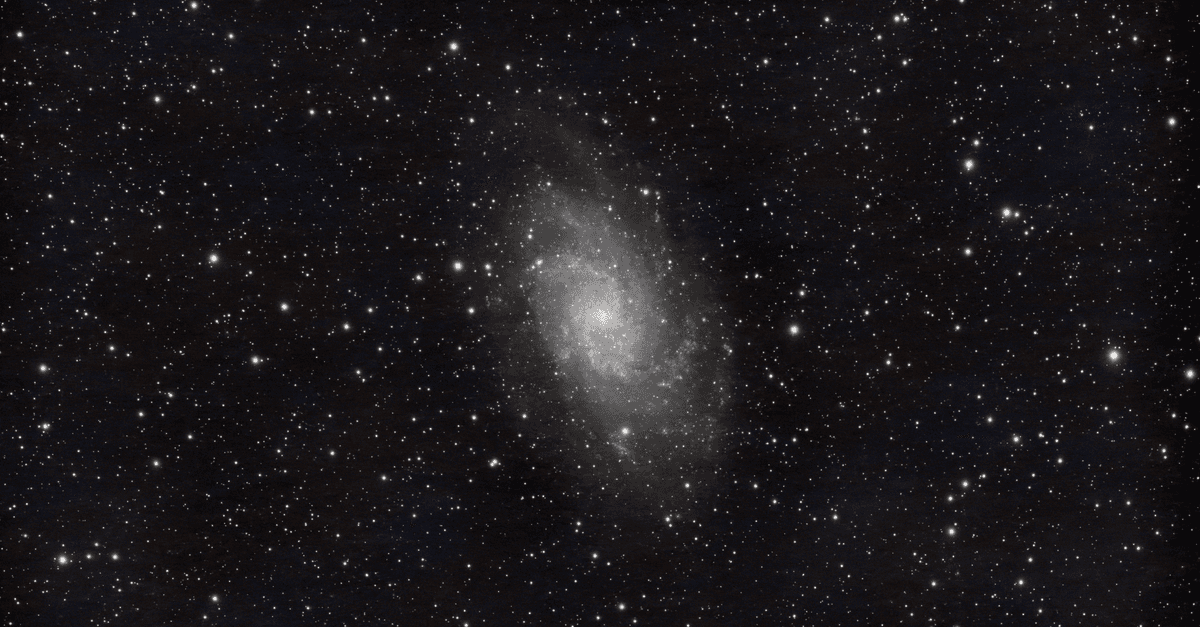
Photo: Del Woodcock / Pexels
Hubble's law is a single line on a graph: the farther away a galaxy is, the faster it appears to be moving away from us. Written as v = H₀ × d, it connects a galaxy's recession velocity to its distance through a number called the Hubble constant. Edwin Hubble published the relation in 1929, and it became the first direct evidence that the universe is expanding. Today the exact value of H₀ is one of cosmology's sharpest disagreements.
What the law says, in plain terms
The equation has three parts. The velocity (v) is how fast a galaxy's light says it is receding, measured in kilometers per second. The distance (d) is how far away it is, usually in megaparsecs (Mpc). One megaparsec is about 3.26 million light-years. The Hubble constant (H₀) is the conversion factor, with units of kilometers per second per megaparsec.
Take a value of 70 km/s/Mpc as a round number. A galaxy 10 Mpc away recedes at about 700 km/s. A galaxy 100 Mpc away recedes at about 7,000 km/s. Double the distance and you double the speed. That linear relationship is the entire law, and its simplicity is the reason it was so startling.
| Distance | Light-travel scale | Recession speed at H₀ = 67.4 | Recession speed at H₀ = 73.04 |
|---|---|---|---|
| 10 Mpc | about 33 million light-years | 674 km/s | 730 km/s |
| 100 Mpc | about 326 million light-years | 6,740 km/s | 7,304 km/s |
| 1,000 Mpc | about 3.3 billion light-years | 67,400 km/s | 73,040 km/s |
The two columns use the two most-cited measurements of H₀, which are explained later in this article. Notice that by 1,000 Mpc the recession "speed" exceeds a fifth of the speed of light, and the simple formula stops being a good guide. At those distances you need the full cosmological model.
Why "law" is a slightly generous word
Hubble's law is an observed relationship, not a fundamental law like conservation of energy. It falls out of a deeper idea: if space is expanding uniformly, any two points drift apart at a rate proportional to the distance between them. The law is what that idea looks like from inside one galaxy.
Think of the surface of a balloon being inflated, with dots drawn on it. From any dot, every other dot moves away, and the more distant ones move away faster. No dot is the center. The analogy has limits, since the balloon's surface is curved into a third dimension while real space needs no such embedding, but it captures the key point: expansion looks the same from everywhere.
A second picture is a loaf of raisin bread rising in the oven. Each raisin sees its neighbors move away, and the raisins farthest from it move the most, because more dough lies between them. The raisins themselves are not moving through the dough. The dough is growing.
Slipher, Leavitt, and the pieces before Hubble
Hubble did not discover the expansion alone. Three bodies of work had to exist first: redshift measurements, a way to find distances, and a theory that allowed expansion.
Slipher measured the velocities
Vesto Slipher at Lowell Observatory in Arizona measured the first Doppler shift of a "spiral nebula" in 1912 and found that nearly all of them were moving away. By the time Hubble published, the velocity list was largely Slipher's. In a PNAS retrospective, astronomer Robert Kirshner notes that Slipher had assembled velocities for 41 galaxies, 36 of them receding. Hubble's 1929 velocities came mostly from Slipher, plus four new ones from his Mount Wilson colleague Milton Humason.
A Doppler shift is the stretching or compressing of light waves from a moving source. Light from a receding object is shifted toward longer, redder wavelengths, which is why the result is called redshift. Astronomers measure it by splitting the light into a spectrum, and the technique at the heart of this is spectroscopy. Known spectral lines from elements like hydrogen and calcium show up at wavelengths shifted by a predictable amount, and that shift reveals the velocity.
Leavitt provided the ruler
Velocities were the easy half. Distances were the hard half. The breakthrough came from a researcher who was not allowed to use the telescopes. Henrietta Leavitt worked at Harvard College Observatory as a human "computer," measuring photographic plates. In 1908 she published a catalog of 1,777 variable stars in the Magellanic Clouds and noted that the brighter ones had longer periods. In 1912, with Edward Pickering, she published a study of 25 Cepheids in the Small Magellanic Cloud that showed a clean relation between brightness and pulsation period.
The logic is elegant. The stars in the Small Magellanic Cloud are all at roughly the same distance, so differences in apparent brightness reflect differences in true brightness. That made Cepheids the first standard candle: measure a Cepheid's period, read off how luminous it really is, compare to how bright it looks, and you get its distance. About a year after Leavitt's report, Ejnar Hertzsprung determined distances to several Milky Way Cepheids, which allowed the relation to be calibrated in real units. Leavitt died on December 12, 1921, at age 53. Mathematician Gösta Mittag-Leffler tried to nominate her for a Nobel Prize in 1924, unaware she was gone, and the prize is not awarded posthumously. The family of stars she used is covered in the article on Cepheids and other variable stars.
Hubble placed the nebulae outside the Milky Way
On October 6, 1923, Hubble used the 100-inch telescope at Mount Wilson to photograph Andromeda. He first marked a star on the plate as a nova, then crossed out the "N" and wrote "VAR" for variable. It was a Cepheid with a period of about 31.4 days. Applying Leavitt's relation, he reported in 1925 a distance of roughly 930,000 to 950,000 light-years, depending on the account. That was far outside the Milky Way and settled the "island universe" argument that had been running since the 1920 Shapley-Curtis debate.
The distance was also too small. The modern value for Andromeda is more than two million light-years. The error was in the calibration, a problem that would shadow Hubble's constant for decades.
Lemaître got there first, in French
Georges Lemaître, a Belgian priest and physicist, derived the expanding-universe relation in 1927 from Einstein's equations of general relativity and compared it with the available velocities. He published in a Belgian journal, in French. A 1931 English translation dropped the passage containing the equation for the constant, and Wikipedia's article on Hubble's law notes that Lemaître himself made those changes.
The priority issue was formally addressed in 2018. At the International Astronomical Union general assembly in Vienna, members attending voted in favor of renaming the relation the Hubble-Lemaître law, and the IAU then put Resolution B4 to an electronic vote of all its members, which passed by a wide margin (reported as about 78 percent in favor). The result is a recommendation, and many papers still say "Hubble's law."
The 1929 paper, in detail
Hubble's paper "A relation between distance and radial velocity among extra-galactic nebulae" appeared in the Proceedings of the National Academy of Sciences in March 1929. It said radial velocities were available for 46 extra-galactic nebulae, but individual distances could be estimated for only 24 of them. The distances rested on recognizing stars of a known type in each galaxy, such as Cepheids in the nearest ones and the brightest stars in the rest, and treating them as standard-brightness markers.
Hubble fit a line through the points and quoted slopes of about 500 and 530 km/s per megaparsec, depending on how the data were grouped. The velocities reached about 1,000 km/s, and the most distant galaxies in his table were only about 2 megaparsecs away by his distances. By today's standards that is a tiny volume of space. The graph looked messy, and a reader could have objected that a line through it was optimistic.
What Hubble himself thought it meant
Hubble was cautious about the interpretation. Kirshner's retrospective notes that Hubble was looking for the "de Sitter effect," a prediction from an alternative relativistic model in which light from distant objects appears redshifted. He described the linear law as a first approximation over a restricted range. That caution is one reason the physical interpretation is usually credited to theorists such as Lemaître rather than to Hubble himself.
How wrong were the numbers?
Very. Hubble's constant of about 500 km/s/Mpc is roughly seven times the modern value. Kirshner states that Hubble's distances were too small by a factor of about seven, and that explains it, since distance sits in the denominator of the slope. Divide 500 by 7 and you land at about 71, close to today's range.
The error mattered for more than bookkeeping. The reciprocal of H₀ has units of time, and a constant of 500 km/s/Mpc gives about 2 billion years. That is shorter than the age of the Earth's rocks, which was already known to be several billion years. The mismatch was an embarrassment for early expanding-universe models.
| Year | Who | H₀ (km/s/Mpc) | Note |
|---|---|---|---|
| 1929 | Hubble | about 500 | Distances too small by about a factor of seven |
| 1952 | Baade | roughly half of Hubble's | Two Cepheid populations recognized; distance scale roughly doubled |
| 1970s | Sandage vs. de Vaucouleurs | about 50 vs. about 100 | A decades-long dispute over the distance scale |
| 2001 | HST Key Project | 72 ± 8 | Freedman et al., Astrophysical Journal |
| 2018 | Planck | 67.4 ± 0.5 | From the cosmic microwave background |
| 2022 | SH0ES | 73.04 ± 1.04 | Riess et al., Astrophysical Journal Letters |
Baade and the doubling of the universe
In 1952, at the IAU meeting in Rome, Walter Baade reported that Cepheids fall into two populations with different period-luminosity relations. The classical Cepheids Leavitt studied are more luminous than the type used in some calibrations, so earlier distance estimates to other galaxies were too small. Baade's correction roughly doubled extragalactic distances. For Andromeda, the estimate moved from under a million light-years to roughly two million. A larger distance for the same velocity means a smaller H₀, and the age problem eased.
The lesson of this history is that H₀ is a ratio, so its history is the history of distance measurement. Every revision came from fixing an error in the ladder, not from the velocities, which were measured accurately from the start.
Why the redshift is not an ordinary Doppler shift
The word "recession velocity" invites a mental picture of galaxies flying outward through space. At small distances that picture is fine. At large distances it misleads, and cosmologists use a more careful description.
Space itself stretches
In the expanding universe, the light wave stretches as it travels, because the space it travels through is growing. A photon that left a galaxy when the universe was half its current size arrives with twice its original wavelength. In symbols, 1 + z equals the ratio of the universe's scale then to now, where z is the redshift. For a galaxy at z = 1, the universe was half its present size when the light left.
A useful comparison is a wave drawn on a rubber band. Stretch the band and the wave gets longer. Nobody pushed the wave; the band grew. Cosmological redshift is the band-stretching version of the effect.
Beyond the Hubble radius
Divide the speed of light by H₀ and you get a distance called the Hubble radius. For H₀ = 67.4 km/s/Mpc it is about 4,450 Mpc, or about 14.5 billion light-years. For H₀ = 73.04 km/s/Mpc it is about 4,100 Mpc, or about 13.4 billion light-years. Galaxies beyond this distance have a recession velocity, in the Hubble-law sense, greater than the speed of light.
That does not break special relativity. Relativity limits how fast objects pass through space. It places no limit on how fast space can grow between two distant points. Light from those galaxies emitted long ago can still reach us, because the Hubble radius itself changes over time, and a photon that starts outside can end up inside it. The question of what that means for the observable universe belongs to the article on how big the universe is.
The Hubble time is not the age
The reciprocal of H₀ is called the Hubble time. For 67.4 km/s/Mpc it is about 14.5 billion years, and for 73.04 about 13.4 billion years. The actual age of the universe is about 13.8 billion years, according to the standard model, which sits between the two. The Hubble time is a rough scale, not an age, because the expansion rate has not been constant. It slowed while gravity dominated and then, in the last several billion years, sped up.
Peculiar velocities and the Hubble flow
Galaxies also move because of gravity, independent of the expansion. These "peculiar velocities" can reach several hundred kilometers per second. For nearby galaxies they swamp the expansion, which is why a few close neighbors are approaching us instead of receding. The Hubble flow, the region where the expansion dominates, begins at tens of megaparsecs. Wikipedia's article on Hubble's law notes that the scatter around the trend line in Hubble's original diagram comes from this effect.
Inside a galaxy cluster the same story holds more strongly. The galaxies in a cluster are gravitationally bound and do not expand apart. The expansion does not tear apart your solar system, the Milky Way, or the Local Group either. It operates on the largest scales, where gravity's grip has weakened enough to let it show.
How astronomers measure H₀ today
There are two main routes to H₀, and they use different physics.
The distance ladder
The local approach is a direct descendant of Hubble's. Build a chain of distance indicators, each calibrated by the one below:
- Parallax gives geometric distances to nearby stars, measured by the tiny shifts in position as Earth orbits the Sun.
- Cepheids calibrated by parallax serve as markers in nearby galaxies.
- Tip of the red giant branch (TRGB) and J-region asymptotic giant branch (JAGB) stars are alternative markers with different strengths.
- Type Ia supernovae in galaxies with calibrated distances become the next rung, bright enough to be seen across hundreds of megaparsecs. See supernova types for why they work as standard candles.
- Redshifts of the supernova host galaxies provide the velocities.
The SH0ES team, led by Adam Riess, reported in 2022 a Hubble constant of 73.04 ± 1.04 km/s/Mpc from Cepheids in the host galaxies of 42 Type Ia supernovae. Combining HST measurements of the tip of the red giant branch with Cepheids gave 72.53 ± 0.99.
The cosmic microwave background
The other route is indirect. The cosmic microwave background (CMB) is the oldest light in the universe, released about 380,000 years after the Big Bang. Its pattern of hot and cold spots encodes the sound waves that rippled through the early plasma, and the physical size of those ripples works as a ruler. Cosmologists measure the ruler's apparent angular size on the sky, then use a model of how the universe expanded to calculate H₀ today.
The Planck satellite team reported in 2018, under the standard ΛCDM model (a universe of dark energy, cold dark matter, and ordinary matter), H₀ = 67.4 ± 0.5 km/s/Mpc, with a matter density parameter of 0.315 ± 0.007.
| Method | Group | H₀ (km/s/Mpc) | Type |
|---|---|---|---|
| CMB, ΛCDM fit | Planck, 2018 | 67.4 ± 0.5 | Early universe, model-dependent |
| Cepheids + Type Ia supernovae | SH0ES, 2022 | 73.04 ± 1.04 | Local, distance ladder |
| Tip of the red giant branch (HST + JWST) | CCHP, 2024 | 70.39 ± 1.22 (stat) ± 1.33 (sys) ± 0.70 (σ_SN) | Local, distance ladder |
| JWST Cepheids, JAGB, and TRGB combined | SH0ES team, 2024 | 72.6 ± 2.0 | Local, distance ladder |
The Hubble tension
Compare the top two rows. The difference between 73.04 and 67.4 is about 5.6 km/s/Mpc, and combining the quoted uncertainties gives roughly 1.15 km/s/Mpc, so the gap is about five standard deviations. The SH0ES paper states a "5-sigma difference" from the value predicted by Planck and ΛCDM. In practice, a five-sigma discrepancy in a well-controlled measurement is rare enough that statistical luck is a poor explanation. Something is wrong with one measurement, or the model connecting the early universe to the present.
Is it a measurement error?
The first line of defense is to re-check the distance ladder. The most direct worry was that Cepheids in crowded fields might be blended with neighboring stars, biasing their brightness. The James Webb Space Telescope, with sharper resolution in the infrared, can test that. A 2024 paper from the SH0ES team reported that HST Cepheid distances agree with JWST ones within about one sigma, with mean differences of about 0.03 magnitudes versus the 0.18 magnitudes the tension would require. The same paper reports that combining the measures rules out a distance-dependent bias as the source of the tension at about 7 sigma.
Not everyone gets the same number from JWST, though. The Chicago-Carnegie Hubble Program (CCHP), led by Wendy Freedman, used the tip of the red giant branch with 24 Type Ia calibrators and reported 70.39 ± 1.22 (statistical) ± 1.33 (systematic) ± 0.70 (supernova scatter). They concluded that their results are consistent with the standard ΛCDM model without the need for new physics. The SH0ES team attributes a difference of about 2.5 km/s/Mpc between the CCHP result and its full sample to which supernovae were chosen. The dispute is about analysis choices, not about whether JWST works.
Or is it new physics?
If both measurements are right, the model linking them is incomplete. Researchers have proposed several modifications, and none has won agreement:
- Early dark energy: a brief extra push in the early universe that would shrink the sound-wave ruler and raise the inferred H₀.
- Extra relativistic particles: additional light species that change the expansion rate before the CMB was released.
- Interacting dark sector: non-standard couplings between dark matter and dark energy.
- Modified gravity: changes to general relativity on cosmic scales.
All of these have difficulty explaining the CMB and the Hubble tension at once without spoiling other data. The honest summary is that the tension is real in the sense that both teams' results are robust within their own analyses, and unresolved in the sense that no explanation is accepted. The broader context, including the dark matter and dark energy that the standard model relies on, is part of why the question is so fraught.
What the expansion implies
A universe with a beginning
If galaxies are moving apart now, they were closer together in the past. Run the film backward and everything converges toward a hot, dense state. The standard picture is the Big Bang, and Hubble's law is one of its three classic pillars alongside the cosmic microwave background and the abundance of light elements. The age implied by the best current data is about 13.8 billion years.
The Big Bang was not an explosion in a pre-existing space. It was the rapid expansion of space itself, everywhere at once. There is no center from which galaxies fled, which is why every observer sees the same pattern.
Friedmann, Einstein, and the cosmological constant
Theory was ahead of observation. Einstein published general relativity in 1915, and in 1917 he applied it to the whole universe. Believing the universe was static, he added a term called the cosmological constant to hold it steady. In 1922 Alexander Friedmann showed that the equations naturally allow expanding and contracting universes, and Lemaître reached the same conclusion independently in 1927.
George Gamow later recounted that Einstein called the constant his greatest blunder after expansion was confirmed. The irony is that something like it is back. In 1998, two teams studying distant Type Ia supernovae found that the expansion is accelerating, which implies a repulsive component now called dark energy. In the simplest model, dark energy behaves like a cosmological constant.
Why the night sky is dark
An infinite, static, eternal universe full of stars would produce a night sky as bright as a stellar surface, because every line of sight would end on a star. This is Olbers' paradox. The expansion, together with the finite age of the universe, is part of the resolution: light from the most distant sources is redshifted and diluted, and it has not had time to arrive from far enough away. The Olbers' paradox article covers the argument in full.
Cosmic structure
Hubble's law describes the average expansion. On top of it, gravity has pulled matter into galaxies, clusters, filaments, and voids. Measuring redshifts for millions of galaxies lets astronomers map this cosmic web in three dimensions. The pattern of galaxies encodes the same sound-wave ruler seen in the CMB, and it offers an independent check on the expansion history. For small redshifts, the working rule is d ≈ cz/H₀. A galaxy at z = 0.01 has a recession velocity of about 3,000 km/s, which at 70 km/s/Mpc puts it near 43 Mpc, or roughly 140 million light-years.
Common misconceptions
"Galaxies are flying away from a point in the middle." There is no central point. Expansion is uniform, so every location sees every other recede.
"The galaxies are moving through space faster than light." The distances are growing faster than light at large separation because space is expanding. No object outruns light locally.
"Hubble discovered the expansion on his own." He combined Slipher's velocities, Leavitt's period-luminosity relation, and a theory that Friedmann and Lemaître had developed. Lemaître published the relation two years earlier, which is why the IAU recommended the Hubble-Lemaître name.
"Everything is expanding, including me." Bound systems stay bound. The expansion is too weak on the scale of atoms, planets, stars, and galaxies to overcome the forces holding them together.
"The Hubble tension proves the Big Bang is wrong." It does not. The disagreement is about the precise rate of expansion, not whether expansion happened. Every method finds a universe that is expanding, and the disagreement is a few percent.
Frequently asked questions
Q: What is Hubble's law? A: Hubble's law states that the recession velocity of a distant galaxy equals the Hubble constant multiplied by its distance (v = H₀ × d). It means galaxies farther from us appear to move away faster, which is the signature of an expanding universe. Edwin Hubble published it in 1929.
Q: What is the value of the Hubble constant? A: It depends on the method. Planck's analysis of the cosmic microwave background gives 67.4 ± 0.5 km/s/Mpc, and the SH0ES distance ladder gives 73.04 ± 1.04 km/s/Mpc. The roughly 5-sigma disagreement between them is called the Hubble tension, and it remains unresolved.
Q: Who really discovered the expansion of the universe? A: Several people contributed. Vesto Slipher measured the redshifts, Henrietta Leavitt provided the Cepheid distance method, Georges Lemaître derived the relation in 1927, and Edwin Hubble published the data-supported version in 1929. In 2018 the IAU recommended calling it the Hubble-Lemaître law.
Q: Can galaxies recede faster than the speed of light? A: In the Hubble-law sense, yes. Galaxies beyond the Hubble radius, about 13 to 14.5 billion light-years depending on H₀, have recession velocities above the speed of light. This does not violate relativity because the galaxies are not moving through space that fast. Space between us and them is growing.
Q: Why was Hubble's original constant so large? A: His distances were too small by about a factor of seven, and the constant is velocity divided by distance. His value of about 500 km/s/Mpc implied an age of roughly 2 billion years, shorter than Earth's rocks. Baade's 1952 recognition of two Cepheid populations began the correction.
Q: Does the universe expand into something? A: Not in any way that requires a space outside it. Expansion means the distances between widely separated objects are growing, and the standard description needs no external space for the universe to grow into. The balloon analogy is useful for the pattern but misleading on this point.
The takeaway
Hubble's law turned the universe from a fixed stage into a process with a history. A straight line through 24 distance measurements and 46 velocities was enough to change the question from "what is the universe like?" to "how did it get this way?" The line was also very wrong in its slope, a reminder that a correct qualitative result can carry a badly wrong number.
The slope is the thing still under dispute. The disagreement of about 5 sigma between the early-universe and local measurements has survived better telescopes, new methods, and attempts to find a mistake. Either there is a subtle error that no one has located, or the simple six-parameter model of the cosmos is missing a piece. In both cases the equation Hubble wrote down is how we will find out.
Sources
- Kirshner (2003), Hubble's diagram and cosmic expansion, PNAS
- Freedman et al. (2001), Final results from the HST Key Project to measure the Hubble constant
- Planck Collaboration (2018), Planck 2018 results VI: Cosmological parameters
- Riess et al. (2022), A Comprehensive Measurement of the Local Value of the Hubble Constant with 1 km/s/Mpc Uncertainty
- Riess et al. (2024), JWST Validates HST Distance Measurements
- Freedman et al. (2024), Status Report on the Chicago-Carnegie Hubble Program
- Wikipedia, Hubble's law and Henrietta Swan Leavitt, used for historical details
Related Reading
Follow new articles
Add SciHub101 to your feed reader to see new science and technology stories.
About the Author
SciHub101 is an independent science and technology publication founded and edited by Buğra Sözeri, a software engineer and app developer based in Türkiye. AI tools assist with drafting and research. Source documentation in the existing archive is uneven, and articles are being reviewed and corrected. The Editorial Team byline identifies editorial responsibility; it does not certify specialist or independent human review. Where we compare products, anything built by our own team is labelled as such — see the editorial guidelines and About page for how corrections and disclosures work.
Related Articles
What Is a Nebula? The Gas Clouds That Build and Destroy Stars
Nebulae are vast clouds of gas and dust between stars. Some are stellar nurseries where new stars form, some are shells shed by dying stars, and some are the debris of supernova explosions. The Orion Nebula is a nursery visible to the naked eye; the Crab Nebula is the expanding wreckage of a star that exploded in 1054.
What Are Saturn's Rings Made Of — And How Long Will They Last?
Saturn's iconic rings are made of more than 90% water ice and span nearly 300,000 km across, yet they are only about 10 meters thick. Surprisingly young in cosmic terms, the rings are slowly draining into Saturn and will vanish entirely in roughly 100 million years.
Hubble's 1929 Redshift Observation: The Data That Proved the Universe Expands
Hubble's 1929 redshift observation tied galaxy speed to distance. See what the 24-galaxy data showed, why his constant was off 7x, and the tension today.
Why Is the Night Sky Dark? Olbers' Paradox Explained
The night sky is dark because the universe has a finite age, not because stars are few. How Olbers' paradox works, who solved it, and what it reveals.
How Old Is the Universe — And How Do We Actually Know?
The universe is 13.8 billion years old. But how do we know? Three independent methods — the cosmic microwave background, the oldest stars, and Hubble's constant — converge on the same answer. Here's the evidence.
How Big Is the Universe — and How Much of It Can We Actually See?
The observable universe is 93 billion light-years across. The full universe is bigger — possibly infinitely so. Here's what we can measure, what we can't, and why.