Direct Lithium Extraction Explained: How DLE Works and What It Cannot Solve
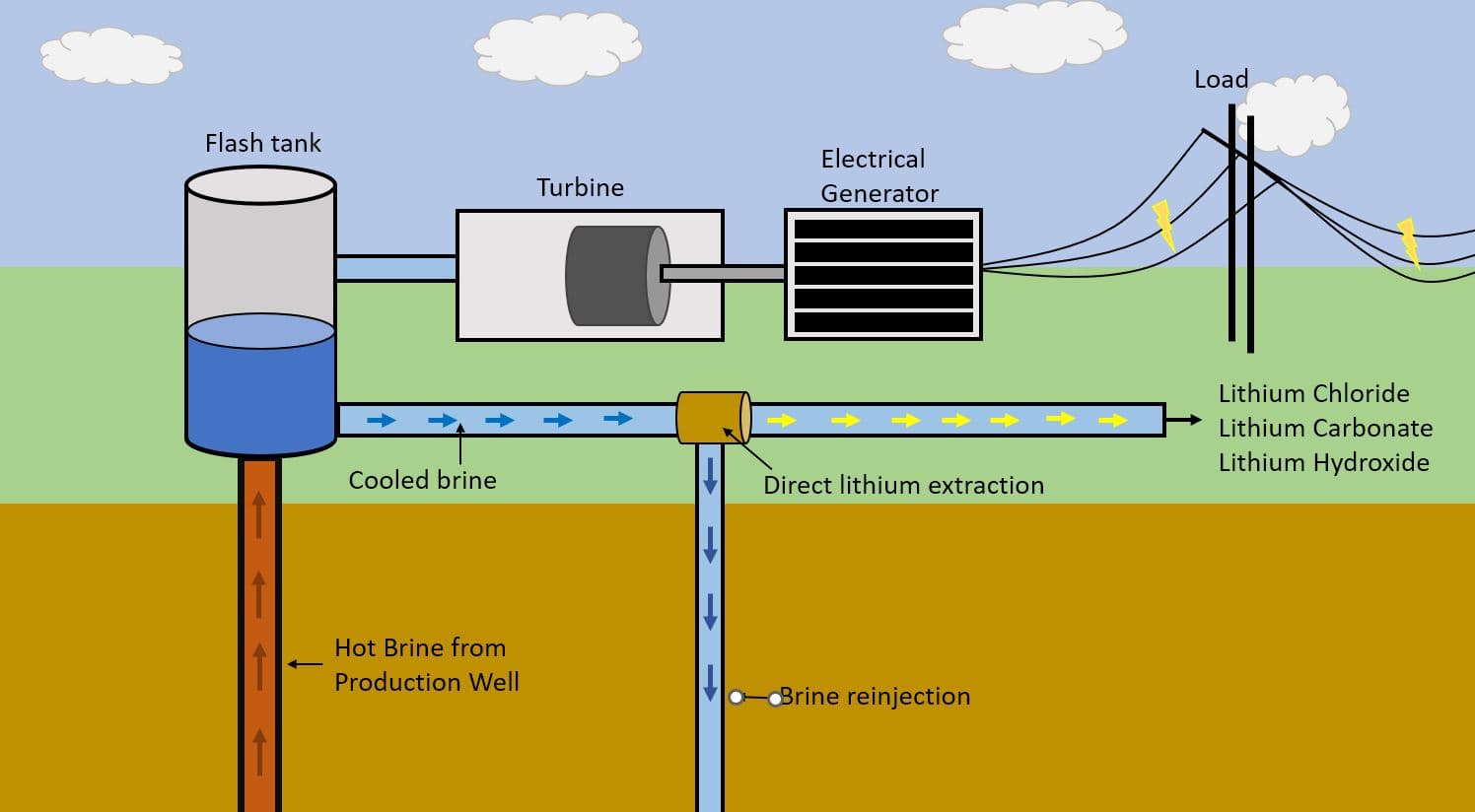
Photo: LazerRocDoc (CC BY-SA 4.0) / Wikimedia Commons / CC BY-SA 4.0
Lithium is the lightest metal and a key ingredient in rechargeable batteries, and batteries now consume more than three-quarters of all lithium produced. The path from a lithium-bearing resource to a battery-grade chemical is not one process. Hard-rock mining, brine evaporation, and direct lithium extraction (DLE) use different chemistry, water, energy, and land, so a fair comparison needs a clearly defined boundary.
DLE refers to processes that selectively capture lithium from salty underground water, called brine, without letting it sit in evaporation ponds for a year or more. This article explains how the main DLE families work, what published numbers say about recovery, water, and waste, and why a promising laboratory result is not the same as a finished solution.
Direct answer: Direct lithium extraction selectively removes lithium from brine using sorbents, membranes, or solvents, then yields a lithium-rich solution for further conversion. It can recover a larger share of the lithium than evaporation ponds and takes days instead of months, according to company data, and it can be paired with geothermal power. Its real-world performance depends on brine chemistry, water balance, energy, chemicals, reinjection, waste, and scale. DLE is a technology family, not one guaranteed method.
Where lithium comes from
Three routes supply the world's lithium, and they behave differently.
Brines. Brines are salty fluids that hold lithium alongside sodium, potassium, magnesium, calcium, boron, and more. Continental brines in salt flats, called salars, are a major commercial source and hold most of the world's lithium reserves. Oilfield brines and geothermal brines are also being explored, though their lithium concentrations are usually lower, which makes pond evaporation unattractive for them.
Hard rock. Lithium-bearing minerals, most famously spodumene, are mined from rock called pegmatite. The ore is crushed, concentrated, heated, and chemically converted. This route has a different footprint of land, energy, and waste than brine.
Recycling. Recovering lithium from used batteries and manufacturing scrap is growing but cannot yet replace primary supply, because the stock of batteries in service is still expanding. DLE and recycling address different points in the chain.
The table shows how production and reserves split among the major countries in the U.S. Geological Survey's 2023 figures, as compiled in the lithium mining overview. The USGS publishes updated numbers each year in its lithium statistics and information pages, so check the latest edition before quoting a figure.
| Country | 2023 mine production (tonnes of lithium) | Reserves (tonnes of lithium) | Main source type |
|---|---|---|---|
| Australia | 91,700 | 7,000,000 | Hard rock |
| Chile | 41,400 | 9,300,000 | Brine |
| China | 35,700 | 3,000,000 | Brine and hard rock |
| Zimbabwe | 14,900 | 480,000 | Hard rock |
| Argentina | 8,630 | 4,000,000 | Brine |
| World | 204,000 | About 30,000,000 | Mixed |
Notice the mismatch. Argentina and Chile hold a large share of reserves but produce less than Australia, which mines hard rock. Much of the new brine capacity under development is meant to change that balance, and DLE is one of the technologies proposed to do it. The cross-country picture is covered in our ranking of countries with the most lithium reserves.
What "direct" means, and the evaporation baseline
To understand DLE, start with what it replaces. In a conventional salar operation, brine is pumped into a series of large shallow ponds. Sun and wind evaporate the water, salts crystallize in sequence, and lithium becomes more concentrated until the liquid is ready for chemical processing. The method is cheap in energy because the sun does the work. The cost is time, land, and water. According to a 2024 chemistry paper on solvent extraction, pond production can take up to 18 months, nearly 50% of the available lithium is not recovered, and evaporation causes large water consumption.
An analogy: ponds are like drying laundry on a line. It costs almost nothing in energy, and it works well on a hot, windy day, but it is slow, needs a lot of space, and depends on the weather. DLE is closer to a clothes dryer. It is faster and more controllable, but it needs equipment, power, and maintenance.
The company-reported numbers show the pitch. Eramet, a French mining group, announced the start of commissioning at its Centenario plant in Argentina on July 3, 2024. In its press release, Eramet reported about 90% lithium recovery from its brine using an in-house DLE process, compared with an estimated 40% to 50% for natural evaporation at the same site, and a lead time of about one week against 12 to 18 months for evaporation. The plant is designed for 24,000 tonnes per year of battery-grade lithium carbonate equivalent at full capacity.
Those are company figures, and the capacity is a design target, not a measured result. They are a useful illustration of the claim being made, not independent proof of performance.
The word "direct" also needs care. It does not mean instant, chemical-free, or zero-water. A DLE system may still need pretreatment, washing, stripping, polishing, concentration, and conversion. A unit that captures lithium efficiently but consumes large amounts of water or energy downstream may not deliver the advantage that the capture step alone suggests. For that reason, the whole system boundary matters, not only the capture reactor.
How sorbents and ion exchange capture lithium
The most commercially advanced DLE family uses a solid material that binds lithium preferentially, then releases it. A sorbent is a material that holds a chemical species on its surface or inside its structure. An ion-exchange material swaps one ion for another. The idea is similar to a coffee filter with a built-in preference. Pour in a mixture, and one component lodges in the solid while the rest passes through.
The Berkeley Lab's geothermal-lithium FAQ describes a typical sequence for the Salton Sea region in California. Operators first add inputs that react with interfering minerals and turn them into solids that can be removed. The clarified brine then flows through an adsorption step, where beads of aluminum or titanium oxide particles bind dissolved lithium. The beads are washed, possibly with acid, to release the lithium, which is recovered as lithium chloride. It is then refined to lithium carbonate or lithium hydroxide monohydrate. The leftover brine is reinjected into the reservoir.
Several variables determine whether this works in the field:
- Capacity: how many milligrams of lithium a gram of sorbent can hold per cycle.
- Selectivity: how strongly the material prefers lithium over sodium, magnesium, calcium, and others.
- Kinetics: how fast the material loads and unloads.
- Regeneration: how many cycles the material survives before it loses capacity or breaks down.
- Fouling: whether suspended solids, scale, or organic matter coat the material.
Regeneration creates its own water and chemical balance. The material must be washed and stripped, the stripping solution must be managed, and the sorbent itself must eventually be replaced, transported, and disposed of or recycled. A headline recovery percentage that omits that downstream accounting is incomplete.
Membranes and electrochemical approaches
Membranes sort ions by size, charge, or the way they dissolve in a medium. In lithium recovery, the most common approach is nanofiltration, which can pass singly charged lithium ions more readily than doubly charged magnesium. This matters because magnesium is chemically similar to lithium and is abundant in many brines.
A 2024 paper on solar-driven membrane separation of lithium shows both the promise and the practical catch. The study treated an artificial salt-lake brine containing 348.4 grams per liter of total salt and cut the magnesium-to-lithium mass ratio from 19.8 to 0.3, a 66-fold reduction. The membrane rejected 98.3% of magnesium chloride and 78.5% of calcium chloride, but only 2.0% of lithium chloride. The recovered lithium carbonate was about 99% pure, which the authors say meets battery-grade requirements. A separate five-day test of water evaporation and salt collection stayed stable.
The same paper notes the catch that applies to many membrane schemes. Conventional nanofiltration usually requires diluting concentrated brine by a factor of 10 to 20 with freshwater during pretreatment, and it yields only a lithium-enriched solution that needs energy-intensive concentration afterward. Membranes can also be sensitive to fouling, scaling, pressure, and chemical compatibility.
Electrochemical systems use an applied voltage and a selective electrode to move or capture lithium. They can be paired with renewable or geothermal electricity, but electricity demand, electrode durability, and water chemistry determine whether they hold up at scale. Public discussion often blurs these categories under one label. A more useful question than "does the project use DLE" is which mechanism, on which brine, at what scale, with which measured mass balance.
Solvent extraction and hybrid systems
Solvent extraction uses an organic liquid that preferentially bonds lithium and pulls it out of the water. After mixing, the two liquids separate, much like oil and vinegar, with the lithium now in the organic phase. A second step strips it back into a clean aqueous solution.
The 2024 paper cited above reviews the trade-offs in this family. The commercial LiSX process is not selective over calcium and magnesium. Systems based on tributyl phosphate and iron chloride are selective over those ions but need high phase ratios and concentrated hydrochloric acid for stripping. Crown ethers and related molecules are highly selective but expensive and hard to prepare. The authors' own system, which pairs two organic compounds, reached 68% lithium extraction in a single stage from a synthetic geothermal brine, with reported selectivity of about 620 for lithium over sodium, 3,100 over potassium, 596 over magnesium, and 2,290 over calcium.
Two details in that study deserve attention. The synthetic brine, modeled on a real geothermal-type deposit, held only 220 parts per million lithium alongside 58.8 grams per liter of calcium. That is a brutal environment: a trace of the target among enormous quantities of lookalikes. Also, a single-stage 68% result is not a full-process recovery, since real plants chain multiple stages.
Hybrid designs combine sorption, membranes, ion exchange, precipitation, and polishing. A hybrid train can improve product purity or protect a sensitive selective material, but each added unit adds equipment, control points, and failure modes. The best configuration depends on the resource, not on a generic ranking of technologies.
Geothermal lithium: pairing heat with minerals
Geothermal brines carry both heat and dissolved minerals. A power plant can use the heat to generate electricity, a DLE unit can recover lithium from the cooled brine, and the leftover fluid can be reinjected underground. The appeal is that wells, pipes, and pumps already exist and can serve two purposes.
The Salton Sea region in southern California is the best-known example. The Berkeley Lab FAQ, based on a one-year pilot study by Lawrence Berkeley National Laboratory with the University of California campuses at Riverside and Davis and other partners, reports the following numbers:
- About 24,000 tonnes of lithium flow through existing geothermal plants in the field each year. At an assumed 90% recovery rate, about 21,600 tonnes would be recoverable annually.
- The reservoir holds about 0.76 million tonnes of lithium in proven reserves and up to 2.6 million tonnes in accessible reserves.
- One tonne of lithium metal is equivalent to about 5.32 tonnes of lithium carbonate equivalent (LCE), the unit in which the commercial product is traded.
Each of these is an estimate from the study's assumptions, and the 90% recovery rate is an assumption rather than a measurement from an operating plant. The caveat applies throughout this article. Resource estimates, recovery percentages, and production plans for geothermal lithium all come with a "provided that" attached.
Site specifics are decisive. Temperature, pressure, flow rate, scaling, corrosion, and the chemistry of the reservoir affect both economics and environmental performance. A brine that is rich in lithium but also in silica, iron, or arsenic needs more pretreatment, and that adds cost and waste.
Water: what can and cannot be claimed
Water is the most contested question in DLE. The claim usually made is that DLE uses less water than evaporation ponds, because the ponds lose large volumes of water to the atmosphere. The honest answer is that it depends on where you draw the boundary and which operation you compare.
The Berkeley Lab FAQ offers the best quantified example for one region. For this discussion, 1 acre-foot is about 1,233 cubic meters.
| Item | Acre-feet per year | Approximate cubic meters per year |
|---|---|---|
| Existing geothermal plants, per megawatt | 16 | About 20,000 |
| A 50-megawatt plant | About 800 | About 1.0 million |
| All Salton Sea geothermal plants combined (about 0.25% of Imperial Irrigation District supply) | About 6,500 | About 8.0 million |
| Expansion to 920 MW of geothermal power | About 15,000 | About 18.5 million |
| Adding lithium extraction at that scale | About 50,000 to 65,000 | About 62 to 80 million |
The FAQ states that the last line is about 6% of the Imperial Irrigation District's current Colorado River allocation. For lithium alone, one company's allocation implies about 0.2 acre-feet per tonne of LCE, which is about 250 cubic meters, though the company said its actual use may be lower. The study could not verify how much water companies would recycle.
Two lessons come from this. First, DLE does not mean "no water." Water goes to washing, stripping, cooling, chemical preparation, and downstream conversion. Second, the right comparison is absolute volume against local supply, because 6% of a river allocation in an arid basin is a large number even if the per-tonne figure looks small. A statement such as "uses less water" is incomplete without a comparator and a boundary. For wider context on why local water stress matters, see our explainer on water scarcity.
Reinjection and subsurface uncertainty
Many DLE proposals reinject the treated brine into the reservoir. That avoids surface discharge, but it does not erase subsurface effects. The reinjected fluid differs from the fluid pumped out, because lithium and other ions have been removed and reagents may have been added. Pressure, chemistry, well integrity, connectivity between reservoir zones, and induced seismicity all need site-specific analysis.
The Berkeley Lab FAQ looked at seismicity directly for the Salton Sea. It reports that seismic activity rose after geothermal production began in 1982 and leveled off in the early 2000s, that since 1996 seismicity has been only weakly correlated with injection volume, and that current rates resemble those of the nearby Brawley Seismic Zone, which is driven by tectonic activity. The study does not expect lithium extraction to affect seismicity at current production and injection rates, because it would not require additional drilling or reinjection at those rates. It does recommend avoiding injection wells near active faults. That is a finding for one geothermal field, not a general rule for brine reinjection everywhere.
Waste streams and byproducts
The Berkeley Lab study estimates that the main solid byproduct is an iron-rich silica precipitate, called filter cake, which resembles sand and is usually not hazardous, though it can carry trace arsenic and lead. A high-end estimate of added solid waste for the full buildout is 889,000 tons per year, though the authors expect the real figure to be lower. About one-fifth to one-third of existing geothermal solid waste is classed as hazardous under California rules, and it goes to a permitted hazardous landfill in Kern County.
Other possible waste streams include spent sorbent, used solvent, concentrate brine, and acid or base wash solutions. As an analogy, a DLE plant is like a high-volume coffee shop. The product is what customers see, but behind the counter there are filters to replace, grounds to dispose of, and cleaning chemicals to manage. A fair environmental assessment counts the grounds.
Energy and emissions
DLE consumes energy for pumping, pressure, heating, cooling, membrane operation, electrochemistry, and conversion. A geothermal project can supply low-carbon electricity and heat from the same wells, which is an advantage over a standalone plant on a fossil-heavy grid. Construction, drilling, chemicals, and grid backup still add to the lifecycle total, though.
The carbon footprint depends on the energy mix and on the system boundary. It cannot be inferred from the words "direct," "geothermal," or "clean" alone. Published life-cycle studies should state their assumptions, operating data, plant scale, and whether upstream materials are included. If a source does not, treat its emissions claim as provisional.
From brine to battery-grade chemical
A lithium-rich solution is not a finished product. Battery makers buy chemicals with defined purity and consistency, mainly lithium carbonate and lithium hydroxide. The DLE output usually needs concentration, impurity removal, precipitation or conversion, drying, and quality control. The Berkeley Lab FAQ describes recovery as lithium chloride followed by refining to carbonate or hydroxide.
Impurities such as magnesium, calcium, boron, and sulfate can reduce recovery, raise reagent use, and fail a product specification. Even a process with very strong capture may need an elaborate polishing train. Qualification with a battery manufacturer can take longer than a pilot demonstration, because cell makers test materials over long periods before approving them. For background on what the finished chemical does inside a cell, see our explainers on how lithium-ion batteries work and how EV batteries work.
Laboratory, pilot, and commercial evidence
A claim about DLE should say what level of evidence stands behind it.
Laboratory evidence. Bench experiments test capacity, selectivity, and regeneration under controlled conditions, often on synthetic brine in small volumes and short cycles. They are useful for comparing mechanisms. The 68% single-stage extraction and the 66-fold magnesium reduction cited above are laboratory results.
Pilot evidence. A pilot plant uses real or representative brine and runs continuously. It reveals fouling, maintenance problems, water balance, and product quality that batch tests miss. Eramet reports that its process was tested for five years in a pilot plant at the Centenario site, and its 90% recovery figure is a company-reported number.
Commercial evidence. A commercial plant must sustain performance for years, manage waste, meet permits, secure energy, and operate safely. A project announcement or a funding award is not proof of commercial production, profitability, or environmental superiority. Eramet's own release notes that output in 2024 would be very limited and that ramp-up was expected by mid-2025, which illustrates how long the gap between commissioning and full output can be.
Most published numbers fall in the first two categories. Careful readers match each number to its category before comparing technologies.
A decision framework for evaluating DLE claims
| Question | Why it matters | Evidence to request |
|---|---|---|
| What is the brine chemistry? | Selectivity and fouling depend on impurities | Independent resource characterization |
| What capture mechanism is used? | "DLE" covers several different technologies | Process flow diagram and material data |
| What is the full water balance? | Capture can shift water use downstream | Withdrawal, consumption, recycling, and discharge data |
| What happens to spent brine? | Reinjection or disposal affects impact | Reservoir, permit, and monitoring plan |
| What is the energy source? | Pumping and conversion affect emissions | Measured energy use and lifecycle boundary |
| What evidence level exists? | Lab, pilot, and commercial claims differ | Operating duration, scale, and third-party validation |
| What is the product? | A lithium-rich fluid may need conversion | Purity, consistency, and downstream qualification |
| How are wastes handled? | Wastes can move from one stream to another | Reagent, resin, concentrate, and disposal plan |
This framework keeps a single performance number from standing in for a full lifecycle assessment.
Community and ecological dimensions
Lithium projects affect water rights, land, roads, power lines, employment, noise, and local ecosystems. Community acceptance depends on process, transparency, and benefits as much as on any technology label. The Berkeley Lab pilot study of the Salton Sea, funded by the U.S. Department of Energy, set out to evaluate resources in the geothermal field and the impacts of extracting lithium from it. Independent studies, published numbers, and local consultation before projects scale up are a useful template.
Environmental review should look at construction, operation, accidental release, water draw, reinjection, waste, closure, and long-term monitoring. A critical mineral can support energy-transition goals and still demand strict local accountability. One does not cancel the other.
DLE and the battery supply chain
DLE is one link in a chain that includes exploration, extraction, processing, chemical conversion, cathode manufacturing, cell production, use, and recycling. Boosting brine supply through DLE does not remove the need for efficient batteries, material substitution, recycling, demand management, or responsible mining. The International Energy Agency's Global Critical Minerals Outlook 2025, published on May 21, 2025, models lithium supply and demand under several scenarios, which is a good place to look for how expected supply growth compares with expected demand.
Batteries that use less lithium, or none, change the picture. Our explainer on sodium-ion batteries covers a chemistry that avoids lithium altogether. For stationary storage, the economics are discussed in grid-scale battery storage. And how a growing electric fleet affects the grid is covered in electric vehicles and the power grid. Newer technologies can be strategically valuable without being environmentally perfect. The best analysis compares alternatives under transparent boundaries instead of presenting one pathway as the answer to every lithium problem. A related question is how a battery electric vehicle works end to end, which our explainer on electric cars answers.
Common misunderstandings
"DLE is the same as lithium mining." DLE is a processing approach for lithium-bearing fluids. The wider system also includes wells, brine management, conversion, infrastructure, and downstream chemical production.
"DLE destroys the brine." The brine is treated, reinjected, or managed, and its chemistry changes after lithium and other components are removed.
"A pilot proves commercial success." A pilot provides operating evidence but does not prove long-term production, profitability, or environmental superiority.
"DLE solves lithium supply alone." Supply also depends on exploration, mining, recycling, manufacturing, demand, substitution, permitting, and infrastructure.
"DLE is clean by definition." The label says how lithium is captured, not how much water, energy, or waste the full system uses.
Limitations
DLE performance is resource-specific and technology-specific. Published recovery, water, energy, speed, or footprint figures may come from one brine, one pilot, one model, or one company, and cannot be generalized without a matched comparator and lifecycle boundary. Laboratory results do not establish long-term operation. Reinjection and subsurface impacts need site-specific evidence. A lithium-rich product is not automatically battery-grade material.
This article is an educational overview, not investment advice, a project approval, an environmental permit assessment, or a prediction of commercial success. Resource estimates, policies, and project status change, so check current USGS, IEA, regulator, and project sources.
The takeaway
DLE is best understood as a set of selective separation tools applied to brines that are very different from one another. In the best-documented settings, such as the company-reported results for Eramet's Argentine brine and the Berkeley Lab analysis of the Salton Sea, the potential gains are clear: higher recovery than ponds, days instead of months, and the chance to reuse geothermal infrastructure. So are the costs: reagents, energy, water drawn from sources other people rely on, solid waste, and unresolved questions about long-term operation. The useful habit is to ask what was measured, at what scale, on which brine, and inside what boundary. A recovery rate without those answers is a marketing number. With them, it is the start of an engineering comparison.
Frequently asked questions
Q: What is direct lithium extraction? A: DLE is a family of processes that selectively recover lithium from brine using materials or methods such as sorbents, ion exchange, membranes, electrochemistry, or solvents, and deliver a lithium-rich solution for further refining.
Q: Is DLE faster than evaporation ponds? A: Company data say yes. Eramet reports a lead time of about one week against 12 to 18 months for evaporation. Pretreatment, regeneration, concentration, and conversion still take time, and ramp-up of a new plant can run for many months.
Q: Does DLE use no water? A: No. Water is used for washing, regeneration, cooling, chemical preparation, and downstream processing. At the Salton Sea, the Berkeley Lab study estimates that adding lithium extraction at full buildout could need about 50,000 to 65,000 acre-feet per year, roughly 6% of the local Colorado River allocation.
Q: What recovery rate does DLE achieve? A: It varies by method and brine. Eramet reports about 90% for its process against 40% to 50% for evaporation at the same site, and a 2024 laboratory study reported 68% in a single solvent-extraction stage. These are not directly comparable, because the processes, brines, and boundaries differ.
Q: What is geothermal lithium? A: It is lithium recovered from hot geothermal brines that may also be used for power or heat. The Berkeley Lab study estimates that about 24,000 tonnes of lithium flow through existing Salton Sea plants each year, and about 21,600 tonnes would be recoverable at an assumed 90% recovery.
Q: Does DLE produce battery-grade lithium directly? A: Not automatically. DLE gives a lithium-rich solution, usually lithium chloride, that needs purification and conversion to lithium carbonate or hydroxide to meet a battery specification.
Q: Is DLE more sustainable than hard-rock mining? A: The answer depends on the resource, process, energy, water, waste, land, emissions, and boundary. No universal ranking is justified without matched, independent life-cycle studies.
Sources
- Berkeley Lab LIRRIC, Frequently Asked Questions on geothermal lithium, based on the Salton Sea pilot study.
- Eramet, press release on the Centenario DLE plant, July 3, 2024 (company-reported figures).
- Study on selective lithium solvent extraction from geothermal-type brine, PubMed Central.
- Study on solar-driven membrane separation for direct lithium extraction, PubMed Central.
- Lithium mining, overview with USGS 2023 production and reserves table.
- U.S. Geological Survey, Lithium statistics and information.
- International Energy Agency, Global Critical Minerals Outlook 2025.
This article is educational and does not provide investment, project-approval, or environmental-permitting advice.
Read next:
Follow new articles
Add SciHub101 to your feed reader to see new science and technology stories.
About the Author
SciHub101 is an independent science and technology publication founded and edited by Buğra Sözeri, a software engineer and app developer based in Türkiye. AI tools assist with drafting and research. Source documentation in the existing archive is uneven, and articles are being reviewed and corrected. The Editorial Team byline identifies editorial responsibility; it does not certify specialist or independent human review. Where we compare products, anything built by our own team is labelled as such — see the editorial guidelines and About page for how corrections and disclosures work.
Related Articles
Green Steel Explained: Hydrogen, Electrolysis and the Hardest Part of Decarbonizing Steel
Green steel is made with far less CO2 than blast-furnace steel. How hydrogen direct reduction, scrap and electric arc furnaces work, and what limits them.
Carbon Mineralization Explained: Turning CO2 Into Stable Carbonate Minerals
Carbon mineralization turns CO2 into solid carbonate rock. How it works, what Iceland's CarbFix showed, and why energy, rate, and MRV decide net removal.
How Do Electric Cars Actually Work?
An EV is dramatically simpler than a petrol car — a battery, a motor, some software. Here's how the parts work together, the trade-offs versus combustion, and what's coming next.
How Lithium-Ion Batteries Work
The battery in your phone contains enough energy to seriously injure you. Understanding it reveals one of chemistry's most elegant solutions.
Countries With the Most Lithium Reserves (USGS 2026)
Chile holds the largest lithium reserves at 9.2 million tonnes, ahead of Australia, China, Argentina, and the United States. Reserves, resources, and production tell three different stories.
Countries With the Most Rare Earth Metals (USGS 2026 Data)
China holds about 44 million tonnes of rare earth reserves and mined roughly 270,000 tonnes in 2025, about 69% of the world total. Here is how the reserve and production rankings differ, and why refining matters more than either.