Green Steel Explained: Hydrogen, Electrolysis and the Hardest Part of Decarbonizing Steel
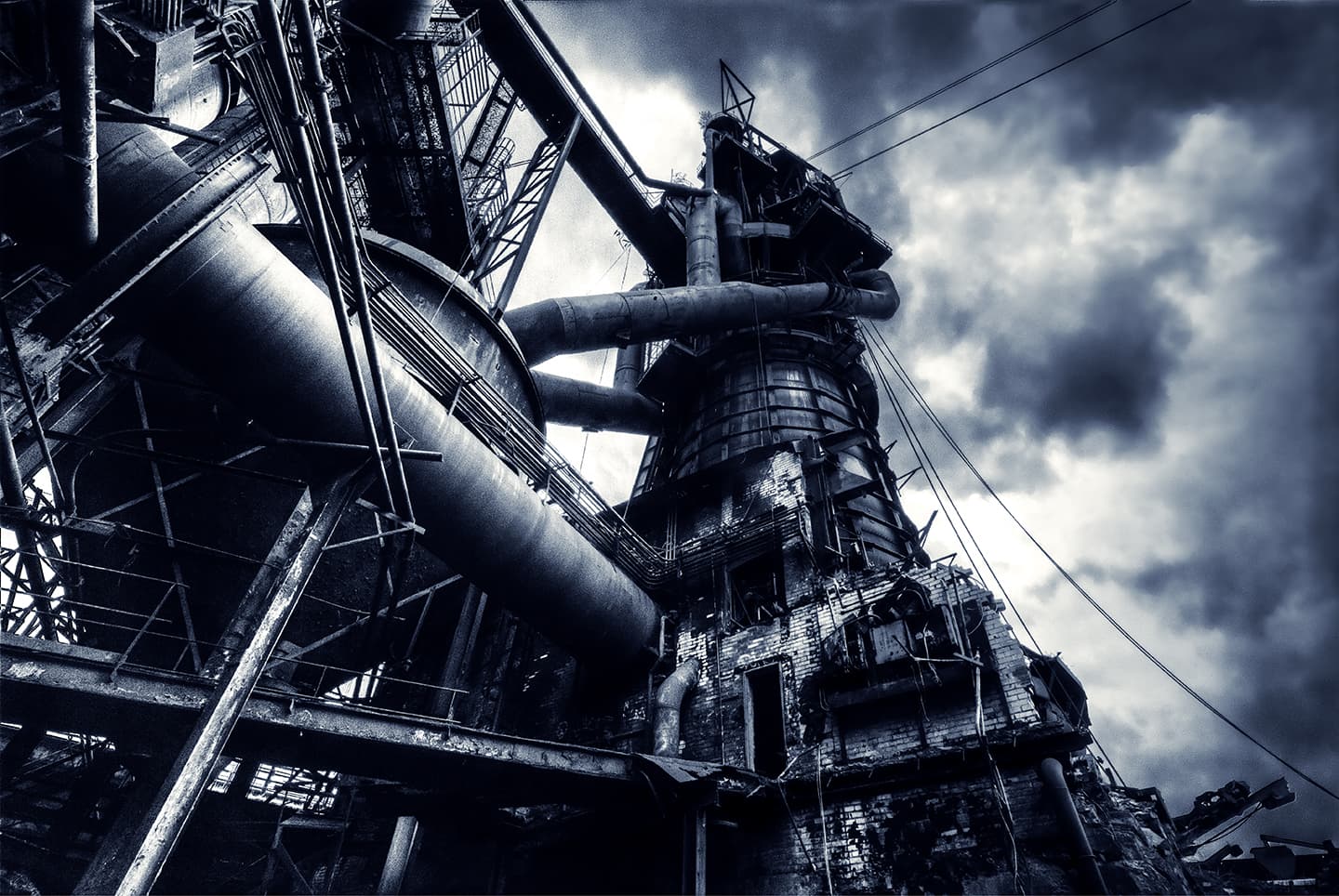
Photo: George Corbin (CC BY 2.0) / Wikimedia Commons / CC BY 2.0
Steel holds up buildings, bridges, railways, ships, cars, wind turbines, and pipelines, and the world made about 1.9 billion tonnes of it in 2024. It is also one of the hardest materials to make without carbon dioxide, because conventional ironmaking uses coal-derived carbon for more than heat. Carbon is the chemical tool that strips oxygen from iron ore. Swapping the electricity source cannot remove that step.
Green steel is a broad public label for steel made with much lower greenhouse-gas emissions than the conventional route. It is not one technology, and it is not a universal legal category. This article explains why the carbon is built into the chemistry, how scrap furnaces and hydrogen-based direct reduction change it, what the real projects have achieved so far, and why several of them have stalled.
Direct answer: Green steel means lower-emissions steelmaking measured against a stated baseline and boundary. The two leading routes are electric arc furnaces that melt recycled scrap, and hydrogen direct reduction, in which hydrogen replaces coal-derived carbon as the oxygen remover before an electric furnace melts the iron. Both need large amounts of low-carbon electricity, suitable ore or scrap, new infrastructure, and a market willing to pay more. No single route is best for every region or steel product.
Why conventional steel is built on carbon
Iron ore is an oxide
Iron in the ground is mostly combined with oxygen, as hematite (Fe₂O₃) and magnetite (Fe₃O₄). To get metal, a process must remove the oxygen. In a blast furnace, coke (a coal product) burns to provide heat and also produces carbon monoxide, which grabs oxygen from the ore. The simplified reaction for the main step is:
$$\text{Fe}_2\text{O}_3 + 3,\text{CO} \rightarrow 2,\text{Fe} + 3,\text{CO}_2$$
The molten iron, called pig iron, contains around 4% carbon. It then goes to a basic oxygen furnace, where blown oxygen burns most of that carbon out and adjusts the chemistry to produce steel.
The point to remember is that the carbon dioxide comes partly from the chemistry. An analogy: if you want to rust-proof a nail by pulling the rust off, you need something that bonds to the oxygen. Carbon is cheap, hot, and abundant, and it does the job very well. The price is that every oxygen atom it removes leaves as CO₂. Running the same furnace on wind power does not change that.
How big the problem is
The International Energy Agency's iron and steel technology roadmap, published in 2020, put the sector's direct emissions at about 2.6 billion tonnes of CO₂ per year, roughly 7% of energy-system CO₂ and about 10% when indirect power-sector emissions and steel off-gas combustion are counted. Average direct intensity was about 1.4 tonnes of CO₂ per tonne of crude steel, and coal supplied around 75% of the sector's energy. Other sources give somewhat different figures depending on the year and system boundary. The green steel overview cites roughly 1.8 tonnes of CO₂ per tonne of steel when upstream emissions are included. The IEA also noted that, without targeted action, sector emissions would drift to about 2.7 billion tonnes by 2050, and that they would need to fall at least 50% by then.
A blast furnace fleet has a long life. The IEA put the average age at about 13 years since last major refurbishment in 2020, and about 24 years since initial installation. The IEA estimated that running existing assets to the end of their lives could emit about 65 billion tonnes of CO₂ cumulatively. That is why the sector's timing is more about capital cycles than about science. Each time a blast furnace comes up for a major rebuild, the owner faces a decision, and each decision locks in decades.
Steel is not one product
Rebar for concrete, sheet for car bodies, electrical steel for transformers, rail, pipe, and stainless steel have different requirements for impurities, surface, strength, and consistency. A low-emissions ironmaking process still has to produce material that meets the buyer's specification. That is a larger constraint than it sounds, because a premium for green steel can only be charged on steel that performs as well.
The scrap route and electric arc furnaces
An electric arc furnace (EAF) melts steel using electricity passed through graphite electrodes, which strike an arc to the metal charge. Most EAFs melt scrap. If the electricity is low-carbon, an EAF can make steel with far lower emissions than a blast furnace. The overview of green steel notes that recycling a tonne of scrap avoids about 1.5 tonnes of CO₂, and the IEA roadmap finds that scrap-based production needs about one-eighth of the energy of ore-based production.
The EAF route is already large and varies by region. In 2024, world crude steel output was about 1.885 billion tonnes, of which electric arc furnaces made 29.1%, about 548 million tonnes, and the blast furnace route about 70.4%, according to figures from the World Steel Association as reported by GMK Center.
| Region | 2024 crude steel output | Share made in electric arc furnaces |
|---|---|---|
| World | About 1,885 million tonnes | 29.1% |
| China | About 1,005 million tonnes | 10.2% |
| European Union | 129.7 million tonnes | 44.4% |
| United States | Not stated in the source | 71.8% |
| Italy | Not stated in the source | 89.3% |
The contrast between China and the United States explains why the scrap route cannot simply be copied everywhere. A country has to have enough scrap before it can melt it. China built much of its steel-using stock recently, so the supply of end-of-life steel is still limited. The United States has a long-established stock of old cars, buildings, and appliances that now returns as scrap.
Scrap has limits. Steel lasts for decades inside buildings, bridges, and vehicles, so the amount of scrap available this year reflects what was built decades ago, while demand reflects today's needs. The IEA roadmap found that iron ore supplies about 70% of metallic inputs and that scrap alone cannot meet needs, even with global recycling rates around 80% to 90%. Scrap also accumulates residual elements, especially copper and tin, that cannot be removed in the furnace. Those residuals limit which grades can be made from scrap, which is why high-end automotive sheet usually needs cleaner iron. Sorting, dilution with clean iron, and process control decide what scrap can become.
Hydrogen direct reduction
The chemical idea
In direct reduction, the ore is never melted. A hot reducing gas flows through lumps or pellets of iron ore and strips off the oxygen, leaving solid sponge iron. The direct reduced iron (DRI) overview describes it as occurring below about 1,200 °C, typically in a temperature range of 800 to 1,200 °C, with the ore reduced in stages from hematite to magnetite, then to ferrous oxide, then to metallic iron. The product is typically 90% to 94% iron, which makes it a good feedstock for an electric arc furnace. It can be fed to the furnace hot, saving energy, or compacted into hot-briquetted iron for shipping.
Today most DRI uses natural gas or coal-derived gas as the reducing agent. In a hydrogen version, the reaction changes to:
$$\text{Fe}_2\text{O}_3 + 3,\text{H}_2 \rightarrow 2,\text{Fe} + 3,\text{H}_2\text{O}$$
The by-product is water vapor, not carbon dioxide. The reaction overall absorbs heat, so the process needs a heat source, and in hydrogen plants that is typically electricity. The green steel overview gives about 820 °C for direct reduction with hydrogen.
The chemistry is attractive, but the plant needs much more than a hydrogen pipe. It also needs pelletized ore, heat, an electric furnace, a rolling mill, and a hydrogen supply that is genuinely low-carbon.
Ore quality
DRI processes generally prefer high-grade pellets, because impurities in the ore, called gangue, do not melt away as they do in a blast furnace. In an EAF fed with DRI, gangue ends up as extra slag, which increases electricity use and reduces yield. This means that regions with abundant, lower-grade ore may need an extra beneficiation step or a different route. Iron ore geography therefore becomes a competitive factor in a way that coal geography was for blast furnaces.
Hydrogen supply
Hydrogen can be made by splitting water with electricity (electrolysis), from natural gas with or without carbon capture, or by other routes. "Hydrogen steel" is therefore not automatically low-carbon. The hydrogen has to be made with low-carbon power, and the electricity has to be accounted for honestly. Our explainers on how green hydrogen is made and on whether green hydrogen could replace fossil fuels cover the production question in detail.
Electricity is the system constraint
A hydrogen-DRI plant draws electricity for electrolysis, hydrogen compression and heating, pelletizing, melting in the EAF, rolling, and auxiliary equipment. The green steel overview cites an estimate of about 2,600 kilowatt-hours per tonne of steel for the hydrogen electrolysis alone, and that the hydrogen needed for direct reduction in the European Union would require an estimated 180 gigawatts of renewable capacity. At the global scale, the IEA roadmap estimated that building one hydrogen-based DRI plant per month would add about 720 terawatt-hours of electricity demand by 2050.
A tonne of steel made this way is, in effect, a lot of stored electricity, and a plant making millions of tonnes per year needs a power supply on the scale of a small city. The mismatch between those numbers and the spare capacity of a regional grid is what makes the project hard.
The climate result depends on whether the power is low-carbon on the relevant accounting basis. A region may have plentiful wind and solar but lack transmission, storage, or firm supply. If a plant runs on a coal-heavy grid when renewables are low, operating emissions can rise. A credible assessment states the electricity mix, the timing assumptions, and whether new generation is dedicated to the plant. For background on how supply and demand balance, see our explainers on renewable energy and why grid storage is hard, and for current rankings see countries with the most renewable electricity.
Carbon capture and alternative reductants
Carbon capture can reduce emissions from a blast furnace or from gas-based processes, provided capture rates, energy for capture, transport, storage permanence, and leakage are measured. The green steel overview notes a range of estimates for top-gas recycling with capture: a 2017 study found a 56.5% cut in blast-furnace CO₂ with capture and storage, and 26.2% with only reducing-agent recycling. The same overview cites 65% to 80% for capturing carbon from coke oven gases, but cost and infrastructure have limited adoption. Capture does not eliminate every upstream or process burden. How the technology works is covered in our pieces on how carbon capture works and carbon capture in practice.
Other options reduce emissions by smaller amounts or are earlier in development. The same overview cites biomass fuel as reducing emissions by 5% to 28%, and the HIsarna ironmaking process as cutting CO₂ by around 20%. Molten oxide electrolysis, which runs near 1,600 °C and uses electric current instead of a chemical reductant, is a longer-term option that companies such as Boston Metal are working to commercialize. Biomass and methane-derived hydrogen can bring land-use, supply-chain, or leakage concerns. A technology label alone does not give a lifecycle result.
What has actually been built
Pilot and demonstration plants matter because they turn arguments into measurements. Two examples show both progress and difficulty.
HYBRIT in Sweden
HYBRIT was launched in 2016 by the steelmaker SSAB, the iron ore miner LKAB, and the utility Vattenfall. In June 2021, its pilot plant in Luleå produced the first hydrogen-reduced sponge iron. SSAB then rolled steel made from that iron at its Oxelösund site and delivered a trial batch to the Volvo Group. In its August 18, 2021 announcement, SSAB described the result as the world's first fossil-free steel and stated the goal of demonstrating the technology on an industrial scale as early as 2026. According to the HYBRIT project site, the project completed a hydrogen gas storage pilot in February 2025, with results indicating that industrial-scale storage is technically possible, and its temporary building permit for the pilot hydrogen storage facility in Luleå was extended on February 24, 2026, to allow operation until 2031.
HYBRIT shows the chemistry works at pilot scale with real ore. It is a trial batch, though, and the scaling from pilot to a full commercial plant is the harder step.
Stegra in northern Sweden
Stegra (formerly H2 Green Steel) is building a full-scale hydrogen-based steel plant at Boden in northern Sweden. The project shows what the scale-up looks like. A report by GMK Center states that the original construction plan was 25 billion Swedish kronor, that production was originally scheduled for 2024 and has been postponed several times, and that the latest statement put the start in early 2027, with the timeline now being revised again. Swedish press reports cited by that article put the cost increase at least 10 billion kronor, bringing total capital raised to about 100 billion kronor. The same report says Stegra completed a €1.4 billion funding round, and on September 30, 2026, Stegra announced that its CEO, Henrik Henriksson, was being replaced. These are press-reported figures and they may change.
ArcelorMittal's Spanish decision
In November 2024, ArcelorMittal postponed its decision to invest in a 2.3-million-tonne-per-year hydrogen-based DRI plant at its Gijón site in Spain, citing an unfavorable political, market, and energy situation, slow development of green hydrogen, shortcomings in the European carbon border adjustment, and the lack of a clear Spanish regulatory framework for green hydrogen. Construction of a 1.1-million-tonne electric arc furnace at Gijón had begun in May 2024, and EAF construction at both Gijón and Sestao would continue. This pattern is common: the electric furnace can go ahead while the hydrogen step waits.
| Project | What it is | Status reported in the sources |
|---|---|---|
| HYBRIT (SSAB, LKAB, Vattenfall) | Pilot hydrogen DRI in Luleå, Sweden | First hydrogen-reduced sponge iron June 2021; trial steel delivered to Volvo in 2021; hydrogen storage pilot permit extended to 2031 |
| Stegra, Boden | Full-scale hydrogen-based steel plant | Originally due 2024; latest statement early 2027, timeline under revision; funding rounds and cost increases |
| ArcelorMittal, Gijón | Planned 2.3 Mt/yr hydrogen DRI | Investment decision postponed in November 2024; 1.1 Mt EAF under construction |
Cost, demand, and the green premium
Hydrogen production is estimated to raise steel costs by 20% to 30% over conventional methods, according to the green steel overview, and other costs include new furnaces, infrastructure, and high-grade ore. The premium varies by region, project, financing, policy, and carbon price. No single current premium applies everywhere.
Demand-side action can help create a market. Buyers such as vehicle makers may pay more for lower-emission steel, but they also need specifications, verification, delivery schedules, and confidence that the material performs like conventional steel. Policy can change the balance. The European Union's carbon border adjustment mechanism, which covers iron and steel, entered into force on May 17, 2023, with the mechanism taking effect in 2026. Check the European Commission for the current schedule of charges. It is meant to stop imports from escaping the carbon price that European producers pay. Its design details, such as how emissions are measured and which are included, strongly affect which route gets rewarded.
For readers interested in who emits the most overall, our ranking of countries with the highest CO₂ emissions and the explainer on climate change science provide context.
Certification and emissions accounting
A buyer who asks whether a tonne of steel is "green" is really asking about a boundary. Does the figure cover only the plant, or also mining, pelletizing, and transport? Are emissions split among co-products by mass, by market value, or by another rule? Is renewable electricity physically delivered, contracted on paper, or averaged across the grid? Are avoided emissions counted?
Standards and certification schemes try to make these claims comparable, but they differ. A product can have a lower declared footprint under one scheme without being comparable to a product certified under another. A published claim should state its methodology and baseline, not just a label. A useful sentence has this shape: "Cradle-to-gate emissions of X kilograms of CO₂ per tonne of steel, measured over period Y, using electricity from source Z, compared with baseline B."
Industrial geography changes
Steel plants cluster near ore, coal, ports, water, customers, or established infrastructure. A transition can shift the preferred locations. Hydrogen DRI favors places with high-quality ore and cheap low-carbon electricity, which is part of why the flagship projects are in northern Sweden. Scrap EAFs favor demand centers with abundant scrap and strong grids. Moving ore, pellets, hydrogen, or hot-briquetted iron changes transport emissions. One idea is to make the iron where energy is cheap and ship it to where steel is used. That makes sense on paper but adds logistics, and a low-carbon process in one region may not produce the lowest lifecycle result once shipping and infrastructure are counted.
Water, land, and local impacts
Electrolysis consumes water, and mining, pelletizing, cooling, and steelmaking also use it. Water stress is local, so a national average can hide community impacts. New renewable generation, transmission lines, mines, pipelines, and industrial plants take land and affect ecosystems. A decarbonization project should also address air quality, noise, truck traffic, waste, labor, community consultation, and closure. Lower carbon is important, but it is not the only environmental or social criterion.
What good measurement looks like
A credible steel claim states emissions per tonne of product, the time period, the process route, feedstock, electricity source, hydrogen source, boundary, data source, and uncertainty. Independent verification matters because announcements and models can differ from long-term operation.
Track the transition on several levels: absolute emissions, emissions intensity, production volume, scrap share, hydrogen source, electricity mix, capture rates, ore quality, and plant utilization. Intensity can improve while total emissions rise, if production grows faster than the intensity falls. The IEA's 2020 roadmap showed that this was its baseline concern, with emissions projected to reach about 2.7 billion tonnes by 2050 if nothing changed.
Sequencing and operating reality
Steel plants cannot change every process at once. A transition may start with efficiency upgrades, better scrap sorting, furnace improvements, renewable power contracts, and heat recovery, while a new direct-reduction line is developed. The order affects emissions, capital risk, workforce needs, and the ability to keep supplying customers.
A plant is not a laboratory. It must handle variable ore, maintenance outages, demand swings, quality targets, and safety rules. A hydrogen-DRI furnace may be technically feasible but run at lower utilization than a blast furnace if hydrogen is intermittent or expensive. A low-carbon EAF still depends on scrap quality and grid capacity. A transition plan should therefore report operating hours, product mix, startup behavior, and the conditions under which performance was measured.
Workforce and infrastructure matter too. New furnaces, electrolyzers, substations, storage tanks, and pipelines need operators, maintenance teams, emergency procedures, and training. The ArcelorMittal and Stegra examples above show how quickly finance, policy, and construction schedules interact. Communities may see construction impacts years before any emissions benefit. Honest reporting includes those conditions instead of describing the transition only as a future process diagram. Everyday steel structures, like those described in our explainers on how skyscrapers are built and how bridges are engineered, depend on this same supply chain, which is why a transition that disrupts supply is costly.
Route comparison framework
| Route | Main reducing or melting principle | Main low-carbon opportunity | Main constraint |
|---|---|---|---|
| Blast furnace + basic oxygen furnace | Carbon-based reduction and oxygen conversion | Efficiency, lower-carbon fuels, or capture | Process carbon and coal dependence |
| Scrap EAF | Electric melting of recycled steel | Low-carbon electricity and recycling | Scrap quantity, quality, and residuals |
| H2-DRI + EAF | Hydrogen removes oxygen; electricity melts iron | Low-carbon hydrogen and power | Ore quality, hydrogen, and electricity demand |
| Gas-DRI + EAF | Gas-derived reducing chemistry | Efficiency or capture | Fossil gas and methane assumptions |
| Biomass or alternative reductant | Non-coal reducing inputs | Potential fossil-carbon reduction | Sustainable feedstock and scale |
| Capture-enabled route | Captures selected process emissions | Storage and verified capture | Energy, transport, storage, and leakage |
| Molten oxide electrolysis | Electric current separates iron from oxide | Direct electrification | Early-stage; high temperatures and materials |
This is an analytical framework, not a ranking. The best route varies by ore, scrap, power, infrastructure, and product.
Common misunderstandings
"Hydrogen steel is automatically green." The hydrogen has to be low-carbon, and so does the electricity used to make the hydrogen and melt the iron.
"Recycling can cover all steel demand." Scrap supply reflects steel made decades ago, so even high recycling rates cannot meet the total need for new metal.
"Green steel is a legal definition." The meaning depends on the certification, procurement scheme, or jurisdiction. Treat the phrase as a description that needs a stated method.
"A pilot plant proves the economics." A pilot shows the chemistry works with real materials. It does not show that a commercial plant will be financed, built, and run on time, as the Stegra and Gijón examples illustrate.
Limitations
Green steel has no single universal process, emissions value, or product meaning. Hydrogen production, electricity mix, ore, scrap, carbon capture, transport, certification, and allocation can change the result. A pilot, announcement, or model is not proof of commercial scale, profitability, or a particular emissions reduction. Several figures here, such as the IEA's 2020 roadmap numbers and the cost and electricity estimates from the overview source, are estimates from specific years or studies and may differ from current data. Project status can change quickly, so verify with current company and agency sources. This article is an educational industrial-decarbonization overview, not an investment recommendation, procurement specification, or permit assessment.
The takeaway
The hardest part of decarbonizing steel is not a missing invention. It is the combination of chemistry that depends on carbon, enormous electricity needs, ore that suits direct reduction, long-lived capital, and a product sold at commodity prices. Scrap-fed electric furnaces are already large and are growing, but they are limited by how much steel was made in the past. Hydrogen direct reduction works in pilot plants, and its first full-scale plants are showing how much money, time, and clean power it takes. The sensible question to ask about any green steel claim is not "which technology" but "which electricity, which hydrogen, which ore, which boundary, and which year of data."
Frequently asked questions
Q: What is green steel? A: It is steel made with substantially lower greenhouse-gas emissions than a stated conventional baseline, usually blast furnace steel. The meaning depends on the process route and accounting boundary, and it is not a single legal standard.
Q: How does hydrogen reduce steel emissions? A: In direct reduction, hydrogen reacts with iron oxide to make iron and water vapor, instead of using carbon monoxide that produces CO₂. The saving is only real if the hydrogen and the electricity that powers the process are low-carbon.
Q: What is an electric arc furnace? A: An EAF melts scrap or direct reduced iron using electricity. In 2024, EAFs made about 29.1% of world crude steel, with the share ranging from about 10% in China to about 72% in the United States, according to worldsteel data reported by GMK Center.
Q: Why can't scrap supply all the steel we need? A: Steel stays in buildings, bridges, and vehicles for decades, so the scrap available today reflects past production, while demand reflects present needs. The IEA roadmap found that iron ore supplies about 70% of metallic inputs.
Q: Why does ore quality matter for hydrogen direct reduction? A: Direct reduction processes prefer high-grade pellets, because impurities do not leave as slag in the reduction step. Lower-grade ore may need extra processing, which affects energy use and cost.
Q: Is green steel more expensive? A: Usually, at present. The green steel overview cites an estimate that hydrogen production raises costs by 20% to 30% over conventional methods. The real premium depends on electricity prices, capital cost, policy, and product.
Q: Why have some green steel projects been delayed? A: Reported reasons include slow development of green hydrogen supply, high costs, financing needs, and unclear policy. Stegra's Boden plant slipped from a planned 2024 start to early 2027 or later, and ArcelorMittal postponed its Gijón hydrogen DRI decision in November 2024.
Sources
- International Energy Agency, Iron and Steel Technology Roadmap, 2020.
- GMK Center, The share of EAF in global steel production in 2024 increased to 29.1%, June 2025, reporting World Steel Association data.
- GMK Center, Stegra again requires additional funding for the construction of a green plant.
- GMK Center, ArcelorMittal postpones investment in DRI plant in Gijón, November 28, 2024.
- SSAB, The world's first fossil-free steel ready for delivery, August 18, 2021.
- HYBRIT project site.
- Green steel, Direct reduced iron, and Carbon Border Adjustment Mechanism, overview articles used for process figures and policy dates.
This article is educational and does not provide investment, procurement, or industrial-permitting advice.
Read next:
Follow new articles
Add SciHub101 to your feed reader to see new science and technology stories.
About the Author
SciHub101 is an independent science and technology publication founded and edited by Buğra Sözeri, a software engineer and app developer based in Türkiye. AI tools assist with drafting and research. Source documentation in the existing archive is uneven, and articles are being reviewed and corrected. The Editorial Team byline identifies editorial responsibility; it does not certify specialist or independent human review. Where we compare products, anything built by our own team is labelled as such — see the editorial guidelines and About page for how corrections and disclosures work.
Related Articles
PFAS Explained: Why ‘Forever Chemicals’ Persist and How Cleanup Works
PFAS are thousands of fluorinated chemicals prized for heat and grease resistance. See why many persist, how risk is assessed, and what cleanup can do.
Direct Lithium Extraction Explained: How DLE Works and What It Cannot Solve
Direct lithium extraction pulls lithium from brine with sorbents, membranes or solvents. How DLE works, what the numbers show, and where limits remain.
Carbon Mineralization Explained: Turning CO2 Into Stable Carbonate Minerals
Carbon mineralization turns CO2 into solid carbonate rock. How it works, what Iceland's CarbFix showed, and why energy, rate, and MRV decide net removal.

Direct Air Capture: How It Works, What It Costs, and Where It Fits
Direct air capture (DAC) machines pull carbon dioxide out of ambient air with chemical sorbents or solvents, then release it as a pure stream for storage or use. The technology works. The constraint is energy and cost: reported prices run from about $600 to more than $1,000 per tonne, and operating capacity is a tiny fraction of annual emissions.
How to Reduce Your Carbon Footprint: 20 High-Impact Actions (Ranked by Real Data)
The average person in a high-income country produces 16 metric tons of CO2-equivalent emissions annually. Half of this comes from four categories: transportation (27 percent), energy (home heating/cooling and electricity, 25 percent), food (14 percent), and consumption (goods and packaging, 14 percent). Reducing your carbon footprint requires action in these four areas. However, the impact varies dramatically. Flying four times per year generates 2 metric tons (12 percent of your footprint); driving 10,000 miles generates 2 metric tons; eating meat 5 times weekly for a year generates 0.5 metric tons. A household reducing driving 50 percent saves 1.5 metric tons per year; switching to a renewable-energy grid saves 2–4 metric tons annually; adopting a plant-dominant diet saves 0.3–1 metric ton per year. This guide ranks reduction actions by real-world impact (based on life-cycle assessment studies and carbon accounting data), separates high-impact actions from feel-good gestures, and addresses the systemic limitations of individual action. The highest-impact step is also the most difficult: reduce air travel. The second-highest is home energy efficiency. The third is dietary shift. Together, these three actions can reduce emissions by 40–60 percent; the remaining 20 actions add incremental improvements.