Pluto and the Kuiper Belt: The Solar System's Outer Frontier

Photo: Francis Glenn Marciano / Pexels
On July 14, 2015, NASA's New Horizons spacecraft raced past Pluto at roughly 14 kilometers per second, ending a journey that had begun with a launch in January 2006. For about a day, its cameras and spectrometers ran flat out, because the probe was moving far too fast to brake into orbit. What came back overturned a long-held picture of the dwarf planet as a frozen, inert rock. Pluto has mountains of water ice, plains of slowly churning nitrogen, layered blue haze, and signs of a hidden ocean.
This article covers what the flyby found, why Pluto lost its planet status in 2006, what the Kuiper Belt actually contains, and why a small, red, snowman-shaped rock named Arrokoth may matter as much as Pluto itself.
How Pluto was found and why it stayed a mystery for 85 years
Clyde Tombaugh, a young observer at Lowell Observatory in Flagstaff, Arizona, found Pluto in 1930 by comparing photographic plates of the same patch of sky taken days apart. A point of light that shifted against the fixed stars had to be something in the solar system. NASA lists the announcement date as March 14, 1930, and the name came from Venetia Burney, an 11-year-old schoolgirl in England (NASA Pluto facts). Pluto, the Roman god of the underworld, suited a world that never gets warm.
For decades afterward, almost nothing could be measured. Pluto's average distance from the Sun is about 39 astronomical units (AU), where one AU is the Earth-Sun distance of roughly 150 million km. At that range it is a faint dot even to large telescopes, and its disk is smaller than a single pixel in most images. Astronomers knew its brightness, its slow 248-year orbit, and that it had a large moon, Charon, found in 1978. Almost everything else was inference.
Today NASA gives its diameter as 2,377 km, about two-thirds the width of Earth's Moon, and its mass as about one-sixth that of the Moon (NASA Pluto facts). A world that small, that cold, and that far away looked like a good candidate for a dead, cratered snowball.
Pluto in numbers
| Property | Value | Source |
|---|---|---|
| Diameter | 2,377 km | NASA |
| Mass | about one-sixth of the Moon's | NASA |
| Distance from the Sun | about 30 to 49.3 AU (average about 39 AU) | NASA |
| Orbital period | about 248 Earth years | NASA |
| Length of one day | about 153 hours | NASA |
| Axial tilt | 57 degrees, retrograde rotation | NASA |
| Average surface temperature | about -232 C (-387 F) | NASA |
| Known moons | five: Charon, Nix, Hydra, Kerberos, Styx | NASA |
The table figures are from NASA's Pluto fact sheet. The 57-degree tilt is worth pausing on. Pluto effectively rolls around its orbit on its side, so its poles get long stretches of continuous sunlight followed by long stretches of darkness, a seasonal pattern covered in detail in our piece on Pluto's extreme seasons.
Why Pluto stopped being a planet
The reclassification was not triggered by anything Pluto did. It was triggered by what astronomers kept finding next to it. From the early 1990s onward, surveys turned up icy bodies beyond Neptune, and by the mid-2000s some were uncomfortably big. Eris, announced in 2005, turned out to be more massive than Pluto, which forced a question: if Pluto is a planet, is Eris one, and what about the next discovery?
In August 2006 the International Astronomical Union (IAU), meeting in Prague, answered with a formal definition. A planet must orbit the Sun, be massive enough for gravity to pull it into a nearly round shape, and have cleared the neighborhood around its orbit. Pluto meets the first two conditions and fails the third, because it shares its region with a swarm of Kuiper Belt objects. It became a dwarf planet. For the full history of the vote and the arguments around it, see Why Pluto Is Not a Planet.
Think of the "cleared the neighborhood" rule like a mayor's authority over a district. A planet dominates its orbital lane the way a mayor controls a city, while a dwarf planet is one resident among many who happen to be large. The analogy also exposes the rule's weakness. Some planetary scientists argue that "dominance" is a matter of degree, since Neptune itself has Pluto and other objects locked into resonant orbits, and they prefer a definition built on a body's intrinsic properties rather than its surroundings. The debate has not ended. What the flyby settled is a different question, whether Pluto is scientifically interesting. It is.
Pluto versus Eris, the size question
Early measurements suggested Eris might be larger than Pluto in diameter as well as mass. New Horizons changed that. Pluto's diameter is about 2,377 km, while Eris is estimated at about 2,326 km, so Pluto is the larger body by width but Eris is the more massive one, at roughly 16.4 versus 13.0 times 10^21 kg (Wikipedia: Pluto, citing published mass and size measurements). Eris is denser, which is why a slightly smaller world can carry more mass. That is why the "Pluto is the largest dwarf planet by diameter, Eris by mass" phrasing appears in careful sources.
What New Horizons actually did
New Horizons launched on January 19, 2006, and made its closest approach on July 14, 2015. NASA's Pluto page gives the date, and a separate photo caption in the same source records a distant approach image from July 13 at about 768,000 km (NASA Pluto facts). The relative speed at closest approach was about 13.8 km per second, according to flyby simulations based on the mission design. That is nearly 50,000 km per hour.
The speed explains why the mission was a flyby and not an orbit. Slowing a probe from that velocity would have required a huge amount of fuel, and the launch mass budget could not carry it. Instead the spacecraft pre-programmed a tightly choreographed sequence of observations and then pointed its antenna back at Earth. Radio signals take about 4.5 hours to cross that distance, and the data rate was so low that the full dataset took roughly 16 months to arrive. Navigating a probe to hit a target that small, from that far away, is its own engineering story, outlined in how spacecraft navigate in deep space.
Before the flyby, no one had even mapped the surface. The best Hubble images showed brightness blotches only a few hundred kilometers across. Within a few days, the first close images revealed craters, ridges, and a bright heart-shaped region that did not look like anything predicted. The surprises were not small ones.
Sputnik Planitia: a slow-motion lava lamp of nitrogen ice
The bright left lobe of Pluto's "heart" is Sputnik Planitia, a basin about 1,000 km wide and about 3 km deep, filled with frozen nitrogen and carbon monoxide ices (Wikipedia: Pluto). The surface of this plain is divided into polygon-shaped cells, each roughly 16 to 48 km across, separated by shallow troughs. NASA's visualization team describes them as convection cells that are less than a million years old (NASA Scientific Visualization Studio).
Convection is the same process that moves heat in a pot of simmering soup or in a lava lamp. Pluto's interior is warm relative to its frigid surface, and that heat reaches the nitrogen layer from below. The warmed ice becomes buoyant and rises in the center of a cell, spreads sideways, cools, and sinks again along the cell edges. Because nitrogen ice is soft even at about -230 C, it can flow on timescales short enough to see the pattern preserved.
The consequence is striking: Sputnik Planitia has no visible impact craters. Craters accumulate on any surface that stays still, so a crater-free plain is a young plain. The Wikipedia summary of published crater counts gives an upper limit under 10 million years for the surface, and one later study gives an estimate of about 180,000 years (Wikipedia: Pluto). On a body 39 AU from the Sun, a surface that young means resurfacing is happening now, or at least recently.
Solid nitrogen on the margins of the basin also flows as glaciers, with ice moving out of the highlands and into the plain. Where nitrogen ice has been removed by sublimation, the exposed terrain looks pitted and rugged, a texture the mission team nicknamed "bladed" or "snakeskin" in different regions. Pluto is not a static ice ball. It is a place where several kinds of ice take on the roles that rock and water play on Earth.
Mountains made of water ice
At the western edge of Sputnik Planitia, the ground rises into jagged ranges. Norgay Montes and Hillary Montes are named for Tenzing Norgay and Edmund Hillary, the first climbers confirmed to have reached the summit of Mount Everest. NASA's Pluto page lists the tallest mountains at about 2 to 3 km high (NASA Pluto facts), and NASA mission imagery captions put Norgay Montes peaks near 3.5 km (11,000 feet). That is comparable to the Rocky Mountains in relief, though not in the surrounding altitude or mass.
These mountains are not made of rock. They are built from water ice. At Pluto's surface temperature, water ice is brittle and rigid, as hard as granite is on Earth, and it can hold up steep slopes for billions of years. Nitrogen, methane, and carbon monoxide ices, by contrast, are soft and mobile. The result is a layered world: a strong water-ice bedrock, with softer ices flowing across it in plains and glaciers, much as water, soil, and rock interact on Earth.
The sizes of the other landforms are modest but still telling. NASA lists valleys up to about 600 km long and craters up to about 260 km wide (NASA Pluto facts). Older terrain on the dark, red-brown regions is heavily cratered, so Pluto shows a patchwork of surface ages, from ancient to nearly brand new.
A thin atmosphere with blue haze
Pluto's atmosphere is mostly nitrogen with traces of methane and carbon monoxide. The surface pressure measured in 2015 was about 1.0 pascal (Wikipedia: Pluto), which is roughly 10 microbars, or about one hundred-thousandth of Earth's sea-level pressure of around 101,000 pascals. Surface gravity is only about 6% of Earth's (NASA Pluto facts), so the thin gas extends far above the ground.
When New Horizons looked back at Pluto after passing it, the Sun lit the atmosphere from behind and revealed more than a dozen distinct haze layers reaching altitudes on the order of 100 km or more. Small particles scatter blue light more efficiently than red, so the haze looks blue in backlit photos, the same sort of effect that tints Earth's sky. The haze particles are thought to form when sunlight breaks apart methane and nitrogen high up, and the fragments recombine into larger organic molecules that drift down and stain the surface red-brown.
The atmosphere is not constant. Pluto's orbit swings between about 30 and 49.3 AU, and its tilt creates long seasons. As nitrogen warms it sublimates, which is when ice turns to gas without melting, and the atmosphere thickens. As Pluto retreats from the Sun, much of that gas should refreeze onto the surface. How quickly this happens, and what it does to the glaciers, is the topic of ongoing observations using stellar occultations, when Pluto passes in front of a distant star and the starlight dims through the atmosphere. Our piece on Pluto's seasons covers that full cycle.
Is there an ocean under Pluto's ice?
One of the most debated results is the possibility of a liquid water ocean deep inside Pluto. The evidence is indirect but follows a clean line of reasoning, laid out in a 2016 Nature paper by Francis Nimmo and colleagues (DOI: 10.1038/nature20148; summarized by UC Santa Cruz).
Sputnik Planitia sits almost exactly on the axis that points toward and away from Charon. A basin that deep should be a mass deficit, a hole, which would tend to make a spinning body reorient the basin away from the tidal axis. But the basin is on that axis, which implies extra mass hidden beneath it. The authors estimated only a small chance of such an alignment being coincidence, and they argued that without a dense layer below, a nitrogen fill more than 40 km thick would be needed to explain the mass excess, which they considered implausible. A liquid water layer, being denser than ice, supplies the extra mass more naturally, and the impact that dug the basin would have thinned the crust above it.
The wording matters here: this is an inference from gravity, tides, and geometry, not a direct detection. Wikipedia's summary of the literature lists proposed ocean thicknesses on the order of 100 to 180 km (Wikipedia: Pluto), but those numbers depend on modeling assumptions. Other researchers argue alternative explanations might exist. If confirmed, Pluto would join the list of icy worlds with possible hidden oceans, including Europa and Enceladus, which we cover in the search for life on the ocean moons.
Charon: a moon so big the pair orbit a point in space
Charon is about 1,212 km across, just over half of Pluto's diameter, and orbits only about 19,640 km away (the orbital distance is from NASA Pluto facts). No other moon in the solar system is so large compared to its parent. The center of mass of the pair lies in the space between them, so Pluto and Charon orbit a point outside Pluto, which is why many astronomers describe them as a double dwarf planet. Both bodies are tidally locked, meaning each always shows the same face to the other. A person standing on Pluto's Charon-facing side would see Charon hang motionless in the sky.
The surface of Charon looks different from Pluto's. Its northern pole is stained a dark red-brown patch informally called Mordor Macula, which researchers interpret as organic compounds built from methane that escaped Pluto's atmosphere and froze onto Charon's polar cap. Its equator is split by long canyons and cliffs. Serenity Chasma is more than 200 km long and an estimated 5 to 7 km deep (Wikipedia: Serenity Chasma), and the broader fracture belt extends much farther. A 2016 analysis proposed that these cracks formed when an ancient subsurface ocean froze and expanded, a hypothesis built on fault geometry rather than a direct measurement.
Four small moons, Nix, Hydra, Kerberos, and Styx, orbit farther out. Each is under 160 km wide (NASA Pluto facts). Their orbits are chaotic in the sense that they tumble unpredictably, pushed around by the gravity of the Pluto-Charon pair.
The Kuiper Belt: a second asteroid belt made of ice
The Kuiper Belt starts at Neptune's orbit, about 30 AU from the Sun, and its main body ends near 50 AU. Beyond that, a sparser scattered disk reaches toward 1,000 AU (NASA Kuiper Belt facts). Astronomers have cataloged more than 2,000 trans-Neptunian objects, which means any object orbiting beyond Neptune, and estimate that hundreds of thousands are at least 100 km across and millions are smaller.
The composition is the main contrast with the asteroid belt between Mars and Jupiter. Main-belt asteroids are mostly rock and metal, because the inner solar system was too hot for ices to survive. Kuiper Belt objects (KBOs) are mixtures of rock with water ice and frozen ammonia, methane, and other volatiles (NASA Kuiper Belt facts). Think of the asteroid belt as a gravel pit and the Kuiper Belt as a frozen pantry. Comets that pass through the inner solar system are thought to be escaped KBOs, a link explored in our explainer on asteroids, comets, and meteors and in the piece on the Oort cloud and Kuiper Belt.
On mass, the belt is surprisingly light. NASA estimates that its total mass is no more than about 10% of Earth's, and NASA says the material likely lost over time amounted to seven to ten Earth masses (NASA Kuiper Belt facts). All of Pluto's neighbors combined would not outweigh a small planet. This depletion is evidence that the outer solar system was once a much more crowded place.
Four kinds of Kuiper Belt orbit
KBOs are grouped by how their orbits relate to Neptune's. The categories tell a history of migration and scattering.
| Class | Orbit | Example | What it tells us |
|---|---|---|---|
| Classical (cubewanos) | Near-circular, about 40 to 50 AU, not locked to Neptune | Arrokoth | Least disturbed remnants, with a "cold" low-inclination population |
| Resonant (plutinos and others) | Locked in a 3:2 resonance with Neptune, so three Neptune orbits per two of the object's | Pluto | Captured when Neptune's orbit moved outward |
| Scattered disk | Eccentric orbits that dip close to Neptune | Eris | Flung outward by past encounters with Neptune |
| Detached | Perihelion too far for Neptune to explain | Sedna | Origin debated: passing star, birth cluster, or an unseen planet |
The classes follow NASA's Kuiper Belt classification. Pluto's 3:2 resonance acts like a timing arrangement that keeps Pluto and Neptune from ever meeting, even though Pluto's orbit crosses inside Neptune's at its closest approach to the Sun. Each time Pluto is near that crossing point, Neptune is far away on the other side of its orbit. The resonance is a clue that Neptune migrated outward early in solar system history, sweeping bodies into these orbital locks, a process tied to the formation story in how the solar system formed.
The big KBOs and their oddities
Pluto is not alone in size. The Kuiper Belt and scattered disk contain several worlds large enough to be round, and each has quirks.
| Object | Approximate diameter | Orbit range | Notes |
|---|---|---|---|
| Pluto | 2,377 km | 29.7 to 49.3 AU | Dwarf planet with five moons, studied by New Horizons |
| Eris | about 2,326 km | about 38 to 98 AU | More massive than Pluto; scattered disk |
| Haumea | about 1,560 km long | about 35 to 52 AU | Elongated, fast spinner; ring and two moons reported |
| Makemake | about 1,430 km | about 38.5 to 53 AU | Bright, icy surface |
| Quaoar | about 1,100 km | about 42 to 45 AU | Dense ring far from its surface |
| Sedna | roughly 1,000 km | about 76 AU to well over 900 AU | Detached orbit; very long period |
Pluto's range is from NASA, and Eris's diameter and mass comparison is from Wikipedia's Pluto article. The sizes for Haumea, Makemake, Quaoar, and Sedna are approximate and are refined by occultation measurements over time, so treat them as rounded estimates. Sedna's aphelion also varies by source. NASA's Kuiper Belt page gives a range from about 76 AU out to about 1,200 AU (NASA Kuiper Belt facts), while other catalogs give figures near 900 AU, so the outer limit is uncertain.
Quaoar's impossible ring
The most unexpected recent KBO result is a ring around Quaoar. In a 2023 Nature paper, Bruno Morgado, Bruno Sicardy, and colleagues reported a dense ring at about 7.4 times Quaoar's radius (Morgado et al., Nature 614, 2023, via Warwick repository). That is far outside the classical Roche limit, the distance inside which a planet's tides should tear loose material and prevent it from clumping into a moon. Rings known before were all inside it.
The authors suggest elastic collisions between ring particles can keep the ring stable at that distance, and note that the ring sits near a 1:3 spin-orbit resonance, an orbit where a ring particle circles Quaoar once for every three times Quaoar rotates. The same resonance is shared by rings found at Chariklo and Haumea. The detection came from observing starlight blink out as Quaoar passed in front of four different background stars between 2018 and 2021. If you want a broader tour of rings, planetary rings explained covers the giant planets, where ring physics is better understood.
Arrokoth: the most primitive object ever visited
After Pluto, New Horizons flew on to a second target, a Kuiper Belt object first spotted with the Hubble Space Telescope on June 26, 2014 and later officially named Arrokoth, a Powhatan word meaning "sky" (NASA Arrokoth page). The probe flew past it on January 1, 2019, at a distance of about 3,538 km, when Arrokoth was about 43.4 AU from the Sun (Wikipedia: Arrokoth). NASA describes it as the most distant and most primitive object a spacecraft had explored.
Arrokoth is a contact binary, two lobes joined at a narrow neck, like a partially flattened snowman. The best-fit overall size is about 34.5 km long and 13.8 km thick. The larger lobe, Wenu, measures roughly 20 km across, and the smaller one, Weeyo, about 15 km (Wikipedia: Arrokoth). The surface is very red, redder than Pluto, coated with organic compounds called tholins that form when sunlight and cosmic rays break apart simple ices. Spectra show methanol and complex organic material, with no sign of water ice.
Why Arrokoth matters for planet formation
The shape is the story. The two lobes appear to have formed separately and then merged at a speed on the order of 2 meters per second, roughly a walking pace, and the merger angle was shallow (Wikipedia: Arrokoth). A violent impact would have crushed or melted them. Instead, the gentle contact preserved both lobes' fine detail, including smooth surfaces and few craters; the largest, nicknamed Maryland, is a few kilometers wide.
That favors a formation model called streaming instability: in a gas-rich disk, swirling pebble-sized particles bunch up and collapse under their own gravity into planetesimals, the building blocks of planets, without needing a long ladder of ever-bigger collisions. Arrokoth is a frozen sample of that process. It belongs to the dynamically "cold" classical population, with a low-inclination, nearly circular orbit of about 294 years (Wikipedia: Arrokoth). Because it has barely been heated or disturbed since it formed about 4.5 billion years ago, it may preserve conditions from the early outer disk, a setting described in what a protoplanetary disk is.
What we still do not know
Several open questions remain, and honest answers say "uncertain."
First, is there a liquid ocean inside Pluto? The gravity-and-geometry argument is strong but not conclusive, and a direct test would need a spacecraft in orbit with radar or magnetic measurements. Second, why is Pluto's surface so young in places? Heat from radioactive decay, leftover heat from formation, and possibly a slush layer all contribute, and the balance is unknown. Third, what shaped the detached orbits of objects like Sedna? A passing star, a nearby birth cluster, and an unseen distant planet are all proposed, and none is confirmed.
Another issue is how many large KBOs remain undiscovered. The current catalog holds a little over 2,000 objects while the estimated population of 100 km-class bodies is in the hundreds of thousands, so the sample we know is a small fraction. Discovering them is the same kind of job as spotting faint planets around other stars, a patient search for tiny signals described in how we find exoplanets, only done in our own backyard.
Where exploration goes next
New Horizons continues outward and has no confirmed third flyby target. NASA's Kuiper Belt page describes the two flybys so far, Pluto in 2015 and Arrokoth in 2019 (NASA Kuiper Belt facts). Its instruments still measure charged particles, dust, and the faint glow of hydrogen in the outer solar system, in the same region where the Voyager spacecraft are headed, as in Voyager 1 and 2's journey.
A Pluto orbiter has been discussed in the planetary science community as a natural follow-up. It could watch glaciers move, track atmospheric collapse over seasons, probe for an ocean, and map the surface at higher resolution than a single flyby allows. No such mission is approved, and the long travel time, on the order of a decade or more even with efficient trajectories, is a major obstacle. Ground and space telescopes meanwhile keep refining orbits, sizes, and compositions of distant KBOs.
The takeaway
Pluto's demotion was a lesson in how definitions follow discovery. The Kuiper Belt turned out to be a populated region, not a lonely outpost, and Pluto was its first and largest known member. What New Horizons added is that a small, cold, distant body can still be geologically alive, with convecting ice, flowing glaciers, layered hazes, and perhaps a hidden ocean. At Arrokoth, the same probe showed that the early solar system built planetesimals gently. Those two results, one active and one pristine, together make the Kuiper Belt a better laboratory than anyone expected in 2006.
Frequently asked questions
Q: Is Pluto still a planet? A: Not under the International Astronomical Union's 2006 definition. Pluto orbits the Sun and is round, but it has not cleared its orbital neighborhood, so it is classed as a dwarf planet. Some planetary scientists still dispute the definition, but the IAU classification is the official one.
Q: How big is Pluto compared to the Moon? A: Pluto is about 2,377 km across, roughly two-thirds the diameter of the Moon, and its mass is about one-sixth of the Moon's. Its surface gravity is about 6% of Earth's, according to NASA.
Q: Does Pluto have an ocean? A: Possibly. The position of Sputnik Planitia on the Pluto-Charon axis suggests a hidden mass beneath it, and a liquid water layer is the leading explanation, per a 2016 Nature study. It is an inference from gravity and geometry, not a direct detection.
Q: What is the Kuiper Belt? A: It is a disk-shaped region of icy bodies beyond Neptune, from about 30 to 50 AU from the Sun. NASA estimates hundreds of thousands of objects are over 100 km wide, with a total mass of no more than about 10% of Earth's.
Q: How is the Kuiper Belt different from the asteroid belt? A: The asteroid belt between Mars and Jupiter is mostly rock and metal. Kuiper Belt objects are rock mixed with water ice and frozen methane and ammonia, and the belt lies far farther from the Sun, so its bodies stayed cold and relatively unaltered.
Q: What is Arrokoth? A: Arrokoth is a roughly 34.5 km-long, two-lobed Kuiper Belt object that New Horizons flew past on January 1, 2019. Its smooth contact between the lobes suggests that planetesimals can form by gentle gravitational collapse, not violent collisions.
Q: Will another spacecraft visit Pluto? A: No mission is currently approved. A Pluto orbiter has been proposed by scientists because a flyby can only observe once, but travel time and cost are significant hurdles.
Sources
- NASA, Pluto facts and Kuiper Belt facts, accessed October 2026.
- NASA, Arrokoth (2014 MU69).
- NASA Scientific Visualization Studio, Pluto's Heart: A Cosmic Lava Lamp.
- Nimmo et al., "Reorientation of Sputnik Planitia implies a subsurface ocean on Pluto," Nature 540, 2016, summarized by UC Santa Cruz.
- Morgado et al., "A dense ring of the trans-Neptunian object Quaoar outside its Roche limit," Nature 614, 2023, Warwick repository.
Related reading
Follow new articles
Add SciHub101 to your feed reader to see new science and technology stories.
About the Author
SciHub101 is an independent science and technology publication founded and edited by Buğra Sözeri, a software engineer and app developer based in Türkiye. AI tools assist with drafting and research. Source documentation in the existing archive is uneven, and articles are being reviewed and corrected. The Editorial Team byline identifies editorial responsibility; it does not certify specialist or independent human review. Where we compare products, anything built by our own team is labelled as such — see the editorial guidelines and About page for how corrections and disclosures work.
Related Articles
Uranus and Neptune: The Solar System's Forgotten Ice Giants
Uranus and Neptune are the outermost planets in the solar system, built mostly from hot, dense water, methane, and ammonia rather than hydrogen and helium. Uranus lies on its side and gives off almost no excess heat. Neptune radiates about 2.6 times the energy it absorbs and drives the fastest winds measured on any planet. Only Voyager 2 has ever visited either world.
How Do We Detect Exoplanet Atmospheres — and What Are Biosignatures?
Telescopes can read the chemical fingerprints of atmospheres on planets hundreds of light-years away using transmission spectroscopy — splitting light into a spectrum that reveals which molecules are present. Finding oxygen, ozone, or methane in the right combination could indicate life, but interpreting these signals without false positives is enormously complex.

Pluto: What New Horizons Found in 2015 and What We Still Don't Know
New Horizons passed 12,500 km above Pluto on July 14, 2015, the only spacecraft ever to do so. It found a nitrogen glacier churning in convection cells, water-ice mountains, layered blue haze, and a possible buried ocean, then spent 16 months sending the data home.

Why Pluto Is Not a Planet — IAU Reclassification Explained
Why Pluto was demoted in 2006: the IAU's three-part planet definition, the discovery of Eris, New Horizons data, and the ongoing scientific debate.
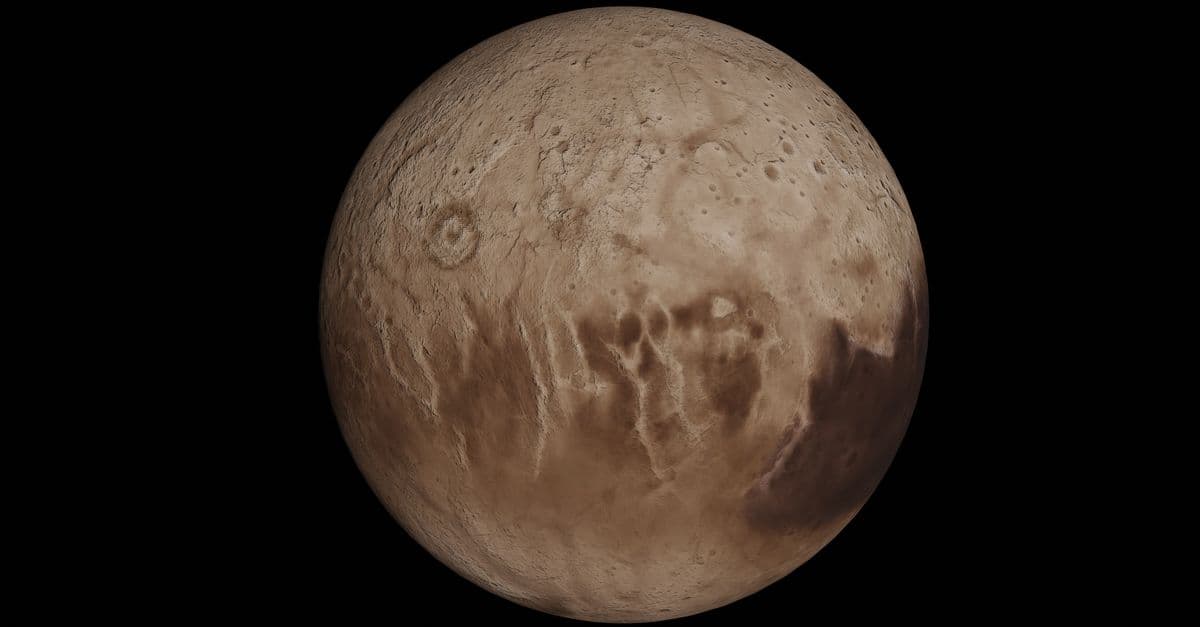
Pluto's Extreme Seasons: How a Dwarf Planet's Atmosphere Grows and Disappears
Pluto has an atmosphere. In 2015, New Horizons measured its surface pressure at about 1 Pascal — roughly 1/100,000th of Earth's at sea level. That atmosphere is not stable. Over Pluto's 248-year orbit, it inflates and then freezes entirely out onto the surface, cycling between a thin gaseous envelope and nothing at all. We arrived just in time to see it while it still existed.

Oort Cloud and Kuiper Belt Explained
Oort Cloud vs Kuiper Belt: two icy reservoirs at the edge of the solar system. Sources of comets, Planet Nine, interstellar visitors, and Voyager.