Uranus and Neptune: The Solar System's Forgotten Ice Giants
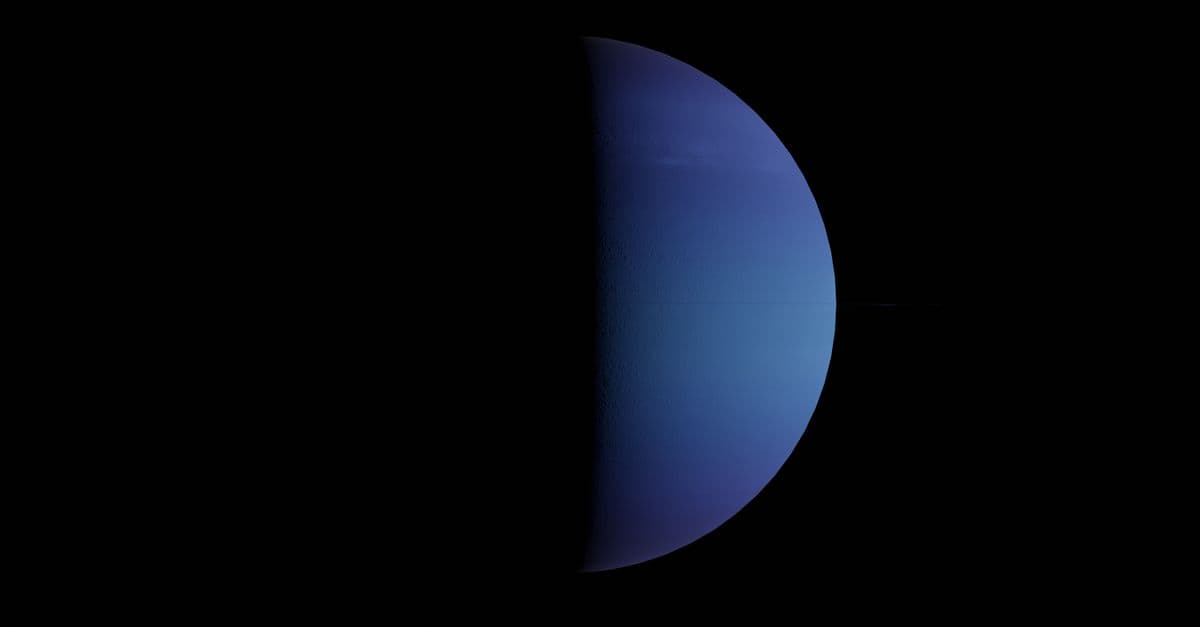
Photo: Del Woodcock / Pexels
Uranus and Neptune are the two planets nobody has orbited. A single spacecraft, Voyager 2, flew past Uranus on January 24, 1986 and Neptune on August 25, 1989, and most of what we know about their interiors, magnetic fields, and moons still traces back to those two brief encounters. The pair belong to a class of their own, the ice giants, and each is odd in its own way. Uranus lies on its side and gives off almost no excess heat. Neptune radiates roughly 2.6 times the energy it absorbs and whips up the fastest winds measured on any planet.
What makes a planet an ice giant?
The name is misleading. Nothing on Uranus or Neptune is frozen in the way a skating rink is frozen. Planetary scientists sort the building materials of the solar system into three bins: gases (hydrogen and helium), ices (water, ammonia, and methane), and rock. The "ice" label comes from the fact that these compounds would be frozen solid if you pulled them out into the cold of the outer solar system. Inside the planets, at enormous pressure and temperature, they are a hot, dense, electrically conducting fluid.
NASA describes Uranus as more than 80 percent water, methane, and ammonia fluid by mass, sitting above a small rocky core. Neptune is described in similar terms, with 80 percent or more of its mass in icy material. Jupiter and Saturn are the opposite: mostly hydrogen and helium, with the heavier stuff concentrated toward the center. If Jupiter is a balloon with a stone in it, an ice giant is closer to a pressure-cooked stew with a pebble at the bottom.
The sizes are worth keeping in mind. According to NASA's planetary fact sheet, Uranus has about 14.5 Earth masses and Neptune about 17.1, and each is roughly four times Earth's diameter. They are small next to Jupiter's 318 Earth masses, yet large enough that each could swallow around 60 Earths by volume.
| Property | Uranus | Neptune |
|---|---|---|
| Mass (Earth = 1) | 14.5 | 17.1 |
| Equatorial diameter | 51,118 km | 49,528 km |
| Average distance from the Sun | about 19 AU (2.9 billion km) | about 30 AU (4.5 billion km) |
| Orbital period | about 84 Earth years | about 165 Earth years |
| Axial tilt | 97.77 degrees | 28 degrees |
| Length of day | about 17 hours | about 16 hours |
| Known moons (NASA) | 28 on the fact sheet, 29 on the moons page | 16 |
| Fastest winds | about 900 km/h | more than 2,000 km/h |
Sources: NASA Uranus and Neptune fact pages and the NASA Planetary Fact Sheet, all linked at the end of this article.
How did planets this big form so far out?
This is an unsolved problem, and it is one reason the ice giants matter. Building a 15-Earth-mass planet by slowly gathering solid material is quick near the Sun, where the disk is dense, and painfully slow at 20 to 30 AU (an astronomical unit, or AU, is the Earth-Sun distance), where there is less material and it moves in long, lazy orbits. The window to grab gas before it disperses from the young disk is short. One proposal is that the ice giants formed closer in and migrated outward, which would also help explain how they ended up in their present orbits.
The broader story of how a spinning cloud of gas and dust became eight planets is told in our piece on how the solar system formed, and the disk physics behind it is covered in what a protoplanetary disk is and how planets form. For the ice giants, the honest summary is that formation models can produce them, but not yet in a way that settles the details of their composition.
Uranus: the planet that was knocked over
William Herschel first spotted Uranus in 1781, and astronomers accepted it as a planet two years later. It was the first planet found with a telescope rather than known since antiquity. Nearly two centuries later, Voyager 2 showed that the planet is strange in ways no one had predicted.
The 98-degree tilt and its 42-year seasons
Earth's axis is tilted 23.5 degrees from the vertical, and that tilt gives us seasons. Uranus is tilted 97.77 degrees, so its axis lies almost flat in the plane of its orbit. Earth spins like a top as it circles the Sun. Uranus rolls around the Sun like a ball, with first one pole and then the other aimed toward it.
The result is the most extreme seasonal cycle in the solar system. Over an 84-year orbit, each pole gets about 42 years of continuous sunlight followed by about 42 years of continuous night. When Voyager 2 arrived in 1986, the south pole was pointed almost directly at the Sun. For a refresher on why a tilt produces seasons at all, see our explainer on why we have seasons.
The odd part is the temperature. Averaged over a full Uranian year, the poles receive more sunlight than the equator, yet the poles are not warmer than the equator. Why remains an open question.
What knocked Uranus over?
The leading explanation is a giant impact early in the planet's history. Reinhardt and colleagues ran a large set of high-resolution simulations (published in the Monthly Notices of the Royal Astronomical Society) and found that an oblique, glancing collision can tip a planet's spin axis and throw out a debris disk. Some of the simulated disks were massive and rocky enough to form regular satellites, which fits the fact that Uranus's major moons orbit in the planet's tilted equatorial plane.
That last detail is the real clue. If Uranus had been tipped after its moons formed, the moons would likely still orbit in the old plane. They do not, so either the tilt came first and the moons formed afterward from impact debris, or a more complicated sequence took place. Earlier simulations by a Durham University group, led by Jacob Kegerreis, reached a similar conclusion: a collision with an object roughly twice the mass of Earth could do the job. Some researchers have also proposed that more than one impact occurred. None of this is settled.
The planet that gives off almost no heat
Every giant planet with a deep interior radiates more energy than it absorbs from the Sun, because it is still shedding heat left over from formation and from slow contraction. The comparison is made with a ratio: emitted energy divided by absorbed energy. A ratio of 1 means the planet is simply re-radiating sunlight. Anything above 1 means an internal heat source.
Uranus has long been the outlier. The Voyager-era analysis by Pearl and colleagues gave a ratio of 1.06, with an uncertainty of 0.08, which is barely distinguishable from 1. A 2025 reanalysis by Patrick Irwin and colleagues, using new albedo data collected between 2000 and 2009, gives an orbit-averaged ratio of 1.15 with an uncertainty of 0.06. That ratio shifts across the orbit, from about 1.03 near perihelion to about 1.24 near aphelion, because Uranus's orbit is slightly elliptical. The authors conclude that Uranus is not in thermal equilibrium with the Sun, but its excess heat is still far smaller than that of the other giants.
| Planet | Emitted / absorbed energy | Source |
|---|---|---|
| Uranus | 1.06 ± 0.08 (Voyager-era) | Pearl et al. 1990 |
| Uranus | 1.15 ± 0.06 (reanalysis) | Irwin et al. 2025 |
| Neptune | 2.61 ± 0.28 | Pearl and Conrath 1991 |
Jupiter and Saturn both radiate clearly more than they absorb. The exact ratios for those two planets have been revised in recent years, so we leave them out of the table rather than quote numbers that may be out of date.
Three ideas for the missing heat
Researchers have put forward several explanations, and they are not mutually exclusive.
A lid on the interior. If Uranus's interior is organized into stable compositional layers, convection could be suppressed. Think of a pot with a tight lid and a thick layer of oil floating on top: the soup underneath stays hot, but very little heat reaches the surface. In that case Uranus could be hot deep down and still look cold from outside.
An impact that rearranged things. The same collision that tilted the planet could have left behind a stratified structure, or released the heat that Uranus would otherwise be shedding today. Debris from a giant impact settling into a shell is one version of this idea.
Measurement problems. Voyager made a single pass at one season. The Irwin study shows that even a modest improvement in the albedo changes the ratio noticeably, and the uncertainties on Uranus's heat output remain large compared with those for Neptune.
Magnetic fields that make no sense
Earth's magnetic field is roughly a bar magnet aligned within about 10 degrees of its rotation axis, centered on the planet. Uranus and Neptune do not follow that pattern. NASA reports that Uranus's magnetic axis is tilted nearly 60 degrees from its rotation axis and is offset from the center by about one-third of the planet's radius. Neptune's field axis is tilted about 47 degrees, and NASA puts its field strength at about 27 times Earth's.
A possible explanation involves a form of water that exists only at extreme pressure. In 2018, Marius Millot and colleagues at Lawrence Livermore National Laboratory squeezed water ice between diamond anvils and then hit it with laser-driven shock waves. The ice melted near 5,000 kelvin at about 200 gigapascals (roughly two million atmospheres), which is about 4,000 kelvin hotter than its melting point at lower pressure. The experiments provided the first direct evidence for "superionic ice," a phase predicted in 1988 in which hydrogen ions flow like a liquid through a rigid lattice of oxygen atoms.
Superionic ice conducts electricity through those moving ions. A model proposed roughly a decade before the experiment holds that Uranus and Neptune have thick layers of superionic ice beneath a thin shell of ordinary conducting fluid, and that only the thin fluid shell generates a magnetic field. A shallow dynamo like that would not be centered or aligned the way a deep one is. The experiments support that picture, though they do not prove it. For the general physics of how planets make magnetic fields, see our article on how planetary magnetic fields work.
A related idea, often called "diamond rain," proposes that carbon in the deep interior is squeezed into diamond that sinks toward the core, releasing a little heat. Laser and X-ray experiments on hydrocarbon samples have produced tiny diamonds under shock conditions, but no one has seen this inside a planet, and the idea remains speculation.
Atmosphere, color, and rings
Below the 1.3-bar level, Uranus's atmosphere is about 83 percent hydrogen, 15 percent helium, and 2.3 percent methane by volume. Methane absorbs red light and lets blue and green wavelengths scatter back out, which gives both Uranus and Neptune their color. Uranus holds the record for the coldest planetary atmosphere: a minimum temperature of 49 kelvin (minus 224.2 degrees Celsius) in its tropopause.
Uranus has 13 known rings. Their discovery was an accident. On March 10, 1977, a team led by James Elliot, Edward Dunham, and Douglas Mink observed from the Kuiper Airborne Observatory as Uranus passed in front of a star, hoping to study the planet's atmosphere. The star blinked several times before and after the planet covered it, which revealed narrow rings. Voyager 2 and later the Hubble Space Telescope added the rest. The rings are dark and narrow compared with Saturn's broad, bright system. For a comparison across all four giant planets, see planetary rings explained.
Uranus's moons
The five major moons are Miranda, Ariel, Umbriel, Titania, and Oberon. William Herschel found Titania and Oberon in 1787, William Lassell found Ariel and Umbriel in 1851, and Gerard Kuiper found Miranda in 1948. NASA's fact sheet lists 28 known moons, and its moons page, updated in 2026, counts 29 after recent discoveries. The names come from the works of Shakespeare and Alexander Pope.
Miranda is the showpiece. Voyager 2 imaged a patchwork of ancient cratered plains next to grooved terrain and cliffs, as if the moon had been broken apart and reassembled. One cliff system, Verona Rupes, appears in a single Voyager 2 image. Published estimates of its height range from about 5 km to about 20 km, depending on how the viewing angle is corrected for. If the larger value is right, it is the tallest cliff known in the solar system. The honest answer is that we do not know, because the cliff has been photographed only once, from the side.
Neptune: the ice giant that runs hot
Neptune was found in 1846, when Johann Galle pointed a telescope at the position that mathematical predictions had calculated. Its orbit takes about 165 Earth years, which means it finished its first full circuit since discovery only in 2011, and Hubble marked the occasion with new images. Sunlight at Neptune is about 1/900th as strong as at Earth, and takes about four hours to arrive.
Fastest winds in the solar system
You would expect a planet this far from the Sun to be calm. Neptune is the opposite. NASA reports winds over 2,000 km/h, about three times faster than those on Jupiter and nine times faster than on Earth. Those winds blow in a planet that gets almost no sunlight to drive them.
Neptune's internal heat is the likely answer. The Pearl and Conrath analysis put its emitted-to-absorbed ratio at 2.61, meaning the planet radiates well over twice as much energy as the Sun delivers. That interior heat flux feeds convection, and convection feeds the storms and jets. The reason Neptune has so much more internal heat than Uranus is still a puzzle. Reinhardt and colleagues suggest one answer: a head-on impact on Neptune could have driven dense material deep into the planet and left a less centrally concentrated interior, which may help explain its higher heat flux. This is a hypothesis from simulations, not an observation.
The Great Dark Spot that vanished
Voyager 2 found a huge storm in Neptune's southern hemisphere in 1989, the Great Dark Spot, large enough to contain Earth. It looked like a cousin of Jupiter's long-lived storm, which we cover in our article on the Great Red Spot. It was not. When Hubble began observing Neptune in 1994, the Great Dark Spot was gone, and later images have recorded other dark spots coming and going.
The contrast with Jupiter is instructive. Jupiter's storm has persisted for centuries. Neptune's come and go within years. Researchers do not have a complete explanation for why Neptune's vortices are so short-lived.
Clouds that follow the Sun's 11-year cycle
A 2023 study in Icarus led by Erandi Chavez, then an undergraduate at UC Berkeley, with Imke de Pater as senior author, found something unexpected. Using Keck, Lick, and Hubble images spanning 1994 to 2022, the team found that Neptune's cloud cover tracks the Sun's 11-year activity cycle. More clouds appear about two years after the Sun's peak output of hydrogen Lyman-alpha ultraviolet light. Mid-latitude clouds began fading in 2019 and were almost entirely absent except near the south pole, and they had not returned to earlier levels by June 2023.
The proposed mechanism is photochemistry: sunlight high in the atmosphere triggers reactions that eventually form cloud particles. The authors cautioned that ultraviolet light might also darken the clouds, which would complicate the brightness comparison, and that deep storms could blur the correlation. This is the strongest evidence yet that the Sun influences weather on a planet 30 AU away, based on about 2.5 solar cycles of data.
Rings with arcs
NASA lists at least five main rings around Neptune, plus four prominent arcs, which are clumps of material concentrated within a ring. The main rings are named Galle, Leverrier, Lassell, Arago, and Adams, and the four arcs sit in the outermost, Adams ring. The arcs puzzled astronomers because a clump should spread into a uniform ring; one proposed explanation is that the gravity of a small moon confines the material. We have only a few images of these rings.
Triton: the captured moon
Triton is Neptune's largest moon, at about 2,700 km across, and one of the strangest objects in the solar system. William Lassell found it on October 10, 1846, 17 days after Neptune's discovery. The decisive fact about Triton is its direction of travel. It orbits Neptune backward, opposite to the planet's rotation, and NASA notes that it is the only large moon in the solar system with such a retrograde orbit.
A moon that formed in the disk around its planet inherits that disk's direction of rotation. A backward orbit is therefore strong evidence that Triton was born elsewhere. The leading view is that it is a Kuiper Belt object, a cousin of Pluto, that Neptune captured. Our article on Pluto and the Kuiper Belt explains the neighborhood Triton came from. One widely discussed capture mechanism is that Triton was part of a binary pair, and Neptune's gravity pulled one partner away.
Capture would have been violent. Tidal forces from Neptune would have flexed Triton as its orbit shrank and became circular, which dumps energy into the moon as heat. The details, including how long the interior stayed warm, are not settled.
Nitrogen geysers on a minus 235 degree world
Voyager 2 measured Triton's surface temperature at about minus 235 degrees Celsius (minus 391 degrees Fahrenheit). Even so, it found dark plumes rising from the surface. NASA/JPL describes a plume with a narrow stem rising nearly 8 km, then forming a cloud that drifts about 150 km downwind. The mechanism is still not settled. One candidate is that sunlight warms dark material under a transparent layer of nitrogen ice, raising gas pressure until it vents and carries dark particles aloft. Triton's thin atmosphere is mostly nitrogen with a little methane.
NASA counts Triton among the few geologically active moons in the solar system. Our dedicated article, Triton: Neptune's captured moon and its inevitable doom, goes deeper into the geology.
A moon with an expiration date
Triton's orbit is slowly shrinking. In the commonly cited nominal case from a tidal analysis by C. F. Chyba and colleagues, Triton reaches Neptune's Roche limit in about 3.6 billion years. The Roche limit is the distance inside which a moon's own gravity can no longer hold it together against the planet's tides. That figure is a model-dependent estimate: it hinges on how efficiently Neptune dissipates tidal energy, and more recent work has argued for a much longer timescale. When Triton does cross the line, it will either hit Neptune's atmosphere or be torn into a ring system, perhaps one like Saturn's.
What we do not know, and how to find out
Voyager 2 gave us a snapshot, and a single snapshot cannot answer questions that depend on time. We have no seasonal record of either planet's heat output from orbit. Our map of Uranus's magnetic field comes from one flyby. We do not know the interior structure, the composition at depth, or how much of the water is superionic. We have seen Triton's southern hemisphere in detail, not its northern one. Miranda has been photographed at high resolution over only part of its surface.
Ground-based and space telescopes have helped. Hubble, Keck, and the James Webb Space Telescope have tracked clouds, rings, and moons, and the 2026 count of 29 Uranian moons shows that there are still discoveries to be made. But telescopes cannot weigh the planet's gravity field or sample its atmosphere.
The Uranus Orbiter and Probe
The 2023-2032 planetary science decadal survey, titled Origins, Worlds, and Life and published by the National Academies, ranked the Uranus Orbiter and Probe as the highest-priority new flagship mission for that decade. The concept pairs an orbiter that would tour the system for several years with an atmospheric probe that would descend into the planet. Its goals cover Uranus's origin, interior, atmosphere, magnetosphere, moons, and rings. The second-ranked new flagship was an Enceladus Orbilander.
The timing has slipped. The survey assumed a launch around 2031 with a Jupiter gravity assist and a flight of about 13 years. A June 2026 update in The Planetary Science Journal, led by Amy Simon of NASA Goddard, explored later launches without a Jupiter assist, using either a commercially derived solar electric propulsion stage or a larger launch vehicle such as Starship. The team also moved the planned orbit insertion farther from Uranus because of uncertainty about the ring structure. A decadal survey recommendation is not a funded flight project, and no spacecraft is yet on its way.
Why exoplanet astronomers care
NASA lists more than 6,000 confirmed exoplanets, and "Neptunian" is one of its four main categories, alongside gas giants, super-Earths, and terrestrial planets. Surveys such as Kepler found that planets between the size of Earth and Neptune are common around other stars. Yet no planet in our own solar system is a good match for the most typical of them, and the closest local examples are Uranus and Neptune. If you want to know what a planet with a radius of three Earths is made of, the nearest laboratory is 19 AU away. Our guide to how we find exoplanets shows how those distant worlds are detected and why the local examples matter.
Ice giants versus gas giants
| Property | Uranus | Neptune | Jupiter | Saturn |
|---|---|---|---|---|
| Mass (Earth masses) | 14.5 | 17.1 | 317.8 | 95.2 |
| Diameter (Earth = 1) | 4.01 | 3.88 | 11.21 | 9.45 |
| Orbital period (Earth years) | 83.7 | 163.7 | 11.9 | 29.4 |
| Dominant material | Water, methane, ammonia fluid | Water, methane, ammonia fluid | Hydrogen and helium | Hydrogen and helium |
| Internal heat | Little or none | Strong | Clear excess | Clear excess |
| Known moons (NASA fact sheet) | 28 | 16 | 95 | 274 |
Mass, diameter, period, and moon counts come from NASA's Planetary Fact Sheet, which expresses them as ratios to Earth. Moon counts change as new moons are confirmed, so check the current NASA figures.
The takeaway
Uranus and Neptune are easy to overlook because they are faint, distant, and mostly featureless in pictures. But they are probably the more typical kind of planet, and the one class of planet that our solar system lets us study up close only by sending a spacecraft. The questions they pose are specific and testable: why one is cold and the other hot, whether superionic water fills their mantles, and what a captured Kuiper Belt object tells us about the early days of the outer solar system. Answering them needs an orbiter, and the scientific community has said so in writing. The wait, at this point, is mostly about launch windows and money.
Frequently asked questions
Q: Why is Uranus tilted on its side? A: The most widely supported explanation is a giant impact early in the solar system's history. Simulations show that a glancing collision with a large object can tip a planet's spin axis and leave a debris disk that forms moons in the tilted equatorial plane. The idea fits Uranus's moons, but no one has proven it, and some researchers suggest more than one impact.
Q: Why is Neptune warmer than it should be? A: Neptune radiates about 2.6 times as much energy as it absorbs from sunlight, according to the Voyager-era analysis by Pearl and Conrath. The excess comes from internal heat. Leading ideas include leftover heat from formation and a less centrally concentrated interior, possibly the result of a head-on impact. The cause is not settled.
Q: Has any spacecraft orbited Uranus or Neptune? A: No. Voyager 2 flew past Uranus on January 24, 1986, and Neptune on August 25, 1989. It is the only spacecraft to have visited either planet. A Uranus Orbiter and Probe is the top-ranked new flagship mission in the 2023-2032 US decadal survey, but it has not launched.
Q: What is superionic ice? A: It is a high-pressure phase of water in which hydrogen ions move freely, like a liquid, through a rigid lattice of oxygen atoms. Laser-shock experiments published in 2018 gave the first direct evidence for it. It may fill large parts of the interiors of Uranus and Neptune and help explain their unusual magnetic fields.
Q: Why is Triton orbiting backward? A: A moon that formed alongside its planet orbits in the same direction the planet spins. Triton orbits in the opposite direction, which points to a captured origin. Most researchers think it is a Kuiper Belt object, similar to Pluto, that Neptune's gravity pulled in.
Q: Will Triton crash into Neptune? A: Its orbit is slowly shrinking. Under the nominal estimate, Triton reaches Neptune's Roche limit in about 3.6 billion years, though other estimates are shorter or longer. It would then either collide with Neptune's atmosphere or break up into a ring system.
Q: Are Uranus and Neptune made of ice? A: Not in the everyday sense. "Ice" is a planetary-science term for water, methane, and ammonia. Inside the planets these compounds exist as a hot, dense, electrically conducting fluid, not as solid frozen ice, although some forms such as superionic ice may be partly solid.
Sources
- NASA: Uranus facts
- NASA: Neptune facts
- NASA: Uranus moons
- NASA: Triton
- NASA Planetary Fact Sheet, ratios to Earth
- NASA: Voyager 2
- Irwin et al. 2025, "The bolometric Bond albedo and energy balance of Uranus" (arXiv)
- Reinhardt et al., "Bifurcation in the history of Uranus and Neptune: the role of giant impacts" (arXiv)
- Lawrence Livermore National Laboratory: first experimental evidence for superionic ice
- Keck Observatory: clouds on Neptune and the solar cycle
- National Academies: Origins, Worlds, and Life decadal survey
- Simon et al. 2026, Uranus Orbiter and Probe mission update (NASA NTRS)
- NASA/JPL: Triton's volcanic plumes (PIA14449)
Related Reading
Follow new articles
Add SciHub101 to your feed reader to see new science and technology stories.
About the Author
SciHub101 is an independent science and technology publication founded and edited by Buğra Sözeri, a software engineer and app developer based in Türkiye. AI tools assist with drafting and research. Source documentation in the existing archive is uneven, and articles are being reviewed and corrected. The Editorial Team byline identifies editorial responsibility; it does not certify specialist or independent human review. Where we compare products, anything built by our own team is labelled as such — see the editorial guidelines and About page for how corrections and disclosures work.
Related Articles
What Are Saturn's Rings Made Of — And How Long Will They Last?
Saturn's iconic rings are made of more than 90% water ice and span nearly 300,000 km across, yet they are only about 10 meters thick. Surprisingly young in cosmic terms, the rings are slowly draining into Saturn and will vanish entirely in roughly 100 million years.
Pluto and the Kuiper Belt: The Solar System's Outer Frontier
Pluto was reclassified as a dwarf planet in 2006, but the New Horizons flyby in 2015 showed a geologically active world with nitrogen-ice convection, water-ice mountains, hazy skies, and hints of a buried ocean. Beyond it, the Kuiper Belt holds the best-preserved leftovers of planet formation.
Planetary Rings Explained: Not Just Saturn
Saturn's rings are the solar system's most famous structure, but they are far from unique. Uranus has 13 dark, narrow rings discovered by accident in 1977. Neptune has incomplete arcs instead of full circles. Jupiter has a faint ring made of dust blasted off its innermost moons by meteorite impacts. All four giant planets have rings — and they all work differently. Saturn's may be geologically young, which raises a question nobody has fully answered: where did they come from?
Triton: Neptune's Captured Moon and Its Inevitable Doom
Triton orbits Neptune backward, spews nitrogen geysers from a surface colder than anywhere else in the solar system, and is gradually spiraling toward a catastrophic end. It almost certainly came from the Kuiper Belt — and its violent capture may have reshaped the entire Neptunian system.

The Voyager Grand Tour Explained
Voyager used rare planetary alignment, gravity assists, and durable engineering to transform knowledge of the outer Solar System.
William Herschel: The Musician Who Discovered a Planet
William Herschel discovered Uranus in 1781, found infrared radiation in 1800, built the world's largest telescope, and only became an astronomer after a career as an oboist.