What Is the Great Filter? The Fermi Paradox's Darkest Solution

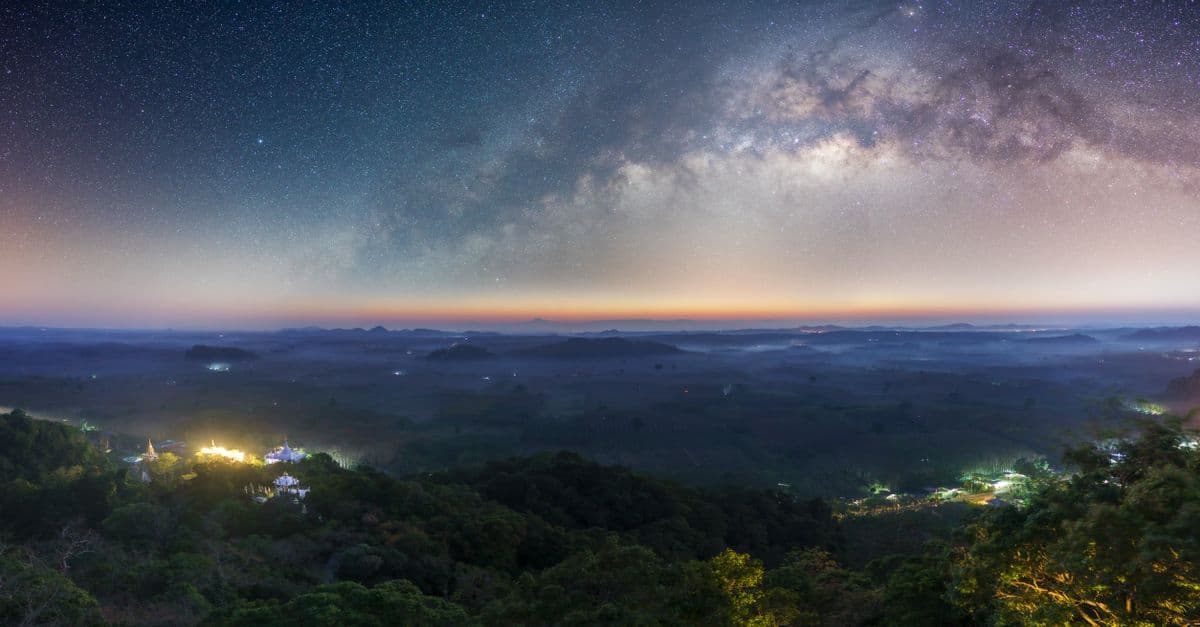
Photo: Del Woodcock / Pexels
The Milky Way contains an estimated 200 to 400 billion stars, and the observable universe holds on the order of 70 sextillion. Yet no telescope has found a confirmed technological signal, a megastructure, or a probe. The Great Filter is the economist Robin Hanson's proposed explanation: somewhere on the path from lifeless chemistry to a civilization that spreads across a galaxy, at least one step is so improbable that almost nothing gets through. The unsettling part is the location. If that step is behind us, we are lucky. If it is ahead, we may be on the way to failing it.
Key takeaways
- The Great Filter is a hypothetical barrier, at least one improbable step, between dead matter and a civilization that colonizes its galaxy.
- A filter behind us (for example, the origin of life or the first complex cell) would mean we are rare and the future is open.
- A filter ahead of us would mean civilizations like ours usually fail before they spread, which is the bleak reading.
- Hanson's own summary: "The easier it was for life to evolve to our stage, the bleaker our future chances probably are."
- Finding independent life on another world would shift the odds toward a filter ahead of us, which is why some researchers hope the search comes up empty.
Where the Great Filter idea comes from
The puzzle underneath it is older than the filter. In 1950, at Los Alamos, Enrico Fermi asked over lunch where everybody was, according to the recollections gathered in the Fermi paradox literature. In 1975 the astrophysicist Michael Hart argued in the Quarterly Journal of the Royal Astronomical Society that the absence of visitors implied we are the first civilization in the galaxy, and Frank Tipler later pressed the same logic with self-replicating probes.
Frank Drake approached from the opposite direction. In 1961 he wrote down the Drake equation for the first SETI meeting at Green Bank, multiplying star formation rate, the fraction of stars with planets, the fraction of those planets that develop life and intelligence, and how long a civilization stays detectable. His group's inputs gave somewhere between 1,000 and 100,000,000 civilizations in the galaxy. Our detailed walk through those terms is in the Drake equation explainer.
Hanson's contribution was to take the silence seriously as data. His essay "The Great Filter: Are We Almost Past It?" was first written in 1996 and posted in its best-known form in 1998 on his George Mason University page. He wrote that "there is a 'Great Filter' along the path between simple dead stuff and explosive life," and he drew the consequence that has made the idea famous. A philosopher, Brandon Carter, had already argued in 1983 that intelligence might be a rare outcome. Hanson turned that single suggestion into an accounting problem with many steps.
Why the galaxy should look crowded by now
The case for a filter rests on timescales. Estimates cited in the Fermi paradox literature put the time for a civilization using slow interstellar travel to settle the whole Milky Way at roughly 5 to 50 million years. Hart's own estimate was a few million. Self-replicating probes could explore the galaxy in as little as a million years.
Set those numbers against the age of the universe, which is about 13.8 billion years. Even the long end of the range, 50 million years, is less than half a percent of that. Imagine a long-distance race where the winner needs one minute and the starting gun fired a day ago. If anyone had entered, someone would have crossed the line many times over.
Researchers have also tried to blunt the objection that intergalactic distances are the barrier. Anders Sandberg and a coauthor, Armstrong, estimated in 2013 that spreading between galaxies is comparable in difficulty to spreading between stars, so distance alone does not explain the quiet.
Meanwhile the supply of planets is not scarce. Kepler data analyzed in 2013 by Petigura and colleagues, published in PNAS, suggested about 11 billion Earth-size planets in the habitable zones of Sun-like stars in the Milky Way. The galaxy has the real estate and the time. What it lacks, as far as we can tell, is visible tenants.
The steps from chemistry to civilization
Hanson did not claim to know which step is hard. He listed a best-guess path of nine items and argued that, because no one appears to have completed step nine, at least one earlier step must have a very low chance. The table below pairs each step with what the Earth record says.
| Step | What has to happen | What Earth's record suggests |
|---|---|---|
| 1 | A suitable star system with organic chemistry | Common, given the planet counts above |
| 2 | Self-replicating molecules such as RNA | Unknown mechanism; life is at least 3.5 billion years old |
| 3 | Simple single-celled life | Established early; stromatolites date to about 3.48 billion years ago |
| 4 | Complex cells with nuclei (eukaryotes) | Oldest candidate fossils are 1.8 to 1.6 billion years old |
| 5 | Sexual reproduction | Appears within eukaryotes |
| 6 | Multicellular life | Evolved independently at least 25 times |
| 7 | Tool-using animals with large brains | Many animals use tools; one lineage built technology |
| 8 | A civilization advancing toward colonization | One example: us |
| 9 | A colonization explosion | Zero examples |
Think of it as a series of locked doors in a corridor. Each door has its own key and its own chance of being opened. A civilization needs all nine, so the chance of reaching the end is the product of the individual chances.
That multiplication is why modest-looking numbers produce dramatic results. As a toy illustration, not a measurement, nine independent steps that each succeed one time in ten leave a one-in-a-billion chance of getting through all of them. Several steps could each be only mildly difficult, or a single one could be nearly impassable. The data we have cannot tell those cases apart, and that ambiguity is the heart of the problem.
Is the filter behind us?
The hopeful reading says the hard step is already in our past. Several candidates have been argued, and each leaves a trace in the geological record.
The origin of life. Nobody has reproduced how non-living chemistry became self-replicating cells. Earth formed about 4.54 billion years ago, and the earliest accepted direct evidence of life, stromatolites (layered structures built by microbial mats) in Western Australia, is about 3.48 billion years old. Some disputed evidence reaches back toward 4.1 billion years. A gap of roughly a billion years, or possibly much less, is hard to turn into a rate from a single sample. For background on the lab work, see the Miller-Urey experiment.
The eukaryotic leap. Prokaryotes, the simple cells without nuclei, dominated for a very long stretch. Eukaryotes, which have nuclei and energy-producing organelles, appear to descend from an archaeon that took in a bacterium that became the mitochondrion. Candidate fossils from the Ruyang Group in China are about 1.8 to 1.6 billion years old, and a molecular-clock analysis points to sterol biosynthesis around 2.3 billion years ago. The science communicator Matt O'Dowd has argued that eukaryogenesis is a plausible past filter because prokaryotes find it increasingly hard to discover new useful proteins. How that merger worked is covered in our piece on how mitochondria became the cell's powerhouses.
Multicellularity and complexity. Multicellularity has evolved independently at least 25 times among eukaryotes, which makes it look easy. Complex multicellular bodies are a different story: they arose in only six lineages (animals, fungi, brown algae, red algae, green algae, and land plants). Animal diversity then expanded rapidly in the Cambrian period, a burst we cover in what the Cambrian explosion was.
If one of these was the filter, it did its work billions of years ago. The galaxy ahead of us could then be nearly empty, and the future belongs to whoever gets there first.
Is the filter ahead of us?
The frightening reading says the improbable step has not happened yet. In that picture, many civilizations reach a stage like ours, and almost none get further.
The usual suspects are technologies and trajectories that scale up faster than the wisdom to manage them.
- Nuclear weapons. The Bulletin of the Atomic Scientists set its Doomsday Clock at 85 seconds to midnight on January 27, 2026, the closest ever, citing nuclear risk, artificial intelligence, and biological threats. For the physics and the history, see how nuclear weapons work.
- Engineered pathogens. Biotechnology gets cheaper every year, which widens the pool of actors who could cause harm.
- Misaligned artificial intelligence. The argument is that a system pursuing goals that diverge from ours could end the civilization that built it. Our overview of AI safety and alignment lays out what researchers mean by the problem.
- Ecological or climate collapse. A civilization could damage the planetary systems it depends on faster than it builds the means to leave.
- Failure to expand. Hanson notes that step nine could fail through catastrophe, procrastination, or resource exhaustion. A civilization might simply never choose to spread.
- Berserker probes. One speculative filter between steps eight and nine proposes that older civilizations built lethal self-replicating machines that destroy young ones.
None of these has been shown to be a universal rule. They are hypotheses about what could stop a civilization, and the strongest evidence that any of them applies is our own short history.
Why finding alien life would be bad news
The philosopher Nick Bostrom made the logic vivid in a 2008 essay in MIT Technology Review, arguing that discovering life elsewhere would be bad news for humanity. The argument is a piece of bookkeeping. Every discovery of independent life tells you a step is easier than you feared. Since the filter has to sit somewhere, easy early steps push it toward the late steps, and the late steps include the ones still in front of us.
Hanson makes the same point about Mars. If single-celled life there evolved independently, the stretch from dead matter to simple cells must be fairly easy, unless Earth and Mars shared some unusual environment. If it arrived through panspermia (life moving between planets on rock), the discovery says little. The table shows how different finds would update the picture, using Bostrom's framing.
| What we find | What it suggests about the filter |
|---|---|
| Nothing, anywhere, after a thorough search | The filter could be behind us; we may be early or alone |
| Independent microbes on Mars or an ocean moon | Origin of life is easy; filter likely later, possibly ahead |
| Independent multicellular life elsewhere | Steps two through six are easy; steps one, seven, eight, or nine become suspects |
| Fossils of a dead technological civilization | A late filter is operating; the strongest warning |
This is also why a detection would be scientifically enormous and psychologically heavy at once. A second origin of life on Mars would be a landmark, and we explore that scenario in what if we found microbial life on Mars. The wider search is surveyed in where we stand in the search for extraterrestrial life and in the case for life on Europa and Enceladus.
The filter and the Drake equation are the same argument in different clothes
Drake's equation and Hanson's filter look like rivals, but they are two ways of slicing one problem. The equation multiplies terms: how many stars form planets, how many planets get life, how many of those get intelligence, how many produce detectable technology, and how long that technology stays detectable. The filter asks which of those multiplications has a very small factor in it.
Map the two onto each other and a pattern appears.
| Drake term | Rough filter equivalent | Where the filter could hide |
|---|---|---|
| Fraction of planets that develop life | Steps two and three | Origin of life |
| Fraction that develop intelligence | Steps four through seven | Eukaryotes, multicellularity, brains |
| Fraction that produce detectable technology | Step eight | Civilization itself |
| Lifetime of a detectable civilization | Steps eight and nine | Self-destruction, or a choice not to expand |
The last row deserves attention. At the 1961 Green Bank meeting, Drake's group concluded that the number of detectable civilizations is roughly equal to their lifetime in years. If civilizations last only a few centuries, the galaxy holds a handful at any moment, spread so thin that none would find another. A short lifetime is therefore a late filter by another name.
This is the sense in which the Great Filter is a genuine refinement. It says that the missing factor could sit in the biology that came before us or in the history that has not yet happened, and that the equation by itself gives no way to tell. Both readings predict the same empty sky today. They differ in what they say about the next ten thousand years.
The statistical objection: maybe there is no paradox
Not everyone accepts that a silent sky needs a dramatic filter. In a 2018 paper, "Dissolving the Fermi Paradox," Anders Sandberg, Eric Drexler, and Toby Ord argued that the paradox arises from using point estimates in the Drake equation. The last four terms (life, intelligence, communication, and lifetime) are not known to within even several orders of magnitude.
When the authors propagated realistic uncertainty ranges through the equation instead of single guesses, they found a substantial probability that no other intelligent life exists in the observable universe. In that case the quiet is not surprising. We could be alone, and there is no need for speculative explanations of why aliens leave no trace.
Think of a lottery where you do not know whether the ticket odds are one in ten thousand or one in a quintillion. Averaging over that ignorance, a drawn winner is far less certain than the optimistic odds imply. The authors' point is that the galaxy being empty is a reasonable outcome of our ignorance rather than a clue requiring a conspiracy or a catastrophe.
This does not remove the filter question. It reframes it: if the combined chance of intelligence is tiny, then some step or steps behind us are doing the filtering. The statistical view fits the hopeful half of Hanson's picture better than the bleak half.
Early filter or late filter: what each one predicts
A good hypothesis sticks its neck out. The two broad versions of the Great Filter predict different things about the universe, and that difference is what makes the idea more than a mood.
| Feature | Filter behind us (early) | Filter ahead of us (late) |
|---|---|---|
| Microbial life elsewhere | Rare or absent | Common |
| Complex or animal-like life elsewhere | Rare | Possibly common |
| Dead or ruined technological civilizations | None expected | Plausibly many |
| What it implies for humanity | Rare, perhaps first, open future | Typical, probably at a dangerous stage |
| Main way to learn more | Fail to find life after careful search | Find life, especially complex life |
Notice that the two columns reward opposite outcomes. A thorough search that turns up nothing leaves the early filter standing and is, in the narrow terms of this argument, the comfortable result. A confirmed second genesis does the reverse. This is the odd inversion at the center of Bostrom's essay: a discovery that would thrill biologists would count as a warning for risk analysts.
Think of a hiking route with a marked pass somewhere between the trailhead and the summit. If you meet dozens of hikers near the trailhead, the route is not hard early on, so the pass is probably higher up and you have not reached it. If you meet nobody anywhere near the start, the difficult stretch could already be behind you, and you have simply started late. The Great Filter asks us to read the empty trail in the same way.
The timing clue that Carter noticed
Carter's 1983 argument, as summarized in the literature on the filter, uses a different kind of evidence: how long evolution took. Earth has been habitable for billions of years, and the Sun will eventually make the planet too hot for complex life. If the path to intelligence were easy, it should have been completed far earlier in Earth's history. That intelligence arrived only late, with a comparatively short window remaining, hints that the path is hard and that we are a lucky outlier, not a typical outcome.
The reasoning is an anthropic one, meaning it accounts for the fact that we can only observe a universe in which observers like us exist. It is also contested. Critics point out that a single example, our own planet, cannot fix a rate, and that different assumptions about how to count observers produce different conclusions. Still, the timing argument is one of the few attempts to extract a number from the biological record rather than from speculation about the future. It tends to push toward an early filter, which is the more hopeful reading, and it is the reason many researchers lean that way despite the bleaker intuitions.
Other explanations that bypass the filter
The Great Filter is one answer among many, and it competes with ideas that do not involve a hard step at all.
The dark forest. Liu Cixin's 2008 novel The Dark Forest proposed that civilizations stay silent because revealing yourself invites destruction. The reasoning rests on three axioms: many civilizations exist, survival is the first need, and civilizations keep expanding. Unlike berserker ideas, which predict visible probes, the dark forest predicts silence. Critics note that it requires near-perfect coordination among civilizations that cannot talk to one another.
The zoo hypothesis. Advanced civilizations may be deliberately avoiding contact, a notion usually credited to the astronomer John Ball, who proposed it in 1973.
Grabby aliens. Robin Hanson and collaborators proposed in 2021 that expansionist civilizations are rare and that we are early. The model has critics, including Kipping, who disputes the model.
Small technology. The SETI Institute astronomer Seth Shostak has argued that advanced civilizations may build small, efficient technology rather than megastructures. If so, the absence of large-scale engineering does not show we are alone. The related idea of star-encircling structures is covered in what a Dyson sphere is.
We have not looked long enough. Searches have covered a small fraction of the sky, frequencies, and time. The 1977 Wow! signal, which we describe in the Wow signal explainer, shows how one ambiguous detection can sit unresolved for decades.
Each explanation makes different predictions, which is useful. A filter ahead of us predicts dead worlds. The dark forest predicts silence everywhere. Small technology predicts faint signatures we have not learned to read. Nothing so far separates them.
What the argument means for how we weigh risks
Researchers who study existential risk, the chance of events that end or permanently cripple civilization, often cite the filter as a reason to take such risks seriously. The reasoning is cautious rather than predictive. If a late filter is even a live possibility, then the survival of civilization is not guaranteed by the sheer number of habitable planets, and the cost of being wrong is total.
That framing has a practical side. Hanson's own wording, that easier early evolution makes our future bleaker, turns discoveries into risk signals. A researcher who finds a second genesis on Mars should expect the news to be read twice: once as a scientific triumph and once as a reason to look harder at what could stop a civilization.
It also helps to keep proportion. Nothing in the argument ranks nuclear weapons above pandemics or artificial intelligence, and nothing in it supplies a probability for any of them. The Doomsday Clock, which the Bulletin of the Atomic Scientists set at 85 seconds to midnight in January 2026, is a judgment by a board of experts about present-day threats, not an output of the Great Filter. The two share a mood, but they rest on different evidence.
The most defensible practical conclusion is modest: a silent universe is not a reason for despair, and it is not a reason for complacency. It is a standing reminder that survival through the technological stage is the one step we can still influence.
What the Great Filter does not say
Several common misreadings are worth clearing up.
It does not say humanity is doomed. The filter is a statistical argument about how rare the whole sequence is. It does not specify a cause or a date, and the same logic is compatible with a filter that is already behind us.
It does not predict a particular disaster. Nuclear war, AI, and pandemics are candidates people discuss, not conclusions derived from the argument. The observation that we see no aliens is weak evidence about what kills civilizations.
It is not a single event. The filter can be one near-impossible step or the product of many moderately hard ones. A probability of one in a billion could come from either structure.
It is not proof that life is rare. If life is common, the filter is later. If life is rare, the filter is early. The argument tells you that the combination is rare, not which half is responsible.
It does not apply only to Earth-like life. The reasoning is about any path to a detectable civilization. If the chemistry of life is different elsewhere, the path may differ, but the logic of a bottleneck remains.
Many popular treatments also treat the filter as an established scientific theory. It is better described as a framework for organizing ignorance, one that gives structure to what we would learn from different discoveries.
How researchers could test it
The argument can in principle be tightened by observation. Haqq-Misra, Kopparapu, and Schwieterman argued in a 2020 Astrobiology paper that telescopes able to search for biosignatures could bound how common life is, and that detecting technosignatures in the mid-infrared could show whether the filter lies behind us or ahead.
The practical routes are modest. Telescopes are beginning to measure the atmospheres of rocky planets for gases that signal biology. Missions to Mars, Europa, and Enceladus look for independent origins of life in our own neighborhood. Each of these targets is covered in our astrobiology overview.
A related question is whether the habitable zone is as hospitable as the planet counts suggest, which our habitable zone explainer examines. And if humanity does pass the filter, the long view of survival is the subject of how civilizations could survive the death of the universe.
Frequently asked questions
Q: Is the Great Filter a single event or multiple steps? A: It can be either. One step with a near-zero chance, such as the origin of life, would be enough. So would several moderately hard steps whose small probabilities multiply. Nine independent steps with a one-in-ten chance each would give a one-in-a-billion chance overall. Current data cannot distinguish the two structures.
Q: Who proposed the Great Filter? A: Economist Robin Hanson of George Mason University. His essay "The Great Filter: Are We Almost Past It?" was first written in 1996 and posted in its best-known form in 1998. He listed nine steps from the right star system to a colonization explosion and argued that at least one must be very improbable.
Q: Why would finding microbes on Mars be bad news? A: Because it would suggest that the origin of life is easy. If the early steps are easy, the improbable step is probably later, possibly still ahead of us. Nick Bostrom made this argument in a 2008 essay in MIT Technology Review. The effect depends on the life being independent of Earth's; life shared through rock exchange would tell us little.
Q: What if aliens are hiding? A: The dark forest idea from Liu Cixin's 2008 novel proposes that civilizations conceal themselves for fear of being destroyed. It predicts silence rather than visible probes. It does not address colonization by civilizations that do not fear others, and it requires every civilization to make the same choice.
Q: Does the speed of light prevent colonization? A: Not on the timescales involved. Estimates in the Fermi paradox literature put the settlement of the Milky Way at about 5 to 50 million years with slow ships, against a universe about 13.8 billion years old. Sandberg and Armstrong estimated in 2013 that crossing between galaxies is comparable in difficulty to crossing between stars.
Q: Could the paradox simply not exist? A: Possibly. Sandberg, Drexler, and Ord argued in 2018 that when the Drake equation's uncertainties are handled properly, there is a substantial probability that we are alone in the observable universe, and the silence needs no special explanation.
Q: Is there an actual probability that humanity survives the filter? A: No credible number exists. The argument is a way to reason about which discoveries would raise or lower concern, not a forecast. Any specific percentage offered for a future filter reflects the speaker's assumptions rather than a measurement.
The takeaway
The Great Filter turns an empty sky into a ledger. Somewhere between star systems and starships, a step costs almost everything that attempts it, and the only question that matters is whether we have already paid. The silence does not tell us. A rare origin of life, a rare complex cell, or a rare intelligence would leave the future open, while a late filter would make our current stage the dangerous one. What the argument does give us is a way to read future discoveries: the more life we find, the more attention the late steps deserve, and the more the next few centuries of our own history start to look like the experiment.
Sources
- Robin Hanson, "The Great Filter: Are We Almost Past It?", George Mason University.
- Sandberg, Drexler, and Ord, "Dissolving the Fermi Paradox", arXiv:1806.02404, 2018.
- Bulletin of the Atomic Scientists, Doomsday Clock, announcement of January 27, 2026.
- Wikipedia, Great Filter, Fermi paradox, Drake equation, and Dark forest hypothesis, for the secondary citations summarized above.
- Wikipedia, Eukaryote, Evolution of multicellularity, and Earliest known life forms, for the biological timeline.
Related Reading
- The Fermi Paradox — Where Is Everybody?
- What Is the Kardashev Scale — And Could Humanity Ever Reach Type III?
- What If We Made First Contact With Alien Life? The Real Plan and What Would Change
- What Is the Great Attractor? The Mysterious Force Pulling Our Galaxy
- What Is a Magnetar? The Most Extreme Object in the Universe
Follow new articles
Add SciHub101 to your feed reader to see new science and technology stories.
About the Author
SciHub101 is an independent science and technology publication founded and edited by Buğra Sözeri, a software engineer and app developer based in Türkiye. AI tools assist with drafting and research. Source documentation in the existing archive is uneven, and articles are being reviewed and corrected. The Editorial Team byline identifies editorial responsibility; it does not certify specialist or independent human review. Where we compare products, anything built by our own team is labelled as such — see the editorial guidelines and About page for how corrections and disclosures work.
Related Articles
Megastructures: Ringworlds and the Engineering of Impossible Scales
A ringworld would not break any law of physics, but it would break every material we know. The spin arithmetic shows exactly where each megastructure sits on the ladder from buildable to impossible.
How Old Is the Universe — And How Do We Actually Know?
The universe is 13.8 billion years old. But how do we know? Three independent methods — the cosmic microwave background, the oldest stars, and Hubble's constant — converge on the same answer. Here's the evidence.
The Search for Extraterrestrial Life: Where Do We Stand?
The search for life beyond Earth focuses on two main questions: (1) Has intelligent life evolved elsewhere in the cosmos? (2) Has life in any form (microbial) emerged on exoplanets or moons? The Drake Equation (1961) estimated the number of communicative civilizations in the Milky Way at N = R × f_p × n_e × f_l × f_i × f_c × L, yielding estimates from 1 to 1 million civilizations depending on parameter assumptions. Yet 70 years of SETI (Search for Extraterrestrial Intelligence) has found no confirmed signals. Meanwhile, exoplanet discoveries (5,500+ as of 2026) reveal that habitable-zone Earth-like planets are common. Mars, Europa, and Enceladus show signs of liquid water and reduced carbon compounds. JWST observations have detected biosignature candidates in exoplanet atmospheres. The paradox is stark: habitable worlds appear common, yet no confirmed biosignatures have been found. This article reviews the evidence for habitable zones, biosignature detection, and the Fermi Paradox.
Astrobiology — The Science of Life Beyond Earth Explained — SciHub101
Astrobiology covers extremophiles, habitability criteria, biosignatures, candidate worlds (Mars, Europa, Enceladus), the Drake equation, and the Fermi paradox.
Nearest Exoplanets That Could Host Life
A guide to the nearest potentially habitable exoplanets, from Proxima b to TRAPPIST-1e, what JWST has found, and why 'habitable' rarely means confirmed.
Ceres: The Asteroid Belt's Dwarf Planet Has Brine and Organics
Ceres is the largest object in the asteroid belt and the only dwarf planet in the inner solar system. NASA's Dawn spacecraft found salty brine deposits in Occator Crater and carbon-rich organic material near Ernutet Crater.