Ingenuity Helicopter: First Aircraft on Mars
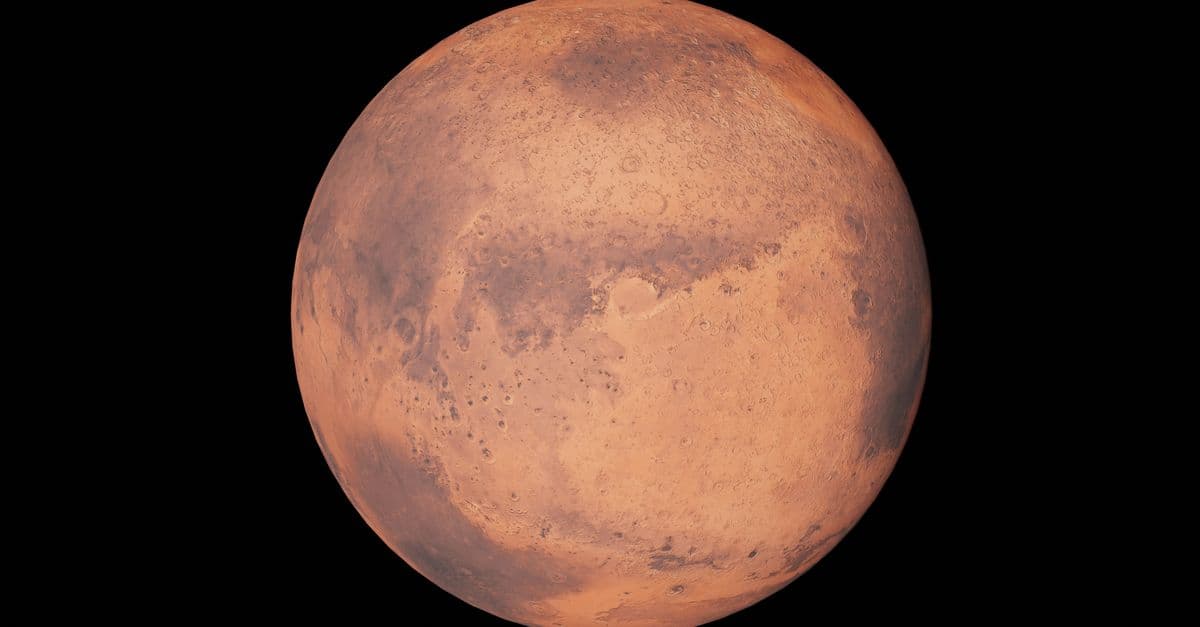
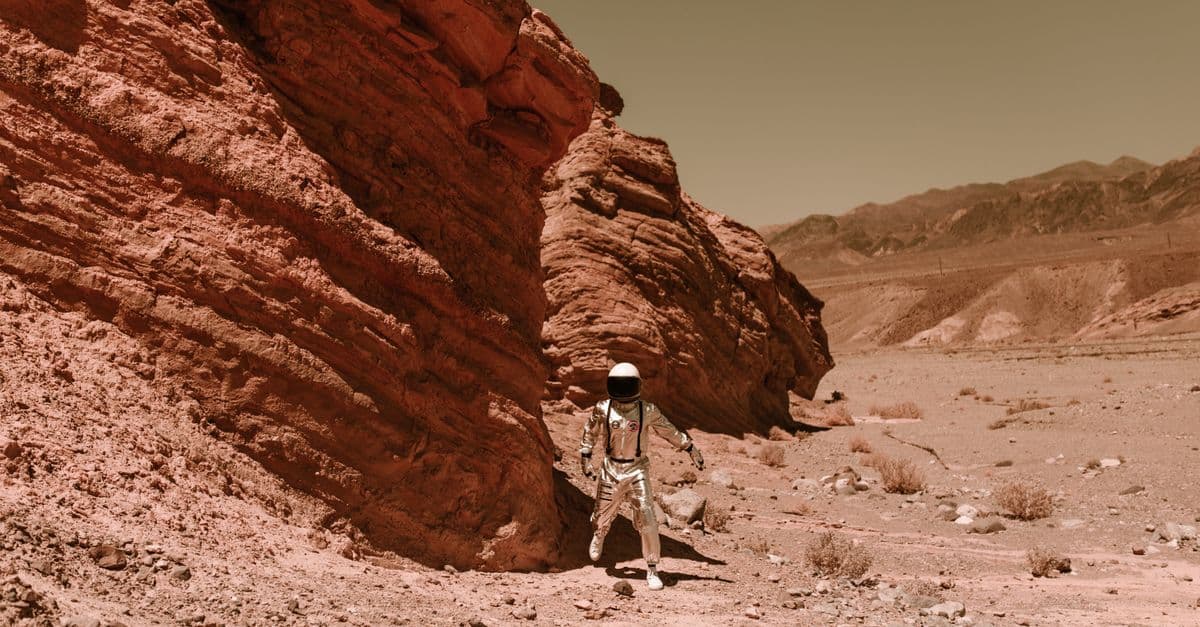
Photo: Zelch Csaba / Pexels
On April 19, 2021, a 1.8-kilogram (4-pound) helicopter named Ingenuity rose 3 meters above a dusty patch of Jezero Crater, hovered for 30 seconds, and settled back down after 39.1 seconds in the air. It was the first powered, controlled flight on another planet. The helicopter was built as a five-flight technology demonstration. It flew 72 times over nearly three years, scouted terrain for the Perseverance rover, and ended its career on January 18, 2024, with a broken set of rotor blades. This article explains how it flew, what went wrong, and what engineers took from it.
Why flying on Mars is so much harder than flying on Earth
A helicopter rotor is a spinning wing. It pushes air downward, and the air pushes back. The lift it produces scales with the density of the air, the square of the blade speed, and the area the blades sweep. Mars cuts the first of those down brutally: NASA's Mars fact sheet gives a surface air density of about 0.016 kilograms per cubic meter, while air at sea level on Earth is roughly 1.2 kilograms per cubic meter. That is about 1.3 percent of Earth's.
Mars does hand flight designers one favor. Surface gravity is 3.73 meters per second squared, about 38 percent of Earth's 9.81. A 1.8-kilogram helicopter therefore weighs about 6.7 newtons on Mars instead of the 17.7 newtons it would weigh at home. Put the two effects together and the arithmetic is still unfriendly: to hold the helicopter up, the product of rotor area and blade speed squared must be roughly 29 times larger than it would be on Earth for the same mass (0.38 divided by 0.013). That figure is a back-of-the-envelope estimate, not a NASA number, but it explains the design in one line.
Think of it like swimming versus wading. A swimmer in a pool can stay up with slow, gentle strokes. Move the same swimmer into water that is 98 percent less dense, and the only way to stay at the surface is to churn very large and very fast. Ingenuity could not make its blades much bigger, because it had to fold up under the belly of a rover and survive a rocket launch. It made them faster instead.
What the thin air does to rotor speed
NASA's specification table puts Ingenuity's rotor span at just under 1.2 meters (4 feet) and describes a pair of coaxial, counter-rotating rotors. Public technical summaries list a rotor speed in the range of 2,400 to 2,700 revolutions per minute, several times faster than the rotor of a small helicopter on Earth. Do the geometry and the numbers are striking. A blade tip sweeping a radius of about 0.6 meters at 2,400 rpm moves at roughly 150 meters per second; at 2,700 rpm it moves at about 170. Those are computed values, not mission data. Sound also travels more slowly in cold carbon dioxide than in Earth air, so those tips move at a substantial fraction of the local speed of sound, a regime where airflow behaves differently than it does around a conventional small helicopter rotor.
The table below sets the Mars case beside Earth using only the figures quoted above.
| Quantity | Earth (sea level) | Mars (surface) | Ratio |
|---|---|---|---|
| Air density | about 1.2 kg/m³ | about 0.016 kg/m³ | about 1.3% |
| Surface gravity | 9.81 m/s² | 3.73 m/s² | about 38% |
| Weight of a 1.8 kg aircraft | about 17.7 N | about 6.7 N | about 38% |
| Rotor area x speed² needed for the same lift | 1 (baseline) | roughly 29 | computed estimate |
Designing a rotor for that regime was one of the hardest parts of the project. The 29-fold penalty is the reason Ingenuity's blades look so oversized relative to its tiny body.
The machine itself: what Ingenuity was made of
Ingenuity stood 49 centimeters (19.3 inches) tall, with a fuselage described by NASA as roughly the size of a tissue box. It carried no science instruments. Its job was to answer an engineering question, which was whether future Mars exploration could include an aerial perspective, and a few cameras were enough to do that.
| Item | Specification | Source |
|---|---|---|
| Mass | 1.8 kg (4 lb) | NASA JPL |
| Height | 49 cm (19.3 in) | NASA first-flight release |
| Rotor span | about 1.2 m (4 ft), two coaxial counter-rotating rotors | NASA JPL |
| Rotor speed | roughly 2,400 to 2,700 rpm | Public specification summary |
| Average power in flight | about 350 W | NASA JPL |
| Battery | six lithium-ion cells, about 35 to 40 Wh | Public specification summary |
| Solar panel | about 425 x 165 mm | Public specification summary |
| Flight computer | Qualcomm Snapdragon 801 on Linux, plus two flight-control microcontrollers | Public specification summary |
| Navigation camera | 640 x 480 pixel black-and-white, downward-facing | Public specification summary |
| Color camera | 13-megapixel color sensor, angled toward the horizon | Public specification summary |
| Radio | Zigbee-based link to the rover | Public specification summary |
The blades are four carbon-fiber airfoils, each about 0.6 meters (2 feet) long, according to IEEE Spectrum's reporting on the end of the mission. Carbon fiber gives high stiffness for very low mass, which matters because the blades have to resist flexing at those speeds without adding weight the motors cannot lift.
A phone processor in a flight computer
One design choice surprised many people outside the project. The main computer was a Qualcomm Snapdragon 801, a processor from the smartphone world, running Linux. Handling the math of vision-based navigation fast enough to keep a helicopter stable needs a lot of computing, and the radiation-hardened chips used on most spacecraft are far slower. Two simpler microcontrollers designed for radiation tolerance handled the flight control loops themselves, which is the part that cannot be allowed to hang.
Think of it as a pilot and an autopilot working together. The microcontrollers hold the aircraft level moment to moment, and the faster smartphone-class computer figures out where the aircraft is by watching the ground go by.
Where the energy went
The energy numbers are worth working through. NASA's description is of a 350-watt average draw during flight and enough energy for roughly 90 seconds of flying per Martian day. Multiply 350 watts by 90 seconds and you get 31,500 joules, or about 8.75 watt-hours. That is a fraction of the battery's 35 to 40 watt-hours.
The rest is the cold tax. Jezero Crater's cold season brought night temperatures that NASA said can plunge as low as about -90 degrees Celsius (-130 degrees Fahrenheit), and the electronics and battery have to stay warm enough to survive until sunrise. Reporting on the helicopter's operations described much of its energy budget being spent on heat rather than on flight. A small solar panel on top of the upper rotor recharges the battery each day, so the whole vehicle lives on whatever sunlight falls on an area about the size of a sheet of paper. The related problem of keeping spacecraft hardware alive through thermal extremes is covered in how spacecraft survive extreme temperature swings.
April 19, 2021: the first flight
Perseverance touched down on February 18, 2021, with Ingenuity folded against its belly. The helicopter was deployed on April 3 and the first flight came 16 days later, inside a test window of about 30 days. Perseverance parked about 64.3 meters (211 feet) away, relayed the radio link, and photographed the flight.
The helicopter lifted off at 3:34 a.m. EDT (12:34 a.m. PDT). NASA's account says the flight was fully autonomous: it could not be flown with a joystick, and it could not be watched in real time from Earth. Altimeter data showed it climbing to the prescribed 3-meter ceiling and holding a stable hover for 30 seconds before landing. The team confirmed success after the data came back through Perseverance.
The site was named Wright Brothers Field, in honor of the Dayton, Ohio, inventors. The flight also picked up an official aviation identity: the International Civil Aviation Organization designator IGY and the call sign INGENUITY. NASA officials called it their "Wright Brothers moment."
The numbers that frame the story: the technology demonstration was planned as up to five flights in 30 days. Ingenuity flew 72 times over nearly three years, about 14 times the number the mission was built for.
Why it had to fly itself
A radio signal takes minutes to cross the gap between Earth and Mars, and the length of that delay changes as the planets move. Real-time piloting would mean steering a helicopter that has already landed, or crashed, by the time the command arrives. So every flight was a plan uploaded in advance. The helicopter executed the plan with onboard guidance, navigation, and control software, flying the route and handling small disturbances on its own. Ground controllers could review the data afterward, and that review is how they learned what each flight had actually done.
For a deeper look at how rovers and aircraft make decisions with no human in the loop, see how Mars rovers think for themselves.
From technology demo to aerial scout
After the five test flights, NASA kept going. Through the later flights, the mission moved from a pure technology demonstration to an "operations demonstration" in which the helicopter scouted ahead for Perseverance, and later to an "engineering demonstration" that tested the aerodynamic and operational limits of the vehicle. The Wikipedia summary of the program places the shift toward mapping and scouting at about flight 6, on May 23, 2021.
| Phase | What it did | Notable detail |
|---|---|---|
| Technology demonstration | Up to five test flights in 30 days | Flight 1 reached 3 m for 39.1 s |
| Operations demonstration | Scouted terrain and photographed sites for Perseverance | Mapping and route reconnaissance became the focus |
| Engineering demonstration | Tested flight limits and new software | Navigation updates for steeper terrain |
| Final season | Flights across the Valinor Hills region | Last flight on January 18, 2024 |
Over the whole campaign the totals are, per the Wikipedia compilation of mission data: 72 flights, 2 hours 8 minutes 48 seconds of flight time, about 17 kilometers (about 10.5 miles, per NASA) of horizontal distance, and a maximum altitude of 24 meters (about 79 feet). NASA's own account of the longest single flight puts it at 704 meters (2,310 feet). IEEE Spectrum reports a total of 128 minutes and about 11 miles, which roughly matches.
One common error is worth heading off here. Some summaries put the total distance at "over 11 kilometers." The 11 figure is miles. The distance flown was about 17 kilometers.
The airfields and the software updates
Ingenuity moved from site to site. It took off from Wright Brothers Field and later used other prepared patches such as Airfield M, which an orbiting camera photographed on February 26, 2022. Its final location was a stretch named Airfield Chi in the Valinor Hills.
Between flights, the team kept rewriting the helicopter's software. Before flight 34, on November 23, 2022, a software update was tested to help avoid landing hazards and to correct a navigation error that appeared over uneven terrain. A lot of the "lessons learned" from Ingenuity are really lessons in remote software maintenance on a machine millions of kilometers away.
A timeline of the dated milestones
| Date | Event |
|---|---|
| February 18, 2021 | Perseverance lands with Ingenuity attached |
| April 3, 2021 | Ingenuity deployed onto the surface |
| April 19, 2021 | Flight 1: 3 m, 39.1 s total |
| May 23, 2021 | Flight 6, with the navigation-image timestamp glitch |
| September 5, 2021 | Flight 13 |
| April 29, 2022 | Flight 28, followed by a communications dropout |
| May 5, 2022 | Communication restored |
| June 6, 2022 | Inclinometer stops working; the inertial unit takes over |
| January 18, 2024 | Flight 72, the last |
| December 11, 2024 | NASA releases preliminary accident findings |
Close calls that taught the team
Flight 6 and the timestamp glitch
On the sixth flight, in May 2021, an interruption in the stream of images from the navigation camera to the flight computer caused a single image to be dropped, and every navigation image after that was stamped with the wrong time. The software tried to correct its position estimate using images it believed were taken at one moment but were actually taken at another. The result was pitch and roll oscillations of up to 20 degrees and spikes in power use, but the helicopter had margin in its rotor system, actuators, and power system and landed safely. The team patched the timing vulnerability afterward.
The episode matters because it shows what kind of failures actually threaten such a vehicle. It was not a broken part. It was a subtle timing bug in the data flow, and the machine survived because the hardware was designed with reserve capacity.
Cold, dark winters
In 2022, low solar energy during the Martian winter strained the helicopter's power budget. After flight 28 on April 29, 2022, communication with the rover dropped out in early May and was restored on May 5. On June 6, 2022, the inclinometer stopped working, and controllers used the inertial measurement unit as a workaround. The helicopter flew on through that winter, with nights that NASA has said can reach about -90°C at Jezero.
None of this was in the original script. A helicopter designed to last a month was being tuned through a full Martian winter.
January 2024: what ended the mission
The end came in two steps. Flight 71, on January 6, 2024, was cut short. Flight 72, on January 18, 2024, was planned as a short vertical check-out: climb to about 12 meters (40 feet), hover for a few seconds while taking images, and come back down.
According to NASA's later account, communication was lost by the 32-second mark, after the helicopter had landed again. Engineers regained contact and spent six days analyzing the data. Images showed a damaged rotor blade, and a broken blade was later found about 13 meters (43 feet) from the helicopter. The aircraft remained upright but could not fly.
The accident investigation
On December 11, 2024, NASA released preliminary findings on the accident. Håvard Grip of the Jet Propulsion Laboratory, the helicopter's first pilot, was quoted describing the most likely chain of events.
- Navigation: The helicopter tracked speed and direction by following features on the ground with its downward-facing camera. The system had been designed for flat, pebbly terrain. By flight 72 it was over steep, mostly featureless sand ripples, and in the investigators' words "lack of surface texture gave the navigation system too little information to work with."
- Touchdown: The navigation errors produced high sideways speeds at touchdown, and the impact tipped the aircraft.
- Blades: The rotor blades snapped about a third of the way from the tip. A broken blade was later found about 13 meters away.
NASA described these findings as preliminary, and the team did not have direct video of the touchdown, so the chain of events is a reconstruction.
Why a blank sand ripple confuses a camera
Ingenuity's navigation worked a lot like a driver judging speed at night by watching the lane markings slide past. According to IEEE Spectrum, a downward-facing VGA camera running at 30 frames per second tracked visual features from one frame to the next to estimate how the ground was moving beneath the aircraft. This is called optical flow. When the ground is covered with pebbles, cracks, and small rocks, every frame has plenty to lock onto, and the speed estimate is accurate.
Take that texture away and the system loses its sense of motion, much as a driver crossing a snowfield in a whiteout stops being able to tell whether the car is moving. Add a slope, which tilts the camera's view of the ground, and the errors compound. Flight 72 was planned as a brief vertical check of the aircraft's systems after flight 71 was cut short, with no long traverse. The ground below was still blank sand, and a short hop was not short enough to escape it.
Ingenuity did not go entirely quiet. It stayed in place and continued to send weekly weather data to Perseverance, plus data from its avionics, which engineers are using for future designs.
What Ingenuity changed
The scouting value
A rover sees the world from a camera mast about two meters above the ground. A helicopter can look over a ridge. The aerial images Ingenuity gathered gave Perseverance's team views of terrain that the rover could not see, and this reduced the guesswork when planning drives. That effect is real, but the quantity of it is easy to overstate. The scientific payoff of Ingenuity was mostly in demonstrating a method, not in headline discoveries of its own, since it carried no science instruments.
The mission's ability to operate on its own was equally important. The scouting role is related to how Perseverance searches for signs of ancient life, which depends on knowing which rocks and outcrops are worth the long drive.
The engineering value
Ingenuity answered a question that had divided engineers: can a rotorcraft fly in air this thin? It could, repeatedly, including in a different season with different density. It also gave designers real data about what actually fails. The flight 6 timing bug, the winter power crunch, and the flight 72 navigation problem are exactly the kind of lessons that cannot come from a wind tunnel.
The mission also tested a design philosophy. A smartphone-class processor and a lean, low-mass airframe are not what most planetary spacecraft use, and 72 flights showed the approach could work for a short-lived technology demonstration. That does not mean such parts suit every mission, and the cold winters showed the limits of the original design. It does mean the trade was tested in the real environment instead of argued on paper.
The project's roots go back further than most people think. The long history of vertical flight, from da Vinci's sketches to the machines that carried people, is told in our article on the helicopter, and Ingenuity is the latest chapter.
What comes next for Mars aircraft
Larger Mars rotorcraft
JPL, NASA's Ames Research Center, and AeroVironment have worked on a concept called the Mars Science Helicopter. JPL describes it as a six-rotor design able to carry 2 to 5 kilograms (4.5 to 11 pounds) of science instruments, and says it remains in early conceptual and design stages. IEEE Spectrum reports that the concept owes its existence to Ingenuity's success. No flight mission or launch date has been announced for it.
A larger machine would face the same physics with larger penalties. More mass means more lift needed, which means more power, which means heavier batteries or a different energy source. Each of those feeds back on the others.
Dragonfly at Titan
NASA's Dragonfly is a rotorcraft mission to Saturn's moon Titan, planned for launch no earlier than July 2028 and arrival in late 2034, for a planned 3.3-year mission. NASA says its rotors will carry it across Titan in flights of several miles each. Titan's atmosphere is thick and rich in nitrogen, which is much friendlier to rotors than Mars's thin carbon dioxide. Our Titan explainer covers the moon's atmosphere and surface in more detail.
The comparison is instructive. A Titan rotorcraft is easier in one way, because the air is dense and gravity is low. It is harder in another, because it will be far from Earth and operate with a very long communications delay, so autonomy is more critical than ever. Ingenuity's final lesson about featureless terrain is directly relevant.
Limitations, misconceptions, and open questions
Misconception: Ingenuity carried scientific instruments. It did not. Its cameras were there for navigation and for demonstration imagery. The scientific value came from showing the concept.
Misconception: it was destroyed. The helicopter stayed upright after flight 72 and kept communicating weekly. It was grounded permanently, but it was not wrecked.
Misconception: Mars has "no air." It has an atmosphere that is about 95 percent carbon dioxide by volume, and it has weather, including wind and dust. Our explainer on the composition of Mars's atmosphere covers the chemistry, and the case for how Mars lost most of its air covers why it is so thin.
Open question: how to navigate over blank terrain. IEEE Spectrum reports that possible improvements include a backup maneuver when featureless terrain is detected and a higher-resolution camera. These are possibilities, not decisions.
Open question: dust and long-term power. Dust on solar panels is a known limit for Mars hardware; the dust storm article covers how it ended some missions and spared others. The radiation environment is another factor for longer-lived Mars systems, covered in our article on measuring radiation on Mars.
Frequently Asked Questions
Q: When did Ingenuity make its first flight, and how long was it? A: On April 19, 2021, Ingenuity climbed to 3 meters, hovered for 30 seconds, and landed after 39.1 seconds in the air. It was the first powered, controlled flight on another planet, and it flew autonomously.
Q: How many flights did Ingenuity complete? A: It completed 72 flights over nearly three years. The mission was planned for five flights in 30 days. Total flight time was about 2 hours 9 minutes, and the distance flown was about 17 kilometers.
Q: Why can a helicopter fly in Mars's thin air? A: Lift depends on air density, blade speed, and rotor area. Mars's air is about 1.3 percent as dense as Earth's, but gravity is 38 percent of Earth's. Ingenuity compensated by spinning lightweight carbon-fiber blades at roughly 2,400 to 2,700 rpm.
Q: What ended Ingenuity's mission? A: A rough landing on flight 72, on January 18, 2024. NASA's investigation concluded that featureless sand ripples left the navigation system with too little information, leading to a hard touchdown that broke the rotor blades.
Q: Is Ingenuity still on Mars? A: Yes. It remains where it landed, grounded but upright, and NASA reported that it continued to send weather and avionics data to Perseverance after the final flight.
Q: Will there be another Mars helicopter? A: Concepts exist, such as the Mars Science Helicopter, which JPL describes as a six-rotor design in early conceptual stages. No flight mission has been announced. Separately, NASA's Dragonfly rotorcraft is planned for Titan, not Mars.
The takeaway
Ingenuity proved something that was far from obvious in 2018: a rotorcraft can fly in air that thin, again and again. Its real contribution was not a single record but a body of evidence about what works and what breaks, from a timing bug on flight 6 to a navigation system that met terrain it had never been designed for. The helicopter did not fail because flying on Mars is impossible. It stopped because its camera ran out of visible features to track, after being asked to do 14 times more than anyone planned. Future Mars aircraft will have larger payloads and better sensors, and they will start with the lessons this small machine paid for.
Read next:
- Mars Dust Storm Impact Research: Mars Global Storms and Settlement Challenges
- Mars Rovers Explained: Perseverance and Curiosity
- Mars Explained: Geology, Water, Atmosphere, and the Challenge of Colonization
Sources:
- NASA, "Ingenuity Mars Helicopter" mission page: science.nasa.gov/mission/mars-2020-perseverance/ingenuity-mars-helicopter
- NASA, "NASA's Ingenuity Mars Helicopter Succeeds in Historic First Flight," April 19, 2021: nasa.gov press release
- NASA Mars Fact Sheet (surface density, gravity): nssdc.gsfc.nasa.gov
- EarthSky, "NASA report on Ingenuity Mars helicopter accident," December 17, 2024: earthsky.org
- IEEE Spectrum, on the end of the Ingenuity mission: spectrum.ieee.org
- Wikipedia, "Ingenuity (helicopter)," used for specification and flight-log cross-checks: en.wikipedia.org
- JPL, Mars Science Helicopter concept image and caption (PIA25661): jpl.nasa.gov
- NASA, Dragonfly mission page: science.nasa.gov/mission/dragonfly
Follow new articles
Add SciHub101 to your feed reader to see new science and technology stories.
About the Author
SciHub101 is an independent science and technology publication founded and edited by Buğra Sözeri, a software engineer and app developer based in Türkiye. AI tools assist with drafting and research. Source documentation in the existing archive is uneven, and articles are being reviewed and corrected. The Editorial Team byline identifies editorial responsibility; it does not certify specialist or independent human review. Where we compare products, anything built by our own team is labelled as such — see the editorial guidelines and About page for how corrections and disclosures work.
Related Articles
Lunar Ice Detection Methods: Finding Water on the Moon
Remote sensing and direct exploration revealed water ice at the Moon's poles—a discovery changing lunar science and enabling future settlement through resource utilization.
Immune System Changes in Space: ISS Immunology Research
ISS studies reveal how microgravity suppresses immune function, explaining increased infection risk in astronauts and informing immunology treatment strategies.
Curiosity Rover: Methane Mystery on Mars
NASA's Curiosity rover detected methane spikes in Mars' atmosphere—evidence of possible microbial life or geological processes that challenge understanding of the Red Planet.
Radiation Measurement on Mars: Health Risks for Settlement
Curiosity's radiation detector has logged the Martian surface dose since August 2012. Here is what it measured, what that means for human health, and how much shielding settlers would need.
Martian Soil Analysis: Mars Geology from Rover Studies
Rover soil analysis shows Mars' surface is crushed basalt, oxidized iron, water-bearing minerals, and perchlorate salt. Here is what each finding means.
Perseverance Rover: Astrobiology Search on Mars
NASA's Perseverance rover is reading Jezero Crater's rocks for signs of ancient microbial life, caching samples for a return trip that no longer has an approved mission, and testing oxygen-making technology for crews.