What Is Interstellar Dust and Why Does It Matter?
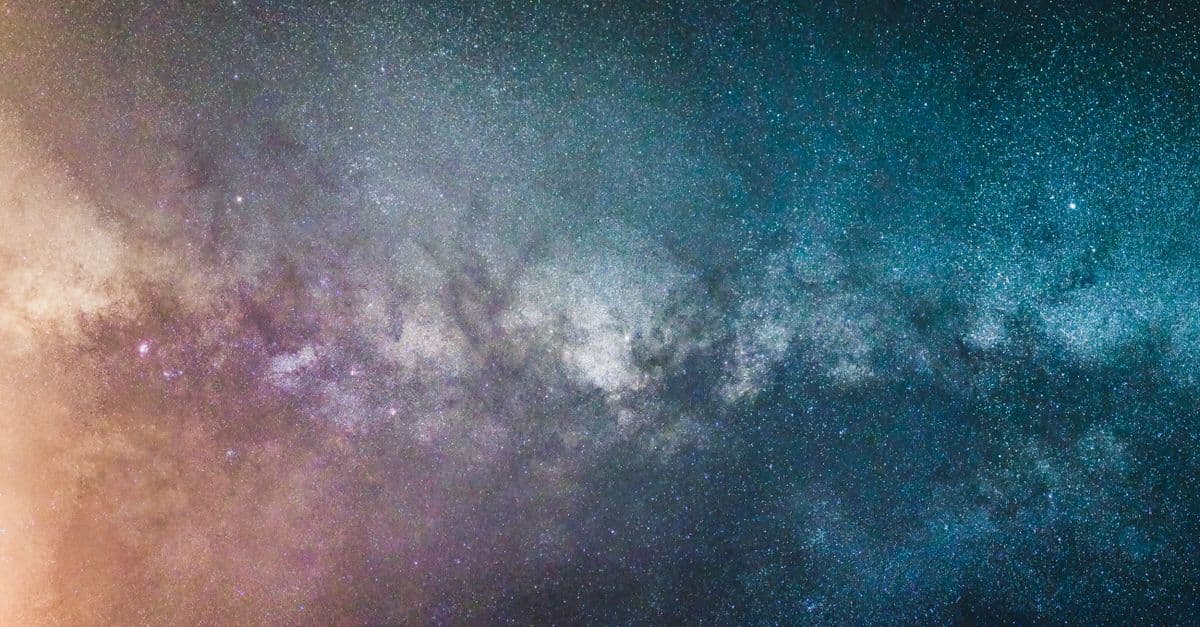
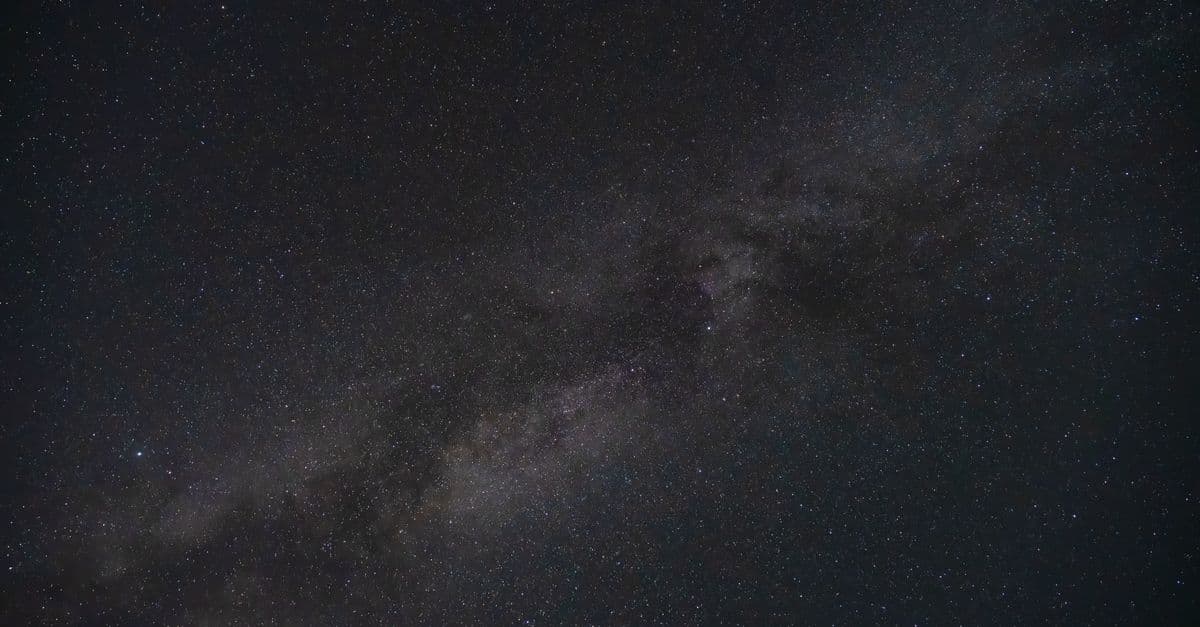
Photo: Erhan Dayı / Pexels
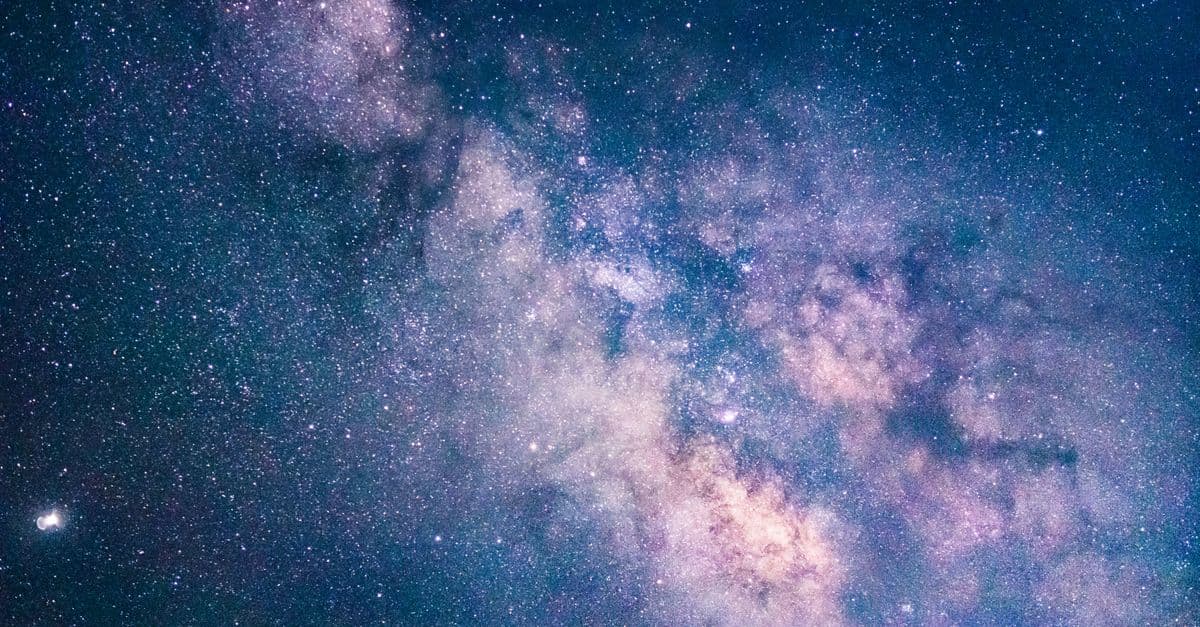
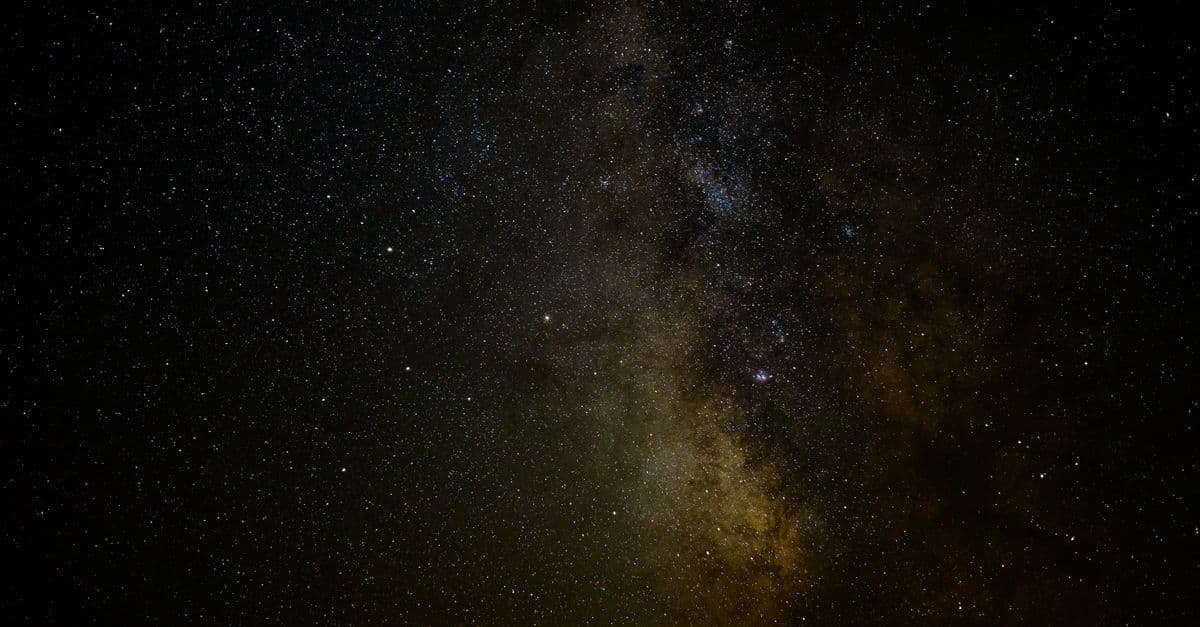
Look at a long-exposure photograph of the Milky Way and you will see dark lanes cutting across the bright band of stars. Those lanes are not empty gaps. They are clouds of interstellar dust: tiny solid grains of silicate rock, carbon compounds, and ice drifting between the stars. By mass, the Milky Way's interstellar medium is about 99% gas and about 1% dust, according to the standard overview of the interstellar medium. That 1% dims distant stars, makes the galaxy's most common molecule, and hands planets their building material.
Think of dust as the smoke of the galaxy. A campfire's smoke is a trace component of the air near it, yet it controls how far you can see, how the light looks, and what chemistry happens on a cold morning. Interstellar dust plays the same role on a scale of thousands of light-years. This article covers what the grains are made of, how they dim light, why they matter for making molecules and planets, where they come from, and why astronomers sometimes treat them as a nuisance to be subtracted.
What dust grains actually are
Interstellar grains are not dirt in the everyday sense. They are solid particles with sizes from a few nanometers, comparable to a large molecule, up to roughly a micrometer. For comparison, a human hair is about 70 micrometers wide, so even the biggest grains are dozens of times thinner than a hair.
Sizes follow a rough power law, first fitted by Mathis, Rumpl, and Nordsieck in 1977 and now called the MRN distribution. The number of grains of radius a scales as:
$$\frac{dn}{da} \propto a^{-3.5}$$
The same power-law form is quoted in the standard overview of the interstellar medium. The exponent has a neat consequence. Small grains are overwhelmingly numerous, so they hold most of the total surface area. Larger grains are rarer but each one is far heavier, so they hold most of the mass. Surface area matters for chemistry, because reactions happen on surfaces. Mass matters for the budget of heavy elements locked away from the gas.
An analogy helps. Picture a beach. Most of the individual sand particles are tiny, yet most of the weight is in the pebbles. If you wanted to know how much water a beach can soak up by surface tension, you would count the fine sand. If you wanted to know how much rock is on the beach, you would weigh the pebbles. Interstellar dust has the same split between the fine and the coarse.
Silicates
Rocky grains are a major component. Amorphous magnesium-iron silicates, with compositions resembling the minerals olivine and pyroxene, show up through two infrared absorption features: one at 9.7 micrometers from silicon-oxygen bonds stretching, and one at 18 micrometers from the silicon-oxygen-silicon angle bending. These features appear as dips in the spectrum of a background star or protostar seen through a dusty cloud.
The interstellar silicates are mostly amorphous, meaning their atoms are jumbled like glass rather than arranged in a repeating crystal. Crystalline silicates turn up in comets and protoplanetary disks, which implies that either the grains were heated and restructured when planetary systems formed, or that cosmic rays and ultraviolet photons in the diffuse medium scramble the crystal order. The Draine review of interstellar dust grains in the Annual Review of Astronomy and Astrophysics treats a mixture of amorphous silicate grains, graphite grains, and polycyclic aromatic hydrocarbons as the working model that best matches observed extinction, emission, and scattering.
Carbon grains
Carbon takes several forms in dust. Amorphous carbon is a disordered, soot-like material. Graphite is carbon arranged in flat hexagonal sheets, the same stacking found in pencil lead. Nanodiamonds, found in meteorites, carry unusual isotope signatures, though their stellar origin is still uncertain. A broad bump in the extinction curve at a wavelength of 2175 angstroms (217.5 nanometers, in the ultraviolet) is generally attributed to carbon, though whether graphite, PAHs, or something else carries it is still debated.
Ices
In cold, dense molecular clouds, where temperatures can be 10 to 20 kelvin (about minus 263 to minus 253 degrees Celsius), gas-phase molecules stick to grains and freeze. The grains grow icy mantles. Water ice is the most abundant, detected through an absorption band near 3 micrometers. Carbon monoxide ice absorbs near 4.67 micrometers, and carbon dioxide ice at 4.27 and 15.2 micrometers. Methanol, ammonia, formic acid, and many other species exist as trace ices.
These mantles matter because they store the cold universe's oxygen, carbon, and nitrogen in a form that can be processed. When a young star heats its surroundings, the ices sublimate and release complex molecules into the gas near where planets will eventually form. The table below summarizes the major ingredients.
| Component | Main identifying feature | Typical setting | Role |
|---|---|---|---|
| Amorphous silicates | Infrared absorption at 9.7 and 18 µm | Diffuse medium, envelopes of young stars | Main carrier of rock-forming elements |
| Graphite and amorphous carbon | Extinction bump near 2175 Å (debated carrier) | Diffuse medium | Ultraviolet absorption, carbon reservoir |
| PAHs | Emission bands at 3.3, 6.2, 7.7, 8.6, and 11.2 µm | Regions lit by ultraviolet starlight | Gas heating, infrared glow |
| Water ice | Absorption near 3 µm | Dense, cold clouds below roughly 20 K | Oxygen reservoir, surface for chemistry |
| CO and CO2 ice | Absorption at 4.67, 4.27, and 15.2 µm | Dense, cold clouds | Carbon reservoir |
How dust dims and reddens starlight
When starlight crosses a dusty region, grains remove some of it in two ways. They absorb photons, converting light energy into heat in the grain, and they scatter photons, bouncing them off the original path. The combined loss is called extinction. Blue light is removed more efficiently than red because grains are comparable in size to the wavelength of visible light, so a star seen through dust looks both dimmer and redder than it is. The effect is the same one that makes a setting sun red when smoke or haze fills the sky.
The loss depends on wavelength in a pattern called the extinction curve. It is steep in the ultraviolet, moderate in visible light, and much weaker in the infrared. Beyond about 5 micrometers, extinction becomes almost negligible apart from absorption features such as the silicate bands. That is why infrared telescopes can see stars and protostars hidden inside clouds that are black in optical images.
Astronomers quantify reddening with the color excess E(B−V), the difference between the observed and intrinsic blue-minus-visual color of a star. The ratio of total to selective extinction, R_V = A(V) / E(B−V), tracks the typical grain size. In the diffuse interstellar medium, R_V averages about 3.1. Along some lines of sight, particularly through dense clouds, it is higher, a sign that grains there have grown larger by coagulation and by accreting ice mantles. At infrared wavelengths such as the K band at 2.2 micrometers, the extinction is only about a tenth of the visual value.
Why astronomers must correct for it
Dust correction touches nearly every branch of astronomy, because almost every distant object is seen through some of it.
- Distances: Type Ia supernovae serve as standard candles in measurements of the expansion rate of the universe. An error in the assumed reddening translates directly into an error in brightness and therefore distance. This is one place where dust accounting enters discussions of the Hubble constant tension.
- Galaxy colors: A reddened young galaxy can mimic an old one, confusing estimates of stellar age and redshift.
- The cosmic microwave background: Dust in our own galaxy glows in the microwave and far-infrared bands and emits polarized light, contaminating maps of the oldest light in the universe. More on that below.
- Exoplanet atmospheres: Hazes made of small particles inside a planet's atmosphere can flatten the spectral features that reveal gases. This is dust of a different kind, but it behaves in a similar way.
How astronomers measure something so small and so far away
Nobody has weighed a cloud of interstellar dust on a scale, so astronomers infer its properties from how it interacts with light. Several independent methods exist, and good models of dust have to satisfy all of them at once.
Extinction and reddening. Compare a star's observed color with the color expected for its spectral type, and the difference reveals how much dust lies in front of it. Repeat the measurement for thousands of stars at different distances, and the dust can be placed in three dimensions. By 2022, extinction data had been used to build a three-dimensional map of the interstellar medium within about 3 kiloparsecs of the Sun, roughly 10,000 light-years.
Thermal emission. Grains heated by starlight radiate in the far-infrared and submillimeter. Dust heated to tens of kelvin glows at these wavelengths, so cold clouds that are invisible in optical images show up brightly in surveys by space observatories and by ALMA. The brightness traces how much dust is present, and the color of the glow gives the grain temperature.
Scattering. Dust reflects starlight, producing reflection nebulae such as the blue haze around the Pleiades. The ratio of forward-scattered to back-scattered light constrains grain size. If an object is much brighter in forward-scattered light, a significant fraction of the grains must be about a micrometer across, as the cosmic dust overview explains.
Polarization. Elongated grains tend to spin and align with the local magnetic field. Starlight passing through the aligned grains becomes slightly polarized, and the grains' own emission is polarized too. This provides a way to map magnetic fields across the galaxy, which is exactly what makes dust such a problem for the microwave background and such a gift for studies of how magnetic fields shape star formation.
Missing elements. Gas-phase measurements of elements such as silicon, magnesium, and iron find less than the cosmic abundance expects. The missing atoms are locked inside grains. This depletion pattern is one of the strongest constraints on what the grains can be made of, because the dust has to account for the atoms that are absent from the gas.
The analogy is a detective reconstructing a person from footprints, a shadow, and what is missing from a pantry. No single clue identifies the culprit, but a model that explains all of them at once is usually close to the truth.
PAHs: the largest molecules in space
Polycyclic aromatic hydrocarbons (PAHs) are flat molecules made of fused hexagonal rings of carbon with hydrogen atoms around the edge. On Earth they form wherever organic material burns incompletely, which is why they appear in soot, grilled food, and exhaust. In space they are common. A NASA estimate, quoted in the summary of cosmic dust, is that more than 20% of the carbon in the universe may be associated with PAHs.
PAHs reveal themselves through the aromatic infrared bands at 3.3, 6.2, 7.7, 8.6, and 11.2 micrometers. These bands appear wherever ultraviolet light from young stars falls on interstellar material. The mechanism is called stochastic heating. A single ultraviolet photon hits a PAH and deposits so much energy in a tiny molecule that its temperature briefly spikes to hundreds of degrees. The molecule then sheds that energy as infrared photons at its characteristic vibrations and cools off again before the next photon arrives.
Think of popcorn in a hot pan: each kernel pops when a burst of energy arrives, not because the whole pan is uniformly hot. A PAH lights up the same way, one photon at a time.
What JWST sees in PAH emission
The James Webb Space Telescope has made PAHs a map of the cold gas that feeds star formation. The PHANGS-JWST program images 19 nearby star-forming galaxies from 2 to 21 micrometers, as described in a summary of the survey from the AAS. The summary notes that about 20% of the infrared light from a star-forming galaxy comes from PAHs, and that the PAH share of 3.3-micrometer light varies from place to place, reaching as much as 65% in some regions relative to starlight. A separate team, studying 1,529 ionized-gas regions in four of the galaxies, concluded that PAHs are likely destroyed by ultraviolet radiation from young stars.
The largest PAHs merge into small graphite grains. Once a molecule has more than roughly a thousand carbon atoms, the line between a large molecule and a small grain stops being meaningful.
Dust as a molecular factory
One of dust's most important jobs is making molecular hydrogen (H₂). Two hydrogen atoms colliding in empty space cannot simply stick together. Forming the bond releases about 4.5 electron volts of energy, and an isolated H₂ molecule has no efficient way to radiate that energy away, so the molecule flies apart again. In the gas phase, the reaction is hopelessly slow at interstellar densities.
A grain solves the problem by acting as a third body that soaks up the excess energy. A hydrogen atom lands and sticks to a cold grain surface, wanders across it, meets another hydrogen atom, and the two bond. The grain takes up part of the released energy as heat, and the new molecule departs. This route is called the Langmuir-Hinshelwood mechanism. It is the main way the universe makes H₂ in present-day galaxies.
The consequences are large. Without H₂, there would be no cold, dense molecular clouds, because H₂ and the molecules it helps create are what let gas radiate heat away and collapse. No collapse means no stars forming in the way they do now. Dust grains also shield the cloud interiors from ultraviolet light that would otherwise break the molecules apart. The grain is the catalyst, the shield, and the surface all at once. For more on the physical conditions of these regions, see our explainer on stellar nurseries.
Chemistry on frozen surfaces
At around 10 kelvin, atoms and small molecules that stick to grains can react with one another in ways that are impossible in the gas. A well-studied sequence builds methanol by adding hydrogen to carbon monoxide: CO becomes HCO, then H₂CO, then CH₃OH. Ultraviolet photons and cosmic rays strike the ice and break bonds, creating reactive fragments that recombine into larger organic molecules. When the grain warms, near a protostar for example, the products evaporate into the gas where radio telescopes can detect them.
Our overview of astrochemistry and molecules in space lists the families of molecules found so far. The link between that chemistry and the solar system is visible in comets. In 2016, a team led by Kathrin Altwegg used the ROSINA mass spectrometer aboard ESA's Rosetta spacecraft to report the first unambiguous detection of glycine in a comet's coma, along with phosphorus. Glycine is the simplest amino acid. ROSINA measured the molecule directly in the gas around comet 67P/Churyumov-Gerasimenko, so no sample handling could introduce Earthly contamination. Where the glycine formed is a separate question, but organic molecules in comets are generally thought to trace the chemistry of cold ices that predates the solar system.
Where dust comes from, and where it goes
Dust is not eternal. Grains form, grow, get shattered, and get destroyed, and the balance determines how much dust a galaxy contains. Astronomers have found this accounting harder than it sounds.
Sources
Evolved low- and intermediate-mass stars. Stars of roughly 1 to 8 solar masses that reach the asymptotic giant branch lose mass in cool, slow winds. Gas leaving the star cools enough for refractory material to condense into grains. Oxygen-rich stars make silicates. Carbon-rich stars make carbon grains and silicon carbide. Our article on AGB stars explains the stellar side of this process.
Supernovae. Core-collapse explosions produce enormous quantities of freshly made heavy elements in ejecta that cool quickly, and observations suggest each such supernova may make roughly 0.3 solar masses of dust. Not all of that survives, because the reverse shock that sweeps back through the ejecta can destroy part of it. How much survives is contested. If the fraction is high, supernovae can explain the dust seen in very young galaxies where AGB stars have not had time to evolve. The supernova explainer covers the explosion itself.
Other stars. Red supergiants, luminous blue variables, novae, and Wolf-Rayet stars also lose dusty material. Eta Carinae's Homunculus nebula is a well-known dusty outflow.
Growth in the cold medium. Grains also grow inside molecular clouds by accreting atoms and molecules from the gas, building ice mantles and in some cases adding refractory material.
The dust budget problem
When astronomers add up dust production by evolved stars and compare it with the dust actually observed, the stars fall short. A study of the Small Magellanic Cloud by Boyer and colleagues found that AGB and red supergiant stars can account for only up to about 2% of the dust in that galaxy's interstellar medium. Supernovae could close the gap only if each one made around 0.05 solar masses of dust or more and most exploded inside dense clouds that shielded the dust from their own shock waves. Otherwise, the authors conclude, grains must grow in the interstellar medium itself, at a rate two to three orders of magnitude above the AGB dust production rate.
A competing line of work argues that supernovae may be efficient enough on their own. A paper on "maximally dusty" galaxies treats core-collapse supernovae as dust sources and reproduces observed dust masses over four orders of magnitude, across redshifts from 0 to 8.4, provided net destruction is small. The open question, then, is not whether stars make dust. It is how much of the dust that stars make survives, and how much of today's dust is grown in the cold interstellar medium rather than inherited intact from stars.
Destruction
Supernova blast waves are the main destroyer. A fast shock erodes grains by sputtering, where fast ions knock atoms off the surface, and by grain-grain collisions that shatter larger grains into smaller ones. Ultraviolet photons and cosmic rays break down ice mantles and organic coatings. Grains can also be consumed when gas falls into a star, a process astronomers call astration.
The balance of growth, shattering, and sputtering sets the size distribution. The MRN power law is often read as a signature of shattering cascades, where collisions break large grains into many small ones, though the details depend on the model.
Presolar grains: stardust in the laboratory
The most direct way to study interstellar dust is to hold some. Presolar grains are microscopic particles found in primitive meteorites that formed around other stars before the solar system existed. They survived the birth of the Sun without being vaporized, locked inside meteorite parent bodies for 4.6 billion years.
Presolar grains are identified by their isotopes. The ratios of carbon-12 to carbon-13, silicon-29 to silicon-28, or oxygen-17 to oxygen-16 in a presolar grain lie far outside the range found in anything made in the solar system, by factors that can reach thousands. Such ratios can only arise in the interiors of specific kinds of stars, so each grain acts as a fingerprint of the star that made it.
| Presolar grain type | Likely origin | Notes |
|---|---|---|
| Silicon carbide (SiC) | Mostly carbon-rich AGB stars; minority from supernovae and novae | The best-studied type; large grains can be extracted from meteorites with acid |
| Graphite | AGB stars and supernovae | Carries isotope signatures of both |
| Silicate | Mostly oxygen-rich AGB stars | Harder to find because meteorite silicates are abundant and hard to distinguish from solar-system material |
| Nanodiamonds | Uncertain | Most abundant by number; individual stellar sources are hard to pin down |
| Titanium carbide; silicon nitride | Supernovae (TiC is found inside graphite and SiC grains) | Rare |
The oldest grains
In January 2020, a team led by Philipp Heck of the Field Museum and the University of Chicago reported ages for presolar silicon carbide grains from the Murchison meteorite, which fell in Australia in 1969. Their method used cosmic rays. As grains drift through interstellar space, cosmic rays strike them and create rare isotopes such as neon-21. The longer a grain travels, the more of those isotopes it accumulates, so the abundance acts as a clock for the grain's trip. The coverage of the study reports that most grains were 4.6 to 4.9 billion years old and some were older than 5.5 billion years, which makes them the oldest solid material yet dated. The ages carry large uncertainties, so the exact figures are best read as approximations.
The team suggested that many of the grains formed during a period of enhanced star formation roughly 7 billion years ago, before the solar system existed. Because only about 5% of meteorites contain presolar grains at all, each result has a lot of leverage on a small sample.
Not all captured dust is presolar. NASA's Stardust mission returned samples from comet Wild 2 to Earth in 2006, and those samples included material that formed in the hot inner solar system, a reminder that distinguishing true stardust from reworked solar-system material takes careful isotope work.
Dust and the story of star formation
On the scale of a whole galaxy, dust changes how light escapes. Massive young stars form inside dense molecular clouds that block ultraviolet and visible light. The grains absorb that starlight and warm to tens of kelvin. They then re-radiate the energy as a smooth glow in the far-infrared, peaking at wavelengths of roughly 100 micrometers. A galaxy hiding a violent burst of star formation can therefore look dim in optical light and brilliant in the infrared.
This gives astronomers a measuring tool. If most of the ultraviolet light from young stars is absorbed by dust, the total infrared luminosity (integrated from 8 to 1,000 micrometers) tracks the star formation rate. A widely used calibration from Kennicutt in 1998 is:
$$\text{SFR}\ [M_\odot\ \text{yr}^{-1}] \approx 1.7 \times 10^{-10}\ L_{\text{TIR}}\ [L_\odot]$$
This applies best to dusty starbursts, where nearly all the ultraviolet light is absorbed. In dust-poor galaxies, ultraviolet light escapes and the infrared underestimates the rate, so astronomers combine the two. Later work, including the Kennicutt and Evans review of star formation in the Milky Way and nearby galaxies, provided updated prescriptions for converting infrared light and other tracers into star formation rates.
The extreme cases are ultraluminous infrared galaxies, which emit more than 10¹² solar luminosities in the infrared, usually because a galaxy merger has driven gas into a compact starburst. Arp 220, the nearest example at about 250 million light-years (roughly 77 megaparsecs), is the site of a merger-driven starburst, and in 2011 astronomers reported seven supernovae seen there at once. At cosmic noon, a period roughly 10 to 11 billion years ago when star formation peaked, dusty galaxies contributed a large share of all star formation. ALMA, which detects dust continuum emission at millimeter and submillimeter wavelengths, has revealed a population that Hubble largely missed in optical images. The cosmic story of star formation cannot be told from optical light alone, and our article on stellar feedback describes how young stars in turn push dust and gas back out of their birth clouds.
Dust as a foreground: the CMB lesson
Dust is a bright nuisance for cosmologists. Grains in the Milky Way emit thermally in the microwave and far-infrared, and because they tend to align with the galaxy's magnetic fields, their emission is polarized. That polarization can mimic the faint pattern that cosmologists hope to detect from primordial gravitational waves in the cosmic microwave background.
This was not a hypothetical worry. In March 2014, the BICEP2 team announced a polarization signal that they interpreted as a possible imprint of gravitational waves from cosmic inflation. Planck data at 353 gigahertz, a frequency where dust emission dominates, showed the signal could be largely due to dust. A joint analysis of BICEP2, the Keck Array, and Planck in 2015 reported strong evidence for dust and no statistically significant evidence for primordial tensor modes, with an upper limit on the tensor-to-scalar ratio of 0.12 at 95% confidence. The lesson for the field is that every sensitive microwave measurement now has to model dust carefully. It is the price of looking at the sky from inside a dusty galaxy.
Dust and the birth of planets
Planets begin as dust. In a young stellar system, a disk of gas and micrometer-sized grains orbits the new star. Grains collide at low speeds and stick, growing from microns to millimeters to pebbles. The interstellar grains that arrive from the parent molecular cloud, along with their icy mantles, are the seed material. Our explainers on protoplanetary disks and how the solar system formed follow the sequence from grains to planetesimals to planets.
The ice mantles matter again here. Beyond the "snow line," the distance from the star where water freezes, ice-coated grains stick together more readily and provide extra solid mass, which is one reason giant planets form in the cooler outer disk. Closer in, the ices evaporate, leaving silicate and carbon grains for the rocky planets. In that sense the ingredients for the Earth were gathered and chemically seasoned in the cold of a molecular cloud before the Sun lit up.
The local picture: dust inside the solar system
Dust is also all around us in a milder form. Sunlight scattering off interplanetary dust produces the faint zodiacal light that is visible after sunset in dark skies. That dust is dominated by debris from comets and asteroids rather than by grains that arrived from interstellar space, although a small stream of true interstellar grains passes through the solar system.
Common misconceptions about cosmic dust
"Dust" does not mean the same thing as household dust. Interstellar grains are far smaller and made largely of rock-forming and carbon material, not skin cells and fibers. They also exist at extremely low densities. The space between stars contains a few atoms per cubic centimeter in the diffuse medium, and dust is a tiny fraction of that.
Dark lanes are not holes. A dark patch in the sky marks a region where dust blocks light from behind. Infrared images of the same patch often reveal stars or forming protostars hidden inside.
Dust is not just a hindrance. It is easy to think of grains as obstructions. In practice, galaxies without dust would have a very different chemistry, with far less molecular hydrogen, fewer molecules, and perhaps a smaller supply of rocky planets.
Dust is not only old. Presolar grains are ancient, but most of today's dust has been processed many times. Some of it formed in the last few hundred million years in stellar winds, and some has grown within clouds.
The takeaway
Dust makes up only about 1% of the interstellar medium by mass, but its influence far exceeds its share. Its surfaces turn hydrogen atoms into the molecules that let clouds collapse. Its opacity shields cold gas and turns starlight into infrared glow. Its isotopes record the deaths of stars that came before the Sun. Its larger descendants, grown in disks, become planets. The same grains also blur our view of the early universe, which is why the most careful measurements in cosmology include a model of dust. Understanding the galaxy means understanding the smoke it is made to look through.
Frequently asked questions
Q: What is interstellar dust made of? A: Mostly amorphous silicates, carbon grains in several forms including graphite and polycyclic aromatic hydrocarbons, and icy mantles of water, carbon monoxide, carbon dioxide, methanol, and ammonia in cold clouds. Silicates are identified by infrared absorption at 9.7 and 18 micrometers.
Q: How much of the interstellar medium is dust? A: About 1% by mass. The other 99% is gas, mostly hydrogen and helium. Despite the small share, dust controls extinction, molecule formation, and the infrared glow of galaxies.
Q: Why does dust make stars look redder? A: Grains of roughly the same size as visible wavelengths scatter and absorb blue light more efficiently than red light. Starlight that passes through dust loses more blue than red, so the star appears dimmer and redder. Astronomers call the effect reddening and measure it with color excess.
Q: How does dust help form molecular hydrogen? A: Two hydrogen atoms in empty space cannot bond efficiently because the energy released by bonding has nowhere to go. On a cold grain surface, atoms stick, move around, and combine, and the grain absorbs the excess energy. This surface route is the main way H₂ forms in modern galaxies.
Q: Where does interstellar dust come from? A: Evolved stars on the asymptotic giant branch, supernova ejecta, and other dusty stellar outflows make grains, and grains also grow by accreting material in dense clouds. The relative contribution of each source is an unresolved problem, often called the dust budget problem, because stars alone seem to fall short in some galaxies.
Q: What are presolar grains? A: Presolar grains are particles found in primitive meteorites that formed around other stars before the solar system existed. Their isotope ratios differ greatly from solar-system material, which lets scientists identify the type of star that made each grain.
Q: Why do cosmologists care about dust? A: Polarized microwave emission from Milky Way dust can mimic the signal that primordial gravitational waves would leave in the cosmic microwave background. After the 2014 BICEP2 announcement, joint analysis with Planck data showed dust accounted for much of the signal, so dust modeling is now central to such measurements.
Sources
- B. T. Draine, "Interstellar Dust Grains", Annual Review of Astronomy and Astrophysics 41, 2003.
- Interstellar medium, overview of gas and dust fractions, grain size distribution, and extinction.
- Cosmic dust, overview of grain composition, formation sites, and PAH carbon fraction.
- AAS Nova, "A Detailed Look at Star-Forming Spirals with PHANGS-JWST", June 14, 2023.
- Sci.News coverage of presolar grains in the Murchison meteorite, reporting Heck et al., PNAS, January 2020.
- Phys.org, "Comet contains glycine, key part of recipe for life", reporting Altwegg et al., Science Advances, May 2016.
- Boyer et al., "The Dust Budget of the SMC: Are AGB Stars the Primary Dust Source at Low Metallicity?".
- "Maximally dusty star-forming galaxies", arXiv:1809.11032.
- BICEP2/Keck Array and Planck Collaborations, "A Joint Analysis of BICEP2/Keck Array and Planck Data", 2015.
- R. C. Kennicutt and N. J. Evans, "Star Formation in the Milky Way and Nearby Galaxies", 2012.
Related Reading
- What Is the Interstellar Medium? The Space Between Stars
- What Is Nucleosynthesis? How Atoms Are Forged in Stars
- What Is Protoplanetary Disk and How Do Planets Form?
- What Is Stellar Feedback? How Stars Reshape the Galaxies They're Born In
- What Is Astrochemistry? Molecules in Space
- The Orion Molecular Cloud: Our Closest Star Factory
- How Space Telescopes See in Infrared
Follow new articles
Add SciHub101 to your feed reader to see new science and technology stories.
About the Author
SciHub101 is an independent science and technology publication founded and edited by Buğra Sözeri, a software engineer and app developer based in Türkiye. AI tools assist with drafting and research. Source documentation in the existing archive is uneven, and articles are being reviewed and corrected. The Editorial Team byline identifies editorial responsibility; it does not certify specialist or independent human review. Where we compare products, anything built by our own team is labelled as such — see the editorial guidelines and About page for how corrections and disclosures work.
Related Articles
What Is the Solar Cycle? Sunspots and the Sun's Magnetic Heartbeat
Every 11 years or so, the Sun's magnetic activity rises and falls in a cycle that astronomers have tracked since Galileo's era. The solar cycle sets how many sunspots, flares, and coronal mass ejections occur, and it shapes space weather at Earth.
What Is the Circumgalactic Medium? The Invisible Halo Around Every Galaxy
Every galaxy is wrapped in a huge, diffuse halo of gas that reaches hundreds of thousands of light-years past the visible disk. This circumgalactic medium feeds star formation, receives supernova debris, and holds a large share of a galaxy's baryons and metals.
What Is the Interstellar Medium? The Space Between Stars
The interstellar medium (ISM), the gas and dust filling the space between stars, is not empty. It is a multiphase medium ranging from 10 K molecular clouds where stars form to million-kelvin plasma heated by supernovae. Dust hides the centre of our galaxy from visible light, and the ISM is both the raw material for new stars and the place where dying stars deposit their products.
What Is Astrochemistry? The Molecules of Space and Life's Cosmic Origins
Astrochemistry studies how molecules form and survive in space, from H₂ in dark clouds to amino acids and nucleobases in meteorites and returned asteroid samples.