What If Earth's Magnetic Field Collapsed Tomorrow?
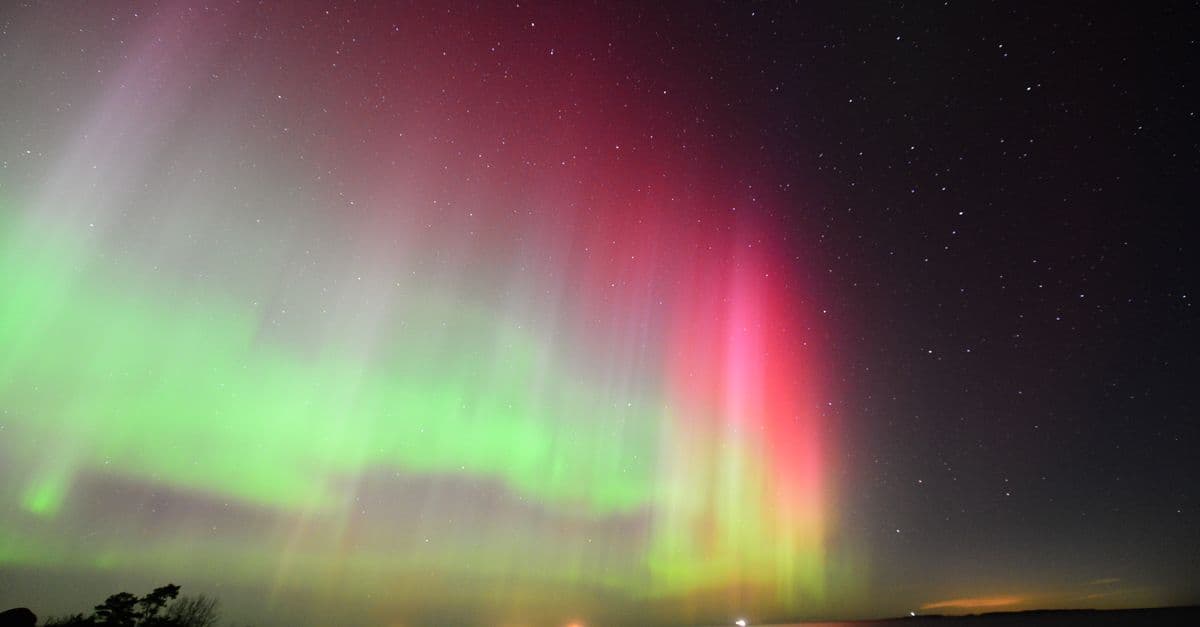
Photo: Dmytro Sharyi / Pexels
At the surface, Earth's magnetic field measures only about 30 to 60 microtesla, a whisper by the standards of laboratory magnets. Yet it carves out a bubble in space tens of thousands of kilometers wide, and inside that bubble the solar wind (the stream of charged particles flowing off the Sun) is pushed aside instead of pouring onto the upper atmosphere. This article asks what would change if that bubble disappeared overnight, and it separates the effects that physics supports from the ones that popular retellings tend to inflate.
Thought experiment. This article explores a hypothetical scenario for educational and speculative purposes. The events described are not predictions and should not be interpreted as warnings, advocacy, or instructions.
What Earth's magnetic field is and what it does
The field comes from the planet's interior. About 2,900 kilometers below your feet the rocky mantle gives way to the outer core, a layer of liquid iron and nickel that extends out to roughly 3,400 kilometers from Earth's center, wrapped around a solid inner core with a radius of about 1,220 kilometers (Wikipedia: Earth's magnetic field). The leading explanation for the field is the geodynamo: heat flowing out of the core keeps the liquid metal churning, Earth's rotation twists that flow into spirals, and a moving electrical conductor generates and sustains a magnetic field. Think of a bicycle dynamo that never runs out of pedaling, because the planet's own heat does the pedaling.
The result looks roughly like a bar magnet tilted a little off the rotation axis. At the surface, measured strength ranges from about 30 to 60 microtesla, with the highest values over Siberia and the lowest over Brazil. Out in space the field is squeezed on the Sun-facing side and stretched into a long tail on the night side. The boundary on the sunward side, called the magnetopause, sits roughly 10 Earth radii out, while the tail reaches beyond 200 Earth radii (same source). For a deeper tour of how planets build fields at all, see How Do Planetary Magnetic Fields Work?
The thing the field pushes against is the solar wind. Near Earth it blows at roughly 250 to 750 kilometers per second, and the Sun sheds on the order of 1.3 to 1.9 million tonnes of material every second this way (Wikipedia: Solar wind). The wind itself is mostly protons, electrons, and helium nuclei. If you want the Sun's side of the story, What Is the Solar Wind? covers how it forms and where it ends.
The field is also not static. The dipole has been declining for centuries. One widely cited figure is a drop of about 6.3 percent per century over the last two hundred years, and ESA's Swarm team reports that the field has lost about 15 percent of its strength over the last 150 years (ESA: Our protective shield). The numbers differ because they measure slightly different things over slightly different periods. Importantly, the current strength is about average for the last 7,000 years, so the present decline is not by itself unusual.
Why a collapse overnight is not a natural event
Before asking what a collapse would do, it helps to ask whether one could happen. The short answer is no, not by any mechanism we know. The geodynamo is powered by the motion of an enormous mass of liquid metal, and a mass that large does not stop in a day any more than the Atlantic Ocean stops sloshing in a day. The field changes on timescales of decades to millennia, and the worst cases in the geological record are far slower than anything a human would call sudden.
The record includes full polarity reversals, in which north and south magnetic poles swap. A compilation of the sea-floor magnetic record counts at least 183 reversals in the last 83 million years, roughly one every 450,000 years, though they are statistically irregular and the gaps vary enormously (Wikipedia: Geomagnetic reversal). ESA, averaging over a longer window, gives one reversal every 200,000 to 300,000 years. The last full reversal, the Brunhes-Matuyama reversal, happened about 780,000 years ago. Most estimates put the duration of a reversal between 1,000 and 10,000 years, and a 2019 study of that last event estimated about 22,000 years.
Then there are excursions, shorter episodes in which the field weakens sharply and recovers without flipping. The best studied is the Laschamp excursion about 41,000 years ago. Beryllium-10 recorded in Greenland ice cores (a radioactive isotope made when cosmic rays hit the atmosphere, so more of it means more cosmic rays got in) suggests the field fell to an estimated 5 percent of normal strength. The event lasted only a few hundred years (Wikipedia: Geomagnetic reversal, citing Nowaczyk et al., 2012).
| Event | When | What happened to the field | How long it took |
|---|---|---|---|
| Brunhes-Matuyama reversal | About 780,000 years ago | Poles swapped; field weak in between | Roughly 1,000 to 10,000 years typical; one 2019 estimate is about 22,000 years |
| Laschamp excursion | About 41,000 years ago | Dropped to an estimated 5% of normal, then recovered | A few hundred years |
| Modern decline | Last 150 to 200 years | Dipole weakening of roughly 6% per century to 15% in 150 years, depending on the measure | Ongoing |
| Instant total collapse | Never observed | Not supported by any known physical mechanism | Not applicable |
Notice what the table says about the starting premise. Even the weakest moments in the record were not zero. During the Brunhes-Matuyama reversal the magnetopause is estimated to have stayed about three Earth radii from the planet, which means a field still existed and still held the solar wind at a distance. So the collapse in this article is a deliberately extreme assumption, closer to switching off a physical law than to running a natural experiment. The companion scenario on a magnetic field flip deals with the more realistic case.
The first hour: the magnetic bubble shrinks
Suppose the field fell to zero instantly. The first thing to go would be the size of the bubble. The distance at which a planet's field balances the pressure of the solar wind scales with the surface field raised to the one-third power, according to the standard Chapman-Ferraro formula for the magnetopause (Wikipedia: Magnetosphere). That is a gentle dependence, which produces a surprising result: the bubble shrinks slowly at first and then fails quickly.
Using a dayside magnetopause of about 10 Earth radii as the starting point and holding the solar wind fixed, the one-third-power rule gives the following rough numbers. They are my own arithmetic from the published formula, not measurements.
| Field strength vs today | Estimated magnetopause distance (Earth radii) |
|---|---|
| 100% | About 10 |
| 50% | About 8 |
| 10% | About 4.6 |
| 5% | About 3.7 |
| 1% | About 2.2 |
A satellite in geostationary orbit sits about 42,000 kilometers from Earth's center, or about 6.6 Earth radii (a standard orbital value). By the table, once the field dropped to roughly a quarter of today's strength, the dayside boundary would be inside that orbit, and geostationary satellites, which carry much of the world's weather imaging and broadcast traffic, would spend part of each day directly in the solar wind. At 5 percent, the figure reached during the Laschamp excursion, the boundary would be near 3.7 Earth radii, well inside geostationary altitude but still far above the atmosphere.
At exactly zero, the picture changes qualitatively. A planet with no internal field still interacts with the solar wind. Charged particles in the planet's upper atmosphere (the ionosphere) carry electrical currents, and the solar wind drags its own magnetic field around that conducting layer, building what is called an induced magnetosphere. Venus has no internal dynamo and relies on exactly this (Wikipedia: Magnetosphere). Researchers have argued that an induced field of this kind could still shield the surface from energetic particles, though the protection would be far more limited at orbital altitudes (cited in Wikipedia: Geomagnetic reversal, citing Birk et al., 2004).
Hours to days: auroras at every latitude
Auroras form when charged particles follow magnetic field lines down into the upper atmosphere and excite oxygen and nitrogen, which then glow. Normally the field funnels those particles to rings around the poles, which is why the Northern and Southern Lights are mostly a high-latitude phenomenon. For the full mechanism, see Aurora Explained.
With the channeling gone, the particle precipitation would no longer be confined to polar rings. The field's absence would also not simply paint the sky for the whole planet at once, because the solar wind is a thin plasma and the energy it carries is limited. What we know from real storms is how far south auroras can reach when the field is overwhelmed. During the Carrington Event of 1859, auroras were reported as far south as Hawaii, Mexico, Cuba, and Italy, and during the March 1989 storm they appeared as far south as Texas and Florida (Wikipedia: Geomagnetic storm). A world with no field would not be a one-night spectacle but a persistent version of those displays, and the display would rise and fall with solar activity rather than staying at one fixed brightness.
The ionosphere would also be disturbed. The ionosphere is the electrically charged layer high in the atmosphere that bounces some radio signals back toward the ground. When it is disrupted, shortwave radio and satellite navigation signals degrade. The 2003 Halloween storms are a useful benchmark: during that run of events, the FAA's Wide Area Augmentation System, a GPS correction service used in aviation, was offline for about 30 hours (Wikipedia: Geomagnetic storm). That is a measurable, documented cost from a storm in which the field was still intact.
Power grids: the part history has already shown us
The most direct technological risk is to the electrical grid. When Earth's magnetic field changes quickly, as it does in a geomagnetic storm, the change induces slow, nearly direct currents in long conductors such as high-voltage lines. NOAA's Space Weather Prediction Center describes these as quasi-DC currents with periods from about 10 seconds to tens of minutes, which push transformers beyond their design range and can saturate their cores (NOAA SWPC: Electric Power Transmission). Saturated transformers draw large reactive currents, heat up, distort the grid's waveform, and can cause protective equipment to trip, leaving grids short of voltage support and, in the worst cases, blacked out.
The standard example is March 13, 1989. A geomagnetic storm collapsed the Hydro-Quebec grid within seconds as relays tripped in a cascade, leaving about six million people without power for nine hours (Wikipedia: Geomagnetic storm). A later industry review attributed the collapse mainly to near-simultaneous relay trips rather than to overheated transformers, which is a useful reminder that grid failures are system failures, not just component failures. The Carrington Event of 1859 was larger still; ice-core evidence suggests storms of that intensity recur roughly once in 500 years. For a grounded look at what a repeat would do to modern infrastructure, read Solar Storms and the Carrington Event.
Here is where the collapse scenario needs care. A field that has simply been absent for a long time does not induce currents; it is the change that matters. So the act of the field disappearing would drive a one-time surge, and after that the grid would be exposed to every solar disturbance without the bubble absorbing the worst of it, because the magnetosphere is also what stores and releases the energy of storms. The practical conclusion is not that every transformer would burn out in the first minute. It is that the baseline risk for long-line grids at higher latitudes would rise sharply, and the engineering response, which includes space weather monitoring and revised operating procedures, would become permanent rather than occasional.
Satellites, GPS, and the Van Allen belts
Satellites are the hardware most exposed to a failing field, because most of them operate inside the region the field protects. Today the best natural preview is the South Atlantic Anomaly, a region over South America and the South Atlantic where the field is weakest. ESA's Swarm mission found that this region has grown by roughly half the area of continental Europe since 2014, and that satellites passing through it receive higher radiation doses that can cause malfunctions, hardware damage, and even blackouts (ESA: Swarm reveals growing weak spot in Earth's magnetic field).
Now picture the weak spot spread over the whole planet. The Van Allen belts, doughnut-shaped zones where the field holds charged particles in place, would lose their trapping structure (see What Are the Van Allen Belts?). Satellites that currently thread between them would meet a very different radiation environment. Electronics would suffer more single-event upsets, in which one energetic particle flips a memory bit, and solar panels would degrade faster.
Storm-driven drag adds a second hazard. Geomagnetic storms heat the upper atmosphere, making it denser at low Earth orbit and dragging satellites downward. NOAA notes that spacecraft in quiet conditions need orbit boosts about four times a year, while near solar maximum they may need maneuvers every two to three weeks (NOAA SWPC: Satellite Drag). In March 1989, NASA's Solar Maximum Mission satellite reportedly "dropped as if it hit a brick wall." The Sun has also been near the peak of its current cycle, as covered in Solar Maximum 2025, so the baseline is not quiet.
GPS and other navigation systems depend on satellites in medium Earth orbit, where the radiation environment is already demanding and the hardware is built to tolerate it. Anyone relying on satellite navigation for aviation, shipping, farming, or timing would see degraded service before they saw any change at ground level. How GPS Works explains why timing precision, not just position, is the quiet dependency here. It would not be accurate to say every satellite dies within 24 hours. A more defensible statement is that satellite lifetimes and reliability would fall, with the most exposed orbits and the oldest, least-hardened hardware failing first.
What happens at the surface: the atmosphere does the heavy lifting
The common mental model is that the magnetic field is the thing that stops cosmic radiation from reaching the ground. The reality is that the atmosphere does most of the shielding, and the field mostly decides which particles ever reach the top of it.
Standard sea-level pressure of 101,325 pascals divided by gravitational acceleration works out to roughly 10,330 kilograms of air above every square meter of ground (my calculation; the figure is idealized because terrain varies). That is about 10 tonnes per square meter, comparable to a 10-meter column of water. Incoming cosmic rays, which are about 99 percent atomic nuclei (roughly 90 percent of those are protons) and about 1 percent electrons, slam into air molecules and break apart into cascades of secondary particles (Wikipedia: Cosmic ray). Most of the energy is spent high in the atmosphere. For more on where these particles come from, see What Are Cosmic Rays?
The magnetic field currently deflects most primary particles before they reach the atmosphere, and the heliosphere (the Sun's own magnetic bubble) deflects many more. If the field vanished, more primaries would arrive, particularly at low latitudes that are currently well shielded. The dose at the ground would go up, but from a modest baseline.
| Setting | Typical cosmic-ray dose |
|---|---|
| Sea level, global range | About 0.3 mSv per year |
| Higher-altitude cities | About 1.0 mSv per year |
| World average cosmic-ray component (UNSCEAR) | 0.39 mSv per year |
| Passenger jet at about 12 km | At least 10 times the sea-level dose |
| Airline crews on long high-altitude routes | Up to 2.2 mSv per year of additional dose |
Source for all rows: Wikipedia: Cosmic ray, citing UNSCEAR. The pattern is that altitude matters more than latitude for ground-level doses, which is why people in high cities already live with multiples of the sea-level dose without any visible effect on the population. That suggests that a modest increase at the surface would not by itself be an overnight health catastrophe. The more important exposure would be for people and equipment at altitude: aircrews, high-altitude flights, and astronauts. Polar routes would be affected first, as they already are the most sensitive to space weather.
Timescales matter here too. Cosmic-ray collisions in the atmosphere make isotopes such as beryllium-10 and chlorine-36, and those isotopes spike in ice cores when the field is weak. That is the evidence scientists use to reconstruct past field strength, and it also records that the atmosphere kept doing its job during the weak-field periods.
Atmospheric loss: slower than the movies suggest
The scenario that scares people most is atmospheric erosion. The idea is that without a field, the solar wind will sandblast the air into space, as it apparently did on Mars. The physics is real, but the timescale is the part that gets exaggerated.
Start with Mars. It has no global magnetic field today, though magnetized patches of crust suggest it had one about 4 billion years ago (NASA: Mars facts). NASA's MAVEN spacecraft measured the present-day loss and found that the solar wind strips roughly 100 grams of gas from the Martian atmosphere each second, a rate that climbs sharply during solar storms (NASA: MAVEN reveals speed of solar wind stripping Martian atmosphere). Over about 4 billion years, MAVEN observations indicate that about two-thirds of the atmosphere's argon-36 and at least about 0.5 bar worth of carbon dioxide escaped (Wikipedia: Atmospheric escape, citing Alsaeed et al., Science, 2017). For the Mars story in more depth, see Why Mars Lost Most of Its Atmosphere.
Now look at Venus, the control case. Venus has no strong intrinsic field, yet NASA lists its surface pressure at 92 bars and its atmospheric mass at about 4.8 x 10^20 kilograms, versus about 5.1 x 10^18 kilograms for Earth (NASA: Venus fact sheet; NASA: Earth fact sheet). That is roughly 94 times as much atmosphere as Earth, on a planet with no strong magnetic shield. A magnetic field is therefore not the only thing, or even the main thing, that determines whether an atmosphere survives. Gravity, temperature, the composition of the gas, the age and activity of the star, and the presence of an induced magnetosphere all matter.
Earth already loses air even with its field. Hydrogen escapes at about 3 kilograms per second and helium at about 50 grams per second (Wikipedia: Atmospheric escape, citing Catling and Zahnle, 2009). A bare Earth would lose more, because sputtering (solar-wind ions knocking atoms out of the upper air) is more pronounced without a planetary magnetosphere. But how much more? Nobody can give a confident number, so consider an illustration instead of a forecast.
Suppose, hypothetically, that the loss rate rose to 1,000 kilograms of air per second, a rate more than 300 times Earth's hydrogen loss. Over a year that is about 3.2 x 10^10 kilograms. Earth's atmosphere has a mass of about 5.1 x 10^18 kilograms, so removing 1 percent (5.1 x 10^16 kilograms) would take about 1.6 million years. Even at a million kilograms per second, a rate well above anything measured on Mars, removing 1 percent would take roughly 1,600 years. Those are my own arithmetic, offered to show scale, not predictions.
The honest summary is that atmospheric loss would be a deep-time concern rather than a first-year concern. It would matter over geological spans, and it would be one of several factors, not an automatic path to a Venus-like or Mars-like world.
Life: what the evidence does and does not show
Claims about mass extinction after a field collapse are common, and the evidence does not support them. A statistical analysis of the fossil record finds no correlation between geomagnetic reversals and extinctions (Wikipedia: Geomagnetic reversal, citing Plotnick, 1980, and Glassmeier and Vogt, 2010). Life has passed through hundreds of reversals and many excursions. That does not prove a total collapse would be harmless, because a total collapse has no precedent, but it does mean that the strong claim that weak fields cause die-offs lacks support.
What can be said is narrower. More radiation reaching the upper atmosphere would raise doses for high-altitude flyers and for any species that lives or migrates at altitude. Increased energetic particle input could also alter upper-atmosphere chemistry, but the size of those effects is debated and not something this article can quantify honestly. Claims that phytoplankton would collapse, that oxygen would fall within months, or that most of the world's people would starve within the first year are not backed by the kind of measurements available for the topics above, so they are best treated as speculation.
Navigation is one biological effect with real evidence behind it. Birds and sea turtles use Earth's magnetic field for orientation during migration, and European robins and other songbirds lose their magnetic compass in the presence of weak radio-frequency noise between about 2 kilohertz and 5 megahertz (Wikipedia: Earth's magnetic field). A world without a field would break the compass these animals use. How they would adapt is unknown, but the effect on migration, and on fisheries and agriculture that depend on migratory species, would be one of the more certain biological consequences. How Animals Navigate With a Magnetic Sense goes through the evidence.
Humans do not have a known magnetic sense, so our own navigation would be unaffected apart from the compass in every phone, ship, and aircraft. Compass needles are driven by the field, so any device that relies on a magnetometer would stop pointing north. Gyroscopic and inertial systems would still work, and satellite navigation would work as long as the satellites did.
Myths and corrections
Several claims appear in almost every retelling of this scenario. Here is how they compare with the evidence.
| Claim | What the evidence supports |
|---|---|
| The field has weakened 9 percent and is about to fail | Published estimates range from about 6 percent per century in dipole strength to about 15 percent over 150 years; the strength is about average for the last 7,000 years |
| The solar wind carries a billion tons per second | Estimates are 1.3 to 1.9 million tonnes per second for the Sun's whole output, which is roughly 500 to 800 times smaller than a billion tons |
| Without a field, the atmosphere would be stripped within decades | Venus has no strong field and holds roughly 94 times Earth's atmospheric mass; loss on Mars is about 100 g/s today |
| Satellites would be dead in 24 hours | Satellites inside the weakest-field region already operate with higher dose rates and occasional faults; lifetimes would shorten, not drop to zero overnight |
| Radiation at the surface would sterilize the planet | The atmosphere, at about 10 tonnes of air per square meter, absorbs most primary particles; high cities already receive about three times the sea-level cosmic-ray dose |
| Reversals cause mass extinctions | Statistical studies find no correlation between reversals and extinctions |
Where the field is weakening right now
The real field is not collapsing, but it is changing in ways worth watching. The South Atlantic Anomaly is the clearest example. ESA's Swarm satellites found a region southwest of Africa weakening faster since 2020 than the rest of the anomaly, while the strong-field region over Canada shrank by 0.65 percent of Earth's surface area and the Siberian strong-field region grew by 0.42 percent. Professor Chris Finlay said in ESA's account, "There's something special happening in this region that is causing the field to weaken in a more intense way."
The magnetic poles are also moving. ESA reports that the north magnetic pole drifted at about 10 kilometers per year before 1994 and at about 65 kilometers per year since 2001 (ESA: Our protective shield). Other compilations give a lower peak speed, near 40 kilometers per year, so the exact figure depends on the model. Both agree that the pole has sped up, which is why navigation models such as the World Magnetic Model need regular updates.
None of this is a collapse. These are features of a dynamic, turbulent liquid core, and the record shows that the field has done this before and recovered. The deeper context for how scientists know what is happening thousands of kilometers below the surface is in What's Inside Earth? Layers Explained.
How a field collapse compares with other disasters
| Scenario | Immediate impact | Timescale | Survivability |
|---|---|---|---|
| Magnetic field collapse | Satellite damage, grid stress, radio disruption, auroras at low latitudes | Hours to centuries | Civilization-scale disruption of technology; ground-level radiation rises modestly |
| Solar flare (Carrington-scale) | Regional power outages, infrastructure damage | Days to weeks | Moderate; some infrastructure survives |
| Asteroid impact | Immediate crater death, global cooling, starvation | Hours to decades | Possible only underground or isolated groups |
| Two moons | Tidal disruption, orbital chaos, climate instability | Years to millennia | Uncertain; life must adapt |
The key difference is that the harm from a field collapse lands mainly on technology and on high-altitude exposure, while the biosphere at ground level is cushioned by the atmosphere. An asteroid or a long darkness attacks food webs directly. A field collapse attacks the machinery that keeps eight billion people supplied, which is a different and in some ways more modern vulnerability.
Could we build a replacement?
Artificial magnetospheres are a staple of science fiction, and they come up in discussions of making Mars habitable. The engineering problem is scale. A magnetosphere that deflects the solar wind must cover a bubble many Earth radii across, which means generating a field over enormous volumes of space, and no existing technology comes close. It is more realistic to harden what we already have.
Hardening has a concrete shape. Grid operators can monitor space weather forecasts and adjust operations when a storm arrives. Satellite makers can use radiation-tolerant electronics and shielding. Airlines can reroute polar flights during radiation storms. All of these practices already exist at small scale because the Sun produces storms with the field fully intact. A permanent absence of the field would turn emergency measures into standard operating procedure and raise the cost of everything that depends on orbit.
The takeaway
An instant collapse of Earth's magnetic field is a thought experiment with no natural trigger. The real record shows a field that weakens, wanders, and sometimes flips, with the weakest recorded moments still leaving a shield in place. If the shield did vanish, the first casualties would be machines: satellites in exposed orbits, long power lines, shortwave radio, and satellite navigation. The sky would show auroras where people have never seen them, and migratory animals would lose a compass they have used for millions of years.
The more surprising part is what would not happen quickly. The atmosphere, with about 10 tonnes of air above every square meter, would keep blocking most radiation, and Venus shows that a planet without a strong magnetic field can hold a very thick atmosphere for a very long time. The field is best understood as one layer in a stack of protections, and its most important job is to protect the technology we have built above the atmosphere.
Frequently asked questions
Q: How fast is Earth's magnetic field weakening right now? A: Estimates depend on the measure. One figure is a dipole decline of about 6.3 percent per century over two centuries, and ESA's Swarm team cites about 15 percent over 150 years. The field is also about average in strength for the last 7,000 years, so the current decline does not by itself signal a collapse.
Q: Could a geomagnetic reversal happen suddenly? A: Most estimates for the duration of a reversal fall between 1,000 and 10,000 years, and a 2019 study put the last one, about 780,000 years ago, at roughly 22,000 years. One 2018 study reported a reversal of only about 200 years, which is still far from sudden. During reversals the field weakens but does not vanish.
Q: Would life on Earth die without the magnetosphere? A: There is no evidence that it would die quickly. Statistical studies find no correlation between reversals and extinctions, and the atmosphere absorbs most incoming particles. Doses would rise most for aircrews, astronauts, and high-altitude regions, and ecosystems that depend on magnetic navigation would be disrupted.
Q: Would Earth lose its atmosphere like Mars? A: Not on any short timescale. Mars loses about 100 grams of gas per second today, and Venus has no strong field yet holds about 94 times Earth's atmospheric mass. A bare Earth would lose more air than it does now, but the process would play out over geological time, not years.
Q: What would happen to GPS and satellites? A: Satellites in or near the radiation belts would face higher radiation doses, more single-event upsets, and faster degradation. The South Atlantic Anomaly already shows this on a small scale, with ESA reporting malfunctions and hardware damage for satellites passing through it. Service would degrade before it vanished.
Q: Could humans build an artificial magnetic field? A: Not with any current technology. Deflecting the solar wind requires a field spanning many Earth radii. Practical protection today means hardening grids, building radiation-tolerant spacecraft, and using space weather forecasts to manage risk.
Sources
Follow new articles
Add SciHub101 to your feed reader to see new science and technology stories.
About the Author
SciHub101 is an independent science and technology publication founded and edited by Buğra Sözeri, a software engineer and app developer based in Türkiye. AI tools assist with drafting and research. Source documentation in the existing archive is uneven, and articles are being reviewed and corrected. The Editorial Team byline identifies editorial responsibility; it does not certify specialist or independent human review. Where we compare products, anything built by our own team is labelled as such — see the editorial guidelines and About page for how corrections and disclosures work.
Related Articles
What If Humans Could Regrow Limbs Like Axolotls?
Axolotls do it effortlessly. What would it mean for medicine, warfare, disability, and human identity if we could too? The science is closer than you think — and the implications are stranger than you'd expect.

What If Continents Collided Differently?
Over geological time, continents have repeatedly collided, separated, and reformed in different configurations. If the continents had assembled differently — say, forming a supercontinent at the equator, or never breaking apart from Pangaea — the climate, life, and evolution would be radically different.

What If the Pacific Ocean Disappeared?
The Pacific Ocean covers nearly a third of Earth's surface and holds about half the planet's water. This thought experiment walks through what physics, climate science, and geology say would happen if it vanished — and why the planet has no substitute for it.

What If Earth Had No Continents?
An Earth covered entirely by ocean — a 'water world' — would have no terrestrial life, simpler climate dynamics, and a chemistry profoundly altered by the absence of continental weathering. Land has shaped Earth far more than most people realize.
What If Antarctica Completely Melted?
Antarctica holds about 26.5 million cubic kilometres of ice — enough to raise global sea levels by roughly 58 metres if it all melted. Coastlines would be redrawn, hundreds of cities flooded, and global climate fundamentally restructured.