Complete Technology Guide 2026 — How Modern Tech Works
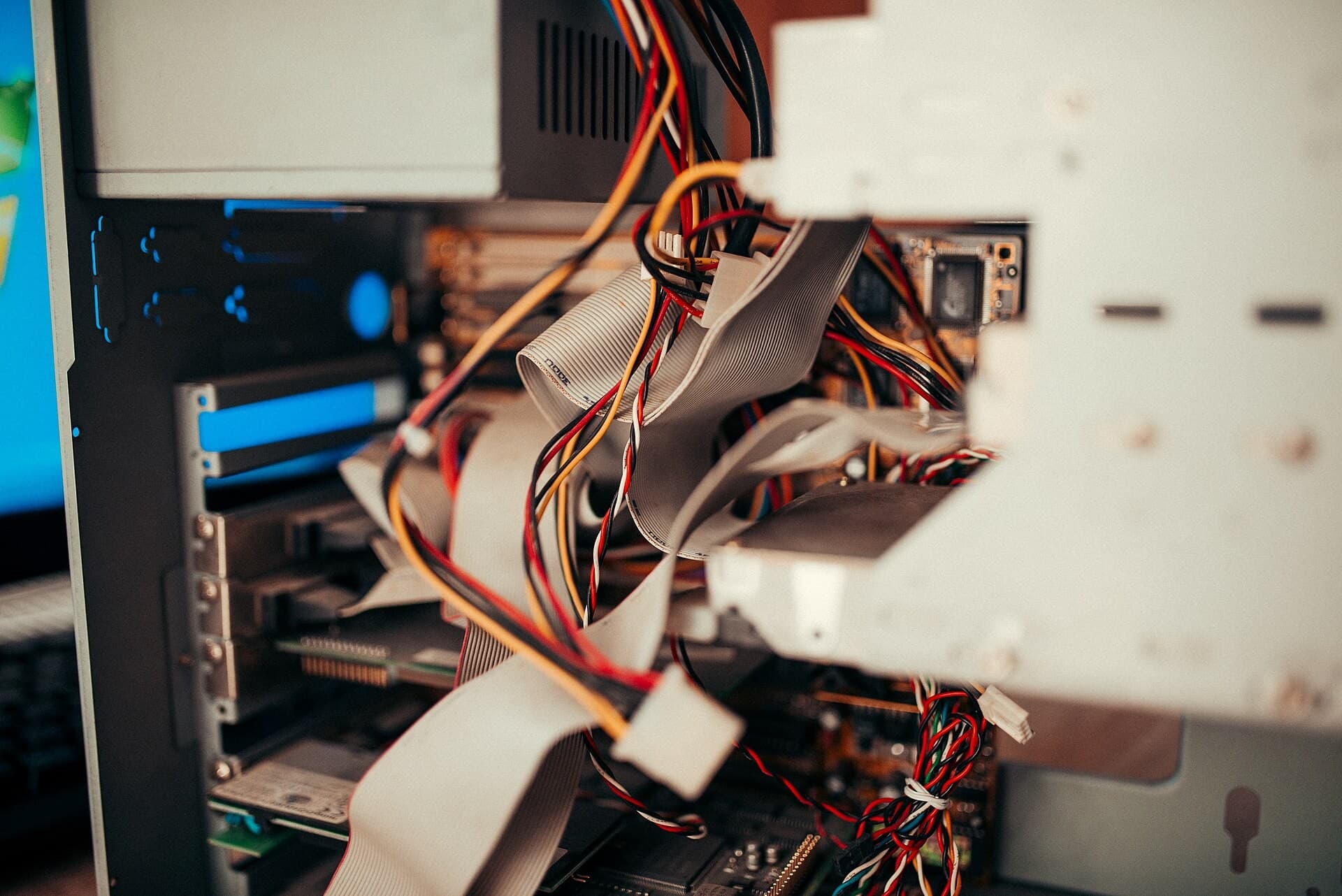
Photo: Shixart1985 (CC BY 2.0) / Wikimedia Commons / CC BY 2.0
Technology is invisible infrastructure. Most people don't think about how their email reaches someone across the world in milliseconds, how their phone recognizes their face, or how data centers manage trillions of requests per second. Yet understanding the underlying systems — networking, computing, cryptography, semiconductors, and AI hardware — is essential to understanding the modern world.
This guide covers how the internet works, how computers process information, how data is encrypted and secured, how quantum computing might change everything, and how semiconductors power it all. We'll examine emerging technologies like AI accelerators, neural network processors, and distributed systems reshaping what's possible.
The Internet: Layers and Protocols
The internet is not a thing in one place — it's a global network of networks connected by protocols. When you send an email or load a web page, your data travels through many intermediaries and layers.
Layers — networking follows a stack of protocols. At the bottom, physical layer: fiber optic cables, copper wires, radio signals carry bits (1s and 0s). At the data link layer, devices on a local network communicate via MAC addresses. At the network layer, the Internet Protocol (IP) routes packets globally using IP addresses (like 192.168.1.1 or 8.8.8.8). At the transport layer, TCP (Transmission Control Protocol) ensures reliable delivery; UDP (User Datagram Protocol) prioritizes speed over reliability. At the application layer, HTTP/HTTPS (web), SMTP (email), DNS (name resolution) operate.
Packets — data is broken into chunks, each with a source IP, destination IP, and content. A packet travels from hop to hop (router to router) until it reaches the destination. Each router looks at the destination IP and forwards the packet toward it. This distributed routing makes the internet resilient — if one path breaks, packets find alternate routes.
DNS — Domain Name System — translates human-readable names (google.com) into IP addresses (142.251.41.14). Without DNS, you'd have to memorize IP addresses for every website. When you type google.com, your browser queries a DNS server, which returns Google's IP, and your browser connects.
Fiber optic cables — hair-thin glass fibers that carry light pulses representing data — span oceans and continents. A single fiber can carry terabits per second. Undersea cables connect continents; terrestrial fiber connects cities; the "last mile" to homes is often copper or wireless.
Source: Internet Society (2024) — The internet comprises billions of devices connected by fiber, wireless, and copper carrying roughly 400 exabytes of data annually.
Key articles: How the Internet Actually Works, How the Internet Works: Packets and Protocols, How Search Engines Index the Web, How Fiber Optic Cables Transmit Data, Undersea Internet Cables Work, History of the Internet: ARPANET to Today, and Internet History and Global Connectivity.
Computing Fundamentals: CPUs, GPUs, and Specialized Hardware
Modern computing depends on processors — devices that execute instructions at blinding speeds. Your laptop contains several types.
CPU (Central Processing Unit) — the main processor that executes general-purpose instructions. Modern CPUs operate at gigahertz speeds (billions of cycles per second) and contain billions of transistors. A transistor is a tiny switch that can be turned on/off to represent 1/0. Arranging transistors into logic gates (AND, OR, NOT) lets you build arithmetic units. Arrange those into larger structures, and you get a CPU capable of complex calculations.
Clock speed (measured in GHz) measures how many times per second a CPU can execute an instruction. A 5 GHz CPU executes up to 5 billion instructions per second. But modern CPUs also use pipelining and parallelism to execute multiple instructions simultaneously, effectively multiplying throughput.
GPU (Graphics Processing Unit) — processors designed for parallel computation, originally built to render graphics. A GPU contains thousands of small cores (instead of a CPU's handful of large cores) that can execute the same instruction on many data points simultaneously. This parallelism makes GPUs exceptional at machine learning (processing millions of data points through a neural network) and physics simulations.
Specialized accelerators — chips designed for specific tasks. TPUs (Tensor Processing Units) accelerate matrix math, essential for AI. FPGAs (Field-Programmable Gate Arrays) can be rewired for different tasks. Custom ASICs (application-specific integrated circuits) like Bitcoin miners optimize for a single algorithm.
Memory hierarchy — CPUs use multiple types of memory at different speeds. L1 cache (tiny, 64KB, ultra-fast) is on the chip itself. L2 cache (256KB, fast) is still on the chip. L3 cache (8MB, slightly slower) is shared. RAM (16-64GB, much slower) is main memory. SSD (1-4TB, even slower) is storage. Accessing L1 is nanoseconds; accessing disk is milliseconds — a million times slower. Algorithm design must minimize cache misses.
Source: Intel (2024) — Modern CPUs contain 10-50 billion transistors, operate at 3-5 GHz, and use multiple cache levels to manage memory latency.
Related articles: How CPU Works Explained, How GPU Works: Why AI Needs Them, The Transistor Changed Everything, History of Computing: Abacus to AI, and Semiconductor Chips: How They Work.
Semiconductors: Manufacturing Miracles
Semiconductors are materials (silicon, germanium) that conduct electricity under certain conditions. When doped (mixed) with other elements, they form transistors — the building blocks of all modern electronics.
A transistor is a tiny switch. It has three terminals: gate, drain, source. Apply voltage to the gate, and current flows from drain to source. This switching enables logic. Arrange transistors into gates (AND, OR, NOT), which form ALUs (arithmetic logic units), which form CPUs.
Modern transistors are fantastically small. A 5-nanometer process can fit a transistor every 5 nanometers — roughly 200 atoms across. This density lets you fit billions of transistors on a chip the size of a fingernail.
Manufacturing semiconductors is extraordinarily complex. Creating a 5nm chip requires 10+ photomasks, each precisely aligned to within nanometers. Extreme ultraviolet (EUV) lithography uses wavelengths of 13.5 nanometers to pattern features. A single fab (fabrication plant) costs $10-20 billion to build and requires thousands of workers.
Remarkably few companies can build state-of-the-art chips. TSMC (Taiwan Semiconductor Manufacturing Company) makes over 50% of the world's advanced chips. Samsung and Intel are distant competitors. This concentration creates geopolitical risk — a chip shortage (like 2021-2023) ripples through the entire economy.
Moore's Law — the observation that transistor density doubles every 2 years — has held for 60 years. But it's slowing. Quantum effects (electron tunneling through barriers) become problematic at smaller scales. Heat dissipation becomes extreme. We're approaching physical limits and economic limits (cost per transistor is rising).
Source: TSMC (2024) — Advanced semiconductor fabrication requires billions in capital, thousands of workers per fab, and precise control within nanometers.
Key articles: Why Semiconductors Are So Hard to Make, Countries Producing the Most Semiconductors, and History of Electricity: Faraday, Tesla, Edison.
Encryption and Cybersecurity
Cybersecurity is an arms race. Attackers develop new exploits; defenders patch vulnerabilities. This ongoing tension shapes how systems are built.
Encryption — transforming readable data (plaintext) into unreadable format (ciphertext) using a key. Without the key, ciphertext is useless noise.
Symmetric encryption (same key encrypts and decrypts) is fast. AES (Advanced Encryption Standard) with a 256-bit key is considered unbreakable with current technology — brute force would require more time than the universe has existed. But symmetric encryption has a problem: how do you share the key securely?
Asymmetric encryption (different keys for encryption and decryption) solves this. You publish a public key; anyone can encrypt with it. Only you hold the private key, needed to decrypt. This is RSA (Rivest-Shamir-Adleman), the basis for HTTPS. The math is elegant: finding prime factors of large numbers is computationally hard, so RSA's security depends on factorization difficulty.
Hashing (one-way encryption) produces a fixed-size output from any input. If you change a single bit of input, the hash changes completely. Used for passwords (store the hash, not the password) and data integrity (verify data hasn't been modified).
Passwords remain the weakest link. Humans choose weak passwords (easily guessable) or reuse passwords across sites (if one site is hacked, attackers try the password everywhere). Multi-factor authentication (password + code from your phone) helps.
Attacks exploit the stack. SQL injection exploits unfiltered inputs to databases. Cross-site scripting (XSS) injects malicious JavaScript. Man-in-the-middle attacks intercept unencrypted communication. Phishing tricks users into revealing credentials. Ransomware encrypts your files and demands payment.
Quantum computers, if built, could break RSA encryption in hours (because they'd efficiently factor large numbers). This is why NIST is standardizing "post-quantum" encryption algorithms now.
Source: NIST (2024) — Cybersecurity depends on encryption, authentication, and continuous monitoring; no single defense is sufficient against all attacks.
Articles: How Encryption Works Explained, How Passwords Are Hacked and How to Stop It, How VPNs Work: Privacy Explained, How Ransomware Works, and How to Actually Secure Your Digital Life.
Quantum Computing and the Future
Quantum computers harness quantum mechanics to perform calculations that classical computers cannot.
A classical bit is 0 or 1. A qubit (quantum bit) can be 0, 1, or a superposition (both simultaneously) until measured. Entanglement lets qubits correlate: the state of one depends on others, enabling collective computation.
Quantum algorithms exploit these properties. Shor's algorithm factors large numbers exponentially faster than classical algorithms — a threat to RSA. Grover's algorithm searches unsorted databases quadratically faster. These speedups are profound but apply to specific problems, not all problems.
Building quantum computers is devilishly hard. Qubits are fragile — any environmental disturbance (heat, vibration, electromagnetic noise) causes decoherence, destroying superposition. Lifetimes are measured in microseconds to seconds. Existing quantum computers (IBM, Google, IonQ) have tens to hundreds of qubits. Useful quantum computers will need millions of qubits, a 1000x increase.
Google claimed quantum supremacy in 2019 by solving a contrived problem faster on a quantum computer than on classical computers. But the result doesn't help with real problems yet. Quantum computing remains in the "interesting research" phase, not yet revolutionary.
The timeline remains uncertain. Experts range from "5 years" (optimistic) to "never" (skeptical). Realistic estimates: useful quantum computers for specific domains (drug simulation, optimization) might emerge in 10-20 years.
Related articles: How Quantum Computers Work: 2026, Quantum Computing Explained Completely, and Quantum Computing and Machine Learning Applications.
Emerging Tech: AI Hardware, Edge Computing, and Specialized Systems
AI has driven specialized hardware innovation. TPUs (Tensor Processing Units) from Google optimize matrix operations for machine learning. NPUs (Neural Processing Units) are appearing in consumer devices (phones, laptops). These specialized chips train models faster and use less energy than general-purpose CPUs.
Edge computing — processing data near its source instead of sending it to cloud data centers — reduces latency and privacy risks. A self-driving car makes decisions milliseconds based on camera feeds; sending video to the cloud and back would be too slow. Processing happens on-device.
5G and 6G — next-generation wireless — enable this. 5G offers lower latency (10ms vs 100ms for 4G) and higher bandwidth. 6G (still in research) aims for even lower latency and higher speeds, enabling real-time remote surgery, autonomous vehicles, and AR/VR.
Neuromorphic computing — chips mimicking brain structure — uses event-based processing (neurons fire when voltages cross thresholds) rather than clocked computation. Early neuromorphic chips show promise for spiking neural networks and ultra-low-power AI.
Photonic computing — using light (photons) instead of electricity (electrons) for computation — is emerging. Photons travel at light speed and don't generate heat, potentially enabling faster, cooler computation. But building photonic circuits is harder than electronic circuits.
Source: IDC (2025) — Specialized AI hardware shipments growing 60% annually, driven by demand for edge inference and training.
Related articles: Cloud Computing and Infrastructure, Edge Computing and Federated Learning, AI Data Center Energy Optimization, and AI Chip Design and Neural Architecture Search.
Internet of Things, Robotics, and Autonomous Systems
IoT (Internet of Things) — connecting billions of devices (sensors, cameras, actuators) to the internet — is reshaping infrastructure.
Smart cities use IoT to optimize traffic (adaptive lights reduce congestion), monitor air quality, manage power grids. Smart homes automate heating, lighting, security. Industrial IoT monitors factory equipment, predicting failures before they happen (avoiding costly downtime).
Security is challenging. IoT devices often have minimal computational capacity and are rarely updated, becoming vulnerable to hacking. A botnet (millions of hacked IoT devices) can mount denial-of-service attacks or mine cryptocurrency.
Robotics — building and programming robots — is advancing. Drones deliver packages. Autonomous vehicles navigate streets. Robotic arms work alongside humans in factories. Boston Dynamics' robots are impressive but limited to controlled settings.
Self-driving cars integrate perception (cameras, lidar, radar), reasoning (neural networks predicting pedestrian behavior), and control (steering, braking). They're safer than humans in controlled conditions but fail in edge cases (construction, extreme weather). Full autonomy (Level 5 — no human intervention needed in any condition) remains years away.
Related articles: How Drones Actually Work, How Self-Driving Cars Work, Modern Robotics Actually Works, and AI in Robotics and Control.
Topics Covered in This Guide (Deep Dives)
Internet and Networking
- How the Internet Actually Works
- How the Internet Works: Packets and Protocols
- How Search Engines Index the Web
- How Fiber Optic Cables Transmit Data
- Undersea Internet Cables Work
- History of the Internet: ARPANET to Today
- Internet History and Global Connectivity
- How WiFi Works: Physics of Wireless Signals
- How Bluetooth Works Explained
- How GPS Works Explained
- How the TikTok Algorithm Works in 2026
Computing Hardware
- How CPU Works Explained
- How GPU Works: Why AI Needs Them
- The Transistor Changed Everything
- History of Computing: Abacus to AI
- Semiconductor Chips: How They Work
- Why Semiconductors Are So Hard to Make
- Countries Producing the Most Semiconductors
Software and Development
- Open Source Software World
- Next.js 15 Developers Guide
- How to Learn Python: Complete Guide 2026
- History of Computing
Encryption and Cybersecurity
- How Encryption Works Explained
- How Passwords Are Hacked and How to Stop It
- How VPNs Work: Privacy Explained
- How Ransomware Works
- How to Actually Secure Your Digital Life
- How to Protect Your Online Privacy in 2026
- Cybersecurity Threats 2026
Quantum Computing
- How Quantum Computers Work: 2026
- Quantum Computing Explained Completely
- Quantum Computing Explained Simply
- Quantum Computing and ML Applications
- AI and Quantum Computing
AI Hardware and Infrastructure
- Cloud Computing and Infrastructure
- How Cloud Computing Works
- Edge Computing and Federated Learning
- AI Data Center Energy Optimization
- AI Chip Design and Neural Architecture
- Transformer Architecture and Attention Mechanisms
- Computer Vision and Object Detection
- Natural Language Processing
- AI Compiler Optimization
- AI in Software Testing
Autonomous Systems and Robotics
- How Drones Actually Work
- How Self-Driving Cars Work
- Modern Robotics Actually Works
- AI in Robotics and Control
Transportation and Energy
- How Airplanes Fly
- How Jet Engines Work
- How Nuclear Power Plants Generate Electricity
- Electric Cars vs Gas Cars
- How EV Charging Works
- How Submarines Work
Media and Perception
- How Deepfakes Work
- How Facial Recognition Works
- How Noise-Cancelling Headphones Work
- How Microphones Work
- How Camera Sensors Work
Information and Media
Technology Skills and Career
- Essential Tech Skills Everyone Should Learn in 2026
- The Best Coding Bootcamps Worth Your Money in 2026
- How to Use Figma for Beginners
Frequently Asked Questions
Q: Why does technology seem to change so fast?
A: Moore's Law (transistor density doubling every 2 years) has driven exponential growth in computing power for 60 years. Exponential growth feels slow initially, then suddenly appears fast. A 10x increase in computer power every decade is normal; humans are just not good at intuiting exponential curves. This rapid progress may slow if semiconductor scaling hits physics limits.
Q: Is quantum computing a threat to cybersecurity?
A: Potentially, but not imminently. Quantum computers could break RSA and elliptic-curve cryptography, but they'd need millions of qubits. Current quantum computers have hundreds of qubits with high error rates. NIST is standardizing "post-quantum" encryption now, which classical computers can implement. The risk is real but distant; migration to quantum-resistant encryption is underway.
Q: Can I trust encryption if governments have backdoors?
A: Strong encryption (AES-256, modern RSA) is unbreakable even with backdoors — you can't make math weaker for "good guys" only. Governments can pressure companies to weaken encryption or hand over keys, but the underlying math is solid. Using open-source encryption tools (where code is publicly auditable) is more trustworthy than proprietary closed-source alternatives.
Q: Will AI replace programmers?
A: AI is changing programming, not eliminating it. AI coding assistants (Copilot, Claude Code) write boilerplate and help debug. But high-level architecture, security decisions, and novel algorithms still require humans. A programmer using AI will outperform one without it. The demand for programming is growing faster than supply, so displacement seems unlikely short-term.
Q: How long until self-driving cars are truly autonomous?
A: Current self-driving systems (Tesla FSD, Waymo) handle many conditions well but fail in edge cases (severe weather, construction, complex urban environments). True Level 5 (autonomous in all conditions without human intervention) requires solving "everything else" — rare scenarios, adversarial cases, edge conditions. Estimates range from 5 years (optimistic) to "decades" (realistic). Waymo and others operate limited robotaxi services in specific geographies, which is progress but not Level 5.
Q: Is the internet becoming more centralized or decentralized?
A: Both simultaneously. Web traffic concentrates on a few platforms (Google, Meta, TikTok), making the internet feel centralized. But infrastructure (cloud providers, CDNs) enables small publishers to reach global audiences cheaply. Blockchain offers decentralized alternatives for finance and data, but centralization via user concentration remains. Decentralization requires more effort than centralization, so concentration is the natural state without countervailing forces.
The Takeaway
Technology is not magic — it's physics and mathematics applied cleverly. The internet works through layered protocols and routing. Computers process information using billions of transistors. Encryption protects data through mathematical impossibility (factorization difficulty). Quantum computers might break some encryption but won't suddenly make all problems easy.
Understanding technology means grasping that everything scales, that tradeoffs are constant (speed vs power consumption, centralization vs resilience), and that coordination problems are hard. Building the internet required decades of incremental progress and cooperation. Semiconductor manufacturing requires billions of dollars and thousands of experts. These aren't bugs — they're features. They preserve stability and prevent anyone from totally dominating.
The future likely involves continued semiconductor innovation (though slower than recent decades), quantum computers for specific problems, AI hardware specialization, and technologies we haven't yet imagined. The fundamentals — bits, circuits, algorithms — won't change.
Last verified: August 2026
Follow new articles
Add SciHub101 to your feed reader to see new science and technology stories.
About the Author
SciHub101 is an independent science and technology publication founded and edited by Buğra Sözeri, a software engineer and app developer based in Türkiye. AI tools assist with drafting and research. Source documentation in the existing archive is uneven, and articles are being reviewed and corrected. The Editorial Team byline identifies editorial responsibility; it does not certify specialist or independent human review. Where we compare products, anything built by our own team is labelled as such — see the editorial guidelines and About page for how corrections and disclosures work.
Related Articles
Digital Twins Explained: How Virtual Models Connect to Real-World Systems
A digital twin is a model kept in sync with a real asset through data. See how sensors, calibration and feedback work, and why a 3D model is not a twin.
Best AI News Summary Aggregators 2026
AI news aggregators 2026: bizimgündem, Ground News, SmartNews, Feedly, Perplexity Discover compared for clustering, source transparency, and hallucination risks.

How Facial Recognition Works: From Pixels to Face Embeddings
Facial recognition turns a face into a short list of numbers and compares it with stored lists. Here is how detection, embeddings, and thresholds work, and why error rates differ across groups and settings.

How Social Engineering Hacking Works — Why Humans Are the Weakest Link
The most sophisticated cyberattacks don't exploit code — they exploit people. Here's how phishing, pretexting, spear phishing, and vishing manipulate human psychology to bypass any technical defense.

How Ransomware Works — The Cybercrime That Shuts Down Hospitals
Ransomware has crippled hospitals, pipelines, and governments. Here is the technical reality of how attackers get in, encrypt files, steal data, and get paid, and which defenses hold up.

How Passwords Are Hacked — And How to Stop It
Your password might already be sitting in a leaked list. Here's how hackers crack, steal, and reuse credentials, and the science behind stopping them.